
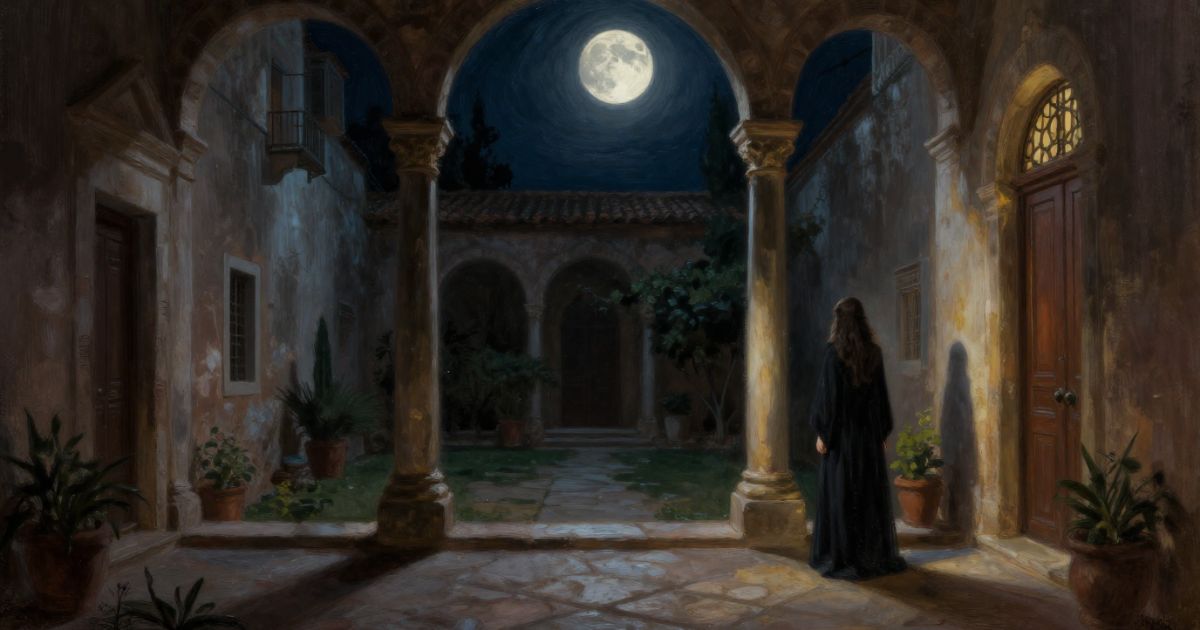
An excerpt from the original text.(complete · 7606 words)
he day of the festival, so long and so impatiently looked for by
Julia, was now arrived. All the neighbouring nobility were invited,
and the gates of the castle were thrown open for a general rejoicing.
A magnificent entertainment, consisting of the most luxurious and
expensive dishes, was served in the halls. Soft music floated along
the vaulted roofs, the walls were hung with decorations, and it seemed
as if the hand of a magician had suddenly metamorphosed this once
gloomy fabric into the palace of a fairy. The marquis, notwithstanding
the gaiety of the scene, frequently appeared abstracted from its
enjoyments, and in spite of all his efforts at cheerfulness, the
melancholy of his heart was visible in his countenance.
In the evening there was a grand ball: the marchioness, who was still
distinguished for her beauty, and for the winning elegance of her
manners, appeared in the most splendid attire. Her hair was ornamented
with a profusion of jewels, but was so disposed as to give an air
rather of voluptuousness than of grace, to her figure. Although
conscious of her charms, she beheld the beauty of Emilia and Julia
with a jealous eye, and was compelled secretly to acknowledge, that
the simple elegance with which they were adorned, was more enchanting
than all the studied artifice of splendid decoration. They were
dressed alike in light Sicilian habits, and the beautiful luxuriance
of their flowing hair was restrained only by bandellets of pearl. The
ball was opened by Ferdinand and the lady Matilda Constanza. Emilia
danced with the young Marquis della Fazelli, and acquitted herself
with the ease and dignity so natural to her. Julia experienced a
various emotion of pleasure and fear when the Count de Vereza, in whom
she recollected the cavalier she had observed from the window, led her
forth. The grace of her step, and the elegant symmetry of her figure,
raised in the assembly a gentle murmur of applause, and the soft blush
which now stole over her cheek, gave an additional charm to her
appearance. But when the music changed, and she danced to the soft
Sicilian measure, the airy grace of her movement, and the unaffected
tenderness of her air, sunk attention into silence, which continued
for some time after the dance had ceased. The marchioness observed the
general admiration with seeming pleasure, and secret uneasiness. She
had suffered a very painful solicitude, when the Count de Vereza
selected her for his partner in the dance, and she pursued him through
the evening with an eye of jealous scrutiny. Her bosom, which before
glowed only with love, was now torn by the agitation of other passions
more violent and destructive. Her thoughts were restless, her mind
wandered from the scene before her, and it required all her address to
preserve an apparent ease. She saw, or fancied she saw, an impassioned
air in the count, when he addressed himself to Julia, that corroded
her heart with jealous fury.
At twelve the gates of the castle were thrown open, and the company
quitted it for the woods, which were splendidly illuminated. Arcades
of light lined the long vistas, which were terminated by pyramids of
lamps that presented to the eye one bright column of flame. At
irregular distances buildings were erected, hung with variegated
lamps, disposed in the gayest and most fantastic forms. Collations
were spread under the trees; and music, touched by unseen hands,
breathed around. The musicians were placed in the most obscure and
embowered spots, so as to elude the eye and strike the imagination.
The scene appeared enchanting. Nothing met the eye but beauty and
romantic splendour; the ear received no sounds but those of mirth and
melody. The younger part of the company formed themselves into
groups, which at intervals glanced through the woods, and were again
unseen. Julia seemed the magic queen of the place. Her heart dilated
with pleasure, and diffused over her features an expression of pure
and complacent delight. A generous, frank, and exalted sentiment
sparkled in her eyes, and animated her manner. Her bosom glowed with
benevolent affections; and she seemed anxious to impart to all around
her, a happiness as unmixed as that she experienced. Wherever she
moved, admiration followed her steps. Ferdinand was as gay as the
scene around him. Emilia was pleased; and the marquis seemed to have
left his melancholy in the castle. The marchioness alone was wretched.
She supped with a select party, in a pavilion on the sea-shore, which
was fitted up with peculiar elegance. It was hung with white silk,
drawn up in festoons, and richly fringed with gold. The sofas were of
the same materials, and alternate wreaths of lamps and of roses
entwined the columns. A row of small lamps placed about the cornice,
formed an edge of light round the roof which, with the other numerous
lights, was reflected in a blaze of splendour from the large mirrors
that adorned the room. The Count Muriani was of the party;--he
complimented the marchioness on the beauty of her daughters; and after
lamenting with gaiety the captives which their charms would enthral,
he mentioned the Count de Vereza. 'He is certainly of all others the
man most deserving the lady Julia. As they danced, I thought they
exhibited a perfect model of the beauty of either sex; and if I
mistake not, they are inspired with a mutual admiration.' The
marchioness, endeavouring to conceal her uneasiness, said, 'Yes, my
lord, I allow the count all the merit you adjudge him, but from the
little I have seen of his disposition, he is too volatile for a
serious attachment.' At that instant the count entered the pavilion:
'Ah,' said Muriani, laughingly, 'you was the subject of our
conversation, and seem to be come in good time to receive the honors
allotted you. I was interceding with the marchioness for her interest
in your favor, with the lady Julia; but she absolutely refuses it; and
though she allows you merit, alleges, that you are by nature fickle
and inconstant. What say you--would not the beauty of lady Julia bind
your unsteady heart?'.
'I know not how I have deserved that character of the marchioness,'
said the count with a smile, 'but that heart must be either fickle or
insensible in an uncommon degree, which can boast of freedom in the
presence of lady Julia.' The marchioness, mortified by the whole
conversation, now felt the full force of Vereza's reply, which she
imagined he pointed with particular emphasis.
The entertainment concluded with a grand firework, which was exhibited
on the margin of the sea, and the company did not part till the dawn
of morning. Julia retired from the scene with regret. She was
enchanted with the new world that was now exhibited to her, and she
was not cool enough to distinguish the vivid glow of imagination from
the colours of real bliss. The pleasure she now felt she believed
would always be renewed, and in an equal degree, by the objects which
first excited it. The weakness of humanity is never willingly
perceived by young minds. It is painful to know, that we are operated
upon by objects whose impressions are variable as they are
indefinable--and that what yesterday affected us strongly, is to-day
but imperfectly felt, and to-morrow perhaps shall be disregarded. When
at length this unwelcome truth is received into the mind, we at first
reject, with disgust, every appearance of good, we disdain to partake
of a happiness which we cannot always command, and we not unfrequently
sink into a temporary despair. Wisdom or accident, at length, recal us
from our error, and offers to us some object capable of producing a
pleasing, yet lasting effect, which effect, therefore, we call
happiness. Happiness has this essential difference from what is
commonly called pleasure, that virtue forms its basis, and virtue
being the offspring of reason, may be expected to produce uniformity of
effect.
The passions which had hitherto lain concealed in Julia's heart,
touched by circumstance, dilated to its power, and afforded her a
slight experience of the pain and delight which flow from their
influence. The beauty and accomplishments of Vereza raised in her a
new and various emotion, which reflection made her fear to encourage,
but which was too pleasing to be wholly resisted. Tremblingly alive to
a sense of delight, and unchilled by disappointment, the young heart
welcomes every feeling, not simply painful, with a romantic
expectation that it will expand into bliss.
Julia sought with eager anxiety to discover the sentiments of Vereza
towards her; she revolved each circumstance of the day, but they
afforded her little satisfaction; they reflected only a glimmering and
uncertain light, which instead of guiding, served only to perplex her.
Now she remembered some instance of particular attention, and then
some mark of apparent indifference. She compared his conduct with that
of the other young noblesse; and thought each appeared equally
desirous of the favor of every lady present. All the ladies, however,
appeared to her to court the admiration of Vereza, and she trembled
lest he should be too sensible of the distinction. She drew from these
reflections no positive inference; and though distrust rendered pain
the predominate sensation, it was so exquisitely interwoven with
delight, that she could not wish it exchanged for her former ease.
Thoughtful and restless, sleep fled from her eyes, and she longed with
impatience for the morning, which should again present Vereza, and
enable her to pursue the enquiry. She rose early, and adorned herself
with unusual care. In her favorite closet she awaited the hour of
breakfast, and endeavoured to read, but her thoughts wandered from the
subject. Her lute and favorite airs lost half their power to please;
the day seemed to stand still--she became melancholy, and thought the
breakfast-hour would never arrive. At length the clock struck the
signal, the sound vibrated on every nerve, and trembling she quitted
the closet for her sister's apartment. Love taught her disguise. Till
then Emilia had shared all her thoughts; they now descended to the
breakfast-room in silence, and Julia almost feared to meet her eye. In
the breakfast-room they were alone. Julia found it impossible to
support a conversation with Emilia, whose observations interrupting
the course of her thoughts, became uninteresting and tiresome. She was
therefore about to retire to her closet, when the marquis entered. His
air was haughty, and his look severe. He coldly saluted his daughters,
and they had scarcely time to reply to his general enquiries, when the
marchioness entered, and the company soon after assembled. Julia, who
had awaited with so painful an impatience for the moment which should
present Vereza to her sight, now sighed that it was arrived. She
scarcely dared to lift her timid eyes from the ground, and when by
accident they met his, a soft tremour seized her; and apprehension
lest he should discover her sentiments, served only to render her
confusion conspicuous. At length, a glance from the marchioness
recalled her bewildered thoughts; and other fears superseding those of
love, her mind, by degrees, recovered its dignity. She could
distinguish in the behaviour of Vereza no symptoms of particular
admiration, and she resolved to conduct herself towards him with the
most scrupulous care.
This day, like the preceding one, was devoted to joy. In the evening
there was a concert, which was chiefly performed by the nobility.
Ferdinand played the violoncello, Vereza the German flute, and Julia
the piana-forte, which she touched with a delicacy and execution that
engaged every auditor. The confusion of Julia may be easily imagined,
when Ferdinand, selecting a beautiful duet, desired Vereza would
accompany his sister. The pride of conscious excellence, however,
quickly overcame her timidity, and enabled her to exert all her
powers. The air was simple and pathetic, and she gave it those charms
of expression so peculiarly her own. She struck the chords of her
piana-forte in beautiful accompaniment, and towards the close of the
second stanza, her voice resting on one note, swelled into a tone so
exquisite, and from thence descended to a few simple notes, which she
touched with such impassioned tenderness that every eye wept to the
sounds. The breath of the flute trembled, and Hippolitus entranced,
forgot to play. A pause of silence ensued at the conclusion of the
piece, and continued till a general sigh seemed to awaken the audience
from their enchantment. Amid the general applause, Hippolitus was
silent. Julia observed his behaviour, and gently raising her eyes to
his, there read the sentiments which she had inspired. An exquisite
emotion thrilled her heart, and she experienced one of those rare
moments which illuminate life with a ray of bliss, by which the
darkness of its general shade is contrasted. Care, doubt, every
disagreeable sensation vanished, and for the remainder of the evening
she was conscious only of delight. A timid respect marked the manner
of Hippolitus, more flattering to Julia than the most ardent
professions. The evening concluded with a ball, and Julia was again
the partner of the count.
When the ball broke up, she retired to her apartment, but not to
sleep. Joy is as restless as anxiety or sorrow. She seemed to have
entered upon a new state of existence;--those fine springs of
affection which had hitherto lain concealed, were now touched, and
yielded to her a happiness more exalted than any her imagination had
ever painted. She reflected on the tranquillity of her past life, and
comparing it with the emotions of the present hour, exulted in the
difference. All her former pleasures now appeared insipid; she
wondered that they ever had power to affect her, and that she had
endured with content the dull uniformity to which she had been
condemned. It was now only that she appeared to live. Absorbed in the
single idea of being beloved, her imagination soared into the regions
of romantic bliss, and bore her high above the possibility of evil.
Since she was beloved by Hippolitus, she could only be happy.
From this state of entranced delight, she was awakened by the sound of
music immediately under her window. It was a lute touched by a
masterly hand. After a wild and melancholy symphony, a voice of more
than magic expression swelled into an air so pathetic and tender, that
it seemed to breathe the very soul of love. The chords of the lute
were struck in low and sweet accompaniment. Julia listened, and
distinguished the following words;
SONNET
Still is the night-breeze!--not a lonely sound
Steals through the silence of this dreary hour;
O'er these high battlements Sleep reigns profound,
And sheds on all, his sweet oblivious power.
On all but me--I vainly ask his dews
To steep in short forgetfulness my cares.
Th' affrighted god still flies when Love pursues,
Still--still denies the wretched lover's prayers.
An interval of silence followed, and the air was repeated; after which
the music was heard no more. If before Julia believed that she was
loved by Hippolitus, she was now confirmed in the sweet reality. But
sleep at length fell upon her senses, and the airy forms of ideal
bliss no longer fleeted before her imagination. Morning came, and she
arose light and refreshed. How different were her present sensations
from those of the preceding day. Her anxiety had now evaporated in
joy, and she experienced that airy dance of spirits which accumulates
delight from every object; and with a power like the touch of
enchantment, can transform a gloomy desert into a smiling Eden. She
flew to the breakfast-room, scarcely conscious of motion; but, as she
entered it, a soft confusion overcame her; she blushed, and almost
feared to meet the eyes of Vereza. She was presently relieved,
however, for the Count was not there. The company assembled--Julia
watched the entrance of every person with painful anxiety, but he for
whom she looked did not appear. Surprised and uneasy, she fixed her
eyes on the door, and whenever it opened, her heart beat with an
expectation which was as often checked by disappointment. In spite of
all her efforts, her vivacity sunk into languor, and she then
perceived that love may produce other sensations than those of
delight. She found it possible to be unhappy, though loved by
Hippolitus; and acknowledged with a sigh of regret, which was yet new
to her, how tremblingly her peace depended upon him. He neither
appeared nor was mentioned at breakfast; but though delicacy prevented
her enquiring after him, conversation soon became irksome to her, and
she retired to the apartment of Madame de Menon. There she employed
herself in painting, and endeavoured to beguile the time till the hour
of dinner, when she hoped to see Hippolitus. Madame was, as usual,
friendly and cheerful, but she perceived a reserve in the conduct of
Julia, and penetrated without difficulty into its cause. She was,
however, ignorant of the object of her pupil's admiration. The hour so
eagerly desired by Julia at length arrived, and with a palpitating
heart she entered the hall. The Count was not there, and in the course
of conversation, she learned that he had that morning sailed for
Naples. The scene which so lately appeared enchanting to her eyes, now
changed its hue; and in the midst of society, and surrounded by
gaiety, she was solitary and dejected. She accused herself of having
suffered her wishes to mislead her judgment; and the present conduct
of Hippolitus convinced her, that she had mistaken admiration for a
sentiment more tender. She believed, too, that the musician who had
addressed her in his sonnet, was not the Count; and thus at once was
dissolved all the ideal fabric of her happiness. How short a period
often reverses the character of our sentiments, rendering that which
yesterday we despised, to-day desirable. The tranquil state which she
had so lately delighted to quit, she now reflected upon with regret.
She had, however, the consolation of believing that her sentiments
towards the Count were unknown, and the sweet consciousness that her
conduct had been governed by a nice sense of propriety.
The public rejoicings at the castle closed with the week; but the gay
spirit of the marchioness forbade a return to tranquillity; and she
substituted diversions more private, but in splendour scarcely
inferior to the preceding ones. She had observed the behaviour of
Hippolitus on the night of the concert with chagrin, and his
departure with sorrow; yet, disdaining to perpetuate misfortune by
reflection, she sought to lose the sense of disappointment in the
hurry of dissipation. But her efforts to erase him from her
remembrance were ineffectual. Unaccustomed to oppose the bent of her
inclinations, they now maintained unbounded sway; and she found too
late, that in order to have a due command of our passions, it is
necessary to subject them to early obedience. Passion, in its undue
influence, produces weakness as well as injustice. The pain which now
recoiled upon her heart from disappointment, she had not strength of
mind to endure, and she sought relief from its pressure in afflicting
the innocent. Julia, whose beauty she imagined had captivated the
count, and confirmed him in indifference towards herself, she
incessantly tormented by the exercise of those various and splenetic
little arts which elude the eye of the common observer, and are only
to be known by those who have felt them. Arts, which individually are
inconsiderable, but in the aggregate amount to a cruel and decisive
effect.
From Julia's mind the idea of happiness was now faded. Pleasure had
withdrawn her beam from the prospect, and the objects no longer
illumined by her ray, became dark and colourless. As often as her
situation would permit, she withdrew from society, and sought the
freedom of solitude, where she could indulge in melancholy thoughts,
and give a loose to that despair which is so apt to follow the
disappointment of our first hopes.
Week after week elapsed, yet no mention was made of returning to
Naples. The marquis at length declared it his intention to spend the
remainder of the summer in the castle. To this determination the
marchioness submitted with decent resignation, for she was here
surrounded by a croud of flatterers, and her invention supplied her
with continual diversions: that gaiety which rendered Naples so dear
to her, glittered in the woods of Mazzini, and resounded through the
castle.
The apartments of Madame de Menon were spacious and noble. The windows
opened upon the sea, and commanded a view of the straits of Messina,
bounded on one side by the beautiful shores of the isle of Sicily, and
on the other by the high mountains of Calabria. The straits, filled
with vessels whose gay streamers glittered to the sun-beam, presented
to the eye an ever-moving scene. The principal room opened upon a
gallery that overhung the grand terrace of the castle, and it
commanded a prospect which for beauty and extent has seldom been
equalled. These were formerly considered the chief apartments of the
castle; and when the Marquis quitted them for Naples, were allotted
for the residence of Madame de Menon, and her young charge. The
marchioness, struck with the prospect which the windows afforded, and
with the pleasantness of the gallery, determined to restore the rooms
to their former splendour. She signified this intention to madame, for
whom other apartments were provided. The chambers of Emilia and Julia
forming part of the suite, they were also claimed by the marchioness,
who left Julia only her favorite closet. The rooms to which they
removed were spacious, but gloomy; they had been for some years
uninhabited; and though preparations had been made for the reception
of their new inhabitants, an air of desolation reigned within them
that inspired melancholy sensations. Julia observed that her chamber,
which opened beyond madame's, formed a part of the southern building,
with which, however, there appeared no means of communication. The
late mysterious circumstances relating to this part of the fabric, now
arose to her imagination, and conjured up a terror which reason could
not subdue. She told her emotions to madame, who, with more prudence
than sincerity, laughed at her fears. The behaviour of the marquis,
the dying words of Vincent, together with the preceding circumstances
of alarm, had sunk deep in the mind of madame, but she saw the
necessity of confining to her own breast doubts which time only could
resolve.
Julia endeavoured to reconcile herself to the change, and a
circumstance soon occurred which obliterated her present sensations,
and excited others far more interesting. One day that she was
arranging some papers in the small drawers of a cabinet that stood in
her apartment, she found a picture which fixed all her attention. It
was a miniature of a lady, whose countenance was touched with sorrow,
and expressed an air of dignified resignation. The mournful sweetness
of her eyes, raised towards Heaven with a look of supplication, and
the melancholy languor that shaded her features, so deeply affected
Julia, that her eyes were filled with involuntary tears. She sighed
and wept, still gazing on the picture, which seemed to engage her by a
kind of fascination. She almost fancied that the portrait breathed,
and that the eyes were fixed on hers with a look of penetrating
softness. Full of the emotions which the miniature had excited, she
presented it to madame, whose mingled sorrow and surprise increased
her curiosity. But what were the various sensations which pressed upon
her heart, on learning that she had wept over the resemblance of her
mother! Deprived of a mother's tenderness before she was sensible of
its value, it was now only that she mourned the event which
lamentation could not recall. Emilia, with an emotion as exquisite,
mingled her tears with those of her sister. With eager impatience they
pressed madame to disclose the cause of that sorrow which so
emphatically marked the features of their mother.
'Alas! my dear children,' said madame, deeply sighing, 'you engage me
in a task too severe, not only for your peace, but for mine; since in
giving you the information you require, I must retrace scenes of my
own life, which I wish for ever obliterated. It would, however, be
both cruel and unjust to withhold an explanation so nearly interesting
to you, and I will sacrifice my own ease to your wishes.
'Louisa de Bernini, your mother, was, as you well know, the only
daughter of the Count de Bernini. Of the misfortunes of your family, I
believe you are yet ignorant. The chief estates of the count were
situated in the Val di Demona, a valley deriving its name from its
vicinity to Mount AEtna, which vulgar tradition has peopled with
devils. In one of those dreadful eruptions of AEtna, which deluged
this valley with a flood of fire, a great part of your grandfather's
domains in that quarter were laid waste. The count was at that time
with a part of his family at Messina, but the countess and her son,
who were in the country, were destroyed. The remaining property of the
count was proportionably inconsiderable, and the loss of his wife and
son deeply affected him. He retired with Louisa, his only surviving
child, who was then near fifteen, to a small estate near Cattania.
There was some degree of relationship between your grandfather and
myself; and your mother was attached to me by the ties of sentiment,
which, as we grew up, united us still more strongly than those of
blood. Our pleasures and our tastes were the same; and a similarity of
misfortunes might, perhaps, contribute to cement our early friendship.
I, like herself, had lost a parent in the eruption of AEtna. My mother
had died before I understood her value; but my father, whom I revered
and tenderly loved, was destroyed by one of those terrible events; his
lands were buried beneath the lava, and he left an only son and myself
to mourn his fate, and encounter the evils of poverty. The count, who
was our nearest surviving relation, generously took us home to his
house, and declared that he considered us as his children. To amuse
his leisure hours, he undertook to finish the education of my brother,
who was then about seventeen, and whose rising genius promised to
reward the labours of the count. Louisa and myself often shared the
instruction of her father, and at those hours Orlando was generally of
the party. The tranquil retirement of the count's situation, the
rational employment of his time between his own studies, the education
of those whom he called his children, and the conversation of a few
select friends, anticipated the effect of time, and softened the
asperities of his distress into a tender complacent melancholy. As for
Louisa and myself, who were yet new in life, and whose spirits
possessed the happy elasticity of youth, our minds gradually shifted
from suffering to tranquillity, and from tranquillity to happiness. I
have sometimes thought that when my brother has been reading to her a
delightful passage, the countenance of Louisa discovered a tender
interest, which seemed to be excited rather by the reader than by the
author. These days, which were surely the most enviable of our lives,
now passed in serene enjoyments, and in continual gradations of
improvement.
'The count designed my brother for the army, and the time now drew
nigh when he was to join the Sicilian regiment, in which he had a
commission. The absent thoughts, and dejected spirits of my cousin,
now discovered to me the secret which had long been concealed even
from herself; for it was not till Orlando was about to depart, that
she perceived how dear he was to her peace. On the eve of his
departure, the count lamented, with fatherly yet manly tenderness, the
distance which was soon to separate us. "But we shall meet again,"
said he, "when the honors of war shall have rewarded the bravery of my
son." Louisa grew pale, a half suppressed sigh escaped her, and, to
conceal her emotion, she turned to her harpsichord.
'My brother had a favorite dog, which, before he set off, he presented
to Louisa, and committing it to her care, begged she would be kind to
it, and sometimes remember its master. He checked his rising emotion,
but as he turned from her, I perceived the tear that wetted his cheek.
He departed, and with him the spirit of our happiness seemed to
evaporate. The scenes which his presence had formerly enlivened, were
now forlorn and melancholy, yet we loved to wander in what were once
his favorite haunts. Louisa forbore to mention my brother even to me,
but frequently, when she thought herself unobserved, she would steal
to her harpsichord, and repeat the strain which she had played on the
evening before his departure.
'We had the pleasure to hear from time to time that he was well: and
though his own modesty threw a veil over his conduct, we could collect
from other accounts that he had behaved with great bravery. At length
the time of his return approached, and the enlivened spirits of Louisa
declared the influence he retained in her heart. He returned, bearing
public testimony of his valour in the honors which had been conferred
upon him. He was received with universal joy; the count welcomed him
with the pride and fondness of a father, and the villa became again
the seat of happiness. His person and manners were much improved; the
elegant beauty of the youth was now exchanged for the graceful dignity
of manhood, and some knowledge of the world was added to that of the
sciences. The joy which illumined his countenance when he met Louisa,
spoke at once his admiration and his love; and the blush which her
observation of it brought upon her cheek, would have discovered, even
to an uninterested spectator, that this joy was mutual.
'Orlando brought with him a young Frenchman, a brother officer, who
had rescued him from imminent danger in battle, and whom he introduced
to the count as his preserver. The count received him with gratitude
and distinction, and he was for a considerable time an inmate at the
villa. His manners were singularly pleasing, and his understanding was
cultivated and refined. He soon discovered a partiality for me, and he
was indeed too pleasing to be seen with indifference. Gratitude for
the valuable life he had preserved, was perhaps the groundwork of an
esteem which soon increased into the most affectionate love. Our
attachment grew stronger as our acquaintance increased; and at length
the chevalier de Menon asked me of the count, who consulted my heart,
and finding it favorable to the connection, proceeded to make the
necessary enquiries concerning the family of the stranger. He obtained
a satisfactory and pleasing account of it. The chevalier was the
second son of a French gentleman of large estates in France, who had
been some years deceased. He had left several sons; the family-estate,
of course, devolved to the eldest, but to the two younger he
had bequeathed considerable property. Our marriage was solemnized in a
private manner at the villa, in the presence of the count, Louisa, and
my brother. Soon after the nuptials, my husband and Orlando were
remanded to their regiments. My brother's affections were now
unalterably fixed upon Louisa, but a sentiment of delicacy and
generosity still kept him silent. He thought, poor as he was, to
solicit the hand of Louisa, would be to repay the kindness of the
count with ingratitude. I have seen the inward struggles of his heart,
and mine has bled for him. The count and Louisa so earnestly solicited
me to remain at the villa during the campaign, that at length my
husband consented. We parted--O! let me forget that period!--Had I
accompanied him, all might have been well; and the long, long years of
affliction which followed had been spared me.'
The horn now sounded the signal for dinner, and interrupted the
narrative of Madame. Her beauteous auditors wiped the tears from their
eyes, and with extreme reluctance descended to the hall. The day was
occupied with company and diversions, and it was not till late in the
evening that they were suffered to retire. They hastened to madame
immediately upon their being released; and too much interested for
sleep, and too importunate to be repulsed, solicited the sequel of her
story. She objected the lateness of the hour, but at length yielded to
their entreaties. They drew their chairs close to hers; and every
sense being absorbed in the single one of hearing, followed her
through the course of her narrative.
'My brother again departed without disclosing his sentiments; the
effort it cost him was evident, but his sense of honor surmounted
every opposing consideration. Louisa again drooped, and pined in
silent sorrow. I lamented equally for my friend and my brother; and
have a thousand times accused that delicacy as false, which withheld
them from the happiness they might so easily and so innocently have
obtained. The behaviour of the count, at least to my eye, seemed to
indicate the satisfaction which this union would have given him. It
was about this period that the marquis Mazzini first saw and became
enamoured of Louisa. His proposals were very flattering, but the
count forbore to exert the undue authority of a father; and he ceased
to press the connection, when he perceived that Louisa was really
averse to it. Louisa was sensible of the generosity of his conduct,
and she could scarcely reject the alliance without a sigh, which her
gratitude paid to the kindness of her father.
'But an event now happened which dissolved at once our happiness, and
all our air-drawn schemes for futurity. A dispute, which it seems
originated in a trifle, but soon increased to a serious degree, arose
between the Chevalier de Menon and my brother. It was decided by the
sword, and my dear brother fell by the hand of my husband. I shall
pass over this period of my life. It is too painful for recollection.
The effect of this event upon Louisa was such as may be imagined. The
world was now become indifferent to her, and as she had no prospect of
happiness for herself, she was unwilling to withhold it from the
father who had deserved so much of her. After some time, when the
marquis renewed his addresses, she gave him her hand. The characters
of the marquis and his lady were in their nature too opposite to form
a happy union. Of this Louisa was very soon sensible; and though the
mildness of her disposition made her tamely submit to the unfeeling
authority of her husband, his behaviour sunk deep in her heart, and
she pined in secret. It was impossible for her to avoid opposing the
character of the marquis to that of him upon whom her affections had
been so fondly and so justly fixed. The comparison increased her
sufferings, which soon preyed upon her constitution, and very visibly
affected her health. Her situation deeply afflicted the count, and
united with the infirmities of age to shorten his life.
'Upon his death, I bade adieu to my cousin, and quitted Sicily for
Italy, where the Chevalier de Menon had for some time expected me. Our
meeting was very affecting. My resentment towards him was done away,
when I observed his pale and altered countenance, and perceived the
melancholy which preyed upon his heart. All the airy vivacity of his
former manner was fled, and he was devoured by unavailing grief and
remorse. He deplored with unceasing sorrow the friend he had murdered,
and my presence seemed to open afresh the wounds which time had begun
to close. His affliction, united with my own, was almost more than I
could support, but I was doomed to suffer, and endure yet more. In a
subsequent engagement my husband, weary of existence, rushed into the
heat of battle, and there obtained an honorable death. In a paper
which he left behind him, he said it was his intention to die in that
battle; that he had long wished for death, and waited for an
opportunity of obtaining it without staining his own character by the
cowardice of suicide, or distressing me by an act of butchery. This
event gave the finishing stroke to my afflictions;--yet let me
retract;--another misfortune awaited me when I least expected one. The
Chevalier de Menon died without a will, and his brothers refused to
give up his estate, unless I could produce a witness of my marriage. I
returned to Sicily, and, to my inexpressible sorrow, found that your
mother had died during my stay abroad, a prey, I fear, to grief. The
priest who performed the ceremony of my marriage, having been
threatened with punishment for some ecclesiastical offences, had
secretly left the country; and thus was I deprived of those proofs
which were necessary to authenticate my claims to the estates of my
husband. His brothers, to whom I was an utter stranger, were either
too prejudiced to believe, or believing, were too dishonorable to
acknowledge the justice of my claims. I was therefore at once
abandoned to sorrow and to poverty; a small legacy from the count de
Bernini being all that now remained to me.
'When the marquis married Maria de Vellorno, which was about this
period, he designed to quit Mazzini for Naples. His son was to
accompany him, but it was his intention to leave you, who were both
very young, to the care of some person qualified to superintend your
education. My circumstances rendered the office acceptable, and my
former friendship for your mother made the duty pleasing to me. The
marquis was, I believe, glad to be spared the trouble of searching
further for what he had hitherto found it difficult to obtain--a
person whom inclination as well as duty would bind to his interest.'
Madame ceased to speak, and Emilia and Julia wept to the memory of the
mother, whose misfortunes this story recorded. The sufferings of
madame, together with her former friendship for the late marchioness,
endeared her to her pupils, who from this period endeavoured by every
kind and delicate attention to obliterate the traces of her sorrows.
Madame was sensible of this tenderness, and it was productive in some
degree of the effect desired. But a subject soon after occurred, which
drew off their minds from the consideration of their mother's fate to
a subject more wonderful and equally interesting.
One night that Emilia and Julia had been detained by company, in
ceremonial restraint, later than usual, they were induced, by the easy
conversation of madame, and by the pleasure which a return to liberty
naturally produces, to defer the hour of repose till the night was far
advanced. They were engaged in interesting discourse, when madame,
who was then speaking, was interrupted by a low hollow sound, which
arose from beneath the apartment, and seemed like the closing of a
door. Chilled into a silence, they listened and distinctly heard it
repeated. Deadly ideas crowded upon their imaginations, and inspired a
terror which scarcely allowed them to breathe. The noise lasted only
for a moment, and a profound silence soon ensued. Their feelings at
length relaxed, and suffered them to move to Emilia's apartment, when
again they heard the same sounds. Almost distracted with fear, they
rushed into madame's apartment, where Emilia sunk upon the bed and
fainted. It was a considerable time ere the efforts of madame recalled
her to sensation. When they were again tranquil, she employed all her
endeavours to compose the spirits of the young ladies, and dissuade
them from alarming the castle. Involved in dark and fearful doubts,
she yet commanded her feelings, and endeavoured to assume an
appearance of composure. The late behaviour of the marquis had
convinced her that he was nearly connected with the mystery which hung
over this part of the edifice; and she dreaded to excite his
resentment by a further mention of alarms, which were perhaps only
ideal, and whose reality she had certainly no means of proving.
Influenced by these considerations, she endeavoured to prevail on
Emilia and Julia to await in silence some confirmation of their
surmises; but their terror made this a very difficult task. They
acquiesced, however, so far with her wishes, as to agree to conceal
the preceding circumstances from every person but their brother,
without whose protecting presence they declared it utterly impossible
to pass another night in the apartments. For the remainder of this
night they resolved to watch. To beguile the tediousness of the time
they endeavoured to converse, but the minds of Emilia and Julia were
too much affected by the late occurrence to wander from the subject.
They compared this with the foregoing circumstance of the figure and
the light which had appeared; their imaginations kindled wild
conjectures, and they submitted their opinions to madame, entreating
her to inform them sincerely, whether she believed that disembodied
spirits were ever permitted to visit this earth.
'My children,' said she, 'I will not attempt to persuade you that the
existence of such spirits is impossible. Who shall say that any thing
is impossible to God? We know that he has made us, who are embodied
spirits; he, therefore, can make unembodied spirits. If we cannot
understand how such spirits exist, we should consider the limited
powers of our minds, and that we cannot understand many things which
are indisputably true. No one yet knows why the magnetic needle points
to the north; yet you, who have never seen a magnet, do not hesitate
to believe that it has this tendency, because you have been well
assured of it, both from books and in conversation. Since, therefore,
we are sure that nothing is impossible to God, and that such beings
may exist, though we cannot tell how, we ought to consider by what
evidence their existence is supported. I do not say that spirits
have appeared; but if several discreet unprejudiced persons were to
assure me that they had seen one, I should not be proud or bold enough
to reply--'it is impossible.' Let not, however, such considerations
disturb your minds. I have said thus much, because I was unwilling to
impose upon your understandings; it is now your part to exercise your
reason, and preserve the unmoved confidence of virtue. Such spirits,
if indeed they have ever been seen, can have appeared only by the
express permission of God, and for some very singular purposes; be
assured that there are no beings who act unseen by him; and that,
therefore, there are none from whom innocence can ever suffer harm.'
No further sounds disturbed them for that time; and before the morning
dawned, weariness insensibly overcame apprehension, and sunk them in
repose.
When Ferdinand learned the circumstances relative to the southern side
of the castle, his imagination seized with avidity each appearance of
mystery, and inspired him with an irresistible desire to penetrate the
secrets of his desolate part of the fabric. He very readily consented
to watch with his sisters in Julia's apartment; but as his chamber was
in a remote part of the castle, there would be some difficulty in
passing unobserved to her's. It was agreed, however, that when all was
hushed, he should make the attempt. Having thus resolved, Emilia and
Julia waited the return of night with restless and fearful impatience.
At length the family retired to rest. The castle clock had struck one,
and Julia began to fear that Ferdinand had been discovered, when a
knocking was heard at the door of the outer chamber.
Her heart beat with apprehensions, which reason could not justify.
Madame rose, and enquiring who was there, was answered by the voice of
Ferdinand. The door was cheerfully opened. They drew their chairs
round him, and endeavoured to pass the time in conversation; but fear
and expectation attracted all their thoughts to one subject, and
madame alone preserved her composure. The hour was now come when the
sounds had been heard the preceding night, and every ear was given to
attention. All, however, remained quiet, and the night passed without
any new alarm.
The greater part of several succeeding nights were spent in watching,
but no sounds disturbed their silence. Ferdinand, in whose mind the
late circumstances had excited a degree of astonishment and curiosity
superior to common obstacles, determined, if possible, to gain
admittance to those recesses of the castle, which had for so many
years been hid from human eye. This, however, was a design which he
saw little probability of accomplishing, for the keys of that part of
the edifice were in the possession of the marquis, of whose late
conduct he judged too well to believe he would suffer the apartments
to be explored. He racked his invention for the means of getting
access to them, and at length recollected that Julia's chamber formed
a part of these buildings, it occurred to him, that according to the
mode of building in old times, there might formerly have been a
communication between them. This consideration suggested to him the
possibility of a concealed door in her apartment, and he determined to
survey it on the following night with great care.
Master this chapter. Complete your experience
Purchase the complete book to access all chapters and support classic literature
As an Amazon Associate, we earn a small commission from qualifying purchases at no additional cost to you.
Available in paperback, hardcover, and e-book formats
Let's Analyse the Pattern
The tendency to mistake intense initial attraction for permanent love, leading to disproportionate emotional investment and inevitable heartbreak.
Why This Matters
Connect literature to life
This chapter teaches how to gauge whether someone's romantic interest matches your own intensity before you get in too deep.
Practice This Today
Next time someone shows romantic interest, try the 'Action Test'—watch what they do consistently over weeks, not just what they say in heated moments.
Now let's explore the literary elements.
Key Quotes & Analysis
"the simple elegance with which they were adorned, was more enchanting than all the studied artifice of splendid decoration"
Context: Comparing Julia and Emilia's natural beauty to the marchioness's over-the-top glamour
This reveals the central conflict between authentic beauty and artificial display. The marchioness tries too hard with jewels and elaborate styling, while the sisters' simple pearl hair bands make them more attractive. It shows how insecurity often leads to overcompensation.
In Today's Words:
The girls looked better in their simple outfits than their stepmother did in all her expensive, flashy clothes.
"Although conscious of her charms, she beheld the beauty of Emilia and Julia with a jealous eye"
Context: Describing the marchioness watching her stepdaughters at the ball
This captures the psychology of competitive insecurity. Even though the marchioness knows she's attractive, she can't help but see the sisters as threats. Her jealousy will drive the conflict throughout the story.
In Today's Words:
Even though she knew she looked good, she couldn't help being jealous of how beautiful her stepdaughters were.
"it seemed as if the hand of a magician had suddenly metamorphosed this once gloomy fabric into the palace of a fairy"
Context: Describing how the castle is transformed for the festival
This magical transformation mirrors Julia's emotional state—everything seems enchanted when you're falling in love. But it also suggests that this beauty is temporary and possibly illusory, foreshadowing disappointment.
In Today's Words:
The whole place looked like it had been magically transformed from a depressing old castle into something from a fairy tale.
Thematic Threads
Romantic Illusion
In This Chapter
Julia reads deep meaning into Vereza's glances and builds lasting love from one dance and a sonnet
Development
Introduced here as Julia's first romantic experience
In Your Life:
You might catch yourself planning a future with someone after a few good dates or amazing chemistry.
Family Secrets
In This Chapter
The miniature portrait reveals Julia's mother's tragic story, hidden for years
Development
Builds on earlier hints about the family's mysterious past
In Your Life:
You might discover that family stories you were told aren't the whole truth, especially about 'difficult' relatives.
Jealousy
In This Chapter
The marchioness watches Julia with growing resentment, seeing her stepdaughter as a rival
Development
Escalates from previous tension between stepmother and stepdaughter
In Your Life:
You might notice older women in your life becoming competitive when you receive male attention they want.
Hidden Mysteries
In This Chapter
Strange sounds from the castle's southern wing suggest supernatural presence or concealed secrets
Development
Introduced here as the gothic supernatural element begins
In Your Life:
You might sense that something is 'off' in your workplace or home but can't pinpoint what's really happening.
Class Boundaries
In This Chapter
Vereza's sudden departure to Naples without explanation reflects the casual way nobility treats those beneath them
Development
Continues the theme of social hierarchy determining behavior
In Your Life:
You might experience how people with more money or status feel free to disappear from your life without explanation.
You now have the context. Time to form your own thoughts.
Discussion Questions
- 1
What specific actions and words made Julia believe Count Vereza was genuinely interested in her, and how did her interpretation differ from what actually happened?
analysis • surface - 2
Why do you think Vereza left so suddenly without explanation, and what does this reveal about the difference between enjoying someone's company and making a commitment?
analysis • medium - 3
Where do you see Julia's pattern today - people reading deep meaning into casual interactions or building entire futures around brief connections?
application • medium - 4
If you were Julia's friend, what advice would you give her about protecting her heart while still remaining open to genuine connection?
application • deep - 5
What does Julia's experience teach us about the difference between the intensity of new attraction and the reliability of proven commitment?
reflection • deep
Critical Thinking Exercise
Decode the Mixed Signals
Think of a time when you or someone you know misread romantic interest - maybe a coworker's friendliness, a date's enthusiasm, or someone's attention at a party. Write down what specific actions or words seemed like 'signs' at the time, then analyze what those behaviors actually indicated versus what you hoped they meant.
Consider:
- •People can enjoy your company without wanting a relationship
- •Kindness and romantic interest often look identical in the moment
- •Your emotional investment can make you see connections that aren't there
Journaling Prompt
Write about a time when you built up expectations based on someone's behavior, only to discover you had misread the situation. What would you do differently now to protect your heart while staying open to real connection?
Coming Up Next...
Chapter 3: Secrets in Stone and Blood
Ferdinand's determination to uncover the castle's secrets leads him to search for hidden passages in Julia's chamber, while the mysterious sounds from the southern wing promise to reveal their source.



