
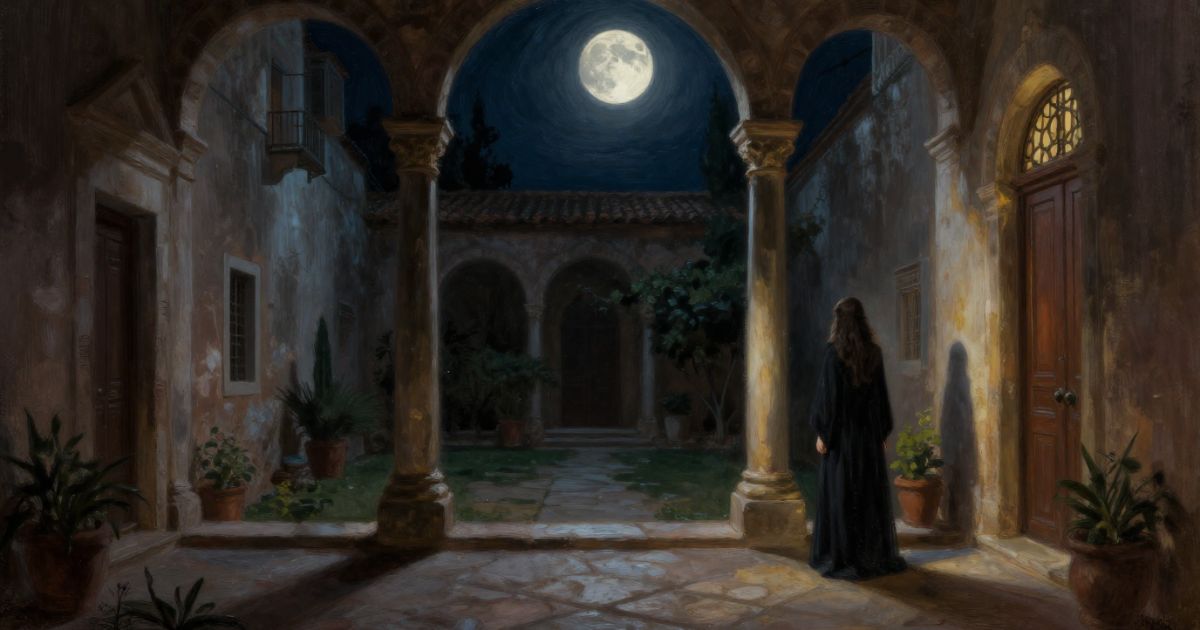
An excerpt from the original text.(complete · 4739 words)
owards the close of the sixteenth century, this castle was in the
possession of Ferdinand, fifth marquis of Mazzini, and was for some
years the principal residence of his family. He was a man of a
voluptuous and imperious character. To his first wife, he married
Louisa Bernini, second daughter of the Count della Salario, a lady yet
more distinguished for the sweetness of her manners and the gentleness
of her disposition, than for her beauty. She brought the marquis one
son and two daughters, who lost their amiable mother in early
childhood. The arrogant and impetuous character of the marquis
operated powerfully upon the mild and susceptible nature of his lady:
and it was by many persons believed, that his unkindness and neglect
put a period to her life. However this might be, he soon afterwards
married Maria de Vellorno, a young lady eminently beautiful, but of a
character very opposite to that of her predecessor. She was a woman of
infinite art, devoted to pleasure, and of an unconquerable spirit. The
marquis, whose heart was dead to paternal tenderness, and whose
present lady was too volatile to attend to domestic concerns,
committed the education of his daughters to the care of a lady,
completely qualified for the undertaking, and who was distantly
related to the late marchioness.
He quitted Mazzini soon after his second marriage, for the gaieties
and splendour of Naples, whither his son accompanied him. Though
naturally of a haughty and overbearing disposition, he was governed by
his wife. His passions were vehement, and she had the address to bend
them to her own purpose; and so well to conceal her influence, that he
thought himself most independent when he was most enslaved. He paid an
annual visit to the castle of Mazzini; but the marchioness seldom
attended him, and he staid only to give such general directions
concerning the education of his daughters, as his pride, rather than
his affection, seemed to dictate.
Emilia, the elder, inherited much of her mother's disposition. She had
a mild and sweet temper, united with a clear and comprehensive mind.
Her younger sister, Julia, was of a more lively cast. An extreme
sensibility subjected her to frequent uneasiness; her temper was warm,
but generous; she was quickly irritated, and quickly appeased; and to
a reproof, however gentle, she would often weep, but was never sullen.
Her imagination was ardent, and her mind early exhibited symptoms of
genius. It was the particular care of Madame de Menon to counteract
those traits in the disposition of her young pupils, which appeared
inimical to their future happiness; and for this task she had
abilities which entitled her to hope for success. A series of early
misfortunes had entendered her heart, without weakening the powers of
her understanding. In retirement she had acquired tranquillity, and
had almost lost the consciousness of those sorrows which yet threw a
soft and not unpleasing shade over her character. She loved her young
charge with maternal fondness, and their gradual improvement and
respectful tenderness repaid all her anxiety. Madame excelled in music
and drawing. She had often forgot her sorrows in these amusements,
when her mind was too much occupied to derive consolation from books,
and she was assiduous to impart to Emilia and Julia a power so
valuable as that of beguiling the sense of affliction. Emilia's taste
led her to drawing, and she soon made rapid advances in that art.
Julia was uncommonly susceptible of the charms of harmony. She had
feelings which trembled in unison to all its various and enchanting
powers.
The instructions of madame she caught with astonishing quickness, and
in a short time attained to a degree of excellence in her favorite
study, which few persons have ever exceeded. Her manner was entirely
her own. It was not in the rapid intricacies of execution, that she
excelled so much in as in that delicacy of taste, and in those
enchanting powers of expression, which seem to breathe a soul through
the sound, and which take captive the heart of the hearer. The lute
was her favorite instrument, and its tender notes accorded well with
the sweet and melting tones of her voice.
The castle of Mazzini was a large irregular fabrick, and seemed suited
to receive a numerous train of followers, such as, in those days,
served the nobility, either in the splendour of peace, or the
turbulence of war. Its present family inhabited only a small part of
it; and even this part appeared forlorn and almost desolate from the
spaciousness of the apartments, and the length of the galleries which
led to them. A melancholy stillness reigned through the halls, and the
silence of the courts, which were shaded by high turrets, was for many
hours together undisturbed by the sound of any foot-step. Julia, who
discovered an early taste for books, loved to retire in an evening to
a small closet in which she had collected her favorite authors. This
room formed the western angle of the castle: one of its windows looked
upon the sea, beyond which was faintly seen, skirting the horizon, the
dark rocky coast of Calabria; the other opened towards a part of the
castle, and afforded a prospect of the neighbouring woods. Her musical
instruments were here deposited, with whatever assisted her favorite
amusements. This spot, which was at once elegant, pleasant, and
retired, was embellished with many little ornaments of her own
invention, and with some drawings executed by her sister. The cioset
was adjoining her chamber, and was separated from the apartments of
madame only by a short gallery. This gallery opened into another, long
and winding, which led to the grand staircase, terminating in the
north hall, with which the chief apartments of the north side of the
edifice communicated.
Madame de Menon's apartment opened into both galleries. It was in one
of these rooms that she usually spent the mornings, occupied in the
improvement of her young charge. The windows looked towards the sea,
and the room was light and pleasant. It was their custom to dine in
one of the lower apartments, and at table they were always joined by a
dependant of the marquis's, who had resided many years in the castle,
and who instructed the young ladies in the Latin tongue, and in
geography. During the fine evenings of summer, this little party
frequently supped in a pavilion, which was built on an eminence in the
woods belonging to the castle. From this spot the eye had an almost
boundless range of sea and land. It commanded the straits of Messina,
with the opposite shores of Calabria, and a great extent of the wild
and picturesque scenery of Sicily. Mount Etna, crowned with eternal
snows, and shooting from among the clouds, formed a grand and sublime
picture in the background of the scene. The city of Palermo was also
distinguishable; and Julia, as she gazed on its glittering spires;
would endeavour in imagination to depicture its beauties, while she
secretly sighed for a view of that world, from which she had hitherto
been secluded by the mean jealousy of the marchioness, upon whose mind
the dread of rival beauty operated strongly to the prejudice of Emilia
and Julia. She employed all her influence over the marquis to detain
them in retirement; and, though Emilia was now twenty, and her sister
eighteen, they had never passed the boundaries of their father's
domains.
Vanity often produces unreasonable alarm; but the marchioness had in
this instance just grounds for apprehension; the beauty of her lord's
daughters has seldom been exceeded. The person of Emilia was finely
proportioned. Her complexion was fair, her hair flaxen, and her dark
blue eyes were full of sweet expression. Her manners were dignified
and elegant, and in her air was a feminine softness, a tender timidity
which irresistibly attracted the heart of the beholder. The figure of
Julia was light and graceful--her step was airy--her mien animated,
and her smile enchanting. Her eyes were dark, and full of fire, but
tempered with modest sweetness. Her features were finely turned--every
laughing grace played round her mouth, and her countenance quickly
discovered all the various emotions of her soul. The dark auburn hair,
which curled in beautiful profusion in her neck, gave a finishing
charm to her appearance.
Thus lovely, and thus veiled in obscurity, were the daughters of the
noble Mazzini. But they were happy, for they knew not enough of the
world seriously to regret the want of its enjoyments, though Julia
would sometimes sigh for the airy image which her fancies painted, and
a painful curiosity would arise concerning the busy scenes from which
she was excluded. A return to her customary amusements, however, would
chase the ideal image from her mind, and restore her usual happy
complacency. Books, music, and painting, divided the hours of her
leisure, and many beautiful summer-evenings were spent in the
pavilion, where the refined conversation of madame, the poetry of
Tasso, the lute of Julia, and the friendship of Emilia, combined to
form a species of happiness, such as elevated and highly susceptible
minds are alone capable of receiving or communicating. Madame
understood and practised all the graces of conversation, and her young
pupils perceived its value, and caught the spirit of its character.
Conversation may be divided into two classes--the familiar and the
sentimental. It is the province of the familiar, to diffuse
cheerfulness and ease--to open the heart of man to man, and to beam a
temperate sunshine upon the mind.--Nature and art must conspire to
render us susceptible of the charms, and to qualify us for the
practice of the second class of conversation, here termed sentimental,
and in which Madame de Menon particularly excelled. To good sense,
lively feeling, and natural delicacy of taste, must be united an
expansion of mind, and a refinement of thought, which is the result of
high cultivation. To render this sort of conversation irresistibly
attractive, a knowledge of the world is requisite, and that enchanting
case, that elegance of manner, which is to be acquired only by
frequenting the higher circles of polished life. In sentimental
conversation, subjects interesting to the heart, and to the
imagination, are brought forward; they are discussed in a kind of
sportive way, with animation and refinement, and are never continued
longer than politeness allows. Here fancy flourishes,--the
sensibilities expand--and wit, guided by delicacy and embellished by
taste--points to the heart.
Such was the conversation of Madame de Menon; and the pleasant gaiety
of the pavilion seemed peculiarly to adapt it for the scene of social
delights. On the evening of a very sultry day, having supped in their
favorite spot, the coolness of the hour, and the beauty of the night,
tempted this happy party to remain there later than usual. Returning
home, they were surprised by the appearance of a light through the
broken window-shutters of an apartment, belonging to a division of the
castle which had for many years been shut up. They stopped to observe
it, when it suddenly disappeared, and was seen no more. Madame de
Menon, disturbed at this phaenomenon, hastened into the castle, with a
view of enquiring into the cause of it, when she was met in the north
hall by Vincent. She related to him what she had seen, and ordered an
immediate search to be made for the keys of those apartments. She
apprehended that some person had penetrated that part of the edifice
with an intention of plunder; and, disdaining a paltry fear where her
duty was concerned, she summoned the servants of the castle, with an
intention of accompanying them thither. Vincent smiled at her
apprehensions, and imputed what she had seen to an illusion, which the
solemnity of the hour had impressed upon her fancy. Madame, however,
persevered in her purpose; and, after along and repeated search, a
massey key, covered with rust, was produced. She then proceeded to the
southern side of the edifice, accompanied by Vincent, and followed by
the servants, who were agitated with impatient wonder. The key was
applied to an iron gate, which opened into a court that separated this
division from the other parts of the castle. They entered this court,
which was overgrown with grass and weeds, and ascended some steps that
led to a large door, which they vainly endeavoured to open. All the
different keys of the castle were applied to the lock, without effect,
and they were at length compelled to quit the place, without having
either satisfied their curiosity, or quieted their fears. Everything,
however, was still, and the light did not reappear. Madame concealed
her apprehensions, and the family retired to rest.
This circumstance dwelt on the mind of Madame de Menon, and it was
some time before she ventured again to spend an evening in the
pavilion. After several months passed, without further disturbance or
discovery, another occurrence renewed the alarm. Julia had one night
remained in her closet later than usual. A favorite book had engaged
her attention beyond the hour of customary repose, and every
inhabitant of the castle, except herself, had long been lost in sleep.
She was roused from her forgetfulness, by the sound of the castle
clock, which struck one. Surprised at the lateness of the hour, she
rose in haste, and was moving to her chamber, when the beauty of the
night attracted her to the window. She opened it; and observing a fine
effect of moonlight upon the dark woods, leaned forwards. In that
situation she had not long remained, when she perceived a light
faintly flash through a casement in the uninhabited part of the
castle. A sudden tremor seized her, and she with difficulty supported
herself. In a few moments it disappeared, and soon after a figure,
bearing a lamp, proceeded from an obscure door belonging to the south
tower; and stealing along the outside of the castle walls, turned
round the southern angle, by which it was afterwards hid from the
view. Astonished and terrified at what she had seen, she hurried to
the apartment of Madame de Menon, and related the circumstance. The
servants were immediately roused, and the alarm became general. Madame
arose and descended into the north hall, where the domestics were
already assembled. No one could be found of courage sufficient to
enter into the courts; and the orders of madame were disregarded, when
opposed to the effects of superstitious terror. She perceived that
Vincent was absent, but as she was ordering him to be called, he
entered the hall. Surprised to find the family thus assembled, he was
told the occasion. He immediately ordered a party of the servants to
attend him round the castle walls; and with some reluctance, and more
fear, they obeyed him. They all returned to the hall, without having
witnessed any extraordinary appearance; but though their fears were
not confirmed, they were by no means dissipated. The appearance of a
light in a part of the castle which had for several years been shut
up, and to which time and circumstance had given an air of singular
desolation, might reasonably be supposed to excite a strong degree of
surprise and terror. In the minds of the vulgar, any species of the
wonderful is received with avidity; and the servants did not hesitate
in believing the southern division of the castle to be inhabited by a
supernatural power. Too much agitated to sleep, they agreed to watch
for the remainder of the night. For this purpose they arranged
themselves in the east gallery, where they had a view of the south
tower from which the light had issued. The night, however, passed
without any further disturbance; and the morning dawn, which they
beheld with inexpressible pleasure, dissipated for a while the glooms
of apprehension. But the return of evening renewed the general fear,
and for several successive nights the domestics watched the southern
tower. Although nothing remarkable was seen, a report was soon raised,
and believed, that the southern side of the castle was haunted. Madame
de Menon, whose mind was superior to the effects of superstition, was
yet disturbed and perplexed, and she determined, if the light
reappeared, to inform the marquis of the circumstance, and request the
keys of those apartments.
The marquis, immersed in the dissipations of Naples, seldom remembered
the castle, or its inhabitants. His son, who had been educated under
his immediate care, was the sole object of his pride, as the
marchioness was that of his affection. He loved her with romantic
fondness, which she repaid with seeming tenderness, and secret
perfidy. She allowed herself a free indulgence in the most licentious
pleasures, yet conducted herself with an art so exquisite as to elude
discovery, and even suspicion. In her amours she was equally
inconstant as ardent, till the young Count Hippolitus de Vereza
attracted her attention. The natural fickleness of her disposition
seemed then to cease, and upon him she centered all her desires.
The count Vereza lost his father in early childhood. He was now of
age, and had just entered upon the possession of his estates. His
person was graceful, yet manly; his mind accomplished, and his manners
elegant; his countenance expressed a happy union of spirit, dignity,
and benevolence, which formed the principal traits of his character.
He had a sublimity of thought, which taught him to despise the
voluptuous vices of the Neapolitans, and led him to higher pursuits.
He was the chosen and early friend of young Ferdinand, the son of the
marquis, and was a frequent visitor in the family. When the
marchioness first saw him, she treated him with great distinction, and
at length made such advances, as neither the honor nor the
inclinations of the count permitted him to notice. He conducted
himself toward her with frigid indifference, which served only to
inflame the passion it was meant to chill. The favors of the
marchioness had hitherto been sought with avidity, and accepted with
rapture; and the repulsive insensibility which she now experienced,
roused all her pride, and called into action every refinement of
coquetry.
It was about this period that Vincent was seized with a disorder which
increased so rapidly, as in a short time to assume the most alarming
appearance. Despairing of life, he desired that a messenger might be
dispatched to inform the marquis of his situation, and to signify his
earnest wish to see him before he died. The progress of his disorder
defied every art of medicine, and his visible distress of mind seemed
to accelerate his fate. Perceiving his last hour approaching, he
requested to have a confessor. The confessor was shut up with him a
considerable time, and he had already received extreme unction, when
Madame de Menon was summoned to his bedside. The hand of death was now
upon him, cold damps hung upon his brows, and he, with difficulty,
raised his heavy eyes to madame as she entered the apartment. He
beckoned her towards him, and desiring that no person might be
permitted to enter the room, was for a few moments silent. His mind
appeared to labour under oppressive remembrances; he made several
attempts to speak, but either resolution or strength failed him. At
length, giving madame a look of unutterable anguish, 'Alas, madam,'
said he, 'Heaven grants not the prayer of such a wretch as I am. I
must expire long before the marquis can arrive. Since I shall see him
no more, I would impart to you a secret which lies heavy at my heart,
and which makes my last moments dreadful, as they are without hope.'
'Be comforted,' said madame, who was affected by the energy of his
manner, 'we are taught to believe that forgiveness is never denied to
sincere repentance.' 'You, madam, are ignorant of the enormity of my
crime, and of the secret--the horrid secret which labours at my
breast. My guilt is beyond remedy in this world, and I fear will be
without pardon in the next; I therefore hope little from confession
even to a priest. Yet some good it is still in my power to do; let me
disclose to you that secret which is so mysteriously connected with
the southern apartments of this castle.'--'What of them!' exclaimed
madame, with impatience. Vincent returned no answer; exhausted by the
effort of speaking, he had fainted. Madame rung for assistance, and by
proper applications, his senses were recalled. He was, however,
entirely speechless, and in this state he remained till he expired,
which was about an hour after he had conversed with madame.
The perplexity and astonishment of madame, were by the late scene
heightened to a very painful degree. She recollected the various
particulars relative to the southern division of the castle, the many
years it had stood uninhabited--the silence which had been observed
concerning it--the appearance of the light and the figure--the
fruitless search for the keys, and the reports so generally believed;
and thus remembrance presented her with a combination of
circumstances, which served only to increase her wonder, and heighten
her curiosity. A veil of mystery enveloped that part of the castle,
which it now seemed impossible should ever be penetrated, since the
only person who could have removed it, was no more.
The marquis arrived on the day after that on which Vincent had
expired. He came attended by servants only, and alighted at the gates
of the castle with an air of impatience, and a countenance expressive
of strong emotion. Madame, with the young ladies, received him in the
hall. He hastily saluted his daughters, and passed on to the oak
parlour, desiring madame to follow him. She obeyed, and the marquis
enquired with great agitation after Vincent. When told of his death,
he paced the room with hurried steps, and was for some time silent. At
length seating himself, and surveying madame with a scrutinizing eye,
he asked some questions concerning the particulars of Vincent's death.
She mentioned his earnest desire to see the marquis, and repeated his
last words. The marquis remained silent, and madame proceeded to
mention those circumstances relative to the southern division of the
castle, which she thought it of so much importance to discover. He
treated the affair very lightly, laughed at her conjectures,
represented the appearances she described as the illusions of a weak
and timid mind, and broke up the conversation, by going to visit the
chamber of Vincent, in which he remained a considerable time.
On the following day Emilia and Julia dined with the marquis. He was
gloomy and silent; their efforts to amuse him seemed to excite
displeasure rather than kindness; and when the repast was concluded,
he withdrew to his own apartment, leaving his daughters in a state of
sorrow and surprise.
Vincent was to be interred, according to his own desire, in the church
belonging to the convent of St Nicholas. One of the servants, after
receiving some necessary orders concerning the funeral, ventured to
inform the marquis of the appearance of the lights in the south tower.
He mentioned the superstitious reports that prevailed amongst the
household, and complained that the servants would not cross the courts
after it was dark. 'And who is he that has commissioned you with this
story?' said the marquis, in a tone of displeasure; 'are the weak and
ridiculous fancies of women and servants to be obtruded upon my
notice? Away--appear no more before me, till you have learned to
speak what it is proper for me to hear.' Robert withdrew abashed, and
it was some time before any person ventured to renew the subject with
the marquis.
The majority of young Ferdinand now drew near, and the marquis
determined to celebrate the occasion with festive magnificence at the
castle of Mazzini. He, therefore, summoned the marchioness and his son
from Naples, and very splendid preparations were ordered to be made.
Emilia and Julia dreaded the arrival of the marchioness, whose
influence they had long been sensible of, and from whose presence they
anticipated a painful restraint. Beneath the gentle guidance of Madame
de Menon, their hours had passed in happy tranquillity, for they were
ignorant alike of the sorrows and the pleasures of the world. Those
did not oppress, and these did not inflame them. Engaged in the
pursuits of knowledge, and in the attainment of elegant
accomplishments, their moments flew lightly away, and the flight of
time was marked only by improvement. In madame was united the
tenderness of the mother, with the sympathy of a friend; and they
loved her with a warm and inviolable affection.
The purposed visit of their brother, whom they had not seen for
several years, gave them great pleasure. Although their minds retained
no very distinct remembrance of him, they looked forward with eager
and delightful expectation to his virtues and his talents; and hoped
to find in his company, a consolation for the uneasiness which the
presence of the marchioness would excite. Neither did Julia
contemplate with indifference the approaching festival. A new scene
was now opening to her, which her young imagination painted in the
warm and glowing colours of delight. The near approach of pleasure
frequently awakens the heart to emotions, which would fail to be
excited by a more remote and abstracted observance. Julia, who, in the
distance, had considered the splendid gaieties of life with
tranquillity, now lingered with impatient hope through the moments
which withheld her from their enjoyments. Emilia, whose feelings were
less lively, and whose imagination was less powerful, beheld the
approaching festival with calm consideration, and almost regretted the
interruption of those tranquil pleasures, which she knew to be more
congenial with her powers and disposition.
In a few days the marchioness arrived at the castle. She was followed
by a numerous retinue, and accompanied by Ferdinand, and several of
the Italian noblesse, whom pleasure attracted to her train. Her
entrance was proclaimed by the sound of music, and those gates which
had long rusted on their hinges, were thrown open to receive her. The
courts and halls, whose aspect so lately expressed only gloom and
desolation, now shone with sudden splendour, and echoed the sounds of
gaiety and gladness. Julia surveyed the scene from an obscure window;
and as the triumphal strains filled the air, her breast throbbed; her
heart beat quick with joy, and she lost her apprehensions from the
marchioness in a sort of wild delight hitherto unknown to her. The
arrival of the marchioness seemed indeed the signal of universal and
unlimited pleasure. When the marquis came out to receive her, the
gloom that lately clouded his countenance, broke away in smiles of
welcome, which the whole company appeared to consider as invitations
to joy.
The tranquil heart of Emilia was not proof against a scene so
alluring, and she sighed at the prospect, yet scarcely knew why. Julia
pointed out to her sister, the graceful figure of a young man who
followed the marchioness, and she expressed her wishes that he might
be her brother. From the contemplation of the scene before them, they
were summoned to meet the marchioness. Julia trembled with
apprehension, and for a few moments wished the castle was in its
former state. As they advanced through the saloon, in which they were
presented, Julia was covered with blushes; but Emilia, tho' equally
timid, preserved her graceful dignity. The marchioness received them
with a mingled smile of condescension and politeness, and immediately
the whole attention of the company was attracted by their elegance and
beauty. The eager eyes of Julia sought in vain to discover her
brother, of whose features she had no recollection in those of any of
the persons then present. At length her father presented him, and she
perceived, with a sigh of regret, that he was not the youth she had
observed from the window. He advanced with a very engaging air, and
she met him with an unfeigned welcome. His figure was tall and
majestic; he had a very noble and spirited carriage; and his
countenance expressed at once sweetness and dignity. Supper was served
in the east hall, and the tables were spread with a profusion of
delicacies. A band of music played during the repast, and the evening
concluded with a concert in the saloon.
Master this chapter. Complete your experience
Purchase the complete book to access all chapters and support classic literature
As an Amazon Associate, we earn a small commission from qualifying purchases at no additional cost to you.
Available in paperback, hardcover, and e-book formats
Let's Analyse the Pattern
When those with power or responsibility walk away from their duties, creating a vacuum that others must either fill or suffer the consequences.
Why This Matters
Connect literature to life
This chapter teaches how to identify when people in authority positions have abandoned their responsibilities, creating dangerous gaps others will fill.
Practice This Today
This week, notice when managers, parents, or leaders are physically present but emotionally checked out - and watch who steps into those gaps.
Now let's explore the literary elements.
Key Quotes & Analysis
"The arrogant and impetuous character of the marquis operated powerfully upon the mild and susceptible nature of his lady: and it was by many persons believed, that his unkindness and neglect put a period to her life."
Context: Describing how the Marquis's cruelty may have killed his first wife
This quote reveals how emotional abuse can be as deadly as physical violence. It shows that everyone knew what was happening but felt powerless to stop it.
In Today's Words:
Everyone could see that his constant cruelty was slowly killing her, but nobody could do anything about it.
"The marquis, whose heart was dead to paternal tenderness, and whose present lady was too volatile to attend to domestic concerns, committed the education of his daughters to the care of a lady."
Context: Explaining why the daughters were raised by a governess rather than their parents
This shows how both parents have completely abdicated their responsibility. The father feels nothing for his children, and the stepmother is too selfish to care.
In Today's Words:
Since he didn't care about his kids and his new wife was too busy partying to deal with them, he hired someone else to raise them.
"Julia was of a more lively cast; she was susceptible of quick emotion, and of new impression."
Context: Describing Julia's passionate, artistic nature
This establishes Julia as someone who feels everything intensely. Her emotional nature will make her both more vulnerable to manipulation and more capable of deep love.
In Today's Words:
Julia was the type who felt everything deeply and was always open to new experiences.
Thematic Threads
Class
In This Chapter
The Marquis uses his noble status to justify neglecting his children while expecting others to handle his responsibilities
Development
Introduced here
In Your Life:
You might see this when wealthy patients expect extra attention while treating staff poorly, or when management expects you to solve problems they created.
Identity
In This Chapter
Julia and Emilia's identities are shaped more by their governess than their actual parents, showing how identity forms through who actually shows up
Development
Introduced here
In Your Life:
Your professional identity might be shaped more by a mentor or colleague who invested in you than by your official supervisor.
Social Expectations
In This Chapter
Society expects the Marquis to be a father, but there's no real enforcement when he abandons that role entirely
Development
Introduced here
In Your Life:
You might feel pressure to maintain relationships with family members who don't actually fulfill their roles in your life.
Personal Growth
In This Chapter
The daughters thrive under Madame de Menon's care, showing that growth happens when someone actually invests in it
Development
Introduced here
In Your Life:
Your biggest growth periods probably came when someone believed in you and gave you real attention, not just went through the motions.
Human Relationships
In This Chapter
Real relationships require presence and investment—the Marquis has biological connections but no actual relationships with his daughters
Development
Introduced here
In Your Life:
You might have people in your life who claim closeness but never actually show up when it matters.
You now have the context. Time to form your own thoughts.
Discussion Questions
- 1
The Marquis has all the power in this family, but Madame de Menon is doing all the actual parenting. What does this tell you about the difference between having authority and using it responsibly?
analysis • surface - 2
Why do you think the Marquis chose to emotionally abandon his daughters after remarrying? What might he be avoiding by staying away?
analysis • medium - 3
Where have you seen this pattern of 'abandoned authority' in your own life - someone who has the title or position but leaves others to do the actual work?
application • medium - 4
If you were in Madame de Menon's position - watching someone neglect their responsibilities while you care about the people being hurt - how would you decide whether to step in or step back?
application • deep - 5
The daughters are thriving despite their father's neglect because they have one person who genuinely cares. What does this suggest about what children (and adults) actually need to grow?
reflection • deep
Critical Thinking Exercise
Map Your Authority Gaps
Think about your current situation - work, family, community. Identify one area where someone in authority has checked out, leaving others to fill the gap. Draw a simple diagram showing who officially has the power, who's actually doing the work, and who's being affected. Then decide: Is this a gap you should fill, or one you should protect yourself from?
Consider:
- •Consider whether filling the gap enables the person in authority to keep avoiding responsibility
- •Think about whether you have the resources and support to take on this unofficial role
- •Ask yourself if stepping in serves the people who need help, or just makes you feel needed
Journaling Prompt
Write about a time when you stepped into a leadership gap left by someone else. What did you learn about the difference between chosen responsibility and forced responsibility? How did it change your relationship with the person who abandoned their role?
Coming Up Next...
Chapter 2: The Festival of Hearts and Shadows
The grand celebration begins, bringing new faces and possibilities into the sisters' sheltered world. But the mysterious lights in the abandoned wing continue to flicker, and family secrets refuse to stay buried during the festivities.



