
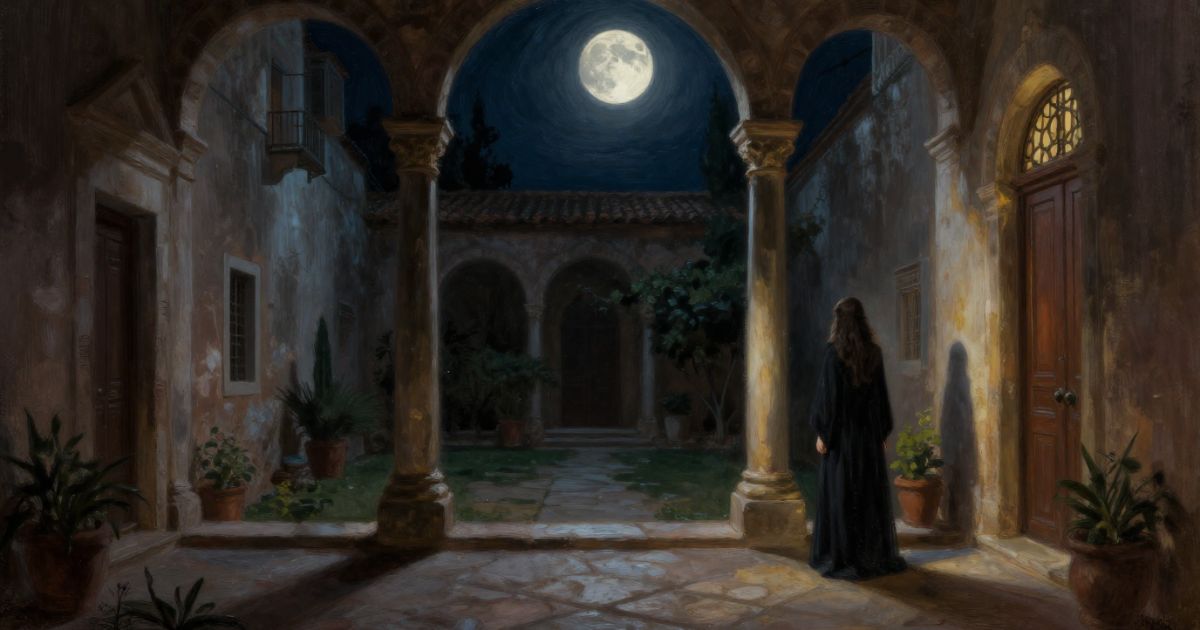
An excerpt from the original text.(complete · 4664 words)
ippolitus, who had languished under a long and dangerous illness
occasioned by his wounds, but heightened and prolonged by the distress
of his mind, was detained in a small town in the coast of Calabria,
and was yet ignorant of the death of Cornelia. He scarcely doubted
that Julia was now devoted to the duke, and this thought was at times
poison to his heart. After his arrival in Calabria, immediately on the
recovery of his senses, he dispatched a servant back to the castle of
Mazzini, to gain secret intelligence of what had passed after his
departure. The eagerness with which we endeavour to escape from
misery, taught him to encourage a remote and romantic hope that Julia
yet lived for him. Yet even this hope at length languished into
despair, as the time elapsed which should have brought his servant
from Sicily. Days and weeks passed away in the utmost anxiety to
Hippolitus, for still his emissary did not appear; and at last,
concluding that he had been either seized by robbers, or discovered
and detained by the marquis, the Count sent off a second emissary to
the castle of Mazzini. By him he learned the news of Julia's flight,
and his heart dilated with joy; but it was suddenly checked when he
heard the marquis had discovered her retreat in the abbey of St
Augustin. The wounds which still detained him in confinement, now
became intolerable. Julia might yet be lost to him for ever. But even
his present state of fear and uncertainty was bliss compared with the
anguish of despair, which his mind had long endured.
As soon as he was sufficiently recovered, he quitted Italy for Sicily,
in the design of visiting the monastery of St Augustin, where it was
possible Julia might yet remain. That he might pass with the secrecy
necessary to his plan, and escape the attacks of the marquis, he left
his servants in Calabria, and embarked alone.
It was morning when he landed at a small port of Sicily, and proceeded
towards the abbey of St Augustin. As he travelled, his imagination
revolved the scenes of his early love, the distress of Julia, and the
sufferings of Ferdinand, and his heart melted at the retrospect. He
considered the probabilities of Julia having found protection from her
father in the pity of the Padre Abate; and even ventured to indulge
himself in a flattering, fond anticipation of the moment when Julia
should again be restored to his sight.
He arrived at the monastery, and his grief may easily be imagined,
when he was informed of the death of his beloved sister, and of the
flight of Julia. He quitted St Augustin's immediately, without even
knowing that Madame de Menon was there, and set out for a town at some
leagues distance, where he designed to pass the night.
Absorbed in the melancholy reflections which the late intelligence
excited, he gave the reins to his horse, and journeyed on unmindful of
his way. The evening was far advanced when he discovered that he had
taken a wrong direction, and that he was bewildered in a wild and
solitary scene. He had wandered too far from the road to hope to
regain it, and he had beside no recollection of the objects left
behind him. A choice of errors, only, lay before him. The view on his
right hand exhibited high and savage mountains, covered with heath and
black fir; and the wild desolation of their aspect, together with the
dangerous appearance of the path that wound up their sides, and which
was the only apparent track they afforded, determined Hippolitus not
to attempt their ascent. On his left lay a forest, to which the path
he was then in led; its appearance was gloomy, but he preferred it to
the mountains; and, since he was uncertain of its extent, there was a
possibility that he might pass it, and reach a village before the
night was set in. At the worst, the forest would afford him a shelter
from the winds; and, however he might be bewildered in its labyrinths,
he could ascend a tree, and rest in security till the return of light
should afford him an opportunity of extricating himself. Among the
mountains there was no possibility of meeting with other shelter than
what the habitation of man afforded, and such a shelter there was
little probability of finding. Innumerable dangers also threatened him
here, from which he would be secure on level ground.
Having determined which way to pursue, he pushed his horse into a
gallop, and entered the forest as the last rays of the sun trembled on
the mountains. The thick foliage of the trees threw a gloom around,
which was every moment deepened by the shades of evening. The path was
uninterrupted, and the count continued to follow it till all
distinction was confounded in the veil of night. Total darkness now
made it impossible for him to pursue his way. He dismounted, and
fastening his horse to a tree, climbed among the branches, purposing
to remain there till morning.
He had not been long in this situation, when a confused sound of
voices from a distance roused his attention. The sound returned at
intervals for some time, but without seeming to approach. He descended
from the tree, that he might the better judge of the direction whence
it came; but before he reached the ground, the noise was ceased, and
all was profoundly silent. He continued to listen, but the silence
remaining undisturbed, he began to think he had been deceived by the
singing of the wind among the leaves; and was preparing to reascend,
when he perceived a faint light glimmer through the foliage from afar.
The sight revived a hope that he was near some place of human
habitation; he therefore unfastened his horse, and led him towards the
spot whence the ray issued. The moon was now risen, and threw a
checkered gleam over his path sufficient to direct him.
Before he had proceeded far the light disappeared. He continued,
however, his way as nearly as he could guess, towards the place whence
it had issued; and after much toil, found himself in a spot where the
trees formed a circle round a kind of rude lawn. The moonlight
discovered to him an edifice which appeared to have been formerly a
monastery, but which now exhibited a pile of ruins, whose grandeur,
heightened by decay, touched the beholder with reverential awe.
Hippolitus paused to gaze upon the scene; the sacred stillness of
night increased its effect, and a secret dread, he knew not wherefore,
stole upon his heart.
The silence and the character of the place made him doubt whether this
was the spot he had been seeking; and as he stood hesitating whether
to proceed or to return, he observed a figure standing under an
arch-way of the ruin; it carried a light in its hand, and passing
silently along, disappeared in a remote part of the building. The
courage of Hippolitus for a moment deserted him. An invincible
curiosity, however, subdued his terror, and he determined to pursue,
if possible, the way the figure had taken.
He passed over loose stones through a sort of court till he came to
the archway; here he stopped, for fear returned upon him. Resuming his
courage, however, he went on, still endeavouring to follow the way the
figure had passed, and suddenly found himself in an enclosed part of
the ruin, whose appearance was more wild and desolate than any he had
yet seen. Seized with unconquerable apprehension, he was retiring,
when the low voice of a distressed person struck his ear. His heart
sunk at the sound, his limbs trembled, and he was utterly unable to
move.
The sound which appeared to be the last groan of a dying person, was
repeated. Hippolitus made a strong effort, and sprang forward, when a
light burst upon him from a shattered casement of the building, and at
the same instant he heard the voices of men!
He advanced softly to the window, and beheld in a small room, which
was less decayed than the rest of the edifice, a group of men, who,
from the savageness of their looks, and from their dress, appeared to
be banditti. They surrounded a man who lay on the ground wounded, and
bathed in blood, and who it was very evident had uttered the groans
heard by the count.
The obscurity of the place prevented Hippolitus from distinguishing
the features of the dying man. From the blood which covered him, and
from the surrounding circumstances, he appeared to be murdered; and
the count had no doubt that the men he beheld were the murderers. The
horror of the scene entirely overcame him; he stood rooted to the
spot, and saw the assassins rifle the pockets of the dying person,
who, in a voice scarcely articulate, but which despair seemed to aid,
supplicated for mercy. The ruffians answered him only with
execrations, and continued their plunder. His groans and his
sufferings served only to aggravate their cruelty. They were
proceeding to take from him a miniature picture, which was fastened
round his neck, and had been hitherto concealed in his bosom; when by
a sudden effort he half raised himself from the ground, and attempted
to save it from their hands. The effort availed him nothing; a blow
from one of the villains laid the unfortunate man on the floor without
motion. The horrid barbarity of the act seized the mind of Hippolitus
so entirely, that, forgetful of his own situation, he groaned aloud,
and started with an instantaneous design of avenging the deed. The
noise he made alarmed the banditti, who looking whence it came,
discovered the count through the casement. They instantly quitted
their prize, and rushed towards the door of the room. He was now
returned to a sense of his danger, and endeavoured to escape to the
exterior part of the ruin; but terror bewildered his senses, and he
mistook his way. Instead of regaining the arch-way, he perplexed
himself with fruitless wanderings, and at length found himself only
more deeply involved in the secret recesses of the pile.
The steps of his pursuers gained fast upon him, and he continued to
perplex himself with vain efforts at escape, till at length, quite
exhausted, he sunk on the ground, and endeavoured to resign himself to
his fate. He listened with a kind of stern despair, and was surprised
to find all silent. On looking round, he perceived by a ray of
moonlight, which streamed through a part of the ruin from above, that
he was in a sort of vault, which, from the small means he had of
judging, he thought was extensive.
In this situation he remained for a considerable time, ruminating on
the means of escape, yet scarcely believing escape was possible. If he
continued in the vault, he might continue there only to be butchered;
but by attempting to rescue himself from the place he was now in, he
must rush into the hands of the banditti. Judging it, therefore, the
safer way of the two to remain where he was, he endeavoured to await
his fate with fortitude, when suddenly the loud voices of the
murderers burst upon his ear, and he heard steps advancing quickly
towards the spot where he lay.
Despair instantly renewed his vigour; he started from the ground, and
throwing round him a look of eager desperation, his eye caught the
glimpse of a small door, upon which the moon-beam now fell. He made
towards it, and passed it just as the light of a torch gleamed upon
the walls of the vault.
He groped his way along a winding passage, and at length came to a
flight of steps. Notwithstanding the darkness, he reached the bottom
in safety.
He now for the first time stopped to listen--the sounds of pursuit
were ceased, and all was silent! Continuing to wander on in effectual
endeavours to escape, his hands at length touched cold iron, and he
quickly perceived it belonged to a door. The door, however, was
fastened, and resisted all his efforts to open it. He was giving up
the attempt in despair, when a loud scream from within, followed by a
dead and heavy noise, roused all his attention. Silence ensued. He
listened for a considerable time at the door, his imagination filled
with images of horror, and expecting to hear the sound repeated. He
then sought for a decayed part of the door, through which he might
discover what was beyond; but he could find none; and after waiting
some time without hearing any farther noise, he was quitting the spot,
when in passing his arm over the door, it struck against something
hard. On examination he perceived, to his extreme surprize, that the
key was in the lock. For a moment he hesitated what to do; but
curiosity overcame other considerations, and with a trembling hand he
turned the key. The door opened into a large and desolate apartment,
dimly lighted by a lamp that stood on a table, which was almost the
only furniture of the place. The Count had advanced several steps
before he perceived an object, which fixed all his attention. This was
the figure of a young woman lying on the floor apparently dead. Her
face was concealed in her robe; and the long auburn tresses which fell
in beautiful luxuriance over her bosom, served to veil a part of the
glowing beauty which the disorder of her dress would have revealed.
Pity, surprize, and admiration struggled in the breast of Hippolitus;
and while he stood surveying the object which excited these different
emotions, he heard a step advancing towards the room. He flew to the
door by which he had entered, and was fortunate enough to reach it
before the entrance of the persons whose steps he heard. Having turned
the key, he stopped at the door to listen to their proceedings. He
distinguished the voices of two men, and knew them to be those of the
assassins. Presently he heard a piercing skriek, and at the same
instant the voices of the ruffians grew loud and violent. One of them
exclaimed that the lady was dying, and accused the other of having
frightened her to death, swearing, with horrid imprecations, that she
was his, and he would defend her to the last drop of his blood. The
dispute grew higher; and neither of the ruffians would give up his
claim to the unfortunate object of their altercation.
The clashing of swords was soon after heard, together with a violent
noise. The screams were repeated, and the oaths and execrations of the
disputants redoubled. They seemed to move towards the door, behind
which Hippolitus was concealed; suddenly the door was shook with great
force, a deep groan followed, and was instantly succeeded by a noise
like that of a person whose whole weight falls at once to the ground.
For a moment all was silent. Hippolitus had no doubt that one of the
ruffians had destroyed the other, and was soon confirmed in the
belief--for the survivor triumphed with brutal exultation over his
fallen antagonist. The ruffian hastily quitted the room, and
Hippolitus soon after heard the distant voices of several persons in
loud dispute. The sounds seemed to come from a chamber over the place
where he stood; he also heard a trampling of feet from above, and
could even distinguish, at intervals, the words of the disputants.
From these he gathered enough to learn that the affray which had just
happened, and the lady who had been the occasion of it, were the
subjects of discourse. The voices frequently rose together, and
confounded all distinction.
At length the tumult began to subside, and Hippolitus could
distinguish what was said. The ruffians agreed to give up the lady in
question to him who had fought for her; and leaving him to his prize,
they all went out in quest of farther prey. The situation of the
unfortunate lady excited a mixture of pity and indignation in
Hippolitus, which for some time entirely occupied him; he revolved the
means of extricating her from so deplorable a situation, and in these
thoughts almost forgot his own danger. He now heard her sighs; and
while his heart melted to the sounds, the farther door of the
apartment was thrown open, and the wretch to whom she had been
allotted, rushed in. Her screams now redoubled, but they were of no
avail with the ruffian who had seized her in his arms; when the count,
who was unarmed, insensible to every pulse but that of a generous
pity, burst into the room, but became fixed like a statue when he
beheld his Julia struggling in the grasp of the ruffian. On
discovering Hippolitus, she made a sudden spring, and liberated
herself; when, running to him, she sunk lifeless in his arms.
Surprise and fury sparkled in the eyes of the ruffian, and he turned
with a savage desperation upon the count; who, relinquishing Julia,
snatched up the sword of the dead ruffian, which lay upon the floor,
and defended himself. The combat was furious, but Hippolitus laid his
antagonist senseless at his feet. He flew to Julia, who now revived,
but who for some time could speak only by her tears. The transitions
of various and rapid sensations, which her heart experienced, and the
strangely mingled emotions of joy and terror that agitated Hippolitus,
can only be understood by experience. He raised her from the floor,
and endeavoured to soothe her to composure, when she called wildly
upon Ferdinand. At his name the count started, and he instantly
remembered the dying cavalier, whose countenance the glooms had
concealed from his view. His heart thrilled with secret agony, yet he
resolved to withhold his terrible conjectures from Julia, of whom he
learned that Ferdinand, with herself, had been taken by banditti in
the way from the villa which had offered them so hospitable a
reception after the shipwreck. They were on the road to a port whence
they designed again to embark for Italy, when this misfortune overtook
them. Julia added, that Ferdinand had been immediately separated from
her; and that, for some hours, she had been confined in the apartment
where Hippolitus found her.
The Count with difficulty concealed his terrible apprehensions for
Ferdinand, and vainly strove to soften Julia's distress. But there was
no time to be lost--they had yet to find a way out of the edifice, and
before they could accomplish this, the banditti might return. It was
also possible that some of the party were left to watch this their
abode during the absence of the rest, and this was another
circumstance of reasonable alarm.
After some little consideration, Hippolitus judged it most prudent to
seek an outlet through the passage by which he entered; he therefore
took the lamp, and led Julia to the door. They entered the avenue, and
locking the door after them, sought the flight of steps down which the
count had before passed; but having pursued the windings of the avenue
a considerable time without finding them, he became certain he had
mistaken the way. They, however, found another flight, which they
descended and entered upon a passage so very narrow and low, as not to
admit of a person walking upright. This passage was closed by a door,
which on examination was found to be chiefly of iron. Hippolitus was
startled at the sight, but on applying his strength found it gradually
yield, when the imprisoned air rushed out, and had nearly extinguished
the light. They now entered upon a dark abyss; and the door which
moved upon a spring, suddenly closed upon them. On looking round they
beheld a large vault; and it is not easy to imagine their horror on
discovering they were in a receptacle for the murdered bodies of the
unfortunate people who had fallen into the hands of the banditti.
The count could scarcely support the fainting spirits of Julia; he ran
to the door, which he endeavoured to open, but the lock was so
constructed that it could be moved only on the other side, and all his
efforts were useless. He was constrained, therefore, to seek for
another door, but could find none. Their situation was the most
deplorable that can be imagined; for they were now inclosed in a vault
strewn with the dead bodies of the murdered, and must there become the
victims of famine, or of the sword. The earth was in several places
thrown up, and marked the boundaries of new-made graves. The bodies
which remained unburied were probably left either from hurry or
negligence, and exhibited a spectacle too shocking for humanity. The
sufferings of Hippolitus were increased by those of Julia, who was
sinking with horror, and who he endeavoured to support to apart of the
vault which fell into a recess--where stood a bench.
They had not been long in this situation, when they heard a noise
which approached gradually, and which did not appear to come from the
avenue they had passed.
The noise increased, and they could distinguish voices. Hippolitus
believed the murderers were returned; that they had traced his
retreat, and were coming towards the vault by some way unknown to him.
He prepared for the worst--and drawing his sword, resolved to defend
Julia to the last. Their apprehension, however, was soon dissipated
by a trampling of horses, which sound had occasioned his alarm, and
which now seemed to come from a courtyard above, extremely near the
vault. He distinctly heard the voices of the banditti, together with
the moans and supplications of some person, whom it was evident they
were about to plunder. The sound appeared so very near, that
Hippolitus was both shocked and surprised; and looking round the
vault, he perceived a small grated window placed very high in the
wall, which he concluded overlooked the place where the robbers were
assembled. He recollected that his light might betray him; and
horrible as was the alternative, he was compelled to extinguish it. He
now attempted to climb to the grate, through which he might obtain a
view of what was passing without. This at length he effected, for the
ruggedness of the wall afforded him a footing. He beheld in a ruinous
court, which was partially illuminated by the glare of torches, a
group of banditti surrounding two persons who were bound on horseback,
and who were supplicating for mercy.
One of the robbers exclaiming with an oath that this was a golden
night, bade his comrades dispatch, adding he would go to find Paulo
and the lady.
The effect which the latter part of this sentence had upon the
prisoners in the vault, may be more easily imagined than described.
They were now in total darkness in this mansion of the murdered,
without means of escape, and in momentary expectation of sharing a
fate similar to that of the wretched objects around them. Julia,
overcome with distress and terror, sunk on the ground; and Hippolitus,
descending from the grate, became insensible of his own danger in his
apprehension for her.
In a short time all without was confusion and uproar; the ruffian who
had left the court returned with the alarm that the lady was fled, and
that Paulo was murdered, The robbers quitting their booty to go in
search of the fugitive, and to discover the murderer, dreadful
vociferations resounded through every recess of the pile.
The tumult had continued a considerable time, which the prisoners had
passed in a state of horrible suspence, when they heard the uproar
advancing towards the vault, and soon after a number of voices shouted
down the avenue. The sound of steps quickened. Hippolitus again drew
his sword, and placed himself opposite the entrance, where he had not
stood long, when a violent push was made against the door; it flew
open, and a party of men rushed into the vault.
Hippolitus kept his position, protesting he would destroy the first
who approached. At the sound of his voice they stopped; but presently
advancing, commanded him in the king's name to surrender. He now
discovered what his agitation had prevented him from observing sooner,
that the men before him were not banditti, but the officers of
justice. They had received information of this haunt of villainy from
the son of a Sicilian nobleman, who had fallen into the hands of the
banditti, and had afterwards escaped from their power.
The officers came attended by a guard, and were every way prepared to
prosecute a strenuous search through these horrible recesses.
Hippolitus inquired for Ferdinand, and they all quitted the vault in
search of him. In the court, to which they now ascended, the greater
part of the banditti were secured by a number of the guard. The count
accused the robbers of having secreted his friend, whom he described,
and demanded to have liberated.
With one voice they denied the fact, and were resolute in persisting
that they knew nothing of the person described. This denial confirmed
Hippolitus in his former terrible surmise; that the dying cavalier,
whom he had seen, was no other than Ferdinand, and he became furious.
He bade the officers prosecute their search, who, leaving a guard over
the banditti they had secured, followed him to the room where the late
dreadful scene had been acted.
The room was dark and empty; but the traces of blood were visible on
the floor; and Julia, though ignorant of the particular apprehension
of Hippolitus, almost swooned at the sight. On quitting the room, they
wandered for some time among the ruins, without discovering any thing
extraordinary, till, in passing under the arch-way by which Hippolitus
had first entered the building, their footsteps returned a deep sound,
which convinced them that the ground beneath was hollow. On close
examination, they perceived by the light of their torch, a trapdoor,
which with some difficulty they lifted, and discovered beneath a
narrow flight of steps. They all descended into a low winding passage,
where they had not been long, when they heard a trampling of horses
above, and a loud and sudden uproar.
The officers apprehending that the banditti had overcome the guard,
rushed back to the trapdoor, which they had scarcely lifted, when they
heard a clashing of swords, and a confusion of unknown voices. Looking
onward, they beheld through the arch, in an inner sort of court, a
large party of banditti who were just arrived, rescuing their
comrades, and contending furiously with the guard.
On observing this, several of the officers sprang forward to the
assistance of their friends; and the rest, subdued by cowardice,
hurried down the steps, letting the trapdoor fall after them with a
thundering noise. They gave notice to Hippolitus of what was passing
above, who hurried Julia along the passage in search of some outlet or
place of concealment. They could find neither, and had not long
pursued the windings of the way, when they heard the trapdoor lifted,
and the steps of persons descending. Despair gave strength to Julia,
and winged her flight. But they were now stopped by a door which
closed the passage, and the sound of distant voices murmured along the
walls.
The door was fastened by strong iron bolts, which Hippolitus vainly
endeavoured to draw. The voices drew near. After much labour and
difficulty the bolts yielded--the door unclosed--and light dawned upon
them through the mouth of a cave, into which they now entered. On
quitting the cave they found themselves in the forest, and in a short
time reached the borders. They now ventured to stop, and looking back
perceived no person in pursuit.
Master this chapter. Complete your experience
Purchase the complete book to access all chapters and support classic literature
As an Amazon Associate, we earn a small commission from qualifying purchases at no additional cost to you.
Available in paperback, hardcover, and e-book formats
Let's Analyse the Pattern
Fear dissolves when protecting someone we love becomes more important than protecting ourselves.
Why This Matters
Connect literature to life
This chapter teaches how love can instantly transform paralyzing fear into fierce action when someone precious faces danger.
Practice This Today
This week, notice when you feel most brave—it's often when protecting others, revealing what you truly value most.
Now let's explore the literary elements.
Key Quotes & Analysis
"The wounds which still detained him in confinement, now became intolerable. Julia might yet be lost to him for ever."
Context: When Hippolitus learns Julia has fled again and might be recaptured
Shows how emotional pain can make physical pain worse. His desperation to reach Julia makes his healing wounds feel unbearable because every moment of delay could mean losing her forever.
In Today's Words:
His injuries felt way worse now that he knew she was in danger and he couldn't get to her fast enough.
"Horror struck upon his heart, and he was upon the point of retreating, when the light moved onward, and he heard it accompanied by the low voice of complaint."
Context: When Hippolitus discovers the bandits' lair and hears sounds of violence
Captures the moment between self-preservation and moral duty. Despite being terrified, he can't ignore someone else's suffering, which leads him to discover Julia.
In Today's Words:
He was scared out of his mind and wanted to run, but he couldn't ignore someone crying for help.
"At the sound of her voice, Hippolitus rushed forward, and plunging his sword in the breast of the ruffian, laid him dead at his feet."
Context: When Hippolitus sees a bandit about to assault Julia
Shows the power of love to overcome fear and hesitation. The moment he recognizes Julia's voice, all his caution disappears and he acts with deadly force to protect her.
In Today's Words:
The second he heard her voice, he didn't think twice - he killed the guy attacking her.
Thematic Threads
Love
In This Chapter
Hippolitus's love for Julia transforms him from terrified observer to fierce protector, willing to kill to defend her
Development
Evolved from romantic longing to life-risking devotion
In Your Life:
You might find unexpected strength when someone you care about needs defending
Courage
In This Chapter
True courage emerges not from fearlessness but from having something more important than personal safety
Development
Introduced here as protective instinct overriding self-preservation
In Your Life:
Your bravest moments often come when you're protecting others, not yourself
Class
In This Chapter
The bandits represent society's outcasts who prey on the vulnerable, while officers of justice restore social order
Development
Continued exploration of how social breakdown creates dangerous spaces
In Your Life:
You might encounter people who exploit others' desperation or vulnerability
Justice
In This Chapter
Law enforcement arrives precisely when hope seems lost, suggesting that justice, though delayed, eventually comes
Development
Introduced here as external force that restores order
In Your Life:
Sometimes help arrives from unexpected sources when situations seem hopeless
Survival
In This Chapter
Julia and Hippolitus must navigate both physical dangers and emotional trauma while maintaining hope
Development
Evolved from individual struggles to shared endurance
In Your Life:
You might face situations where survival requires both physical and emotional resilience
You now have the context. Time to form your own thoughts.
Discussion Questions
- 1
What transformed Hippolitus from a terrified observer into someone willing to kill to protect Julia?
analysis • surface - 2
Why does fear often disappear when we're protecting someone we love, even though the actual danger hasn't changed?
analysis • medium - 3
Where have you seen this pattern in your own life - someone finding unexpected courage when defending others?
application • medium - 4
How could you use this protective instinct pattern to advocate for yourself in difficult situations?
application • deep - 5
What does Hippolitus's instant shift from self-preservation to protection reveal about how love changes our priorities?
reflection • deep
Critical Thinking Exercise
Map Your Protective Instincts
Think of three people or causes you would defend without hesitation, even if it meant personal risk or discomfort. For each one, write down what specific action you would take if they faced a threat. Then consider: how could you extend that same fierce advocacy to protecting yourself or your own boundaries?
Consider:
- •Notice how your fear level changes when you shift focus from self-protection to protecting others
- •Consider whether you give others the same compassion and defense you'd want for yourself
- •Think about situations where you've stayed quiet about your own needs but would speak up for someone else
Journaling Prompt
Write about a time when you found unexpected courage while defending someone else. What did that experience teach you about your own strength? How could you channel that same energy into advocating for yourself?
Coming Up Next...
Chapter 14: Mother and Daughter Reunited
Free but not safe, Hippolitus and Julia must navigate their way back to civilization while the terrible question of Ferdinand's fate hangs over them. Their escape from the bandits' lair is only the beginning of their journey toward truth and resolution.



