
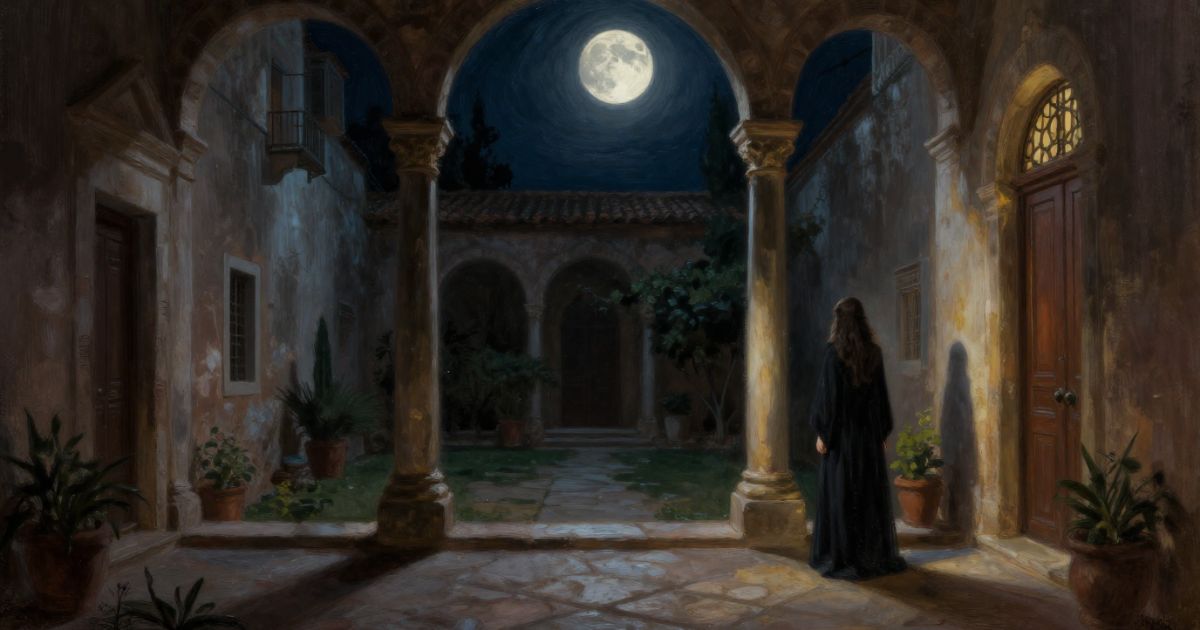
An excerpt from the original text.(complete · 3303 words)
he evening now sunk in darkness, and the hour was fast approaching
which would decide the fate of Julia. Trembling anxiety subdued every
other sensation; and as the minutes passed, her fears increased. At
length she heard the gates of the monastery fastened for the night;
the bell rang the signal for repose; and the passing footsteps of the
nuns told her they were hastening to obey it. After some time, all was
silent. Julia did not yet dare to venture forth; she employed the
present interval in interesting and affectionate conversation with
Madame de Menon, to whom, notwithstanding her situation, her heart
bade a sorrowful adieu.
The clock struck twelve, when she arose to depart. Having embraced her
faithful friend with tears of mingled grief and anxiety, she took a
lamp in her hand, and with cautious, fearful steps, descended through
the long winding passages to a private door, which opened into the
church of the monastery. The church was gloomy and desolate; and the
feeble rays of the lamp she bore, gave only light enough to discover
its chilling grandeur. As she passed silently along the aisles, she
cast a look of anxious examination around--but Ferdinand was no where
to be seen. She paused in timid hesitation, fearful to penetrate the
gloomy obscurity which lay before her, yet dreading to return.
As she stood examining the place, vainly looking for Ferdinand, yet
fearing to call, lest her voice should betray her, a hollow groan
arose from apart of the church very near her. It chilled her heart,
and she remained fixed to the spot. She turned her eyes a little to
the left, and saw light appear through the chinks of a sepulchre at
some distance. The groan was repeated--a low murmuring succeeded, and
while she yet gazed, an old man issued from the vault with a lighted
taper in his hand. Terror now subdued her, and she utterred an
involuntary shriek. In the succeeding moment, a noise was heard in a
remote part of the fabric; and Ferdinand rushing forth from his
concealment, ran to her assistance. The old man, who appeared to be a
friar, and who had been doing penance at the monument of a saint, now
approached. His countenance expressed a degree of surprise and terror
almost equal to that of Julia's, who knew him to be the confessor of
Vincent. Ferdinand seized the father; and laying his hand upon his
sword, threatened him with death if he did not instantly swear to
conceal for ever his knowledge of what he then saw, and also assist
them to escape from the abbey.
'Ungracious boy!' replied the father, in a calm voice, 'desist from
this language, nor add to the follies of youth the crime of murdering,
or terrifying a defenceless old man. Your violence would urge me to
become your enemy, did not previous inclination tempt me to be your
friend. I pity the distresses of the lady Julia, to whom I am no
stranger, and will cheerfully give her all the assistance in my
power.'
At these words Julia revived, and Ferdinand, reproved by the
generosity of the father, and conscious of his own inferiority, shrunk
back. 'I have no words to thank you,' said he, 'or to entreat your
pardon for the impetuosity of my conduct; your knowledge of my
situation must plead my excuse.'--'It does,' replied the father, 'but
we have no time to lose;--follow me.'
They followed him through the church to the cloisters, at the
extremity of which was a small door, which the friar unlocked. It
opened upon the woods.
'This path,' said he, 'leads thro' an intricate part of the woods, to
the rocks that rise on the right of the abbey; in their recesses you
may secrete yourselves till you are prepared for a longer journey. But
extinguish your light; it may betray you to the marquis's people, who
are dispersed about this spot. Farewell! my children, and God's
blessing be upon ye.'
Julia's tears declared her gratitude; she had no time for words. They
stepped into the path, and the father closed the door. They were now
liberated from the monastery, but danger awaited them without, which
it required all their caution to avoid. Ferdinand knew the path which
the friar had pointed out to be the same that led to the rocks where
his horses were stationed, and he pursued it with quick and silent
steps. Julia, whose fears conspired with the gloom of night to magnify
and transform every object around her, imagined at each step that she
took, she perceived the figures of men, and fancied every whisper of
the breeze the sound of pursuit.
They proceeded swiftly, till Julia, breathless and exhausted, could go
no farther. They had not rested many minutes, when they heard a
rustling among the bushes at some distance, and soon after
distinguished a low sound of voices. Ferdinand and Julia instantly
renewed their flight, and thought they still heard voices advance upon
the wind. This thought was soon confirmed, for the sounds now gained
fast upon them, and they distinguished words which served only to
heighten their apprehensions, when they reached the extremity of the
woods. The moon, which was now up, suddenly emerging from a dark
cloud, discovered to them several man in pursuit; and also shewed to
the pursuers the course of the fugitives. They endeavoured to gain the
rocks where the horses were concealed, and which now appeared in view.
These they reached when the pursuers had almost overtaken them--but
their horses were gone! Their only remaining chance of escape was to
fly into the deep recesses of the rock. They, therefore, entered a
winding cave, from whence branched several subterraneous avenues, at
the extremity of one of which they stopped. The voices of men now
vibrated in tremendous echoes through the various and secret caverns
of the place, and the sound of footsteps seemed fast approaching.
Julia trembled with terror, and Ferdinand drew his sword, determined
to protect her to the last. A confused volley of voices now sounded up
that part of the cave were Ferdinand and Julia lay concealed. In a
few moments the steps of the pursuers suddenly took a different
direction, and the sounds sunk gradually away, and were heard no more.
Ferdinand listened attentively for a considerable time, but the
stillness of the place remained undisturbed. It was now evident that
the men had quitted the rock, and he ventured forth to the mouth of
the cave. He surveyed the wilds around, as far as his eye could
penetrate, and distinguished no human being; but in the pauses of the
wind he still thought he heard a sound of distant voices. As he
listened in anxious silence, his eye caught the appearance of a
shadow, which moved upon the ground near where he stood. He started
back within the cave, but in a few minutes again ventured forth. The
shadow remained stationary, but having watched it for some time,
Ferdinand saw it glide along till it disappeared behind a point of
rock. He had now no doubt that the cave was watched, and that it was
one of his late pursuers whose shade he had seen. He returned,
therefore, to Julia, and remained near an hour hid in the deepest
recess of the rock; when, no sound having interrupted the profound
silence of the place, he at length once more ventured to the mouth of
the cave. Again he threw a fearful look around, but discerned no human
form. The soft moon-beam slept upon the dewy landscape, and the solemn
stillness of midnight wrapt the world. Fear heightened to the
fugitives the sublimity of the hour. Ferdinand now led Julia forth,
and they passed silently along the shelving foot of the rocks.
They continued their way without farther interruption; and among the
cliffs, at some distance from the cave, discovered, to their
inexpressible joy, their horses, who having broken their fastenings,
had strayed thither, and had now laid themselves down to rest.
Ferdinand and Julia immediately mounted; and descending to the plains,
took the road that led to a small sea-port at some leagues distant,
whence they could embark for Italy.
They travelled for some hours through gloomy forests of beech and
chesnut; and their way was only faintly illuminated by the moon, which
shed a trembling lustre through the dark foliage, and which was seen
but at intervals, as the passing clouds yielded to the power of her
rays. They reached at length the skirts of the forest. The grey dawn
now appeared, and the chill morning air bit shrewdly. It was with
inexpressible joy that Julia observed the kindling atmosphere; and
soon after the rays of the rising sun touching the tops of the
mountains, whose sides were yet involved in dark vapours.
Her fears dissipated with the darkness.--The sun now appeared amid
clouds of inconceivable splendour; and unveiled a scene which in other
circumstances Julia would have contemplated with rapture. From the
side of the hill, down which they were winding, a vale appeared, from
whence arose wild and lofty mountains, whose steeps were cloathed with
hanging woods, except where here and there a precipice projected its
bold and rugged front. Here, a few half-withered trees hung from the
crevices of the rock, and gave a picturesque wildness to the object;
there, clusters of half-seen cottages, rising from among tufted
groves, embellished the green margin of a stream which meandered in
the bottom, and bore its waves to the blue and distant main.
The freshness of morning breathed over the scene, and vivified each
colour of the landscape. The bright dewdrops hung trembling from the
branches of the trees, which at intervals overshadowed the road; and
the sprightly music of the birds saluted the rising day.
Notwithstanding her anxiety the scene diffused a soft complacency over
the mind of Julia.
About noon they reached the port, where Ferdinand was fortunate enough
to obtain a small vessel; but the wind was unfavourable, and it was
past midnight before it was possible for them to embark.
When the dawn appeared, Julia returned to the deck; and viewed with a
sigh of unaccountable regret, the receding coast of Sicily. But she
observed, with high admiration, the light gradually spreading through
the atmosphere, darting a feeble ray over the surface of the waters,
which rolled in solemn soundings upon the distant shores. Fiery beams
now marked the clouds, and the east glowed with increasing radiance,
till the sun rose at once above the waves, and illuminating them with
a flood of splendour, diffused gaiety and gladness around. The bold
concave of the heavens, uniting with the vast expanse of the ocean,
formed, a coup d'oeil, striking and sublime magnificence of the
scenery inspired Julia with delight; and her heart dilating with high
enthusiasm, she forgot the sorrows which had oppressed her.
The breeze wafted the ship gently along for some hours, when it
gradually sunk into a calm. The glassy surface of the waters was not
curled by the lightest air, and the vessel floated heavily on the
bosom of the deep. Sicily was yet in view, and the present delay
agitated Julia with wild apprehension. Towards the close of day a
light breeze sprang up, but it blew from Italy, and a train of dark
vapours emerged from the verge of the horizon, which gradually
accumulating, the heavens became entirely overcast. The evening shut
in suddenly; the rising wind, the heavy clouds that loaded the
atmosphere, and the thunder which murmured afar off terrified Julia,
and threatened a violent storm.
The tempest came on, and the captain vainly sounded for anchorage: it
was deep sea, and the vessel drove furiously before the wind. The
darkness was interrupted only at intervals, by the broad expanse of
vivid lightnings, which quivered upon the waters, and disclosing the
horrible gaspings of the waves, served to render the succeeding
darkness more awful. The thunder, which burst in tremendous crashes
above, the loud roar of the waves below, the noise of the sailors, and
the sudden cracks and groanings of the vessel conspired to heighten
the tremendous sublimity of the scene.
Far on the rocky shores the surges sound,
The lashing whirlwinds cleave the vast profound;
While high in air, amid the rising storm,
Driving the blast, sits Danger's black'ning form.
Julia lay fainting with terror and sickness in the cabin, and
Ferdinand, though almost hopeless himself, was endeavouring to support
her, when aloud and dreadful crash was heard from above. It seemed as
if the whole vessel had parted. The voices of the sailors now rose
together, and all was confusion and uproar. Ferdinand ran up to the
deck, and learned that part of the main mast, borne away by the wind,
had fallen upon the deck, whence it had rolled overboard.
It was now past midnight, and the storm continued with unabated fury.
For four hours the vessel had been driven before the blast; and the
captain now declared it was impossible she could weather the tempest
much longer, ordered the long boat to be in readiness. His orders were
scarcely executed, when the ship bulged upon a reef of rocks, and the
impetuous waves rushed into the vessel:--a general groan ensued.
Ferdinand flew to save his sister, whom he carried to the boat, which
was nearly filled by the captain and most of the crew. The sea ran so
high that it appeared impracticable to reach the shore: but the boat
had not moved many yards, when the ship went to pieces. The captain
now perceived, by the flashes of lightning, a high rocky coast at
about the distance of half a mile. The men struggled hard at the oars;
but almost as often as they gained the summit of a wave, it dashed
them back again, and made their labour of little avail.
After much difficulty and fatigue they reached the coast, where a new
danger presented itself. They beheld a wild rocky shore, whose cliffs
appeared inaccessible, and which seemed to afford little possibility
of landing. A landing, however, was at last affected; and the sailors,
after much search, discovered a kind of pathway cut in the rock, which
they all ascended in safety.
The dawn now faintly glimmered, and they surveyed the coast, but could
discover no human habitation. They imagined they were on the shores of
Sicily, but possessed no means of confirming this conjecture. Terror,
sickness, and fatigue had subdued the strength and spirits of Julia,
and she was obliged to rest upon the rocks.
The storm now suddenly subsided, and the total calm which succeeded to
the wild tumult of the winds and waves, produced a striking and
sublime effect. The air was hushed in a deathlike stillness, but the
waves were yet violently agitated; and by the increasing light, parts
of the wreck were seen floating wide upon the face of the deep. Some
sailors, who had missed the boat, were also discovered clinging to
pieces of the vessel, and making towards the shore. On observing this,
their shipmates immediately descended to the boat; and, putting off to
sea, rescued them from their perilous situation. When Julia was
somewhat reanimated, they proceeded up the country in search of a
dwelling.
They had travelled near half a league, when the savage features of the
country began to soften, and gradually changed to the picturesque
beauty of Sicilian scenery. They now discovered at some distance a
villa, seated on a gentle eminence, crowned with woods. It was the
first human habitation they had seen since they embarked for Italy;
and Julia, who was almost sinking with fatigue, beheld it with
delight. The captain and his men hastened towards it to make known
their distress, while Ferdinand and Julia slowly followed. They
observed the men enter the villa, one of whom quickly returned to
acquaint them with the hospitable reception his comrades had received.
Julia with difficulty reached the edifice, at the door of which she
was met by a young cavalier, whose pleasing and intelligent
countenance immediately interested her in his favor. He welcomed the
strangers with a benevolent politeness that dissolved at once every
uncomfortable feeling which their situation had excited, and produced
an instantaneous easy confidence. Through a light and elegant hall,
rising into a dome, supported by pillars of white marble, and adorned
with busts, he led them to a magnificent vestibule, which opened upon
a lawn. Having seated them at a table spread with refreshments he left
them, and they surveyed, with surprise, the beauty of the adjacent
scene.
The lawn, which was on each side bounded by hanging woods, descended
in gentle declivity to a fine lake, whose smooth surface reflected the
surrounding shades. Beyond appeared the distant country, arising on
the left into bold romantic mountains, and on the right exhibiting a
soft and glowing landscape, whose tranquil beauty formed a striking
contrast to the wild sublimity of the opposite craggy heights. The
blue and distant ocean terminated the view.
In a short time the cavalier returned, conducting two ladies of a very
engaging appearance, whom he presented as his wife and sister. They
welcomed Julia with graceful kindness; but fatigue soon obliged her to
retire to rest, and a consequent indisposition increased so rapidly,
as to render it impracticable for her to quit her present abode on
that day. The captain and his men proceeded on their way, leaving
Ferdinand and Julia at the villa, where she experienced every kind and
tender affection.
The day which was to have devoted Julia to a cloister, was ushered in
at the abbey with the usual ceremonies. The church was ornamented, and
all the inhabitants of the monastery prepared to attend. The Padre
Abate now exulted in the success of his scheme, and anticipated, in
imagination, the rage and vexation of the marquis, when he should
discover that his daughter was lost to him for ever.
The hour of celebration arrived, and he entered the church with a
proud firm step, and with a countenance which depictured his inward
triumph; he was proceeding to the high altar, when he was told that
Julia was no where to be found. Astonishment for awhile suspended
other emotions--he yet believed it impossible that she could have
effected an escape, and ordered every part of the abbey to be
searched--not forgetting the secret caverns belonging to the
monastery, which wound beneath the woods. When the search was over,
and he became convinced she was fled, the deep workings of his
disappointed passions fermented into rage which exceeded all bounds.
He denounced the most terrible judgments upon Julia; and calling for
Madame de Menon, charged her with having insulted her holy religion,
in being accessary to the flight of Julia. Madame endured these
reproaches with calm dignity, and preserved a steady silence, but she
secretly determined to leave the monastery, and seek in another the
repose which she could never hope to find in this.
The report of Julia's disappearance spread rapidly beyond the walls,
and soon reached the ears of the marquis, who rejoiced in the
circumstance, believing that she must now inevitably fall into his
hands.
After his people, in obedience to his orders, had carefully searched
the surrounding woods and rocks, he withdrew them from the abbey; and
having dispersed them various ways in search of Julia, he returned to
the castle of Mazzini. Here new vexation awaited him, for he now
first learned that Ferdinand had escaped from confinement.
The mystery of Julia's flight was now dissolved; for it was evident by
whose means she had effected it, and the marquis issued orders to his
people to secure Ferdinand wherever he should be found.
Master this chapter. Complete your experience
Purchase the complete book to access all chapters and support classic literature
As an Amazon Associate, we earn a small commission from qualifying purchases at no additional cost to you.
Available in paperback, hardcover, and e-book formats
Let's Analyse the Pattern
True escape from oppressive systems requires accepting help from unexpected sources and navigating constant new challenges rather than reaching permanent safety.
Why This Matters
Connect literature to life
This chapter teaches how to identify who might actually help you in an emergency versus who you assume will help.
Practice This Today
This week, notice when someone you didn't expect offers assistance, and pay attention to who stays silent when you mention problems.
Now let's explore the literary elements.
Key Quotes & Analysis
"Trembling anxiety subdued every other sensation; and as the minutes passed, her fears increased."
Context: Julia waits for the right moment to begin her escape
This captures the physical reality of fear before taking a life-changing risk. Her body responds to the danger even before she faces it, showing how our minds and bodies prepare us for crisis.
In Today's Words:
She was so scared she couldn't think straight, and the waiting just made it worse.
"She paused in timid hesitation, fearful to penetrate the gloomy obscurity which lay before her, yet dreading to return."
Context: Julia stands alone in the dark church, uncertain whether to continue
This moment represents every major life decision - caught between an unknown future and an unacceptable past. The darkness symbolizes uncertainty, but returning means certain misery.
In Today's Words:
She was stuck between a scary unknown future and a past she couldn't go back to.
"Ferdinand was no where to be seen."
Context: Julia searches the empty church for her brother
This simple statement carries enormous weight - her entire escape plan depends on Ferdinand's presence. The moment shows how vulnerable we become when we depend on others for our freedom.
In Today's Words:
Her brother wasn't there, and suddenly she was completely alone.
Thematic Threads
Class
In This Chapter
Julia must rely on a humble friar and common sailors, crossing class lines for survival
Development
Evolved from class as barrier to class as irrelevant in crisis
In Your Life:
You might discover your best career advice comes from someone you considered 'beneath' your level
Identity
In This Chapter
Julia transforms from sheltered noble to resourceful survivor adapting to each new crisis
Development
Continued evolution from passive victim to active agent of her own fate
In Your Life:
You might find that leaving a toxic situation reveals strengths you never knew you had
Social Expectations
In This Chapter
The friar defies religious hierarchy to help, while Julia abandons ladylike behavior for survival
Development
Escalated from questioning expectations to completely abandoning them for survival
In Your Life:
You might need to break family or professional expectations to protect your wellbeing
Personal Growth
In This Chapter
Julia learns to accept help, adapt quickly, and make decisions under extreme pressure
Development
Accelerated growth through crisis, building on earlier self-discovery
In Your Life:
You might find that your biggest challenges become your greatest teachers about your own capabilities
Human Relationships
In This Chapter
Trust forms quickly between strangers in crisis, while family bonds become sources of danger
Development
Deepened understanding that blood doesn't guarantee loyalty, while kindness can come from anywhere
In Your Life:
You might discover that the people who truly support you aren't always the ones you expected
You now have the context. Time to form your own thoughts.
Discussion Questions
- 1
Julia receives help from the old friar, someone she didn't expect to be an ally. What made him decide to help her instead of turning her in?
analysis • surface - 2
Each time Julia and Ferdinand solve one problem—escaping the monastery, evading pursuers—they immediately face a new danger. Why does their journey get harder instead of easier once they're 'free'?
analysis • medium - 3
Think about someone leaving a toxic job, an abusive relationship, or a controlling family situation today. Where do you see this same pattern of unexpected allies and constant new challenges?
application • medium - 4
If you were advising someone planning to escape a controlling situation, what would you tell them about building relationships and preparing for setbacks based on Julia's experience?
application • deep - 5
The friar chooses to help Julia despite his loyalty to the church institution. What does this reveal about when people choose individual conscience over institutional loyalty?
reflection • deep
Critical Thinking Exercise
Map Your Unlikely Allies
Think of a situation where you felt trapped or needed to make a major change. List three people you initially wrote off as unhelpful or even opposed to you. For each person, write one reason they might actually be willing to help if you approached them differently. Then identify what you'd need to offer or ask to turn them from neutral observer into active ally.
Consider:
- •People's public positions don't always match their private sympathies
- •Someone might help you for reasons that have nothing to do with you personally
- •The person closest to the system often knows the best ways around it
Journaling Prompt
Write about a time when you received help from someone unexpected, or when you helped someone despite it going against what others expected of you. What motivated that choice?
Coming Up Next...
Chapter 13: Into the Bandits' Lair
Safe for now at the mysterious villa, Julia and Ferdinand must decide their next move while the marquis intensifies his search. But their hosts may harbor secrets of their own.



