
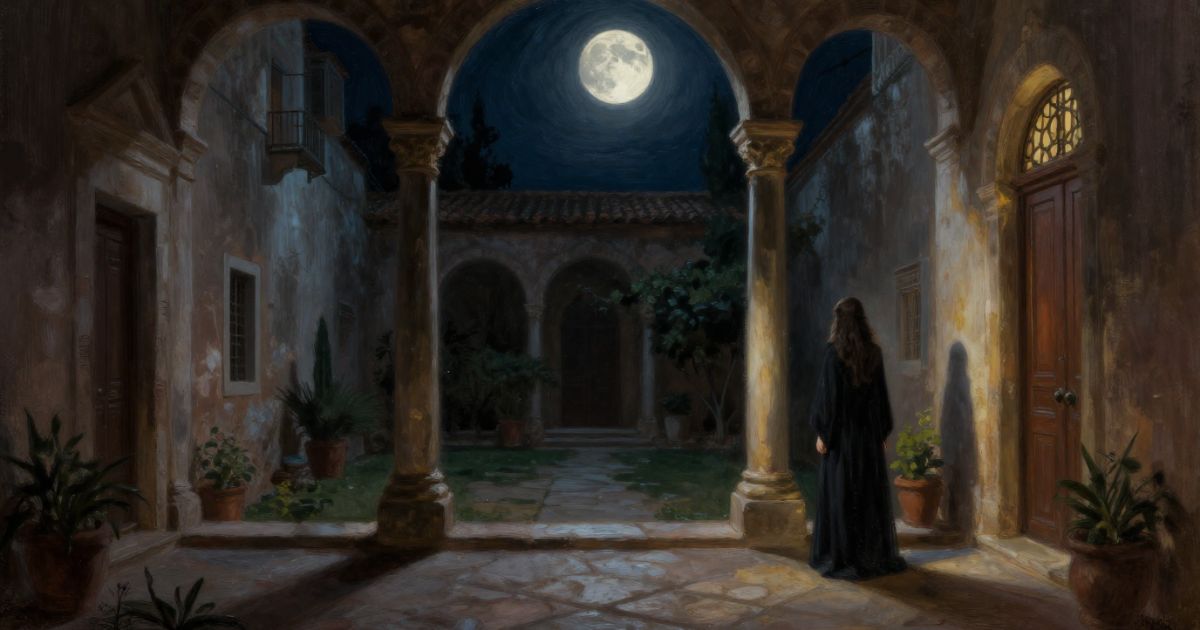
An excerpt from the original text.(complete · 4887 words)
hen Julia had rested, they followed the track before them, and in a
short time arrived at a village, where they obtained security and
refreshment.
But Julia, whose mind was occupied with dreadful anxiety for
Ferdinand, became indifferent to all around her. Even the presence of
Hippolitus, which but lately would have raised her from misery to joy,
failed to soothe her distress. The steady and noble attachment of her
brother had sunk deep in her heart, and reflection only aggravated her
affliction. Yet the banditti had steadily persisted in affirming that
he was not concealed in their recesses; and this circumstance, which
threw a deeper shade over the fears of Hippolitus, imparted a
glimmering of hope to the mind of Julia.
A more immediate interest at length forced her mind from this
sorrowful subject. It was necessary to determine upon some line of
conduct, for she was now in an unknown spot, and ignorant of any place
of refuge. The count, who trembled at the dangers which environed her,
and at the probabilities he saw of her being torn from him for ever,
suffered a consideration of them to overcome the dangerous delicacy
which at this mournful period required his silence. He entreated her
to destroy the possibility of separation, by consenting to become his
immediately. He urged that a priest could be easily procured from a
neighboring convent, who would confirm the bonds which had so long
united their hearts, and who would thus at once arrest the destiny
that so long had threatened his hopes.
This proposal, though similar to the one she had before accepted; and
though the certain means of rescuing her from the fate she dreaded,
she now turned from in sorrow and dejection. She loved Hippolitus with
a steady and tender affection, which was still heightened by the
gratitude he claimed as her deliverer; but she considered it a
prophanation of the memory of that brother who had suffered so much
for her sake, to mingle joy with the grief which her uncertainty
concerning him occasioned. She softened her refusal with a tender
grace, that quickly dissipated the jealous doubt arising in the mind
of Hippolitus, and increased his fond admiration of her character.
She desired to retire for a time to some obscure convent, there to
await the issue of the event, which at present involved her in
perplexity and sorrow.
Hippolitus struggled with his feelings and forbore to press farther
the suit on which his happiness, and almost his existence, now
depended. He inquired at the village for a neighbouring convent, and
was told, that there was none within twelve leagues, but that near the
town of Palini, at about that distance, were two. He procured horses;
and leaving the officers to return to Palermo for a stronger guard,
he, accompanied by Julia, entered on the road to Palini.
Julia was silent and thoughtful; Hippolitus gradually sunk into the
same mood, and he often cast a cautious look around as they travelled
for some hours along the feet of the mountains. They stopped to dine
under the shade of some beach-trees; for, fearful of discovery,
Hippolitus had provided against the necessity of entering many inns.
Having finished their repast, they pursued their journey; but
Hippolitus now began to doubt whether he was in the right direction.
Being destitute, however, of the means of certainty upon this point,
he followed the road before him, which now wound up the side of a
steep hill, whence they descended into a rich valley, where the
shepherd's pipe sounded sweetly from afar among the hills. The evening
sun shed a mild and mellow lustre over the landscape, and softened
each feature with a vermil glow that would have inspired a mind less
occupied than Julia's with sensations of congenial tranquillity.
The evening now closed in; and as they were doubtful of the road, and
found it would be impossible to reach Palini that night, they took the
way to a village, which they perceived at the extremity of the valley.
They had proceeded about half a mile, when they heard a sudden shout
of voices echoed from among the hills behind them; and looking back
perceived faintly through the dusk a party of men on horseback making
towards them. As they drew nearer, the words they spoke were
distinguishable, and Julia heard her own name sounded. Shocked at this
circumstance, she had now no doubt that she was discovered by a party
of her father's people, and she fled with Hippolitus along the valley.
The pursuers, however, were almost come up with them, when they
reached the mouth of a cavern, into which she ran for concealment.
Hippolitus drew his sword; and awaiting his enemies, stood to defend
the entrance.
In a few moments Julia heard the clashing of swords. Her heart
trembled for Hippolitus; and she was upon the point of returning to
resign herself at once to the power of her enemies, and thus avert the
danger that threatened him, when she distinguished the loud voice of
the duke.
She shrunk involuntarily at the sound, and pursuing the windings of
the cavern, fled into its inmost recesses. Here she had not been long
when the voices sounded through the cave, and drew near. It was now
evident that Hippolitus was conquered, and that her enemies were in
search of her. She threw round a look of unutterable anguish, and
perceived very near, by a sudden gleam of torchlight, a low and deep
recess in the rock. The light which belonged to her pursuers, grew
stronger; and she entered the rock on her knees, for the overhanging
craggs would not suffer her to pass otherwise; and having gone a few
yards, perceived that it was terminated by a door. The door yielded to
her touch, and she suddenly found herself in a highly vaulted cavern,
which received a feeble light from the moon-beams that streamed
through an opening in the rock above.
She closed the door, and paused to listen. The voices grew louder, and
more distinct, and at last approached so near, that she distinguished
what was said. Above the rest she heard the voice of the duke. 'It is
impossible she can have quitted the cavern,' said he, 'and I will not
leave it till I have found her. Seek to the left of that rock, while I
examine beyond this point.'
These words were sufficient for Julia; she fled from the door across
the cavern before her, and having ran a considerable way, without
coming to a termination, stopped to breathe. All was now still, and as
she looked around, the gloomy obscurity of the place struck upon her
fancy all its horrors. She imperfectly surveyed the vastness of the
cavern in wild amazement, and feared that she had precipitated herself
again into the power of banditti, for whom along this place appeared a
fit receptacle. Having listened a long time without hearing a return
of voices, she thought to find the door by which she had entered, but
the gloom, and vast extent of the cavern, made the endeavour hopeless,
and the attempt unsuccessful. Having wandered a considerable time
through the void, she gave up the effort, endeavoured to resign
herself to her fate, and to compose her distracted thoughts. The
remembrance of her former wonderful escape inspired her with
confidence in the mercy of God. But Hippolitus and Ferdinand were now
both lost to her--lost, perhaps, for ever--and the uncertainty of
their fate gave force to fancy, and poignancy to sorrow.
Towards morning grief yielded to nature, and Julia sunk to repose. She
was awakened by the sun, whose rays darting obliquely through the
opening in the rock, threw a partial light across the cavern. Her
senses were yet bewildered by sleep, and she started in affright on
beholding her situation; as recollection gradually stole upon her
mind, her sorrows returned, and she sickened at the fatal retrospect.
She arose, and renewed her search for an outlet. The light, imperfect
as it was, now assisted her, and she found a door, which she perceived
was not the one by which she had entered. It was firmly fastened; she
discovered, however, the bolts and the lock that held it, and at
length unclosed the door. It opened upon a dark passage, which she
entered.
She groped along the winding walls for some time, when she perceived
the way was obstructed. She now discovered that another door
interrupted her progress, and sought for the bolts which might fasten
it. These she found; and strengthened by desparation forced them back.
The door opened, and she beheld in a small room, which received its
feeble light from a window above, the pale and emaciated figure of a
woman, seated, with half-closed eyes, in a kind of elbow-chair. On
perceiving Julia, she started from her seat, and her countenance
expressed a wild surprise. Her features, which were worn by sorrow,
still retained the traces of beauty, and in her air was a mild dignity
that excited in Julia an involuntary veneration.
She seemed as if about to speak, when fixing her eyes earnestly and
steadily upon Julia, she stood for a moment in eager gaze, and
suddenly exclaiming, 'My daughter!' fainted away.
The astonishment of Julia would scarcely suffer her to assist the lady
who lay senseless on the floor. A multitude of strange imperfect ideas
rushed upon her mind, and she was lost in perplexity; but as she
examined the features of the stranger; which were now rekindling into
life, she thought she discovered the resemblance of Emilia!
The lady breathing a deep sigh, unclosed her eyes; she raised them to
Julia, who hung over her in speechless astonishment, and fixing them
upon her with a tender earnest expression--they filled with tears. She
pressed Julia to her heart, and a few moments of exquisite,
unutterable emotion followed. When the lady became more composed,
'Thank heaven!' said she, 'my prayer is granted. I am permitted to
embrace one of my children before I die. Tell me what brought you
hither. Has the marquis at last relented, and allowed me once more to
behold you, or has his death dissolved my wretched bondage?'
Truth now glimmered upon the mind of Julia, but so faintly, that
instead of enlightening, it served only to increase her perplexity.
'Is the marquis Mazzini living?' continued the lady. These words were
not to be doubted; Julia threw herself at the feet of her mother, and
embracing her knees in an energy of joy, answered only in sobs.
The marchioness eagerly inquired after her children, 'Emilia is
living,' answered Julia, 'but my dear brother--' 'Tell me,' cried the
marchioness, with quickness. An explanation ensued; When she was
informed concerning Ferdinand, she sighed deeply, and raising her eyes
to heaven, endeavoured to assume a look of pious resignation; but the
struggle of maternal feelings was visible in her countenance, and
almost overcame her powers of resistance.
Julia gave a short account of the preceding adventures, and of her
entrance into the cavern; and found, to her inexpressible surprize,
that she was now in a subterranean abode belonging to the southern
buildings of the castle of Mazzini! The marchioness was beginning her
narrative, when a door was heard to unlock above, and the sound of a
footstep followed.
'Fly!' cried the marchioness, 'secret yourself, if possible, for the
marquis is coming.' Julia's heart sunk at these words; she paused not
a moment, but retired through the door by which she had entered. This
she had scarcely done, when another door of the cell was unlocked, and
she heard the voice of her father. Its sounds thrilled her with a
universal tremour; the dread of discovery so strongly operated upon
her mind, that she stood in momentary expectation of seeing the door
of the passage unclosed by the marquis; and she was deprived of all
power of seeking refuge in the cavern.
At length the marquis, who came with food, quitted the cell, and
relocked the door, when Julia stole forth from her hiding-place. The
marchioness again embraced, and wept over her daughter. The narrative
of her sufferings, upon which she now entered, entirely dissipated the
mystery which had so long enveloped the southern buildings of the
castle.
'Oh! why,' said the marchioness, 'is it my task to discover to my
daughter the vices of her father? In relating my sufferings, I reveal
his crimes! It is now about fifteen years, as near as I can guess from
the small means I have of judging, since I entered this horrible
abode. My sorrows, alas! began not here; they commenced at an earlier
period. But it is sufficient to observe, that the passion whence
originated all my misfortunes, was discovered by me long before I
experienced its most baleful effects.
'Seven years had elapsed since my marriage, when the charms of Maria
de Vellorno, a young lady singularly beautiful, inspired the marquis
with a passion as violent as it was irregular. I observed, with deep
and silent anguish, the cruel indifference of my lord towards me, and
the rapid progress of his passion for another. I severely examined my
past conduct, which I am thankful to say presented a retrospect of
only blameless actions; and I endeavoured, by meek submission, and
tender assiduities, to recall that affection which was, alas! gone for
ever. My meek submission was considered as a mark of a servile and
insensible mind; and my tender assiduities, to which his heart no
longer responded, created only disgust, and exalted the proud spirit
it was meant to conciliate.
'The secret grief which this change occasioned, consumed my spirits,
and preyed upon my constitution, till at length a severe illness
threatened my life. I beheld the approach of death with a steady eye,
and even welcomed it as the passport to tranquillity; but it was
destined that I should linger through new scenes of misery.
'One day, which it appears was the paroxysm of my disorder, I sunk in
to a state of total torpidity, in which I lay for several hours. It is
impossible to describe my feelings, when, on recovering, I found
myself in this hideous abode. For some time I doubted my senses, and
afterwards believed that I had quitted this world for another; but I
was not long suffered to continue in my error, the appearance of the
marquis bringing me to a perfect sense of my situation.
'I now understood that I had been conveyed by his direction to this
recess of horror, where it was his will I should remain. My prayers,
my supplications, were ineffectual; the hardness of his heart repelled
my sorrows back upon myself; and as no entreaties could prevail upon
him to inform me where I was, or of his reason for placing me here, I
remained for many years ignorant of my vicinity to the castle, and of
the motive of my confinement.
'From that fatal day, until very lately, I saw the marquis no
more--but was attended by a person who had been for some years
dependant upon his bounty, and whom necessity, united to an insensible
heart, had doubtless induced to accept this office. He generally
brought me a week's provision, at stated intervals, and I remarked
that his visits were always in the night.
'Contrary to my expectation, or my wish, nature did that for me which
medicine had refused, and I recovered as if to punish with
disappointment and anxiety my cruel tyrant. I afterwards learned,
that in obedience to the marquis's order, I had been carried to this
spot by Vincent during the night, and that I had been buried in effigy
at a neighbouring church, with all the pomp of funeral honor due to my
rank.'
At the name of Vincent Julia started; the doubtful words he had
uttered on his deathbed were now explained--the cloud of mystery which
had so long involved the southern buildings broke at once away: and
each particular circumstance that had excited her former terror, arose
to her view entirely unveiled by the words of the marchioness.--The
long and total desertion of this part of the fabric--the light that
had appeared through the casement--the figure she had seen issue from
the tower--the midnight noises she had heard--were circumstances
evidently dependant on the imprisonment of the marchioness; the latter
of which incidents were produced either by Vincent, or the marquis, in
their attendance upon her.
When she considered the long and dreadful sufferings of her mother,
and that she had for many years lived so near her, ignorant of her
misery, and even of her existence--she was lost in astonishment and
pity.
'My days,' continued the marchioness, 'passed in a dead uniformity,
more dreadful than the most acute vicissitudes of misfortune, and
which would certainly have subdued my reason, had not those firm
principles of religious faith, which I imbibed in early youth, enabled
me to withstand the still, but forceful pressure of my calamity.
'The insensible heart of Vincent at length began to soften to my
misfortunes. He brought me several articles of comfort, of which I had
hitherto been destitute, and answered some questions I put to him
concerning my family. To release me from my present situation, however
his inclination might befriend me, was not to be expected, since his
life would have paid the forfeiture of what would be termed his duty.
'I now first discovered my vicinity to the castle. I learned also,
that the marquis had married Maria de Vellorno, with whom he had
resided at Naples, but that my daughters were left at Mazzini. This
last intelligence awakened in my heart the throbs of warm maternal
tenderness, and on my knees I supplicated to see them. So earnestly I
entreated, and so solemnly I promised to return quietly to my prison,
that, at length, prudence yielded to pity, and Vincent consented to my
request.
'On the following day he came to the cell, and informed me my children
were going into the woods, and that I might see them from a window
near which they would pass. My nerves thrilled at these words, and I
could scarcely support myself to the spot I so eagerly sought. He led
me through long and intricate passages, as I guessed by the frequent
turnings, for my eyes were bound, till I reached a hall of the south
buildings. I followed to a room above, where the full light of day
once more burst upon my sight, and almost overpowered me. Vincent
placed me by a window, which looked towards the woods. Oh! what
moments of painful impatience were those in which I awaited your
arrival!
'At length you appeared. I saw you--I saw my children--and was neither
permitted to clasp them to my heart, or to speak to them! You was
leaning on the arm of your sister, and your countenances spoke the
sprightly happy innocence of youth.--Alas! you knew not the wretched
fate of your mother, who then gazed upon you! Although you were at too
great a distance for my weak voice to reach you, with the utmost
difficulty I avoided throwing open the window, and endeavouring to
discover myself. The remembrance of my solemn promise, and that the
life of Vincent would be sacrificed by the act, alone restrained me. I
struggled for some time with emotions too powerful for my nature, and
fainted away.
'On recovering I called wildly for my children, and went to the
window--but you were gone! Not all the entreaties of Vincent could for
some time remove me from this station, where I waited in the fond
expectation of seeing you again--but you appeared no more! At last I
returned to my cell in an ecstasy of grief which I tremble even to
remember.
'This interview, so eagerly sought, and so reluctantly granted, proved
a source of new misery--instead of calming, it agitated my mind with a
restless, wild despair, which bore away my strongest powers of
resistance. I raved incessantly of my children, and incessantly
solicited to see them again--Vincent, however, had found but too much
cause to repent of his first indulgence, to grant me a second.
'About this time a circumstance occurred which promised me a speedy
release from calamity. About a week elapsed, and Vincent did not
appear. My little stock of provision was exhausted, and I had been two
days without food, when I again heard the doors that led to my prison
creek on their hinges. An unknown step approached, and in a few
minutes the marquis entered my cell! My blood was chilled at the
sight, and I closed my eyes as I hoped for the last time. The sound of
his voice recalled me. His countenance was dark and sullen, and I
perceived that he trembled. He informed me that Vincent was no more,
and that henceforward his office he should take upon himself. I
forbore to reproach--where reproach would only have produced new
sufferings, and withheld supplication where it would have exasperated
conscience and inflamed revenge. My knowledge of the marquis's second
marriage I concealed.
'He usually attended me when night might best conceal his visits;
though these were irregular in their return. Lately, from what motive
I cannot guess, he has ceased his nocturnal visits, and comes only in
the day.
'Once when midnight increased the darkness of my prison, and seemed to
render silence even more awful, touched by the sacred horrors of the
hour, I poured forth my distress in loud lamentation. Oh! never can I
forget what I felt, when I heard a distant voice answered to my moan!
A wild surprize, which was strangely mingled with hope, seized me, and
in my first emotion I should have answered the call, had not a
recollection crossed me, which destroyed at once every half-raised
sensation of joy. I remembered the dreadful vengeance which the
marquis had sworn to execute upon me, if I ever, by any means,
endeavoured to make known the place of my concealment; and though life
had long been a burden to me, I dared not to incur the certainty of
being murdered. I also well knew that no person who might discover my
situation could effect my enlargement, for I had no relations to
deliver me by force; and the marquis, you know, has not only power to
imprison, but also the right of life and death in his own domains; I,
therefore, forbore to answer the call, though I could not entirely
repress my lamentation. I long perplexed myself with endeavouring to
account for this strange circumstance, and am to this moment ignorant
of its cause.'
Julia remembering that Ferdinand had been confined in a dungeon of the
castle, it instantly occurred to her that his prison, and that of the
marchioness, were not far distant; and she scrupled not to believe
that it was his voice which her mother had heard. She was right in
this belief, and it was indeed the marchioness whose groans had
formerly caused Ferdinand so much alarm, both in the marble hall of
the south buildings, and in his dungeon.
When Julia communicated her opinion, and the marchioness believed that
she had heard the voice of her son--her emotion was extreme, and it
was some time before she could resume her narration.
'A short time since,' continued the marchioness, 'the marquis brought
me a fortnight's provision, and told me that I should probably see him
no more till the expiration of that term. His absence at this period
you have explained in your account of the transactions at the abbey of
St Augustin. How can I ever sufficiently acknowledge the obligations I
owe to my dear and invaluable friend Madame de Menon! Oh! that it
might be permitted me to testify my gratitude.'
Julia attended to the narrative of her mother in silent astonishment,
and gave all the sympathy which sorrow could demand. 'Surely,' cried
she, 'the providence on whom you have so firmly relied, and whose
inflictions you have supported with a fortitude so noble, has
conducted me through a labyrinth of misfortunes to this spot, for the
purpose of delivering you! Oh! let us hasten to fly this horrid
abode--let us seek to escape through the cavern by which I entered.'
She paused in earnest expectation awaiting a reply. 'Whither can I
fly?' said the marchioness, deeply sighing. This question, spoken
with the emphasis of despair, affected Julia to tears, and she was for
a while silent.
'The marquis,' resumed Julia, 'would not know where to seek you, or if
he found you beyond his own domains, would fear to claim you. A
convent may afford for the present a safe asylum; and whatever shall
happen, surely no fate you may hereafter encounter can be more
dreadful than the one you now experience.'
The marchioness assented to the truth of this, yet her broken spirits,
the effect of long sorrow and confinement, made her hesitate how to
act; and there was a kind of placid despair in her look, which too
faithfully depicted her feelings. It was obvious to Julia that the
cavern she had passed wound beneath the range of mountains on whose
opposite side stood the castle of Mazzini. The hills thus rising
formed a screen which must entirely conceal their emergence from the
mouth of the cave, and their flight, from those in the castle. She
represented these circumstances to her mother, and urged them so
forcibly that the lethargy of despair yielded to hope, and the
marchioness committed herself to the conduct of her daughter.
'Oh! let me lead you to light and life!' cried Julia with warm
enthusiasm. 'Surely heaven can bless me with no greater good than by
making me the deliverer of my mother.' They both knelt down; and the
marchioness, with that affecting eloquence which true piety inspires,
and with that confidence which had supported her through so many
miseries, committed herself to the protection of God, and implored his
favor on their attempt.
They arose, but as they conversed farther on their plan, Julia
recollected that she was destitute of money--the banditti having
robbed her of all! The sudden shock produced by this remembrance
almost subdued her spirits; never till this moment had she understood
the value of money. But she commanded her feelings, and resolved to
conceal this circumstance from the marchioness, preferring the chance
of any evil they might encounter from without, to the certain misery
of this terrible imprisonment.
Having taken what provision the marquis had brought, they quitted the
cell, and entered upon the dark passage, along which they passed with
cautious steps. Julia came first to the door of the cavern, but who
can paint her distress when she found it was fastened! All her efforts
to open it were ineffectual.--The door which had closed after her, was
held by a spring lock, and could be opened on this side only with a
key. When she understood this circumstance, the marchioness, with a
placid resignation which seemed to exalt her above humanity, addressed
herself again to heaven, and turned back to her cell. Here Julia
indulged without reserve, and without scruple, the excess of her
grief. The marchioness wept over her. 'Not for myself,' said she, 'do
I grieve. I have too long been inured to misfortune to sink under its
pressure. This disappointment is intrinsically, perhaps, little--for I
had no certain refuge from calamity--and had it even been otherwise, a
few years only of suffering would have been spared me. It is for you,
Julia, who so much lament my fate; and who in being thus delivered to
the power of your father, are sacrificed to the Duke de Luovo--that my
heart swells.'
Julia could make no reply, but by pressing to her lips the hand which
was held forth to her, she saw all the wretchedness of her situation;
and her fearful uncertainty concerning Hippolitus and Ferdinand,
formed no inferior part of her affliction.
'If,' resumed the marchioness, 'you prefer imprisonment with your
mother, to a marriage with the duke, you may still secret yourself in
the passage we have just quitted, and partake of the provision which
is brought me.'
'O! talk not, madam, of a marriage with the duke,' said Julia; 'surely
any fate is preferable to that. But when I consider that in remaining
here, I am condemned only to the sufferings which my mother has so
long endured, and that this confinement will enable me to soften, by
tender sympathy, the asperity of her misfortunes, I ought to submit to
my present situation with complacency, even did a marriage with the
duke appear less hateful to me.'
'Excellent girl!' exclaimed the marchioness, clasping Julia to her
bosom; 'the sufferings you lament are almost repaid by this proof of
your goodness and affection! Alas! that I should have been so long
deprived of such a daughter!'
Julia now endeavoured to imitate the fortitude of her mother, and
tenderly concealed her anxiety for Ferdinand and Hippolitus, the idea
of whom incessantly haunted her imagination. When the marquis brought
food to the cell, she retired to the avenue leading to the cavern, and
escaped discovery.
Master this chapter. Complete your experience
Purchase the complete book to access all chapters and support classic literature
As an Amazon Associate, we earn a small commission from qualifying purchases at no additional cost to you.
Available in paperback, hardcover, and e-book formats
Let's Analyse the Pattern
Those in power can perpetuate abuse indefinitely by controlling narratives and training others to ignore obvious signs of distress.
Why This Matters
Connect literature to life
This chapter teaches how to spot when organizations protect abusers by controlling information and silencing victims.
Practice This Today
This week, notice when official explanations for someone's absence feel incomplete, or when you're told not to ask questions about workplace 'personnel matters.'
Now let's explore the literary elements.
Key Quotes & Analysis
"Even the presence of Hippolitus, which but lately would have raised her from misery to joy, failed to soothe her distress."
Context: Julia is consumed with worry about her missing brother Ferdinand
This shows how trauma and family crisis can override even the strongest romantic feelings. Julia's capacity for joy is completely overwhelmed by her fear for Ferdinand's safety, demonstrating the power of family bonds over romantic love.
In Today's Words:
Even seeing the person she loved couldn't make her feel better when she was worried sick about her brother.
"I was buried in effigy, and though I have never since beheld the sun, I have lived to know that my children believe me dead."
Context: The mother explains her fake death and imprisonment to Julia
This reveals the ultimate cruelty of the Marquis's plan - not only physical imprisonment but the psychological torture of knowing her children grieved for her while she lived in darkness. The phrase 'never since beheld the sun' emphasizes her complete isolation.
In Today's Words:
They faked my death and buried an empty coffin while keeping me locked up, and my own kids think I'm dead.
"Let me not live to see you the victim of unjust authority and cruel revenge."
Context: The mother fears Julia will suffer the same fate she has
This shows how abuse creates cycles of fear and how victims often prioritize protecting others over their own freedom. The mother's greatest fear isn't continued imprisonment but seeing her daughter become another victim.
In Today's Words:
I can't stand the thought of watching them do to you what they did to me.
Thematic Threads
Power
In This Chapter
The Marquis uses his absolute authority to imprison his wife and control all information about her fate
Development
Evolved from earlier themes of patriarchal control to show its most extreme form—complete erasure of a person
In Your Life:
You might see this when bosses control all communication about fired employees or families silence discussion of missing relatives
Truth
In This Chapter
The 'supernatural' mysteries of the castle are revealed to be very human suffering that was hidden and ignored
Development
Built on earlier deceptions to show how truth can be buried but never truly silenced
In Your Life:
You might recognize this when workplace 'rumors' turn out to be documented patterns of misconduct that management covered up
Sacrifice
In This Chapter
Julia chooses to stay imprisoned with her mother rather than escape to marry the Duke
Development
Continues Julia's pattern of choosing principle over safety, now extending to family loyalty
In Your Life:
You might face this choice when standing by someone means risking your own security or opportunities
Class
In This Chapter
Vincent the servant eventually shows compassion while the noble Marquis remains cruel, subverting class expectations
Development
Challenges earlier assumptions about nobility and virtue being connected to social position
In Your Life:
You might notice this when working-class colleagues show more integrity than management or wealthy clients
Identity
In This Chapter
The Marchioness has been erased from existence—legally dead while physically alive, stripped of all social identity
Development
Shows the ultimate consequence of the identity struggles Julia has faced throughout
In Your Life:
You might experience this when institutions treat you as invisible or when your concerns are systematically dismissed
You now have the context. Time to form your own thoughts.
Discussion Questions
- 1
How did the Marquis manage to keep his wife imprisoned for fifteen years without anyone discovering the truth?
analysis • surface - 2
Why did Vincent the servant stay silent about the Marchioness's imprisonment for so many years, and what finally changed his behavior?
analysis • medium - 3
Where do you see this pattern of institutional silence enabling abuse in modern workplaces, families, or organizations?
application • medium - 4
If you suspected someone in power was hiding serious wrongdoing, what specific steps would you take to document and report it safely?
application • deep - 5
What does the Marchioness's broken resignation versus Julia's determination to fight reveal about how prolonged abuse affects the human spirit?
reflection • deep
Critical Thinking Exercise
Map the Silence Network
Think of a situation where you suspected something was wrong but everyone acted like everything was normal. Draw a simple map showing who had power, who knew the truth, who stayed silent, and who might have spoken up. Label the reasons each person might have chosen silence over action.
Consider:
- •Consider how authority figures control information and narratives
- •Think about the difference between active participation and passive enabling
- •Examine what incentives exist for people to look the other way
Journaling Prompt
Write about a time when you chose silence over speaking up about something you knew was wrong. What were you protecting, and what would you do differently now?
Coming Up Next...
Chapter 15: The Poison Cup Returns
With both women now trapped in the underground prison, the Marquis's discovery of Julia seems inevitable. The final confrontation approaches as secrets unravel and the fate of the entire family hangs in the balance.



