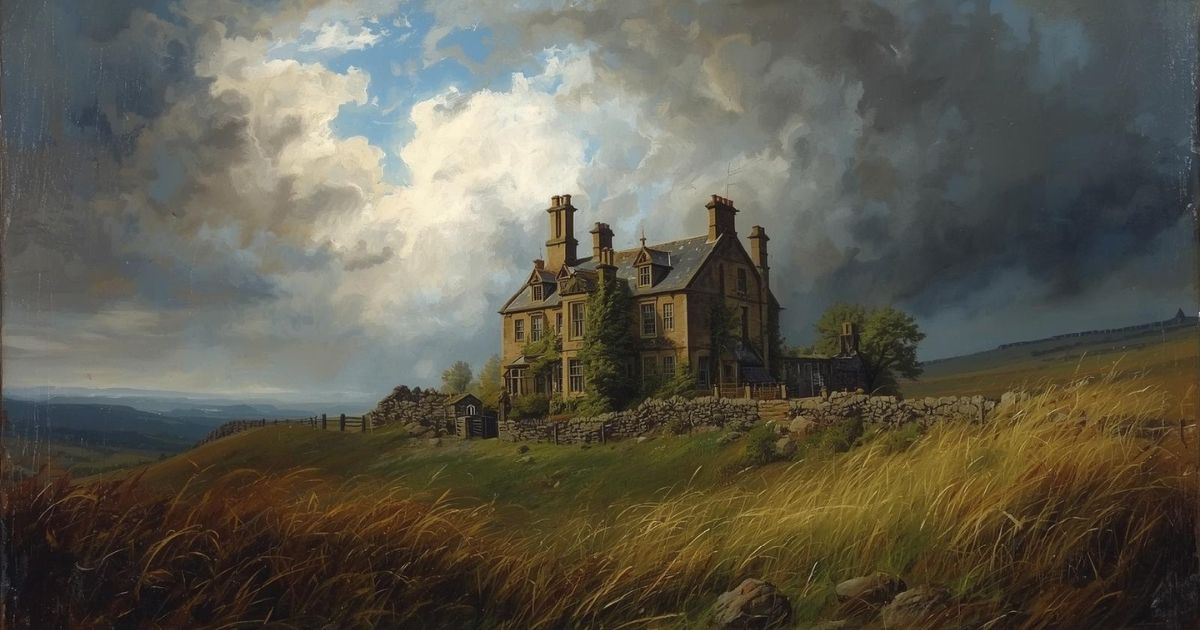
An excerpt from the original text.(complete · 290 words)
1802.—his September I was invited to devastate the moors of a friend in the north, and on my journey to his abode, I unexpectedly came within fifteen miles of Gimmerton. The ostler at a roadside public-house was holding a pail of water to refresh my horses, when a cart of very green oats, newly reaped, passed by, and he remarked,—“Yon’s frough Gimmerton, nah! They’re allas three wick’ after other folk wi’ ther harvest.” “Gimmerton?” I repeated—my residence in that locality had already grown dim and dreamy. “Ah! I know. How far is it from this?” “Happen fourteen mile o’er th’ hills; and a rough road,” he answered. A sudden impulse seized me to visit Thrushcross Grange. It was scarcely noon, and I conceived that I might as well pass the night under my own roof as in an inn. Besides, I could spare a day easily to arrange matters with my landlord, and thus save myself the trouble of invading the neighbourhood again. Having rested awhile, I directed my servant to inquire the way to the village; and, with great fatigue to our beasts, we managed the distance in some three hours. I left him there, and proceeded down the valley alone. The grey church looked greyer, and the lonely churchyard lonelier. I distinguished a moor-sheep cropping the short turf on the graves. It was sweet, warm weather—too warm for travelling; but the heat did not hinder me from enjoying the delightful scenery above and below: had I seen it nearer August, I’m sure it would have tempted me to waste a month among its solitudes. In winter nothing more dreary, in summer nothing more divine, than those glens shut in by hills, and those bluff, bold swells of heath.
Master this chapter. Complete your experience
Purchase the complete book to access all chapters and support classic literature
As an Amazon Associate, we earn a small commission from qualifying purchases at no additional cost to you.
Available in paperback, hardcover, and e-book formats
Let's Analyse the Pattern
The Pull of Unfinished Business
The unconscious drive to revisit emotionally significant places or people, often disguised as practical decisions
Why This Matters
Connect literature to life
Literature helps us identify the unconscious forces that drive our decisions, like Lockwood's 'sudden impulse' that wasn't really sudden at all
Practice This Today
Next time you feel an unexpected urge to contact an ex, drive by an old workplace, or revisit a painful memory, pause and ask: what am I really seeking here?
Now let's explore the literary elements.
Key Quotes & Analysis
"In winter nothing more dreary, in summer nothing more divine, than those glens shut in by hills"
Context: Observing the landscape on his return journey to Gimmerton
Shows how the same place can feel completely different depending on our circumstances and season of life
In Today's Words:
Some places can feel like hell or heaven depending on when you experience them
"my residence in that locality had already grown dim and dreamy"
Context: Realizing how distant his time at Gimmerton had become in his memory
Demonstrates how traumatic or intense experiences can feel unreal once we've gained distance from them
In Today's Words:
That whole chapter of my life started feeling like it never really happened
Thematic Threads
The Power of Place
In This Chapter
The moors and Gimmerton landscape hold deep emotional significance that draws Lockwood back despite time and distance
Development
Physical environments become repositories of memory and emotion, shaping our identity even when we try to leave them behind
In Your Life:
Think about places that still affect you - your childhood home, where you had your first heartbreak, where you felt most alive. These locations hold power over us because they're where we became who we are.
Time and Memory
In This Chapter
Lockwood's memories of Gimmerton had grown 'dim and dreamy' until suddenly confronted with the reality of return
Development
Distance can make intense experiences feel unreal, but proximity instantly reactivates dormant emotions and memories
In Your Life:
Notice how certain songs, smells, or places can instantly transport you back to who you were years ago, complete with all those old feelings.
You now have the context. Time to form your own thoughts.
Discussion Questions
- 1
Why do you think Lockwood was really drawn back to Gimmerton, beyond his stated practical reasons?
psychological • Explores the unconscious motivations behind seemingly rational decisions - 2
How does the description of the landscape as both 'dreary' and 'divine' reflect our relationship with difficult memories?
interpretive • Examines how perspective and time change our relationship to past experiences - 3
What does it mean that his memories had grown 'dim and dreamy' until he was physically close to the place again?
analytical • Considers how physical proximity affects emotional memory and psychological healing - 4
Have you ever found yourself returning to a place or situation that was painful, telling yourself practical reasons when deeper emotions were involved?
personal • Connects literary themes to personal experience and self-awareness
Critical Thinking Exercise
Mapping Your Emotional Geography
Think about a place from your past that still holds emotional charge for you - positive or negative. Write about why you think this location has such power over your memory and feelings. Consider: What happened there? How has your relationship to this place changed over time? If you returned there now, what do you think you'd be seeking?
Consider:
- •Places often hold multiple layers of meaning and memory
- •Our relationship to locations changes as we grow and heal
- •Sometimes we're drawn back to places where we left parts of ourselves
- •Physical environments can trigger emotional states we thought we'd moved past
Journaling Prompt
Write about a time when you felt unexpectedly pulled back to a person, place, or situation from your past. What were you telling yourself about why you wanted to return? What do you think you were really seeking? How did the actual experience compare to what you expected or hoped for?
Coming Up Next...
Chapter 33
Earnshaw remains unable to work, staying close to home while mysterious activities unfold in the garden. A young girl persuades her cousin to clear ground for new plants from the Grange, hinting at fresh beginnings and carefully laid plans that will reshape the future of both estates.