An excerpt from the original text.(complete · 284 words)
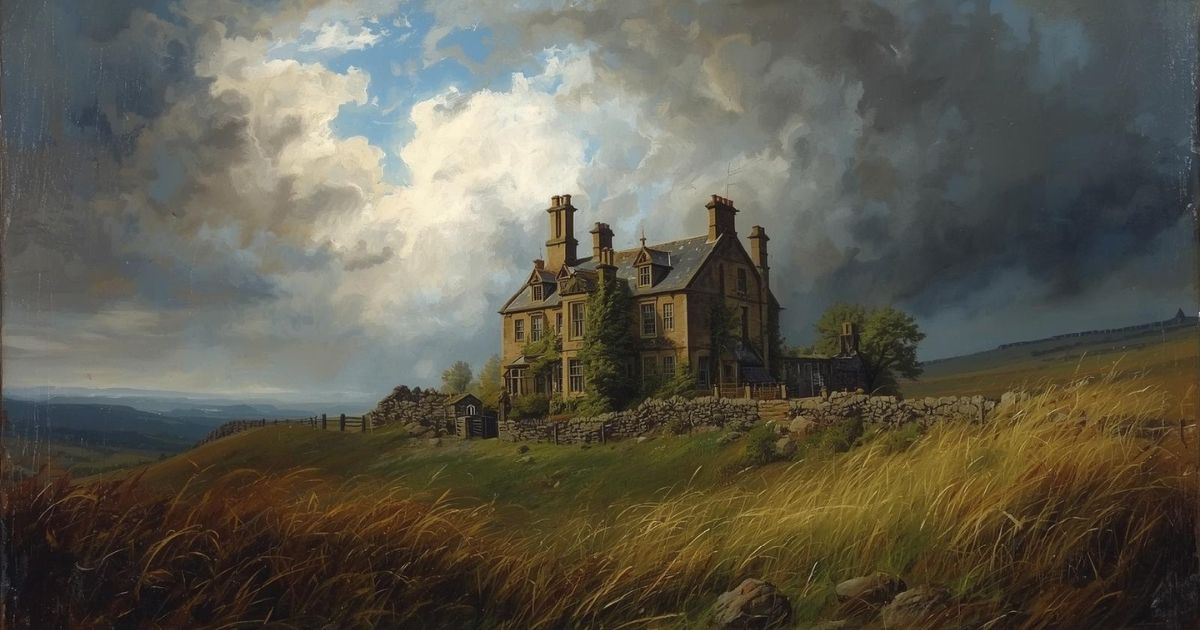
1801— have just returned from a visit to my landlord—the solitary neighbour that I shall be troubled with. This is certainly a beautiful country! In all England, I do not believe that I could have fixed on a situation so completely removed from the stir of society. A perfect misanthropist’s Heaven—and Mr. Heathcliff and I are such a suitable pair to divide the desolation between us. A capital fellow! He little imagined how my heart warmed towards him when I beheld his black eyes withdraw so suspiciously under their brows, as I rode up, and when his fingers sheltered themselves, with a jealous resolution, still further in his waistcoat, as I announced my name. “Mr. Heathcliff?” I said. A nod was the answer. “Mr. Lockwood, your new tenant, sir. I do myself the honour of calling as soon as possible after my arrival, to express the hope that I have not inconvenienced you by my perseverance in soliciting the occupation of Thrushcross Grange: I heard yesterday you had had some thoughts—” “Thrushcross Grange is my own, sir,” he interrupted, wincing. “I should not allow any one to inconvenience me, if I could hinder it—walk in!” The “walk in” was uttered with closed teeth, and expressed the sentiment, “Go to the Deuce!” even the gate over which he leant manifested no sympathising movement to the words; and I think that circumstance determined me to accept the invitation: I felt interested in a man who seemed more exaggeratedly reserved than myself. When he saw my horse’s breast fairly pushing the barrier, he did put out his hand to unchain it, and then sullenly preceded me up the causeway, calling, as we entered the court,—“Joseph, take Mr.
Master this chapter. Complete your experience
Purchase the complete book to access all chapters and support classic literature
As an Amazon Associate, we earn a small commission from qualifying purchases at no additional cost to you.
Available in paperback, hardcover, and e-book formats
Let's Analyse the Pattern
The Mask of Civility
When someone offers surface-level politeness while their entire being radiates rejection and anger
Why This Matters
Connect literature to life
Learning to recognize when someone's words don't match their body language or tone
Practice This Today
This week, notice one time when someone says they're 'fine' but their energy says otherwise. Don't call them out - just notice the disconnect.
Now let's explore the literary elements.
Key Quotes & Analysis
"A perfect misanthropist's Heaven—and Mr. Heathcliff and I are such a suitable pair to divide the desolation between us."
Context: Lockwood describing the isolated location and his kinship with Heathcliff
Shows how isolation can attract certain personalities, and hints at the emotional desolation that will define both men
In Today's Words:
This place is perfect for people who hate dealing with others - me and this Heathcliff guy can split the loneliness.
"The 'walk in' was uttered with closed teeth, and expressed the sentiment, 'Go to the Deuce!'"
Context: Heathcliff's reluctant invitation into his home
Reveals Heathcliff's barely contained hostility and the way anger simmers beneath social politeness
In Today's Words:
He said 'come in' but his body language screamed 'go to hell.'
Thematic Threads
Isolation
In This Chapter
Both men choose remote locations to avoid human contact
Development
Sets up the physical and emotional isolation that breeds obsession and revenge
In Your Life:
Sometimes we isolate when we're hurt, but too much isolation can turn pain into something darker
Social Class
In This Chapter
Lockwood's formal speech contrasts with the working-class servant Joseph
Development
Class differences will drive much of the conflict between characters
In Your Life:
Notice how people from different backgrounds communicate - respect doesn't require matching their style
First Impressions
In This Chapter
Lockwood is drawn to Heathcliff's darkness rather than repelled
Development
This attraction to brooding intensity will mirror other destructive attractions in the story
In Your Life:
Be careful when you're drawn to someone's anger or mystery - sometimes red flags look like green lights
You now have the context. Time to form your own thoughts.
Discussion Questions
- 1
Why is Lockwood drawn to Heathcliff's obvious hostility instead of being put off by it?
character_analysis • Consider what this says about Lockwood's own social needs and personality - 2
What does the isolated setting tell us about both men's relationship with society?
thematic • Think about when isolation is healthy versus when it becomes destructive - 3
How do you handle people who give off hostile energy in your daily life?
personal_application • Reflect on your own reactions to unfriendly or suspicious people - 4
What role does social class play in this first interaction between the characters?
social_context • Consider how Lockwood's educated speech contrasts with the working-class environment
Critical Thinking Exercise
Body Language Detective
Think of a recent interaction where someone's words said one thing but their body language suggested something else. What specific physical cues did you notice? How did you respond?
Consider:
- •What made you notice the disconnect between words and body language?
- •Did you trust the words or the physical cues?
- •How might the situation have gone differently if you'd addressed the subtext?
- •When is it appropriate to call out this kind of disconnect?
Journaling Prompt
Write about a time when you said you were fine but your body language told a different story. What were you really feeling, and why didn't you express it directly?
Coming Up Next...
Chapter 2
Lockwood returns to Wuthering Heights on a misty afternoon, where he'll encounter more of the household's strange inhabitants and witness disturbing scenes that hint at dark family secrets.