An excerpt from the original text.(complete · 1474 words)
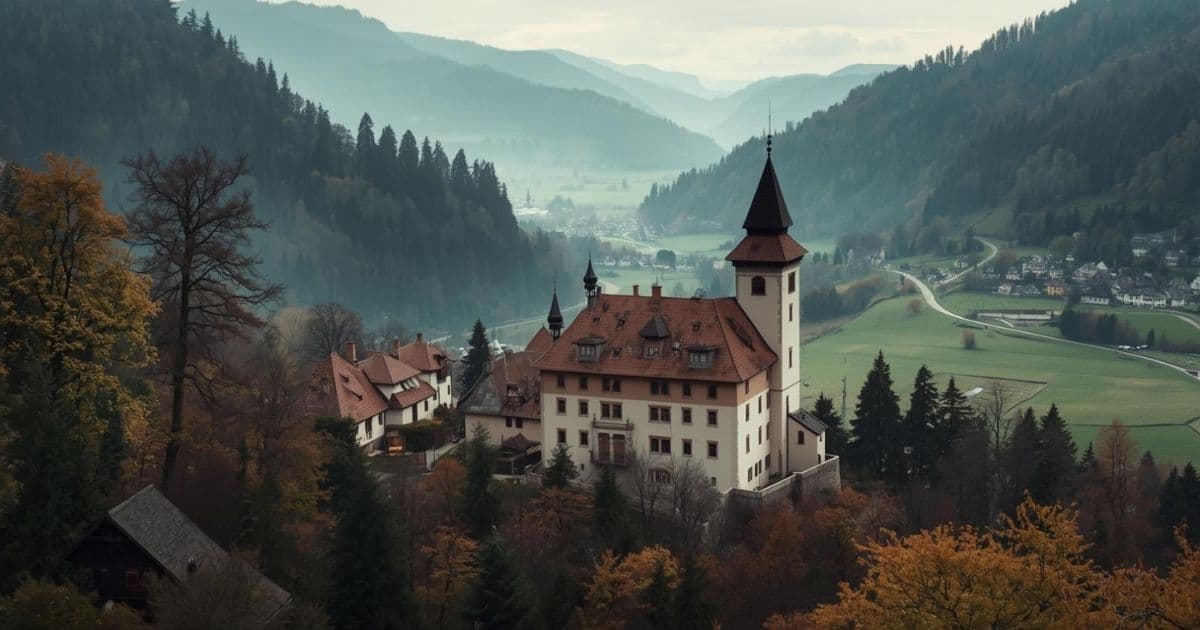
t was getting dusk when Prince Andrew and Pierre drove up to the front
entrance of the house at Bald Hills. As they approached the house,
Prince Andrew with a smile drew Pierre’s attention to a commotion
going on at the back porch. A woman, bent with age, with a wallet on her
back, and a short, long-haired, young man in a black garment had rushed
back to the gate on seeing the carriage driving up. Two women ran out
after them, and all four, looking round at the carriage, ran in dismay
up the steps of the back porch.
“Those are Mary’s ‘God’s folk,’” said Prince Andrew. “They
have mistaken us for my father. This is the one matter in which she
disobeys him. He orders these pilgrims to be driven away, but she
receives them.”
“But what are ‘God’s folk’?” asked Pierre.
Prince Andrew had no time to answer. The servants came out to meet them,
and he asked where the old prince was and whether he was expected back
soon.
The old prince had gone to the town and was expected back any minute.
Prince Andrew led Pierre to his own apartments, which were always kept
in perfect order and readiness for him in his father’s house; he
himself went to the nursery.
“Let us go and see my sister,” he said to Pierre when he returned.
“I have not found her yet, she is hiding now, sitting with her
‘God’s folk.’ It will serve her right, she will be confused, but
you will see her ‘God’s folk.’ It’s really very curious.”
“What are ‘God’s folk’?” asked Pierre.
“Come, and you’ll see for yourself.”
Princess Mary really was disconcerted and red patches came on her face
when they went in. In her snug room, with lamps burning before the icon
stand, a young lad with a long nose and long hair, wearing a monk’s
cassock, sat on the sofa beside her, behind a samovar. Near them, in an
armchair, sat a thin, shriveled, old woman, with a meek expression on
her childlike face.
“Andrew, why didn’t you warn me?” said the princess, with mild
reproach, as she stood before her pilgrims like a hen before her
chickens.
“Charmée de vous voir. Je suis très contente de vous voir,” * she
said to Pierre as he kissed her hand. She had known him as a child, and
now his friendship with Andrew, his misfortune with his wife, and above
all his kindly, simple face disposed her favorably toward him. She
looked at him with her beautiful radiant eyes and seemed to say, “I
like you very much, but please don’t laugh at my people.” After
exchanging the first greetings, they sat down.
* “Delighted to see you. I am very glad to see you.”
“Ah, and Ivánushka is here too!” said Prince Andrew, glancing with
a smile at the young pilgrim.
“Andrew!” said Princess Mary, imploringly. “Il faut que vous
sachiez que c’est une femme,” * said Prince Andrew to Pierre.
“Andrew, au nom de Dieu!” *(2) Princess Mary repeated.
* “You must know that this is a woman.”
* (2) “For heaven’s sake.”
It was evident that Prince Andrew’s ironical tone toward the pilgrims
and Princess Mary’s helpless attempts to protect them were their
customary long-established relations on the matter.
“Mais, ma bonne amie,” said Prince Andrew, “vous devriez au
contraire m’être reconnaissante de ce que j’explique à Pierre
votre intimité avec ce jeune homme.” *
* “But, my dear, you ought on the contrary to be grateful to
me for explaining to Pierre your intimacy with this young
man.”
“Really?” said Pierre, gazing over his spectacles with curiosity and
seriousness (for which Princess Mary was specially grateful to him) into
Ivánushka’s face, who, seeing that she was being spoken about, looked
round at them all with crafty eyes.
Princess Mary’s embarrassment on her people’s account was quite
unnecessary. They were not in the least abashed. The old woman, lowering
her eyes but casting side glances at the newcomers, had turned her cup
upside down and placed a nibbled bit of sugar beside it, and sat
quietly in her armchair, though hoping to be offered another cup of tea.
Ivánushka, sipping out of her saucer, looked with sly womanish eyes
from under her brows at the young men.
“Where have you been? To Kiev?” Prince Andrew asked the old woman.
“I have, good sir,” she answered garrulously. “Just at
Christmastime I was deemed worthy to partake of the holy and heavenly
sacrament at the shrine of the saint. And now I’m from Kolyázin,
master, where a great and wonderful blessing has been revealed.”
“And was Ivánushka with you?”
“I go by myself, benefactor,” said Ivánushka, trying to speak in a
bass voice. “I only came across Pelagéya in Yúkhnovo....”
Pelagéya interrupted her companion; she evidently wished to tell what
she had seen.
“In Kolyázin, master, a wonderful blessing has been revealed.”
“What is it? Some new relics?” asked Prince Andrew.
“Andrew, do leave off,” said Princess Mary. “Don’t tell him,
Pelagéya.”
“No... why not, my dear, why shouldn’t I? I like him. He is kind,
he is one of God’s chosen, he’s a benefactor, he once gave me ten
rubles, I remember. When I was in Kiev, Crazy Cyril says to me (he’s
one of God’s own and goes barefoot summer and winter), he says,
‘Why are you not going to the right place? Go to Kolyázin where a
wonder-working icon of the Holy Mother of God has been revealed.’ On
hearing those words I said good-by to the holy folk and went.”
All were silent, only the pilgrim woman went on in measured tones,
drawing in her breath.
“So I come, master, and the people say to me: ‘A great blessing has
been revealed, holy oil trickles from the cheeks of our blessed Mother,
the Holy Virgin Mother of God.’...”
“All right, all right, you can tell us afterwards,” said Princess
Mary, flushing.
“Let me ask her,” said Pierre. “Did you see it yourselves?” he
inquired.
“Oh, yes, master, I was found worthy. Such a brightness on the face
like the light of heaven, and from the blessed Mother’s cheek it drops
and drops....”
“But, dear me, that must be a fraud!” said Pierre, naïvely, who had
listened attentively to the pilgrim.
“Oh, master, what are you saying?” exclaimed the horrified
Pelagéya, turning to Princess Mary for support.
“They impose on the people,” he repeated.
“Lord Jesus Christ!” exclaimed the pilgrim woman, crossing herself.
“Oh, don’t speak so, master! There was a general who did not
believe, and said, ‘The monks cheat,’ and as soon as he’d said it
he went blind. And he dreamed that the Holy Virgin Mother of the Kiev
catacombs came to him and said, ‘Believe in me and I will make you
whole.’ So he begged: ‘Take me to her, take me to her.’ It’s the
real truth I’m telling you, I saw it myself. So he was brought, quite
blind, straight to her, and he goes up to her and falls down and says,
‘Make me whole,’ says he, ‘and I’ll give thee what the Tsar
bestowed on me.’ I saw it myself, master, the star is fixed into the
icon. Well, and what do you think? He received his sight! It’s a sin
to speak so. God will punish you,” she said admonishingly, turning to
Pierre.
“How did the star get into the icon?” Pierre asked.
“And was the Holy Mother promoted to the rank of general?” said
Prince Andrew, with a smile.
Pelagéya suddenly grew quite pale and clasped her hands.
“Oh, master, master, what a sin! And you who have a son!” she began,
her pallor suddenly turning to a vivid red. “Master, what have you
said? God forgive you!” And she crossed herself. “Lord forgive him!
My dear, what does it mean?...” she asked, turning to Princess
Mary. She got up and, almost crying, began to arrange her wallet. She
evidently felt frightened and ashamed to have accepted charity in a
house where such things could be said, and was at the same time sorry to
have now to forgo the charity of this house.
“Now, why need you do it?” said Princess Mary. “Why did you come
to me?...”
“Come, Pelagéya, I was joking,” said Pierre. “Princesse, ma
parole, je n’ai pas voulu l’offenser. * I did not mean anything,
I was only joking,” he said, smiling shyly and trying to efface his
offense. “It was all my fault, and Andrew was only joking.”
* “Princess, on my word, I did not wish to offend her.”
Pelagéya stopped doubtfully, but in Pierre’s face there was such a
look of sincere penitence, and Prince Andrew glanced so meekly now at
her and now at Pierre, that she was gradually reassured.
Master this chapter. Complete your experience
Purchase the complete book to access all chapters and support classic literature
As an Amazon Associate, we earn a small commission from qualifying purchases at no additional cost to you.
Available in paperback, hardcover, and e-book formats
Let's Analyse the Pattern
Using education or knowledge as a weapon to mock and dominate rather than inform or discuss.
Why This Matters
Connect literature to life
This chapter teaches how to recognize when someone uses education or knowledge as a weapon to establish dominance rather than genuinely help.
Practice This Today
This week, notice when someone explains something in a way that makes the other person feel stupid—that's intellectual cruelty disguised as education.
Now let's explore the literary elements.
Key Quotes & Analysis
"Those are Mary's 'God's folk.' They have mistaken us for my father. This is the one matter in which she disobeys him."
Context: Explaining to Pierre why pilgrims are running away from their carriage
Shows that even the most obedient people have their line in the sand. Mary's quiet rebellion reveals her true character - she'll risk her father's anger to help those in need.
In Today's Words:
Those are the religious people my sister helps. She only stands up to Dad about this one thing.
"I have been to Kiev and to Troitsa and to different holy places, and I have seen miracles with my own eyes."
Context: Describing her pilgrimages and the miraculous healings she's witnessed
Represents absolute faith based on personal experience. Her conviction is unshakeable because she's lived it, not just read about it. This direct experience versus intellectual knowledge becomes the chapter's central conflict.
In Today's Words:
I've been to all the holy places and seen miracles happen right in front of me.
"Forgive me, please forgive me! I did not mean to hurt your feelings."
Context: Apologizing to Pelagéya after his skeptical questions made her cry
Shows Pierre's essential goodness despite his tactlessness. He recognizes when his intellectual curiosity has caused real emotional harm and immediately tries to make amends.
In Today's Words:
I'm sorry, I didn't mean to upset you with my questions.
Thematic Threads
Class
In This Chapter
Educated nobles casually dismiss what working-class pilgrims hold sacred, revealing how class shapes whose beliefs are considered valid
Development
Continues the book's exploration of how social position determines whose voice matters
In Your Life:
You might see this when people with degrees automatically assume they're smarter than those with life experience
Faith
In This Chapter
Simple religious faith meets intellectual skepticism, showing how the same reality can be interpreted through completely different frameworks
Development
Introduced here as a new dimension of the spiritual themes emerging in the novel
In Your Life:
You face this tension when your personal beliefs clash with what others consider 'rational' or 'scientific'
Compassion
In This Chapter
Princess Mary's secret sheltering of pilgrims contrasts sharply with her brother's cruelty toward them
Development
Builds on Mary's established character as someone who acts on her values despite social pressure
In Your Life:
You might find yourself torn between protecting vulnerable people and keeping peace with family or colleagues
Identity
In This Chapter
Andrew and Pierre perform their intellectual superiority partly to reinforce their own educated identities
Development
Continues showing how characters use others to define themselves
In Your Life:
You might catch yourself putting others down to feel better about your own knowledge or status
Power
In This Chapter
Knowledge becomes a tool for establishing dominance rather than fostering understanding
Development
Expands the book's examination of how different forms of power operate in relationships
In Your Life:
You see this when expertise gets weaponized in arguments rather than used to genuinely help or inform
You now have the context. Time to form your own thoughts.
Discussion Questions
- 1
What happens when Andrew and Pierre encounter Princess Mary's religious pilgrims, and how do the brothers react differently?
analysis • surface - 2
Why do Andrew and Pierre mock the pilgrims' beliefs instead of simply disagreeing? What are they really trying to prove?
analysis • medium - 3
Where have you seen educated people use their knowledge as a weapon against others with different beliefs or backgrounds?
application • medium - 4
When someone shares a belief you think is wrong, how can you respond without crushing their dignity or destroying the relationship?
application • deep - 5
What does this scene reveal about the difference between being smart and being wise?
reflection • deep
Critical Thinking Exercise
Rewrite the Conversation
Imagine you're Pierre in this scene. Rewrite the conversation with the pilgrims, showing how you could express skepticism about miracles while still treating them with respect. Focus on the specific words and tone you'd use to disagree without destroying dignity.
Consider:
- •Consider how your tone and word choice affect the listener's feelings
- •Think about what you're really trying to accomplish in the conversation
- •Notice the difference between correcting information and attacking the person
Journaling Prompt
Write about a time when someone used their education or expertise to make you feel small. How did it affect you? Now write about how you want to handle disagreements with people who have different beliefs or less formal education than you.
Coming Up Next...
Chapter 98: Finding Your People
The old prince returns home, and his arrival promises to shift the household dynamics once again. His relationship with his children and his reaction to unexpected guests will reveal more about the complex family tensions brewing at Bald Hills.