An excerpt from the original text.(complete · 1680 words)
n October, 1805, a Russian army was occupying the villages and towns of
the Archduchy of Austria, and yet other regiments freshly arriving from
Russia were settling near the fortress of Braunau and burdening the
inhabitants on whom they were quartered. Braunau was the headquarters of
the commander in chief, Kutúzov.
On October 11, 1805, one of the infantry regiments that had just reached
Braunau had halted half a mile from the town, waiting to be inspected
by the commander in chief. Despite the un-Russian appearance of the
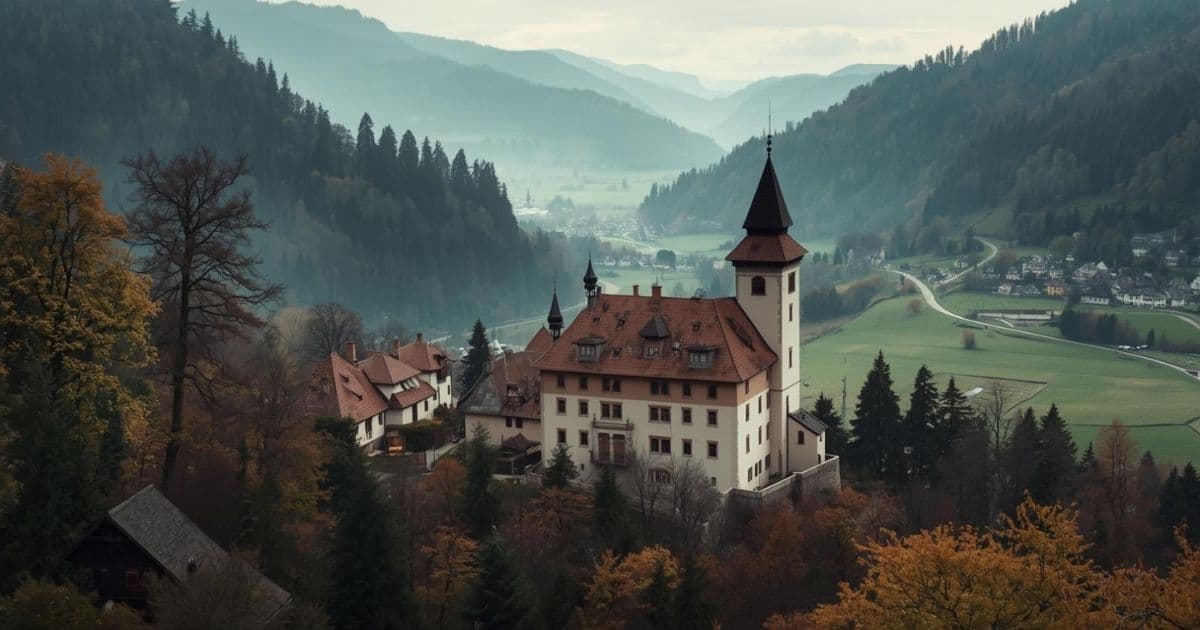
locality and surroundings—fruit gardens, stone fences, tiled roofs,
and hills in the distance—and despite the fact that the inhabitants
(who gazed with curiosity at the soldiers) were not Russians, the
regiment had just the appearance of any Russian regiment preparing for
an inspection anywhere in the heart of Russia.
On the evening of the last day’s march an order had been received that
the commander in chief would inspect the regiment on the march. Though
the words of the order were not clear to the regimental commander, and
the question arose whether the troops were to be in marching order or
not, it was decided at a consultation between the battalion commanders
to present the regiment in parade order, on the principle that it is
always better to “bow too low than not bow low enough.” So the
soldiers, after a twenty-mile march, were kept mending and cleaning all
night long without closing their eyes, while the adjutants and
company commanders calculated and reckoned, and by morning the
regiment—instead of the straggling, disorderly crowd it had been on
its last march the day before—presented a well-ordered array of two
thousand men each of whom knew his place and his duty, had every button
and every strap in place, and shone with cleanliness. And not only
externally was all in order, but had it pleased the commander in chief
to look under the uniforms he would have found on every man a clean
shirt, and in every knapsack the appointed number of articles, “awl,
soap, and all,” as the soldiers say. There was only one circumstance
concerning which no one could be at ease. It was the state of the
soldiers’ boots. More than half the men’s boots were in holes. But
this defect was not due to any fault of the regimental commander, for
in spite of repeated demands boots had not been issued by the Austrian
commissariat, and the regiment had marched some seven hundred miles.
The commander of the regiment was an elderly, choleric, stout, and
thick-set general with grizzled eyebrows and whiskers, and wider from
chest to back than across the shoulders. He had on a brand-new uniform
showing the creases where it had been folded and thick gold epaulettes
which seemed to stand rather than lie down on his massive shoulders. He
had the air of a man happily performing one of the most solemn duties of
his life. He walked about in front of the line and at every step pulled
himself up, slightly arching his back. It was plain that the commander
admired his regiment, rejoiced in it, and that his whole mind was
engrossed by it, yet his strut seemed to indicate that, besides military
matters, social interests and the fair sex occupied no small part of his
thoughts.
“Well, Michael Mítrich, sir?” he said, addressing one of the
battalion commanders who smilingly pressed forward (it was plain that
they both felt happy). “We had our hands full last night. However, I
think the regiment is not a bad one, eh?”
The battalion commander perceived the jovial irony and laughed.
“It would not be turned off the field even on the Tsarítsin
Meadow.”
“What?” asked the commander.
At that moment, on the road from the town on which signalers had been
posted, two men appeared on horse back. They were an aide-de-camp
followed by a Cossack.
The aide-de-camp was sent to confirm the order which had not been
clearly worded the day before, namely, that the commander in chief
wished to see the regiment just in the state in which it had been on
the march: in their greatcoats, and packs, and without any preparation
whatever.
A member of the Hofkriegsrath from Vienna had come to Kutúzov the day
before with proposals and demands for him to join up with the army of
the Archduke Ferdinand and Mack, and Kutúzov, not considering this
junction advisable, meant, among other arguments in support of his view,
to show the Austrian general the wretched state in which the troops
arrived from Russia. With this object he intended to meet the regiment;
so the worse the condition it was in, the better pleased the commander
in chief would be. Though the aide-de-camp did not know these
circumstances, he nevertheless delivered the definite order that the
men should be in their greatcoats and in marching order, and that the
commander in chief would otherwise be dissatisfied. On hearing this the
regimental commander hung his head, silently shrugged his shoulders, and
spread out his arms with a choleric gesture.
“A fine mess we’ve made of it!” he remarked.
“There now! Didn’t I tell you, Michael Mítrich, that if it was said
‘on the march’ it meant in greatcoats?” said he reproachfully to
the battalion commander. “Oh, my God!” he added, stepping resolutely
forward. “Company commanders!” he shouted in a voice accustomed to
command. “Sergeants major!... How soon will he be here?” he asked
the aide-de-camp with a respectful politeness evidently relating to the
personage he was referring to.
“In an hour’s time, I should say.”
“Shall we have time to change clothes?”
“I don’t know, General....”
The regimental commander, going up to the line himself, ordered the
soldiers to change into their greatcoats. The company commanders ran off
to their companies, the sergeants major began bustling (the greatcoats
were not in very good condition), and instantly the squares that had up
to then been in regular order and silent began to sway and stretch and
hum with voices. On all sides soldiers were running to and fro, throwing
up their knapsacks with a jerk of their shoulders and pulling the straps
over their heads, unstrapping their overcoats and drawing the sleeves on
with upraised arms.
In half an hour all was again in order, only the squares had become gray
instead of black. The regimental commander walked with his jerky steps
to the front of the regiment and examined it from a distance.
“Whatever is this? This!” he shouted and stood still. “Commander
of the third company!”
“Commander of the third company wanted by the general!... commander to
the general... third company to the commander.” The words passed along
the lines and an adjutant ran to look for the missing officer.
When the eager but misrepeated words had reached their destination in
a cry of: “The general to the third company,” the missing officer
appeared from behind his company and, though he was a middle-aged man
and not in the habit of running, trotted awkwardly stumbling on his
toes toward the general. The captain’s face showed the uneasiness of
a schoolboy who is told to repeat a lesson he has not learned. Spots
appeared on his nose, the redness of which was evidently due to
intemperance, and his mouth twitched nervously. The general looked the
captain up and down as he came up panting, slackening his pace as he
approached.
“You will soon be dressing your men in petticoats! What is this?”
shouted the regimental commander, thrusting forward his jaw and pointing
at a soldier in the ranks of the third company in a greatcoat of bluish
cloth, which contrasted with the others. “What have you been after?
The commander in chief is expected and you leave your place? Eh? I’ll
teach you to dress the men in fancy coats for a parade.... Eh...?”
The commander of the company, with his eyes fixed on his superior,
pressed two fingers more and more rigidly to his cap, as if in this
pressure lay his only hope of salvation.
“Well, why don’t you speak? Whom have you got there dressed up as a
Hungarian?” said the commander with an austere gibe.
“Your excellency...”
“Well, your excellency, what? Your excellency! But what about your
excellency?... nobody knows.”
“Your excellency, it’s the officer Dólokhov, who has been reduced
to the ranks,” said the captain softly.
“Well? Has he been degraded into a field marshal, or into a soldier?
If a soldier, he should be dressed in regulation uniform like the
others.”
“Your excellency, you gave him leave yourself, on the march.”
“Gave him leave? Leave? That’s just like you young men,” said the
regimental commander cooling down a little. “Leave indeed.... One says
a word to you and you... What?” he added with renewed irritation, “I
beg you to dress your men decently.”
And the commander, turning to look at the adjutant, directed his jerky
steps down the line. He was evidently pleased at his own display of
anger and walking up to the regiment wished to find a further excuse for
wrath. Having snapped at an officer for an unpolished badge, at another
because his line was not straight, he reached the third company.
“H-o-o-w are you standing? Where’s your leg? Your leg?” shouted
the commander with a tone of suffering in his voice, while there were
still five men between him and Dólokhov with his bluish-gray uniform.
Dólokhov slowly straightened his bent knee, looking straight with his
clear, insolent eyes in the general’s face.
“Why a blue coat? Off with it... Sergeant major! Change his coat...
the ras...” he did not finish.
“General, I must obey orders, but I am not bound to endure...”
Dólokhov hurriedly interrupted.
“No talking in the ranks!... No talking, no talking!”
“Not bound to endure insults,” Dólokhov concluded in loud, ringing
tones.
The eyes of the general and the soldier met. The general became silent,
angrily pulling down his tight scarf.
“I request you to have the goodness to change your coat,” he said as
he turned away.
Master this chapter. Complete your experience
Purchase the complete book to access all chapters and support classic literature
As an Amazon Associate, we earn a small commission from qualifying purchases at no additional cost to you.
Available in paperback, hardcover, and e-book formats
Let's Analyse the Pattern
Working harder instead of asking what success actually looks like in this specific situation.
Why This Matters
Connect literature to life
This chapter teaches how to detect when someone's stated request masks a different underlying objective.
Practice This Today
This week, notice when someone gives you a task—ask 'What's the bigger picture here?' or 'What outcome are you hoping for?' before assuming you understand what they really want.
Now let's explore the literary elements.
Key Quotes & Analysis
"it is always better to 'bow too low than not bow low enough'"
Context: The reasoning behind choosing parade order for the inspection
This reveals the military mindset of excessive deference to authority. The officers choose what they think is the safe option, but it shows they don't understand their commander's actual intentions.
In Today's Words:
Better to be overdressed than underdressed - except when you completely misread the situation.
"the soldiers, after a twenty-mile march, were kept mending and cleaning all night long without closing their eyes"
Context: Describing the troops' exhausting preparation for inspection
Shows how the officers' poor decision-making directly harms the common soldiers. The disconnect between leadership and the people who do the actual work creates unnecessary suffering.
In Today's Words:
The workers stayed up all night fixing things that didn't need fixing because management made a bad call.
"Despite the un-Russian appearance of the locality and surroundings"
Context: Describing the Austrian setting where Russian troops are stationed
Establishes the theme of being out of place and the complexity of military occupation. The Russians are foreigners trying to maintain their identity in a strange land.
In Today's Words:
Even though nothing looked familiar and they were clearly not in their own territory.
Thematic Threads
Class
In This Chapter
The rigid military hierarchy creates distance between ranks, preventing the commander from understanding Kutúzov's real intentions
Development
Introduced here
In Your Life:
When your boss's boss makes decisions that don't make sense to you, the hierarchy might be blocking crucial information from flowing down.
Appearance vs Reality
In This Chapter
Perfect parade uniforms mask the troops' actual condition and needs, which is exactly what Kutúzov wants to expose
Development
Introduced here
In Your Life:
Sometimes the messy truth serves you better than a polished presentation, especially when you need help or resources.
Power
In This Chapter
Kutúzov wields power through information control—he knows the real plan while his subordinates scramble in the dark
Development
Introduced here
In Your Life:
The person with the most information usually has the most power in any situation, which is why asking questions matters so much.
Individual Defiance
In This Chapter
Dólokhov boldly confronts authority by wearing non-regulation clothing and standing up to abuse
Development
Introduced here
In Your Life:
Sometimes breaking small rules is the only way to maintain your dignity when the system is grinding you down.
Communication Breakdown
In This Chapter
Critical information arrives too late, causing chaos and wasted effort throughout the regiment
Development
Introduced here
In Your Life:
When communication breaks down at work or home, the people at the bottom of the chain always suffer the most.
You now have the context. Time to form your own thoughts.
Discussion Questions
- 1
What mistake did the regimental commander make, and how did he discover it?
analysis • surface - 2
Why did Kutúzov actually want to see the troops in their shabby gear instead of parade uniforms?
analysis • medium - 3
When have you worked hard preparing for something, only to find out you were preparing for the wrong thing entirely?
application • medium - 4
What questions could the commander have asked upfront to avoid this whole mess?
application • deep - 5
What does this scene reveal about the gap between what people say they want and what they actually need?
reflection • deep
Critical Thinking Exercise
Map Your Last Big Miscommunication
Think of a recent time when you worked hard on something but completely missed the mark because you misunderstood what was really needed. Write down what you thought was expected, what was actually needed, and the questions you could have asked to bridge that gap.
Consider:
- •Focus on situations where good intentions led to wasted effort, not deliberate mistakes
- •Look for patterns in how miscommunication happens in your workplace or relationships
- •Consider whether the other person was clear about their real needs, or if they were also confused
Journaling Prompt
Write about a time when someone completely misunderstood what you needed from them. How did it feel? What could they have asked to get it right?
Coming Up Next...
Chapter 30: The General's Inspection
The inspection continues as Kutúzov himself arrives, and we'll see how the regiment's hasty costume change plays into the larger political game being played between Russian and Austrian leadership.