An excerpt from the original text.(complete · 1718 words)
ierre stepped out of his carriage and, passing the toiling militiamen,
ascended the knoll from which, according to the doctor, the battlefield
could be seen.
It was about eleven o’clock. The sun shone somewhat to the left and
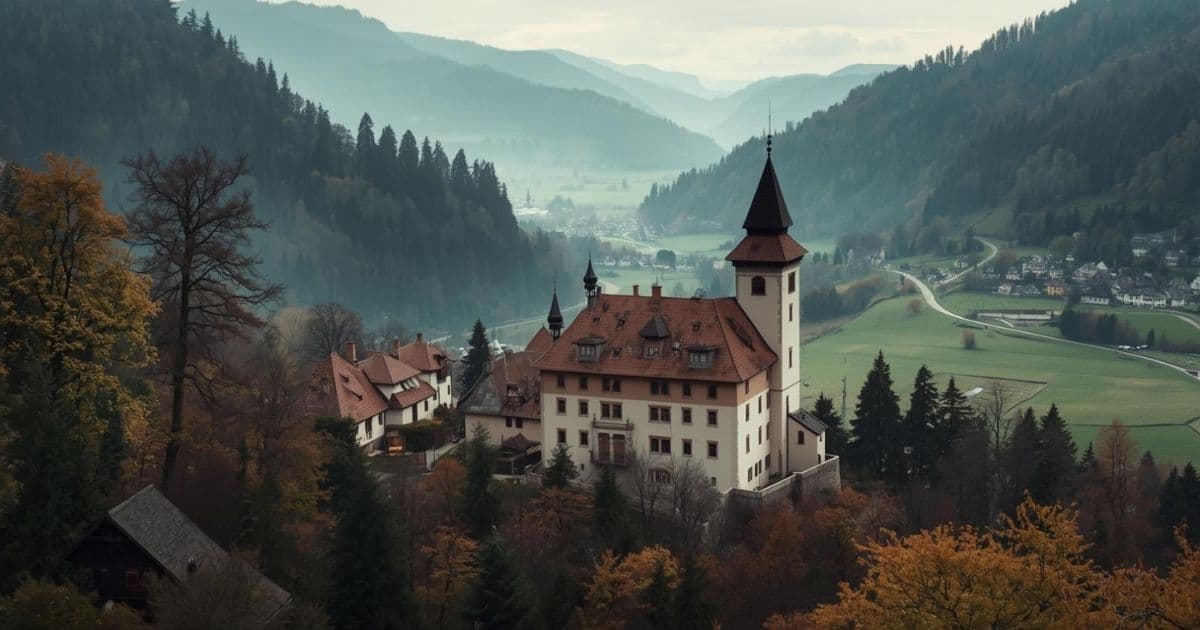
behind him and brightly lit up the enormous panorama which, rising like
an amphitheater, extended before him in the clear rarefied atmosphere.
From above on the left, bisecting that amphitheater, wound the Smolénsk
highroad, passing through a village with a white church some five
hundred paces in front of the knoll and below it. This was Borodinó.
Below the village the road crossed the river by a bridge and, winding
down and up, rose higher and higher to the village of Valúevo visible
about four miles away, where Napoleon was then stationed. Beyond Valúevo
the road disappeared into a yellowing forest on the horizon. Far in
the distance in that birch and fir forest to the right of the road, the
cross and belfry of the Kolochá Monastery gleamed in the sun. Here and
there over the whole of that blue expanse, to right and left of the
forest and the road, smoking campfires could be seen and indefinite
masses of troops—ours and the enemy’s. The ground to the right—along the
course of the Kolochá and Moskvá rivers—was broken and hilly. Between
the hollows the villages of Bezúbova and Zakhárino showed in the
distance. On the left the ground was more level; there were fields of
grain, and the smoking ruins of Semënovsk, which had been burned down,
could be seen.
All that Pierre saw was so indefinite that neither the left nor the
right side of the field fully satisfied his expectations. Nowhere
could he see the battlefield he had expected to find, but only fields,
meadows, troops, woods, the smoke of campfires, villages, mounds, and
streams; and try as he would he could descry no military “position” in
this place which teemed with life, nor could he even distinguish our
troops from the enemy’s.
“I must ask someone who knows,” he thought, and addressed an officer who
was looking with curiosity at his huge unmilitary figure.
“May I ask you,” said Pierre, “what village that is in front?”
“Búrdino, isn’t it?” said the officer, turning to his companion.
“Borodinó,” the other corrected him.
The officer, evidently glad of an opportunity for a talk, moved up to
Pierre.
“Are those our men there?” Pierre inquired.
“Yes, and there, further on, are the French,” said the officer. “There
they are, there... you can see them.”
“Where? Where?” asked Pierre.
“One can see them with the naked eye... Why, there!”
The officer pointed with his hand to the smoke visible on the left
beyond the river, and the same stern and serious expression that Pierre
had noticed on many of the faces he had met came into his face.
“Ah, those are the French! And over there?...” Pierre pointed to a knoll
on the left, near which some troops could be seen.
“Those are ours.”
“Ah, ours! And there?...” Pierre pointed to another knoll in the
distance with a big tree on it, near a village that lay in a hollow
where also some campfires were smoking and something black was visible.
“That’s his again,” said the officer. (It was the Shevárdino Redoubt.)
“It was ours yesterday, but now it is his.”
“Then how about our position?”
“Our position?” replied the officer with a smile of satisfaction. “I
can tell you quite clearly, because I constructed nearly all our
entrenchments. There, you see? There’s our center, at Borodinó, just
there,” and he pointed to the village in front of them with the white
church. “That’s where one crosses the Kolochá. You see down there where
the rows of hay are lying in the hollow, there’s the bridge. That’s our
center. Our right flank is over there”—he pointed sharply to the right,
far away in the broken ground—“That’s where the Moskvá River is, and
we have thrown up three redoubts there, very strong ones. The left
flank...” here the officer paused. “Well, you see, that’s difficult to
explain.... Yesterday our left flank was there at Shevárdino, you see,
where the oak is, but now we have withdrawn our left wing—now it is over
there, do you see that village and the smoke? That’s Semënovsk, yes,
there,” he pointed to Raévski’s knoll. “But the battle will hardly
be there. His having moved his troops there is only a ruse; he will
probably pass round to the right of the Moskvá. But wherever it may be,
many a man will be missing tomorrow!” he remarked.
An elderly sergeant who had approached the officer while he was giving
these explanations had waited in silence for him to finish speaking, but
at this point, evidently not liking the officer’s remark, interrupted
him.
“Gabions must be sent for,” said he sternly.
The officer appeared abashed, as though he understood that one might
think of how many men would be missing tomorrow but ought not to speak
of it.
“Well, send number three company again,” the officer replied hurriedly.
“And you, are you one of the doctors?”
“No, I’ve come on my own,” answered Pierre, and he went down the hill
again, passing the militiamen.
“Oh, those damned fellows!” muttered the officer who followed him,
holding his nose as he ran past the men at work.
“There they are... bringing her, coming... There they are... They’ll be
here in a minute...” voices were suddenly heard saying; and officers,
soldiers, and militiamen began running forward along the road.
A church procession was coming up the hill from Borodinó. First along
the dusty road came the infantry in ranks, bareheaded and with arms
reversed. From behind them came the sound of church singing.
Soldiers and militiamen ran bareheaded past Pierre toward the
procession.
“They are bringing her, our Protectress!... The Iberian Mother of God!”
someone cried.
“The Smolénsk Mother of God,” another corrected him.
The militiamen, both those who had been in the village and those who had
been at work on the battery, threw down their spades and ran to meet the
church procession. Following the battalion that marched along the dusty
road came priests in their vestments—one little old man in a hood with
attendants and singers. Behind them soldiers and officers bore a large,
dark-faced icon with an embossed metal cover. This was the icon that had
been brought from Smolénsk and had since accompanied the army. Behind,
before, and on both sides, crowds of militiamen with bared heads walked,
ran, and bowed to the ground.
At the summit of the hill they stopped with the icon; the men who had
been holding it up by the linen bands attached to it were relieved by
others, the chanters relit their censers, and service began. The hot
rays of the sun beat down vertically and a fresh soft wind played with
the hair of the bared heads and with the ribbons decorating the icon.
The singing did not sound loud under the open sky. An immense crowd
of bareheaded officers, soldiers, and militiamen surrounded the icon.
Behind the priest and a chanter stood the notabilities on a spot
reserved for them. A bald general with a St. George’s Cross on his neck
stood just behind the priest’s back, and without crossing himself (he
was evidently a German) patiently awaited the end of the service, which
he considered it necessary to hear to the end, probably to arouse the
patriotism of the Russian people. Another general stood in a martial
pose, crossing himself by shaking his hand in front of his chest
while looking about him. Standing among the crowd of peasants, Pierre
recognized several acquaintances among these notables, but did not
look at them—his whole attention was absorbed in watching the serious
expression on the faces of the crowd of soldiers and militiamen who were
all gazing eagerly at the icon. As soon as the tired chanters, who were
singing the service for the twentieth time that day, began lazily and
mechanically to sing: “Save from calamity Thy servants, O Mother of
God,” and the priest and deacon chimed in: “For to Thee under God we all
flee as to an inviolable bulwark and protection,” there again kindled in
all those faces the same expression of consciousness of the solemnity
of the impending moment that Pierre had seen on the faces at the foot of
the hill at Mozháysk and momentarily on many and many faces he had met
that morning; and heads were bowed more frequently and hair tossed back,
and sighs and the sound men made as they crossed themselves were heard.
The crowd round the icon suddenly parted and pressed against Pierre.
Someone, a very important personage judging by the haste with which way
was made for him, was approaching the icon.
It was Kutúzov, who had been riding round the position and on his way
back to Tatárinova had stopped where the service was being held. Pierre
recognized him at once by his peculiar figure, which distinguished him
from everybody else.
With a long overcoat on his exceedingly stout, round-shouldered body,
with uncovered white head and puffy face showing the white ball of the
eye he had lost, Kutúzov walked with plunging, swaying gait into
the crowd and stopped behind the priest. He crossed himself with an
accustomed movement, bent till he touched the ground with his hand, and
bowed his white head with a deep sigh. Behind Kutúzov was Bennigsen and
the suite. Despite the presence of the commander in chief, who attracted
the attention of all the superior officers, the militiamen and soldiers
continued their prayers without looking at him.
When the service was over, Kutúzov stepped up to the icon, sank heavily
to his knees, bowed to the ground, and for a long time tried vainly to
rise, but could not do so on account of his weakness and weight. His
white head twitched with the effort. At last he rose, kissed the icon as
a child does with naïvely pouting lips, and again bowed till he touched
the ground with his hand. The other generals followed his example,
then the officers, and after them with excited faces, pressing on one
another, crowding, panting, and pushing, scrambled the soldiers and
militiamen.
Master this chapter. Complete your experience
Purchase the complete book to access all chapters and support classic literature
As an Amazon Associate, we earn a small commission from qualifying purchases at no additional cost to you.
Available in paperback, hardcover, and e-book formats
Let's Analyse the Pattern
Humans create meaning through collective ritual when facing uncertainty, transforming individual fear into communal courage.
Why This Matters
Connect literature to life
This chapter teaches how intentional rituals—even simple ones—help us face uncertainty with dignity rather than panic.
Practice This Today
This week, notice what small rituals you already use before difficult situations, then create one intentional moment of preparation before your next challenging conversation or task.
Now let's explore the literary elements.
Key Quotes & Analysis
"Here and there over the whole of that blue expanse, to right and left of the forest and the road, smoking campfires could be seen and indefinite masses of troops—ours and the enemy's."
Context: Pierre surveys the battlefield from his hilltop vantage point
This captures the fog of war—even from a good position, Pierre can't distinguish friend from enemy. The word 'indefinite' shows how war refuses to fit our expectations of clear lines and obvious strategies. Reality is always messier than we imagine.
In Today's Words:
From up there, you could see camps and groups of people everywhere, but you couldn't tell who was on which side.
"Tomorrow we shall hardly meet again!"
Context: Speaking casually about the upcoming battle's casualties
This moment reveals how soldiers cope with mortality through dark humor and matter-of-fact acceptance. The casual tone masks the horror of what they're facing. It's a defense mechanism that allows them to function despite knowing many will die.
In Today's Words:
A lot of us won't be here tomorrow.
"The old man's legs gave way and he swayed and would have fallen had not the soldiers nearest to him rushed forward and supported him."
Context: Kutuzov struggling to kneel during the religious blessing
This shows authentic leadership—Kutuzov's body is failing but he insists on participating in the ceremony because he understands its importance for morale. His physical vulnerability makes his spiritual commitment more powerful, not less.
In Today's Words:
The old guy's knees buckled and he almost fell, but the soldiers caught him.
Thematic Threads
Class
In This Chapter
Officers and common soldiers unite in prayer, temporarily dissolving military hierarchy before the sacred icon
Development
Continues theme of how extreme circumstances reveal shared humanity across class lines
In Your Life:
Crisis situations often reveal that workplace hierarchies matter less than shared human concerns
Identity
In This Chapter
Pierre struggles to understand his role as observer versus participant in this military-spiritual moment
Development
Pierre's ongoing journey of finding his place continues as he witnesses rather than leads
In Your Life:
Sometimes your role is to witness and learn rather than to act or control
Leadership
In This Chapter
Kutuzov demonstrates leadership through visible vulnerability, struggling to kneel but persisting in showing reverence
Development
Introduces theme of authentic leadership through shared struggle rather than distant authority
In Your Life:
Real leaders show their humanity and effort, not just their competence and control
Community
In This Chapter
Thousands of individuals become unified through shared ritual and collective acknowledgment of mortality
Development
Shows how community forms through shared vulnerability rather than just shared interests
In Your Life:
Strongest bonds form when people face uncertainty or difficulty together, not just good times
Spiritual Preparation
In This Chapter
The blessing ceremony transforms military strategy into spiritual readiness for potential death
Development
Introduced here as counterbalance to purely tactical military thinking
In Your Life:
Major challenges require both practical preparation and mental/spiritual readiness
You now have the context. Time to form your own thoughts.
Discussion Questions
- 1
What did Pierre expect to see when he climbed the hill to observe the battle, and what did he actually find?
analysis • surface - 2
Why do you think the officer casually mentioned how many men would be missing tomorrow, and why did the sergeant correct him so sharply?
analysis • medium - 3
Where do you see people today creating rituals or ceremonies when facing big challenges or uncertainties?
application • medium - 4
If you were facing a major life challenge tomorrow, what kind of preparation or ritual might help you feel more centered and ready?
application • deep - 5
What does Kutuzov's struggle to kneel during the blessing ceremony reveal about effective leadership during crisis?
reflection • deep
Critical Thinking Exercise
Design Your Pre-Challenge Ritual
Think of a recurring challenge you face—difficult conversations at work, family conflicts, medical appointments, or major decisions. Design a simple 2-3 minute ritual you could do beforehand to center yourself. Consider what Pierre witnessed: people acknowledging the seriousness of the moment while drawing strength from something larger than themselves.
Consider:
- •What physical action could help you feel grounded (breathing, holding an object, standing in a specific place)?
- •What reminder of your values or purpose could you include?
- •How could you acknowledge both the difficulty ahead and your capacity to handle it?
Journaling Prompt
Write about a time when you faced something scary or uncertain. What helped you feel stronger or more prepared? How might you create that feeling intentionally next time?
Coming Up Next...
Chapter 212: Playing All Sides Before Battle
The religious ceremony concludes, but Pierre's day of observation is far from over. As the blessed troops return to their positions, the civilian observer will find himself drawn deeper into the heart of the approaching battle.