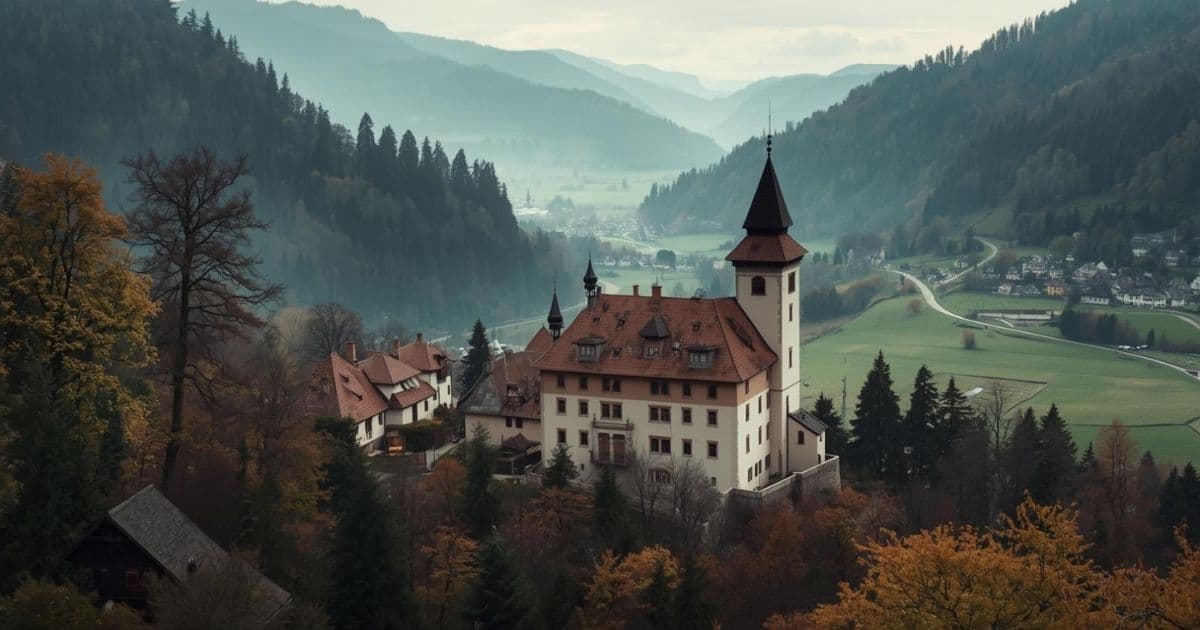
An excerpt from the original text.(complete · 1402 words)
he Rostóvs’ monetary affairs had not improved during the two years
they had spent in the country.
Though Nicholas Rostóv had kept firmly to his resolution and was still
serving modestly in an obscure regiment, spending comparatively little,
the way of life at Otrádnoe—Mítenka’s management of affairs, in
particular—was such that the debts inevitably increased every year.
The only resource obviously presenting itself to the old count was to
apply for an official post, so he had come to Petersburg to look for one
and also, as he said, to let the lassies enjoy themselves for the last
time.
Soon after their arrival in Petersburg Berg proposed to Véra and was
accepted.
Though in Moscow the Rostóvs belonged to the best society without
themselves giving it a thought, yet in Petersburg their circle of
acquaintances was a mixed and indefinite one. In Petersburg they were
provincials, and the very people they had entertained in Moscow without
inquiring to what set they belonged, here looked down on them.
The Rostóvs lived in the same hospitable way in Petersburg as in
Moscow, and the most diverse people met at their suppers. Country
neighbors from Otrádnoe, impoverished old squires and their daughters,
Perónskaya a maid of honor, Pierre Bezúkhov, and the son of their
district postmaster who had obtained a post in Petersburg. Among the
men who very soon became frequent visitors at the Rostóvs’ house in
Petersburg were Borís, Pierre whom the count had met in the street and
dragged home with him, and Berg who spent whole days at the Rostóvs’
and paid the eldest daughter, Countess Véra, the attentions a young man
pays when he intends to propose.
Not in vain had Berg shown everybody his right hand wounded at
Austerlitz and held a perfectly unnecessary sword in his left. He
narrated that episode so persistently and with so important an air that
everyone believed in the merit and usefulness of his deed, and he had
obtained two decorations for Austerlitz.
In the Finnish war he also managed to distinguish himself. He had picked
up the scrap of a grenade that had killed an aide-de-camp standing near
the commander in chief and had taken it to his commander. Just as he had
done after Austerlitz, he related this occurrence at such length and
so insistently that everyone again believed it had been necessary to do
this, and he received two decorations for the Finnish war also. In
1809 he was a captain in the Guards, wore medals, and held some special
lucrative posts in Petersburg.
Though some skeptics smiled when told of Berg’s merits, it could not
be denied that he was a painstaking and brave officer, on excellent
terms with his superiors, and a moral young man with a brilliant career
before him and an assured position in society.
Four years before, meeting a German comrade in the stalls of a Moscow
theater, Berg had pointed out Véra Rostóva to him and had said in
German, “das soll mein Weib werden,” * and from that moment had
made up his mind to marry her. Now in Petersburg, having considered the
Rostóvs’ position and his own, he decided that the time had come to
propose.
* “That girl shall be my wife.”
Berg’s proposal was at first received with a perplexity that was not
flattering to him. At first it seemed strange that the son of an obscure
Livonian gentleman should propose marriage to a Countess Rostóva; but
Berg’s chief characteristic was such a naïve and good natured egotism
that the Rostóvs involuntarily came to think it would be a good thing,
since he himself was so firmly convinced that it was good, indeed
excellent. Moreover, the Rostóvs’ affairs were seriously embarrassed,
as the suitor could not but know; and above all, Véra was twenty-four,
had been taken out everywhere, and though she was certainly good-looking
and sensible, no one up to now had proposed to her. So they gave their
consent.
“You see,” said Berg to his comrade, whom he called “friend”
only because he knew that everyone has friends, “you see, I have
considered it all, and should not marry if I had not thought it all out
or if it were in any way unsuitable. But on the contrary, my papa and
mamma are now provided for—I have arranged that rent for them in the
Baltic Provinces—and I can live in Petersburg on my pay, and with
her fortune and my good management we can get along nicely. I am not
marrying for money—I consider that dishonorable—but a wife should
bring her share and a husband his. I have my position in the service,
she has connections and some means. In our times that is worth
something, isn’t it? But above all, she is a handsome, estimable girl,
and she loves me....”
Berg blushed and smiled.
“And I love her, because her character is sensible and very good.
Now the other sister, though they are the same family, is quite
different—an unpleasant character and has not the same intelligence.
She is so... you know?... Unpleasant... But my fiancée!... Well, you
will be coming,” he was going to say, “to dine,” but changed his
mind and said “to take tea with us,” and quickly doubling up his
tongue he blew a small round ring of tobacco smoke, perfectly embodying
his dream of happiness.
After the first feeling of perplexity aroused in the parents by Berg’s
proposal, the holiday tone of joyousness usual at such times took
possession of the family, but the rejoicing was external and insincere.
In the family’s feeling toward this wedding a certain awkwardness
and constraint was evident, as if they were ashamed of not having loved
Véra sufficiently and of being so ready to get her off their hands. The
old count felt this most. He would probably have been unable to state
the cause of his embarrassment, but it resulted from the state of his
affairs. He did not know at all how much he had, what his debts amounted
to, or what dowry he could give Véra. When his daughters were born
he had assigned to each of them, for her dowry, an estate with three
hundred serfs; but one of these estates had already been sold, and the
other was mortgaged and the interest so much in arrears that it would
have to be sold, so that it was impossible to give it to Véra. Nor had
he any money.
Berg had already been engaged a month, and only a week remained before
the wedding, but the count had not yet decided in his own mind the
question of the dowry, nor spoken to his wife about it. At one time the
count thought of giving her the Ryazán estate or of selling a forest,
at another time of borrowing money on a note of hand. A few days before
the wedding Berg entered the count’s study early one morning and, with
a pleasant smile, respectfully asked his future father-in-law to let
him know what Véra’s dowry would be. The count was so disconcerted by
this long-foreseen inquiry that without consideration he gave the first
reply that came into his head. “I like your being businesslike about
it.... I like it. You shall be satisfied....”
And patting Berg on the shoulder he got up, wishing to end the
conversation. But Berg, smiling pleasantly, explained that if he did not
know for certain how much Véra would have and did not receive at least
part of the dowry in advance, he would have to break matters off.
“Because, consider, Count—if I allowed myself to marry now
without having definite means to maintain my wife, I should be acting
badly....”
The conversation ended by the count, who wished to be generous and to
avoid further importunity, saying that he would give a note of hand
for eighty thousand rubles. Berg smiled meekly, kissed the count on the
shoulder, and said that he was very grateful, but that it was impossible
for him to arrange his new life without receiving thirty thousand in
ready money. “Or at least twenty thousand, Count,” he added, “and
then a note of hand for only sixty thousand.”
“Yes, yes, all right!” said the count hurriedly. “Only excuse me,
my dear fellow, I’ll give you twenty thousand and a note of hand for
eighty thousand as well. Yes, yes! Kiss me.”
Master this chapter. Complete your experience
Purchase the complete book to access all chapters and support classic literature
As an Amazon Associate, we earn a small commission from qualifying purchases at no additional cost to you.
Available in paperback, hardcover, and e-book formats
Let's Analyse the Pattern
When vulnerability meets opportunity, the desperate party always pays more than the relationship is worth.
Why This Matters
Connect literature to life
This chapter teaches how to recognize when someone is taking advantage of your desperate situation rather than genuinely helping.
Practice This Today
This week, notice when people approach you with 'solutions' during your worst moments—ask yourself if their timing feels too convenient.
Now let's explore the literary elements.
Key Quotes & Analysis
"I considered it my duty to let you know that I wish to marry your daughter"
Context: Berg's formal proposal to Count Rostov about Vera
Berg treats marriage like a business transaction, using the word 'duty' rather than love or desire. This reveals his calculated, emotionless approach to what should be a romantic moment.
In Today's Words:
I'm here to inform you that I've decided your daughter would be a suitable wife for my purposes.
"You know my income. How can we manage? That's what I wanted to ask you"
Context: Berg discussing the practical arrangements of marriage with Count Rostov
Berg reduces marriage to a financial equation, asking how they'll 'manage' rather than expressing any emotional connection. He's essentially negotiating a business deal.
In Today's Words:
Let's talk numbers - what's this going to cost me and what are you bringing to the table?
"The debts inevitably increased every year"
Context: Describing the Rostov family's worsening financial situation
This simple statement reveals the family's fundamental problem - they're living beyond their means with no real plan to change. The word 'inevitably' suggests they're trapped in a cycle.
In Today's Words:
No matter what they did, they kept going deeper into debt every year.
Thematic Threads
Financial Desperation
In This Chapter
The Rostovs' mounting debts force them to accept Berg's calculated proposal and promise dowry money they don't have
Development
Escalated from earlier money troubles to complete financial vulnerability
In Your Life:
You might recognize this when financial pressure makes you consider job offers, relationships, or deals you'd normally refuse.
Social Calculation
In This Chapter
Berg treats marriage like a business transaction, selecting Vera based on practical considerations rather than love
Development
Introduced here as extreme example of strategic social climbing
In Your Life:
You see this in people who network only for personal gain or date for status rather than genuine connection.
Class Anxiety
In This Chapter
The Rostovs discover their provincial status in Petersburg, where former guests now look down on them
Development
Continued from their earlier social decline, now with geographic displacement
In Your Life:
You might feel this when changing jobs, neighborhoods, or social circles and suddenly feeling like an outsider.
Exploitation
In This Chapter
Berg leverages the family's desperation to secure a wife and dowry while offering minimal emotional investment
Development
Introduced here as calculated opportunism
In Your Life:
You encounter this when someone offers help during your crisis but their terms seem disproportionately favorable to them.
Compromise
In This Chapter
The family accepts a loveless match because they have no better options for Vera
Development
New theme showing how circumstances force unwanted choices
In Your Life:
You face this when life circumstances make you choose between bad options rather than good ones.
You now have the context. Time to form your own thoughts.
Discussion Questions
- 1
Why does the Rostov family accept Berg's proposal to Vera, even though no one seems particularly excited about it?
analysis • surface - 2
How does Berg's approach to marriage reveal his character and motivations? What does he gain from this arrangement?
analysis • medium - 3
Where do you see people today accepting relationships or opportunities they wouldn't normally consider because they feel they have no other choice?
application • medium - 4
When someone approaches you with a 'perfect solution' during a difficult time, what questions should you ask yourself before accepting?
application • deep - 5
What does this chapter reveal about how desperation changes our decision-making, and how can we protect ourselves from making choices we'll regret?
reflection • deep
Critical Thinking Exercise
Spot the Desperation Deal
Think of a situation in your life where you felt pressured to accept something because you had limited options. Write down what you were desperate for, what the other person offered, and what they gained from the arrangement. Then identify three warning signs that someone might be taking advantage of your vulnerability.
Consider:
- •Notice how timing affects your judgment - are you being rushed to decide?
- •Ask yourself what the other person really gets out of helping you
- •Consider whether this 'opportunity' would still seem good if you weren't in crisis
Journaling Prompt
Write about a time when you had to make a major decision while under pressure. What would you do differently now, and how can you create more options for yourself in future difficult situations?
Coming Up Next...
Chapter 118: When Old Promises Collide with New Ambitions
As the Rostovs navigate their precarious social and financial position in Petersburg, other family members will face their own romantic entanglements and social pressures in the capital's complex society.