
An excerpt from the original text.(complete · 5386 words)
orne Along by the Tide
In less than a week Maggie was at St Ogg’s again,—outwardly in much the
same position as when her visit there had just begun. It was easy for
her to fill her mornings apart from Lucy without any obvious effort;
for she had her promised visits to pay to her aunt Glegg, and it was
natural that she should give her mother more than usual of her
companionship in these last weeks, especially as there were
preparations to be thought of for Tom’s housekeeping. But Lucy would
hear of no pretext for her remaining away in the evenings; she must
always come from aunt Glegg’s before dinner,—“else what shall I have of
you?” said Lucy, with a tearful pout that could not be resisted.
And Mr Stephen Guest had unaccountably taken to dining at Mr Deane’s as
often as possible, instead of avoiding that, as he used to do. At first
he began his mornings with a resolution that he would not dine there,
not even go in the evening, till Maggie was away. He had even devised a
plan of starting off on a journey in this agreeable June weather; the
headaches which he had constantly been alleging as a ground for
stupidity and silence were a sufficient ostensible motive. But the
journey was not taken, and by the fourth morning no distinct resolution
was formed about the evenings; they were only foreseen as times when
Maggie would still be present for a little while,—when one more touch,
one more glance, might be snatched. For why not? There was nothing to
conceal between them; they knew, they had confessed their love, and
they had renounced each other; they were going to part. Honour and
conscience were going to divide them; Maggie, with that appeal from her
inmost soul, had decided it; but surely they might cast a lingering
look at each other across the gulf, before they turned away never to
look again till that strange light had forever faded out of their eyes.
Maggie, all this time, moved about with a quiescence and even torpor of
manner, so contrasted with her usual fitful brightness and ardor, that
Lucy would have had to seek some other cause for such a change, if she
had not been convinced that the position in which Maggie stood between
Philip and her brother, and the prospect of her self-imposed wearisome
banishment, were quite enough to account for a large amount of
depression. But under this torpor there was a fierce battle of
emotions, such as Maggie in all her life of struggle had never known or
foreboded; it seemed to her as if all the worst evil in her had lain in
ambush till now, and had suddenly started up full-armed, with hideous,
overpowering strength! There were moments in which a cruel selfishness
seemed to be getting possession of her; why should not Lucy, why should
not Philip, suffer? She had had to suffer through many years of her
life; and who had renounced anything for her? And when something like
that fulness of existence—love, wealth, ease, refinement, all that her
nature craved—was brought within her reach, why was she to forego it,
that another might have it,—another, who perhaps needed it less? But
amidst all this new passionate tumult there were the old voices making
themselves heard with rising power, till, from time to time, the tumult
seemed quelled. Was that existence which tempted her the full
existence she dreamed? Where, then, would be all the memories of early
striving; all the deep pity for another’s pain, which had been nurtured
in her through years of affection and hardship; all the divine
presentiment of something higher than mere personal enjoyment, which
had made the sacredness of life? She might as well hope to enjoy
walking by maiming her feet, as hope to enjoy an existence in which she
set out by maiming the faith and sympathy that were the best organs of
her soul. And then, if pain were so hard to her, what was it to
others? “Ah, God! preserve me from inflicting—give me strength to bear
it.” How had she sunk into this struggle with a temptation that she
would once have thought herself as secure from as from deliberate
crime? When was that first hateful moment in which she had been
conscious of a feeling that clashed with her truth, affection, and
gratitude, and had not shaken it from her with horror, as if it had
been a loathsome thing? And yet, since this strange, sweet, subduing
influence did not, should not, conquer her,—since it was to remain
simply her own suffering,—her mind was meeting Stephen’s in that
thought of his, that they might still snatch moments of mute confession
before the parting came. For was not he suffering too? She saw it
daily—saw it in the sickened look of fatigue with which, as soon as he
was not compelled to exert himself, he relapsed into indifference
toward everything but the possibility of watching her. Could she refuse
sometimes to answer that beseeching look which she felt to be following
her like a low murmur of love and pain? She refused it less and less,
till at last the evening for them both was sometimes made of a moment’s
mutual gaze; they thought of it till it came, and when it had come,
they thought of nothing else.
One other thing Stephen seemed now and then to care for, and that was
to sing; it was a way of speaking to Maggie. Perhaps he was not
distinctly conscious that he was impelled to it by a secret
longing—running counter to all his self-confessed resolves—to deepen
the hold he had on her. Watch your own speech, and notice how it is
guided by your less conscious purposes, and you will understand that
contradiction in Stephen.
Philip Wakem was a less frequent visitor, but he came occasionally in
the evening, and it happened that he was there when Lucy said, as they
sat out on the lawn, near sunset,—
“Now Maggie’s tale of visits to aunt Glegg is completed, I mean that we
shall go out boating every day until she goes. She has not had half
enough boating because of these tiresome visits, and she likes it
better than anything. Don’t you, Maggie?”
“Better than any sort of locomotion, I hope you mean,” said Philip,
smiling at Maggie, who was lolling backward in a low garden-chair;
“else she will be selling her soul to that ghostly boatman who haunts
the Floss, only for the sake of being drifted in a boat forever.”
“Should you like to be her boatman?” said Lucy. “Because, if you would,
you can come with us and take an oar. If the Floss were but a quiet
lake instead of a river, we should be independent of any gentleman, for
Maggie can row splendidly. As it is, we are reduced to ask services of
knights and squires, who do not seem to offer them with great
alacrity.”
She looked playful reproach at Stephen, who was sauntering up and down,
and was just singing in pianissimo falsetto,—
“The thirst that from the soul doth rise
Doth ask a drink divine.”
He took no notice, but still kept aloof; he had done so frequently
during Philip’s recent visits.
“You don’t seem inclined for boating,” said Lucy, when he came to sit
down by her on the bench. “Doesn’t rowing suit you now?”
“Oh, I hate a large party in a boat,” he said, almost irritably. “I’ll
come when you have no one else.”
Lucy coloured, fearing that Philip would be hurt; it was quite a new
thing for Stephen to speak in that way; but he had certainly not been
well of late. Philip coloured too, but less from a feeling of personal
offence than from a vague suspicion that Stephen’s moodiness had some
relation to Maggie, who had started up from her chair as he spoke, and
had walked toward the hedge of laurels to look at the descending
sunlight on the river.
“As Miss Deane didn’t know she was excluding others by inviting me,”
said Philip, “I am bound to resign.”
“No, indeed, you shall not,” said Lucy, much vexed. “I particularly
wish for your company to-morrow. The tide will suit at half-past ten;
it will be a delicious time for a couple of hours to row to Luckreth
and walk back, before the sun gets too hot. And how can you object to
four people in a boat?” she added, looking at Stephen.
“I don’t object to the people, but the number,” said Stephen, who had
recovered himself, and was rather ashamed of his rudeness. “If I voted
for a fourth at all, of course it would be you, Phil. But we won’t
divide the pleasure of escorting the ladies; we’ll take it alternately.
I’ll go the next day.”
This incident had the effect of drawing Philip’s attention with
freshened solicitude toward Stephen and Maggie; but when they
re-entered the house, music was proposed, and Mrs Tulliver and Mr Deane
being occupied with cribbage, Maggie sat apart near the table where the
books and work were placed, doing nothing, however, but listening
abstractedly to the music. Stephen presently turned to a duet which he
insisted that Lucy and Philip should sing; he had often done the same
thing before; but this evening Philip thought he divined some double
intention in every word and look of Stephen’s, and watched him keenly,
angry with himself all the while for this clinging suspicion. For had
not Maggie virtually denied any ground for his doubts on her side? And
she was truth itself; it was impossible not to believe her word and
glance when they had last spoken together in the garden. Stephen might
be strongly fascinated by her (what was more natural?), but Philip felt
himself rather base for intruding on what must be his friend’s painful
secret. Still he watched. Stephen, moving away from the piano,
sauntered slowly toward the table near which Maggie sat, and turned
over the newspapers, apparently in mere idleness. Then he seated
himself with his back to the piano, dragging a newspaper under his
elbow, and thrusting his hand through his hair, as if he had been
attracted by some bit of local news in the “Laceham Courier.” He was in
reality looking at Maggie who had not taken the slightest notice of his
approach. She had always additional strength of resistance when Philip
was present, just as we can restrain our speech better in a spot that
we feel to be hallowed. But at last she heard the word “dearest”
uttered in the softest tone of pained entreaty, like that of a patient
who asks for something that ought to have been given without asking.
She had never heard that word since the moments in the lane at Basset,
when it had come from Stephen again and again, almost as involuntarily
as if it had been an inarticulate cry. Philip could hear no word, but
he had moved to the opposite side of the piano, and could see Maggie
start and blush, raise her eyes an instant toward Stephen’s face, but
immediately look apprehensively toward himself. It was not evident to
her that Philip had observed her; but a pang of shame, under the sense
of this concealment, made her move from her chair and walk to her
mother’s side to watch the game at cribbage.
Philip went home soon after in a state of hideous doubt mingled with
wretched certainty. It was impossible for him now to resist the
conviction that there was some mutual consciousness between Stephen and
Maggie; and for half the night his irritable, susceptible nerves were
pressed upon almost to frenzy by that one wretched fact; he could
attempt no explanation that would reconcile it with her words and
actions. When, at last, the need for belief in Maggie rose to its
habitual predominance, he was not long in imagining the truth,—she was
struggling, she was banishing herself; this was the clue to all he had
seen since his return. But athwart that belief there came other
possibilities that would not be driven out of sight. His imagination
wrought out the whole story; Stephen was madly in love with her; he
must have told her so; she had rejected him, and was hurrying away. But
would he give her up, knowing—Philip felt the fact with heart-crushing
despair—that she was made half helpless by her feeling toward him?
When the morning came, Philip was too ill to think of keeping his
engagement to go in the boat. In his present agitation he could decide
on nothing; he could only alternate between contradictory intentions.
First, he thought he must have an interview with Maggie, and entreat
her to confide in him; then, again, he distrusted his own interference.
Had he not been thrusting himself on Maggie all along? She had uttered
words long ago in her young ignorance; it was enough to make her hate
him that these should be continually present with her as a bond. And
had he any right to ask her for a revelation of feelings which she had
evidently intended to withhold from him? He would not trust himself to
see her, till he had assured himself that he could act from pure
anxiety for her, and not from egoistic irritation. He wrote a brief
note to Stephen, and sent it early by the servant, saying that he was
not well enough to fulfil his engagement to Miss Deane. Would Stephen
take his excuse, and fill his place?
Lucy had arranged a charming plan, which had made her quite content
with Stephen’s refusal to go in the boat. She discovered that her
father was to drive to Lindum this morning at ten; Lindum was the very
place she wanted to go to, to make purchases,—important purchases,
which must by no means be put off to another opportunity; and aunt
Tulliver must go too, because she was concerned in some of the
purchases.
“You will have your row in the boat just the same, you know,” she said
to Maggie when they went out of the breakfast-room and upstairs
together; “Philip will be here at half-past ten, and it is a delicious
morning. Now don’t say a word against it, you dear dolorous thing. What
is the use of my being a fairy godmother, if you set your face against
all the wonders I work for you? Don’t think of awful cousin Tom; you
may disobey him a little.”
Maggie did not persist in objecting. She was almost glad of the plan,
for perhaps it would bring her some strength and calmness to be alone
with Philip again; it was like revisiting the scene of a quieter life,
in which the very struggles were repose, compared with the daily tumult
of the present. She prepared herself for the boat and at half-past ten
sat waiting in the drawing-room.
The ring of the door-bell was punctual, and she was thinking with
half-sad, affectionate pleasure of the surprise Philip would have in
finding that he was to be with her alone, when she distinguished a
firm, rapid step across the hall, that was certainly not Philip’s; the
door opened, and Stephen Guest entered.
In the first moment they were both too much agitated to speak; for
Stephen had learned from the servant that the others were gone out.
Maggie had started up and sat down again, with her heart beating
violently; and Stephen, throwing down his cap and gloves, came and sat
by her in silence. She thought Philip would be coming soon; and with
great effort—for she trembled visibly—she rose to go to a distant
chair.
“He is not coming,” said Stephen, in a low tone. “I am going in the
boat.”
“Oh, we can’t go,” said Maggie, sinking into her chair again. “Lucy did
not expect—she would be hurt. Why is not Philip come?”
“He is not well; he asked me to come instead.”
“Lucy is gone to Lindum,” said Maggie, taking off her bonnet with
hurried, trembling fingers. “We must not go.”
“Very well,” said Stephen, dreamily, looking at her, as he rested his
arm on the back of his chair. “Then we’ll stay here.”
He was looking into her deep, deep eyes, far off and mysterious as the
starlit blackness, and yet very near, and timidly loving. Maggie sat
perfectly still—perhaps for moments, perhaps for minutes—until the
helpless trembling had ceased, and there was a warm glow on her check.
“The man is waiting; he has taken the cushions,” she said. “Will you go
and tell him?”
“What shall I tell him?” said Stephen, almost in a whisper. He was
looking at the lips now.
Maggie made no answer.
“Let us go,” Stephen murmured entreatingly, rising, and taking her hand
to raise her too. “We shall not be long together.”
And they went. Maggie felt that she was being led down the garden among
the roses, being helped with firm, tender care into the boat, having
the cushion and cloak arranged for her feet, and her parasol opened for
her (which she had forgotten), all by this stronger presence that
seemed to bear her along without any act of her own will, like the
added self which comes with the sudden exalting influence of a strong
tonic, and she felt nothing else. Memory was excluded.
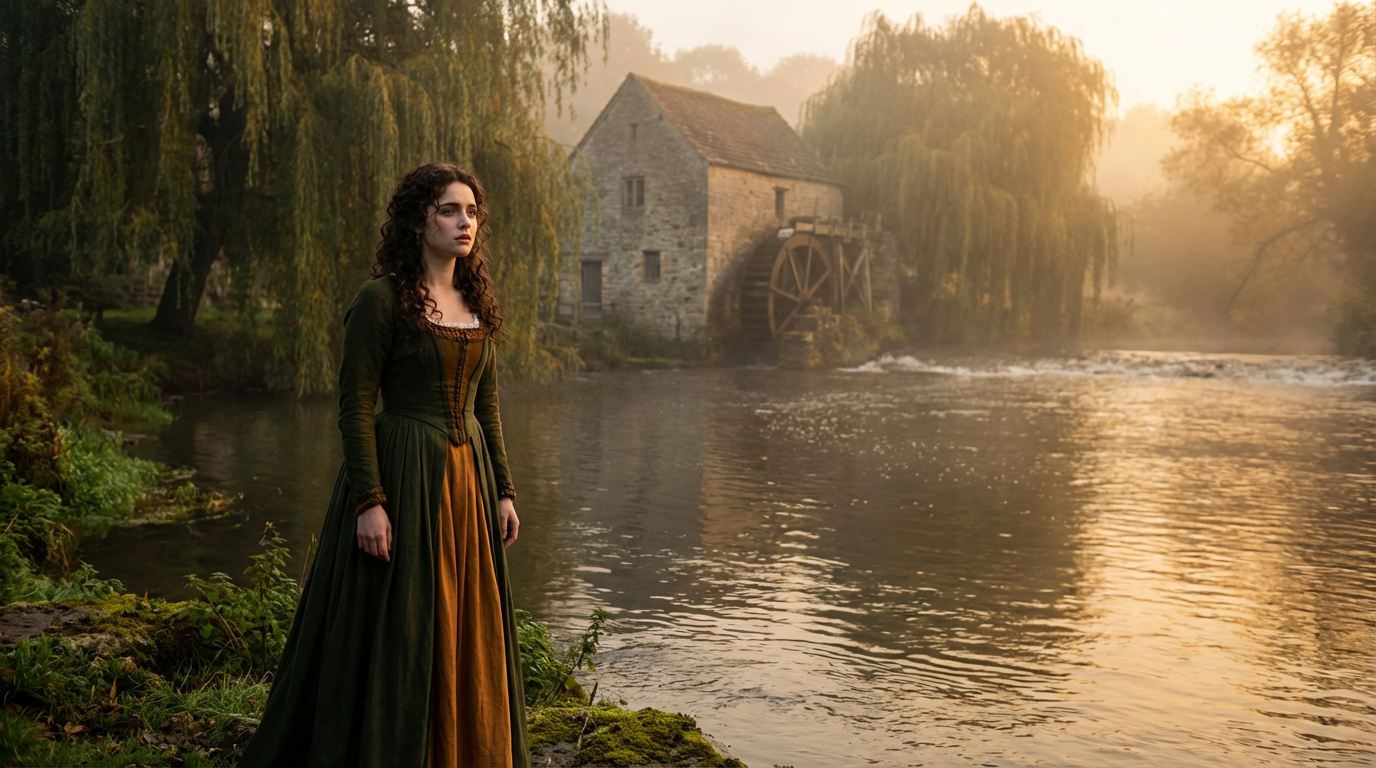
They glided rapidly along, Stephen rowing, helped by the
backward-flowing tide, past the Tofton trees and houses; on between the
silent sunny fields and pastures, which seemed filled with a natural
joy that had no reproach for theirs. The breath of the young, unwearied
day, the delicious rhythmic dip of the oars, the fragmentary song of a
passing bird heard now and then, as if it were only the overflowing of
brimful gladness, the sweet solitude of a twofold consciousness that
was mingled into one by that grave, untiring gaze which need not be
averted,—what else could there be in their minds for the first hour?
Some low, subdued, languid exclamation of love came from Stephen from
time to time, as he went on rowing idly, half automatically; otherwise
they spoke no word; for what could words have been but an inlet to
thought? and thought did not belong to that enchanted haze in which
they were enveloped,—it belonged to the past and the future that lay
outside the haze. Maggie was only dimly conscious of the banks, as they
passed them, and dwelt with no recognition on the villages; she knew
there were several to be passed before they reached Luckreth, where
they always stopped and left the boat. At all times she was so liable
to fits of absence, that she was likely enough to let her waymarks pass
unnoticed.
But at last Stephen, who had been rowing more and more idly, ceased to
row, laid down the oars, folded his arms, and looked down on the water
as if watching the pace at which the boat glided without his help. This
sudden change roused Maggie. She looked at the far-stretching fields,
at the banks close by, and felt that they were entirely strange to her.
A terrible alarm took possession of her.
“Oh, have we passed Luckreth, where we were to stop?” she exclaimed,
looking back to see if the place were out of sight. No village was to
be seen. She turned around again, with a look of distressed questioning
at Stephen.
He went on watching the water, and said, in a strange, dreamy, absent
tone, “Yes, a long way.”
“Oh, what shall I do?” cried Maggie, in an agony. “We shall not get
home for hours, and Lucy? O God, help me!”
She clasped her hands and broke into a sob, like a frightened child;
she thought of nothing but of meeting Lucy, and seeing her look of
pained surprise and doubt, perhaps of just upbraiding.
Stephen moved and sat near her, and gently drew down the clasped hands.
“Maggie,” he said, in a deep tone of slow decision, “let us never go
home again, till no one can part us,—till we are married.”
The unusual tone, the startling words, arrested Maggie’s sob, and she
sat quite still, wondering; as if Stephen might have seen some
possibilities that would alter everything, and annul the wretched
facts.
“See, Maggie, how everything has come without our seeking,—in spite of
all our efforts. We never thought of being alone together again; it has
all been done by others. See how the tide is carrying us out, away from
all those unnatural bonds that we have been trying to make faster round
us, and trying in vain. It will carry us on to Torby, and we can land
there, and get some carriage, and hurry on to York and then to
Scotland,—and never pause a moment till we are bound to each other, so
that only death can part us. It is the only right thing, dearest; it is
the only way of escaping from this wretched entanglement. Everything
has concurred to point it out to us. We have contrived nothing, we have
thought of nothing ourselves.”
Stephen spoke with deep, earnest pleading. Maggie listened, passing
from her startled wonderment to the yearning after that belief that the
tide was doing it all, that she might glide along with the swift,
silent stream, and not struggle any more. But across that stealing
influence came the terrible shadow of past thoughts; and the sudden
horror lest now, at last, the moment of fatal intoxication was close
upon her, called up feelings of angry resistance toward Stephen.
“Let me go!” she said, in an agitated tone, flashing an indignant look
at him, and trying to get her hands free. “You have wanted to deprive
me of any choice. You knew we were come too far; you have dared to take
advantage of my thoughtlessness. It is unmanly to bring me into such a
position.”
Stung by this reproach, he released her hands, moved back to his former
place, and folded his arms, in a sort of desperation at the difficulty
Maggie’s words had made present to him. If she would not consent to go
on, he must curse himself for the embarrassment he had led her into.
But the reproach was the unendurable thing; the one thing worse than
parting with her was, that she should feel he had acted unworthily
toward her. At last he said, in a tone of suppressed rage,—
“I didn’t notice that we had passed Luckreth till we had got to the
next village; and then it came into my mind that we would go on. I
can’t justify it; I ought to have told you. It is enough to make you
hate me, since you don’t love me well enough to make everything else
indifferent to you, as I do you. Shall I stop the boat and try to get
you out here? I’ll tell Lucy that I was mad, and that you hate me; and
you shall be clear of me forever. No one can blame you, because I have
behaved unpardonably to you.”
Maggie was paralyzed; it was easier to resist Stephen’s pleading than
this picture he had called up of himself suffering while she was
vindicated; easier even to turn away from his look of tenderness than
from this look of angry misery, that seemed to place her in selfish
isolation from him. He had called up a state of feeling in which the
reasons which had acted on her conscience seemed to be transmitted into
mere self-regard. The indignant fire in her eyes was quenched, and she
began to look at him with timid distress. She had reproached him for
being hurried into irrevocable trespass,—she, who had been so weak
herself.
“As if I shouldn’t feel what happened to you—just the same,” she said,
with reproach of another kind,—the reproach of love, asking for more
trust. This yielding to the idea of Stephen’s suffering was more fatal
than the other yielding, because it was less distinguishable from that
sense of others’ claims which was the moral basis of her resistance.
He felt all the relenting in her look and tone; it was heaven opening
again. He moved to her side, and took her hand, leaning his elbow on
the back of the boat, and saying nothing. He dreaded to utter another
word, he dreaded to make another movement, that might provoke another
reproach or denial from her. Life hung on her consent; everything else
was hopeless, confused, sickening misery. They glided along in this
way, both resting in that silence as in a haven, both dreading lest
their feelings should be divided again,—till they became aware that the
clouds had gathered, and that the slightest perceptible freshening of
the breeze was growing and growing, so that the whole character of the
day was altered.
“You will be chill, Maggie, in this thin dress. Let me raise the cloak
over your shoulders. Get up an instant, dearest.”
Maggie obeyed; there was an unspeakable charm in being told what to do,
and having everything decided for her. She sat down again covered with
the cloak, and Stephen took to his oars again, making haste; for they
must try to get to Torby as fast as they could. Maggie was hardly
conscious of having said or done anything decisive. All yielding is
attended with a less vivid consciousness than resistance; it is the
partial sleep of thought; it is the submergence of our own personality
by another. Every influence tended to lull her into acquiescence. That
dreamy gliding in the boat which had lasted for four hours, and had
brought some weariness and exhaustion; the recoil of her fatigued
sensations from the impracticable difficulty of getting out of the boat
at this unknown distance from home, and walking for long miles,—all
helped to bring her into more complete subjection to that strong,
mysterious charm which made a last parting from Stephen seem the death
of all joy, and made the thought of wounding him like the first touch
of the torturing iron before which resolution shrank. And then there
was the present happiness of being with him, which was enough to absorb
all her languid energy.
Presently Stephen observed a vessel coming after them. Several vessels,
among them the steamer to Mudport, had passed them with the early tide,
but for the last hour they had seen none. He looked more and more
eagerly at this vessel, as if a new thought had come into his mind
along with it, and then he looked at Maggie hesitatingly.
“Maggie, dearest,” he said at last, “if this vessel should be going to
Mudport, or to any convenient place on the coast northward, it would be
our best plan to get them to take us on board. You are fatigued, and it
may soon rain; it may be a wretched business, getting to Torby in this
boat. It’s only a trading vessel, but I dare say you can be made
tolerably comfortable. We’ll take the cushions out of the boat. It is
really our best plan. They’ll be glad enough to take us. I’ve got
plenty of money about me. I can pay them well.”
Maggie’s heart began to beat with reawakened alarm at this new
proposition; but she was silent,—one course seemed as difficult as
another.
Stephen hailed the vessel. It was a Dutch vessel going to Mudport, the
English mate informed him, and, if this wind held, would be there in
less than two days.
“We had got out too far with our boat,” said Stephen. “I was trying to
make for Torby. But I’m afraid of the weather; and this lady—my
wife—will be exhausted with fatigue and hunger. Take us on board—will
you?—and haul up the boat. I’ll pay you well.”
Maggie, now really faint and trembling with fear, was taken on board,
making an interesting object of contemplation to admiring Dutchmen. The
mate feared the lady would have a poor time of it on board, for they
had no accommodation for such entirely unlooked-for passengers,—no
private cabin larger than an old-fashioned church-pew. But at least
they had Dutch cleanliness, which makes all other inconveniences
tolerable; and the boat cushions were spread into a couch for Maggie on
the poop with all alacrity. But to pace up and down the deck leaning on
Stephen—being upheld by his strength—was the first change that she
needed; then came food, and then quiet reclining on the cushions, with
the sense that no new resolution could be taken that day. Everything
must wait till to-morrow. Stephen sat beside her with her hand in his;
they could only speak to each other in low tones; only look at each
other now and then, for it would take a long while to dull the
curiosity of the five men on board, and reduce these handsome young
strangers to that minor degree of interest which belongs, in a sailor’s
regard, to all objects nearer than the horizon. But Stephen was
triumphantly happy. Every other thought or care was thrown into
unmarked perspective by the certainty that Maggie must be his. The leap
had been taken now; he had been tortured by scruples, he had fought
fiercely with overmastering inclination, he had hesitated; but
repentance was impossible. He murmured forth in fragmentary sentences
his happiness, his adoration, his tenderness, his belief that their
life together must be heaven, that her presence with him would give
rapture to every common day; that to satisfy her lightest wish was
dearer to him than all other bliss; that everything was easy for her
sake, except to part with her; and now they never would part; he
would belong to her forever, and all that was his was hers,—had no
value for him except as it was hers. Such things, uttered in low,
broken tones by the one voice that has first stirred the fibre of young
passion, have only a feeble effect—on experienced minds at a distance
from them. To poor Maggie they were very near; they were like nectar
held close to thirsty lips; there was, there must be, then, a life
for mortals here below which was not hard and chill,—in which affection
would no longer be self-sacrifice. Stephen’s passionate words made the
vision of such a life more fully present to her than it had ever been
before; and the vision for the time excluded all realities,—all except
the returning sun-gleams which broke out on the waters as the evening
approached, and mingled with the visionary sunlight of promised
happiness; all except the hand that pressed hers, and the voice that
spoke to her, and the eyes that looked at her with grave, unspeakable
love.
There was to be no rain, after all; the clouds rolled off to the
horizon again, making the great purple rampart and long purple isles of
that wondrous land which reveals itself to us when the sun goes
down,—the land that the evening star watches over. Maggie was to sleep
all night on the poop; it was better than going below; and she was
covered with the warmest wrappings the ship could furnish. It was still
early, when the fatigues of the day brought on a drowsy longing for
perfect rest, and she laid down her head, looking at the faint, dying
flush in the west, where the one golden lamp was getting brighter and
brighter. Then she looked up at Stephen, who was still seated by her,
hanging over her as he leaned his arm against the vessel’s side. Behind
all the delicious visions of these last hours, which had flowed over
her like a soft stream, and made her entirely passive, there was the
dim consciousness that the condition was a transient one, and that the
morrow must bring back the old life of struggle; that there were
thoughts which would presently avenge themselves for this oblivion. But
now nothing was distinct to her; she was being lulled to sleep with
that soft stream still flowing over her, with those delicious visions
melting and fading like the wondrous aerial land of the west.
Master this chapter. Complete your experience
Purchase the complete book to access all chapters and support classic literature
As an Amazon Associate, we earn a small commission from qualifying purchases at no additional cost to you.
Available in paperback, hardcover, and e-book formats
Let's Analyse the Pattern
How devastating choices accumulate through seemingly reasonable small compromises that weaken resolve and normalize increasingly dangerous behavior.
Why This Matters
Connect literature to life
This chapter teaches how to spot the dangerous pattern of small surrenders that accumulate into major life changes we never consciously chose.
Practice This Today
This week, notice when you catch yourself saying 'just this once' or 'just a little longer'—that's your warning signal to pause and ask where this path actually leads.
Now let's explore the literary elements.
Key Quotes & Analysis
"He had even devised a plan of starting off on a journey in this agreeable June weather; the headaches which he had constantly been alleging as a ground for stupidity and silence were a sufficient ostensible motive. But the journey was not taken."
Context: Describing Stephen's failed attempts to avoid temptation by leaving town
Shows how Stephen lies to himself about his intentions. He makes plans to do the right thing but doesn't follow through, then acts like his presence is inevitable rather than chosen.
In Today's Words:
He kept saying he'd get out of town to avoid the drama, even made up excuses about being sick, but somehow he never actually left.
"It is so much easier to say 'No' when there are not reasons for saying 'Yes.'"
Context: Explaining why Maggie struggles to resist Stephen when he's right there being charming
Captures the universal truth that willpower is hardest when we're face-to-face with temptation. Distance makes moral choices easier than proximity.
In Today's Words:
It's way easier to resist temptation when it's not standing right in front of you looking good.
"She was not thinking of a life with Stephen; she was only thinking of this hour."
Context: As Maggie allows herself to drift away with Stephen on the boat
Shows how people make life-changing decisions by focusing only on the immediate moment. Maggie avoids thinking about consequences by living entirely in the present.
In Today's Words:
She wasn't thinking about the future - she was just focused on right now.
Thematic Threads
Self-Deception
In This Chapter
Both Maggie and Stephen convince themselves they can control their feelings while deliberately creating opportunities to be together
Development
Evolved from Maggie's earlier self-denial about her feelings to active participation in dangerous situations
In Your Life:
You might recognize this when you find yourself making excuses for behavior you know is risky or wrong
Passive Choice
In This Chapter
Maggie allows herself to drift—literally in the boat, metaphorically in her decisions—rather than actively choosing her path
Development
Builds on her lifelong pattern of being swept along by circumstances rather than taking control
In Your Life:
This appears when you let situations unfold rather than making deliberate decisions about your direction
Social Pressure
In This Chapter
The expectation to be polite and accommodating prevents both characters from setting firm boundaries
Development
Continues the book's exploration of how social expectations trap individuals in harmful patterns
In Your Life:
You see this when you compromise your values to avoid seeming rude or difficult
Point of No Return
In This Chapter
The moment when the boat passes their intended stop represents the invisible line between choice and consequence
Development
Introduced here as the culmination of all previous small compromises
In Your Life:
This is the moment in any situation when you realize you've gone too far to easily turn back
You now have the context. Time to form your own thoughts.
Discussion Questions
- 1
How does Maggie end up on a boat to Scotland when she was trying to avoid Stephen Guest?
analysis • surface - 2
Why does Eliot describe this as a series of small surrenders rather than one big decision?
analysis • medium - 3
Where do you see this 'just one more time' pattern in modern relationships, work, or family situations?
application • medium - 4
What boundaries could Maggie have set earlier to prevent this outcome, and how do you set similar boundaries in your own life?
application • deep - 5
What does this chapter reveal about how good people can make devastating choices without being evil?
reflection • deep
Critical Thinking Exercise
Map Your Own Slippery Slope
Think of a situation where you found yourself much further from your original intentions than you planned—maybe staying too late at work became your norm, or helping a friend became enabling them. Write down the first compromise, then trace each small step that led to the bigger problem. Notice how each step felt reasonable in the moment.
Consider:
- •What did you tell yourself at each step to justify continuing?
- •At what point did you realize you were in too deep?
- •What early warning signs did you ignore or rationalize away?
Journaling Prompt
Write about a boundary you need to set now, before you're emotionally compromised. What would your 'exit strategy' look like if temptation increases?
Coming Up Next...
Chapter 53: The Moment of Choice
Maggie will wake to face the full reality of her situation and the choice she's made. The consequences of one impulsive day will ripple through multiple lives, forcing her to confront what she's gained—and what she's lost.



