
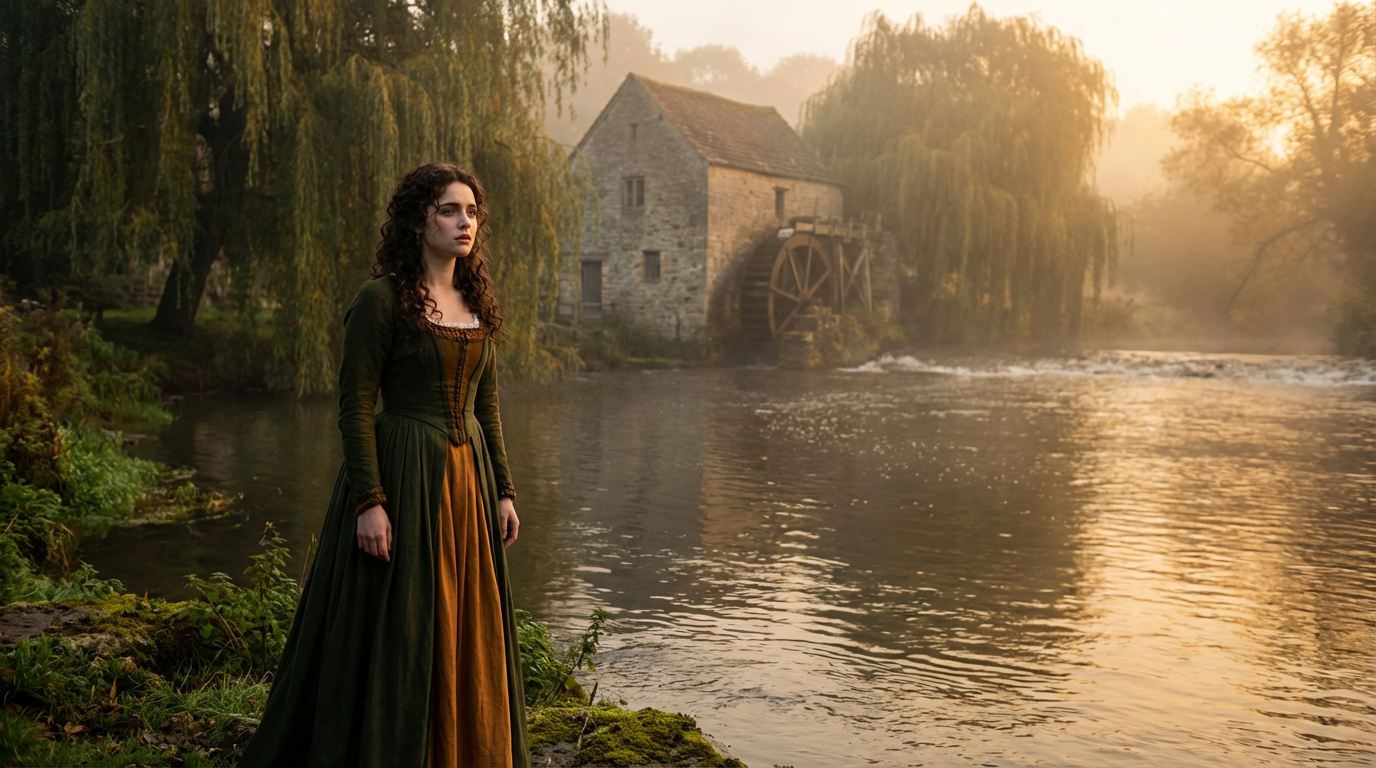
An excerpt from the original text.(complete · 2613 words)
Family Party
Maggie left her good aunt Gritty at the end of the week, and went to
Garum Firs to pay her visit to aunt Pullet according to agreement. In
the mean time very unexpected things had happened, and there was to be
a family party at Garum to discuss and celebrate a change in the
fortunes of the Tullivers, which was likely finally to carry away the
shadow of their demerits like the last limb of an eclipse, and cause
their hitherto obscured virtues to shine forth in full-rounded
splendor. It is pleasant to know that a new ministry just come into
office are not the only fellow-men who enjoy a period of high
appreciation and full-blown eulogy; in many respectable families
throughout this realm, relatives becoming creditable meet with a
similar cordiality of recognition, which in its fine freedom from the
coercion of any antecedents, suggests the hopeful possibility that we
may some day without any notice find ourselves in full millennium, with
cockatrices who have ceased to bite, and wolves that no longer show
their teeth with any but the blandest intentions.
Lucy came so early as to have the start even of aunt Glegg; for she
longed to have some undisturbed talk with Maggie about the wonderful
news. It seemed, did it not? said Lucy, with her prettiest air of
wisdom, as if everything, even other people’s misfortunes (poor
creatures!) were conspiring now to make poor dear aunt Tulliver, and
cousin Tom, and naughty Maggie too, if she were not obstinately bent on
the contrary, as happy as they deserved to be after all their troubles.
To think that the very day—the very day—after Tom had come back from
Newcastle, that unfortunate young Jetsome, whom Mr Wakem had placed at
the Mill, had been pitched off his horse in a drunken fit, and was
lying at St Ogg’s in a dangerous state, so that Wakem had signified his
wish that the new purchasers should enter on the premises at once!
It was very dreadful for that unhappy young man, but it did seem as if
the misfortune had happened then, rather than at any other time, in
order that cousin Tom might all the sooner have the fit reward of his
exemplary conduct,—papa thought so very highly of him. Aunt Tulliver
must certainly go to the Mill now, and keep house for Tom; that was
rather a loss to Lucy in the matter of household comfort; but then, to
think of poor aunty being in her old place again, and gradually getting
comforts about her there!
On this last point Lucy had her cunning projects, and when she and
Maggie had made their dangerous way down the bright stairs into the
handsome parlour, where the very sunbeams seemed cleaner than
elsewhere, she directed her manœuvres, as any other great tactician
would have done, against the weaker side of the enemy.
“Aunt Pullet,” she said, seating herself on the sofa, and caressingly
adjusting that lady’s floating cap-string, “I want you to make up your
mind what linen and things you will give Tom toward housekeeping;
because you are always so generous,—you give such nice things, you
know; and if you set the example, aunt Glegg will follow.”
“That she never can, my dear,” said Mrs Pullet, with unusual vigor,
“for she hasn’t got the linen to follow suit wi’ mine, I can tell you.
She’d niver the taste, not if she’d spend the money. Big checks and
live things, like stags and foxes, all her table-linen is,—not a spot
nor a diamond among ’em. But it’s poor work dividing one’s linen before
one dies,—I niver thought to ha’ done that, Bessy,” Mrs Pullet
continued, shaking her head and looking at her sister Tulliver, “when
you and me chose the double diamont, the first flax iver we’d spun, and
the Lord knows where yours is gone.”
“I’d no choice, I’m sure, sister,” said poor Mrs Tulliver, accustomed
to consider herself in the light of an accused person. “I’m sure it was
no wish o’ mine, iver, as I should lie awake o’ nights thinking o’ my
best bleached linen all over the country.”
“Take a peppermint, Mrs Tulliver,” said uncle Pullet, feeling that he
was offering a cheap and wholesome form of comfort, which he was
recommending by example.
“Oh, but, aunt Pullet,” said Lucy, “you’ve so much beautiful linen. And
suppose you had had daughters! Then you must have divided it when they
were married.”
“Well, I don’t say as I won’t do it,” said Mrs Pullet, “for now Tom’s
so lucky, it’s nothing but right his friends should look on him and
help him. There’s the tablecloths I bought at your sale, Bessy; it was
nothing but good natur’ o’ me to buy ’em, for they’ve been lying in the
chest ever since. But I’m not going to give Maggie any more o’ my Indy
muslin and things, if she’s to go into service again, when she might
stay and keep me company, and do my sewing for me, if she wasn’t wanted
at her brother’s.”
“Going into service” was the expression by which the Dodson mind
represented to itself the position of teacher or governess; and
Maggie’s return to that menial condition, now circumstances offered her
more eligible prospects, was likely to be a sore point with all her
relatives, besides Lucy. Maggie in her crude form, with her hair down
her back, and altogether in a state of dubious promise, was a most
undesirable niece; but now she was capable of being at once ornamental
and useful. The subject was revived in aunt and uncle Glegg’s presence,
over the tea and muffins.
“Hegh, hegh!” said Mr Glegg, good-naturedly patting Maggie on the back,
“nonsense, nonsense! Don’t let us hear of you taking a place again,
Maggie. Why, you must ha’ picked up half-a-dozen sweethearts at the
bazaar; isn’t there one of ’em the right sort of article? Come, now?”
“Mr Glegg,” said his wife, with that shade of increased politeness in
her severity which she always put on with her crisper fronts, “you’ll
excuse me, but you’re far too light for a man of your years. It’s
respect and duty to her aunts, and the rest of her kin as are so good
to her, should have kept my niece from fixing about going away again
without consulting us; not sweethearts, if I’m to use such a word,
though it was never heared in my family.”
“Why, what did they call us, when we went to see ’em, then, eh,
neighbour Pullet? They thought us sweet enough then,” said Mr Glegg,
winking pleasantly; while Mr Pullet, at the suggestion of sweetness,
took a little more sugar.
“Mr Glegg,” said Mrs G., “if you’re going to be undelicate, let me
know.”
“La, Jane, your husband’s only joking,” said Mrs Pullet; “let him joke
while he’s got health and strength. There’s poor Mr Tilt got his mouth
drawn all o’ one side, and couldn’t laugh if he was to try.”
“I’ll trouble you for the muffineer, then, Mr Glegg,” said Mrs G., “if
I may be so bold to interrupt your joking. Though it’s other people
must see the joke in a niece’s putting a slight on her mother’s eldest
sister, as is the head o’ the family; and only coming in and out on
short visits, all the time she’s been in the town, and then settling to
go away without my knowledge,—as I’d laid caps out on purpose for her
to make ’em up for me,—and me as have divided my money so equal——”
“Sister,” Mrs Tulliver broke in anxiously, “I’m sure Maggie never
thought o’ going away without staying at your house as well as the
others. Not as it’s my wish she should go away at all, but quite
contrairy. I’m sure I’m innocent. I’ve said over and over again, ‘My
dear, you’ve no call to go away.’ But there’s ten days or a fortnight
Maggie’ll have before she’s fixed to go; she can stay at your house
just as well, and I’ll step in when I can, and so will Lucy.”
“Bessy,” said Mrs Glegg, “if you’d exercise a little more thought, you
might know I should hardly think it was worth while to unpin a bed, and
go to all that trouble now, just at the end o’ the time, when our house
isn’t above a quarter of an hour’s walk from Mr Deane’s. She can come
the first thing in the morning, and go back the last at night, and be
thankful she’s got a good aunt so close to her to come and sit with. I
know I should, when I was her age.”
“La, Jane,” said Mrs Pullet, “it ’ud do your beds good to have somebody
to sleep in ’em. There’s that striped room smells dreadful mouldy, and
the glass mildewed like anything. I’m sure I thought I should be struck
with death when you took me in.”
“Oh, there is Tom!” exclaimed Lucy, clapping her hands. “He’s come on
Sindbad, as I told him. I was afraid he was not going to keep his
promise.”
Maggie jumped up to kiss Tom as he entered, with strong feeling, at
this first meeting since the prospect of returning to the Mill had been
opened to him; and she kept his hand, leading him to the chair by her
side. To have no cloud between herself and Tom was still a perpetual
yearning in her, that had its root deeper than all change. He smiled at
her very kindly this evening, and said, “Well, Magsie, how’s aunt
Moss?”
“Come, come, sir,” said Mr Glegg putting out his hand. “Why, you’re
such a big man, you carry all before you, it, seems. You’re come into
your luck a good deal earlier than us old folks did; but I wish you
joy, I wish you joy. You’ll get the Mill all for your own again some
day, I’ll be bound. You won’t stop half-way up the hill.”
“But I hope he’ll bear in mind as it’s his mother’s family as he owes
it to,” said Mrs Glegg. “If he hadn’t had them to take after, he’d ha’
been poorly off. There was never any failures, nor lawing, nor
wastefulness in our family, nor dying without wills——”
“No, nor sudden deaths,” said aunt Pullet; “allays the doctor called
in. But Tom had the Dodson skin; I said that from the first. And I
don’t know what you mean to do, sister Glegg, but I mean to give him
a tablecloth of all my three biggest sizes but one, besides sheets. I
don’t say what more I shall do; but that I shall do, and if I should
die to-morrow, Mr Pullet, you’ll bear it in mind,—though you’ll be
blundering with the keys, and never remember as that on the third shelf
o’ the left-hand wardrobe, behind the night-caps with the broad
ties,—not the narrow-frilled uns,—is the key of the drawer in the Blue
Room, where the key o’ the Blue Closet is. You’ll make a mistake, and I
shall niver be worthy to know it. You’ve a memory for my pills and
draughts, wonderful,—I’ll allays say that of you,—but you’re lost among
the keys.” This gloomy prospect of the confusion that would ensue on
her decease was very affecting to Mrs Pullet.
“You carry it too far, Sophy,—that locking in and out,” said Mrs Glegg,
in a tone of some disgust at this folly. “You go beyond your own
family. There’s nobody can say I don’t lock up; but I do what’s
reasonable, and no more. And as for the linen, I shall look out what’s
serviceable, to make a present of to my nephey; I’ve got cloth as has
never been whitened, better worth having than other people’s fine
holland; and I hope he’ll lie down in it and think of his aunt.”
Tom thanked Mrs Glegg, but evaded any promise to meditate nightly on
her virtues; and Mr Glegg effected a diversion for him by asking about
Mr Deane’s intentions concerning steam.
Lucy had had her far-sighted views in begging Tom to come on Sindbad.
It appeared, when it was time to go home, that the man-servant was to
ride the horse, and cousin Tom was to drive home his mother and Lucy.
“You must sit by yourself, aunty,” said that contriving young lady,
“because I must sit by Tom; I’ve a great deal to say to him.”
In the eagerness of her affectionate anxiety for Maggie, Lucy could not
persuade herself to defer a conversation about her with Tom, who, she
thought, with such a cup of joy before him as this rapid fulfilment of
his wish about the Mill, must become pliant and flexible. Her nature
supplied her with no key to Tom’s; and she was puzzled as well as
pained to notice the unpleasant change on his countenance when she gave
him the history of the way in which Philip had used his influence with
his father. She had counted on this revelation as a great stroke of
policy, which was to turn Tom’s heart toward Philip at once, and,
besides that, prove that the elder Wakem was ready to receive Maggie
with all the honours of a daughter-in-law. Nothing was wanted, then,
but for dear Tom, who always had that pleasant smile when he looked at
cousin Lucy, to turn completely round, say the opposite of what he had
always said before, and declare that he, for his part, was delighted
that all the old grievances should be healed, and that Maggie should
have Philip with all suitable despatch; in cousin Lucy’s opinion
nothing could be easier.
But to minds strongly marked by the positive and negative qualities
that create severity,—strength of will, conscious rectitude of purpose,
narrowness of imagination and intellect, great power of self-control,
and a disposition to exert control over others,—prejudices come as the
natural food of tendencies which can get no sustenance out of that
complex, fragmentary, doubt-provoking knowledge which we call truth.
Let a prejudice be bequeathed, carried in the air, adopted by hearsay,
caught in through the eye,—however it may come, these minds will give
it a habitation; it is something to assert strongly and bravely,
something to fill up the void of spontaneous ideas, something to impose
on others with the authority of conscious right; it is at once a staff
and a baton. Every prejudice that will answer these purposes is
self-evident. Our good, upright Tom Tulliver’s mind was of this class;
his inward criticism of his father’s faults did not prevent him from
adopting his father’s prejudice; it was a prejudice against a man of
lax principle and lax life, and it was a meeting-point for all the
disappointed feelings of family and personal pride. Other feelings
added their force to produce Tom’s bitter repugnance to Philip, and to
Maggie’s union with him; and notwithstanding Lucy’s power over her
strong-willed cousin, she got nothing but a cold refusal ever to
sanction such a marriage; “but of course Maggie could do as she
liked,—she had declared her determination to be independent. For Tom’s
part, he held himself bound by his duty to his father’s memory, and by
every manly feeling, never to consent to any relation with the Wakems.”
Thus, all that Lucy had effected by her zealous mediation was to fill
Tom’s mind with the expectation that Maggie’s perverse resolve to go
into a situation again would presently metamorphose itself, as her
resolves were apt to do, into something equally perverse, but entirely
different,—a marriage with Philip Wakem.
Master this chapter. Complete your experience
Purchase the complete book to access all chapters and support classic literature
As an Amazon Associate, we earn a small commission from qualifying purchases at no additional cost to you.
Available in paperback, hardcover, and e-book formats
Let's Analyse the Pattern
Success often reinforces our harshest traits by making us believe our rigid positions are morally justified.
Why This Matters
Connect literature to life
This chapter teaches how to predict whether someone's success will make them more generous or more rigid based on their core personality patterns.
Practice This Today
This week, notice when someone gets a promotion, raise, or win—do they become more flexible with others or more convinced they're always right?
Now let's explore the literary elements.
Key Quotes & Analysis
"relatives becoming creditable meet with a similar cordiality of recognition, which in its fine freedom from the coercion of any antecedents"
Context: Describing how family members suddenly become warm and generous when Tom's fortunes improve
Eliot sarcastically points out how people conveniently forget your past struggles when you become successful. The phrase 'freedom from antecedents' shows how selective human memory can be about others' difficulties.
In Today's Words:
Amazing how friendly family gets when you're doing well, like they completely forgot how they treated you when you were down
"It seemed, did it not? said Lucy, with her prettiest air of wisdom, as if everything, even other people's misfortunes were conspiring now to make poor dear aunt Tulliver happy"
Context: Lucy talking to Maggie about how Tom's success seems to solve everything
Lucy's naive optimism shows she doesn't understand how complex family dynamics really work. She thinks one piece of good news will fix all relationships and conflicts.
In Today's Words:
Isn't it great how everything's working out? Like the universe finally decided to give your family a break
"Tom's was not a nature to be softened by prosperity"
Context: Explaining why Tom becomes more rigid rather than more generous with his success
This reveals a crucial insight about personality types - some people become more judgmental when they succeed, not more understanding. Success feeds their sense of moral superiority rather than creating empathy.
In Today's Words:
Success didn't make Tom nicer - it made him more convinced he was right about everything
Thematic Threads
Pride
In This Chapter
Tom's success with the mill inflates his moral authority and makes him more judgmental rather than grateful
Development
Evolved from Tom's childhood need to be 'right' into adult self-righteousness validated by achievement
In Your Life:
You might catch yourself becoming more demanding or critical when things are going well for you
Class
In This Chapter
The aunts suddenly shower the Tullivers with respect and gifts now that their fortune has turned
Development
Consistent theme showing how social standing determines treatment throughout the novel
In Your Life:
You've likely seen how differently people treat you when your job title, income, or circumstances change
Family Dynamics
In This Chapter
Lucy's well-meaning attempt to reconcile Tom and Maggie backfires because she misreads Tom's character
Development
Building pattern of family members talking past each other and making assumptions about motivations
In Your Life:
You might recognize times when your good intentions in family conflicts made things worse
Moral Certainty
In This Chapter
Tom's rigid personality feeds on prejudices because they provide clear moral authority in complex situations
Development
Tom's need for moral clarity has grown stronger as life's complications have increased
In Your Life:
You might notice how comforting it feels to have clear 'rules' about who's right and wrong in complicated situations
Misunderstanding
In This Chapter
Lucy expects gratitude from Tom about Philip's help but gets the opposite reaction—more rigid opposition
Development
Pattern of characters consistently misreading each other's motivations and reactions
In Your Life:
You've probably experienced giving someone good news and getting an unexpectedly negative reaction
You now have the context. Time to form your own thoughts.
Discussion Questions
- 1
What changes in how the family treats Tom once they learn he's getting the mill back, and what does this reveal about family dynamics?
analysis • surface - 2
Why does learning that Philip helped him get the mill back make Tom more opposed to Maggie's relationship, not less?
analysis • medium - 3
Where have you seen someone become more rigid or judgmental after experiencing success, rather than more generous?
application • medium - 4
How would you approach someone like Tom if you needed to change their mind about something important to you?
application • deep - 5
What does this chapter suggest about whether success reveals character or changes it?
reflection • deep
Critical Thinking Exercise
Track Your Success Patterns
Think of a recent success or win in your life - a promotion, recognition, solving a problem, or achieving a goal. Write down how you felt immediately after and what conclusions you drew about yourself or your methods. Then honestly assess: did this success make you more flexible and generous with others, or did it make you feel more justified in being strict or judgmental?
Consider:
- •Success often feels like validation of our methods, even when other factors contributed
- •Notice whether you became more willing to help others or more convinced others should 'work as hard as you did'
- •Consider how your success affected your patience with people who struggle in similar areas
Journaling Prompt
Write about a time when you had to deal with someone who became more difficult after they succeeded. What approach worked (or might have worked) to reach them?
Coming Up Next...
Chapter 52: Swept Away by Temptation
Tom's expectations about Maggie's 'perverse' behavior are about to be tested as larger forces begin to sweep everyone toward decisions they never anticipated. The tide of events is rising, and soon no one will have the luxury of standing still.



