
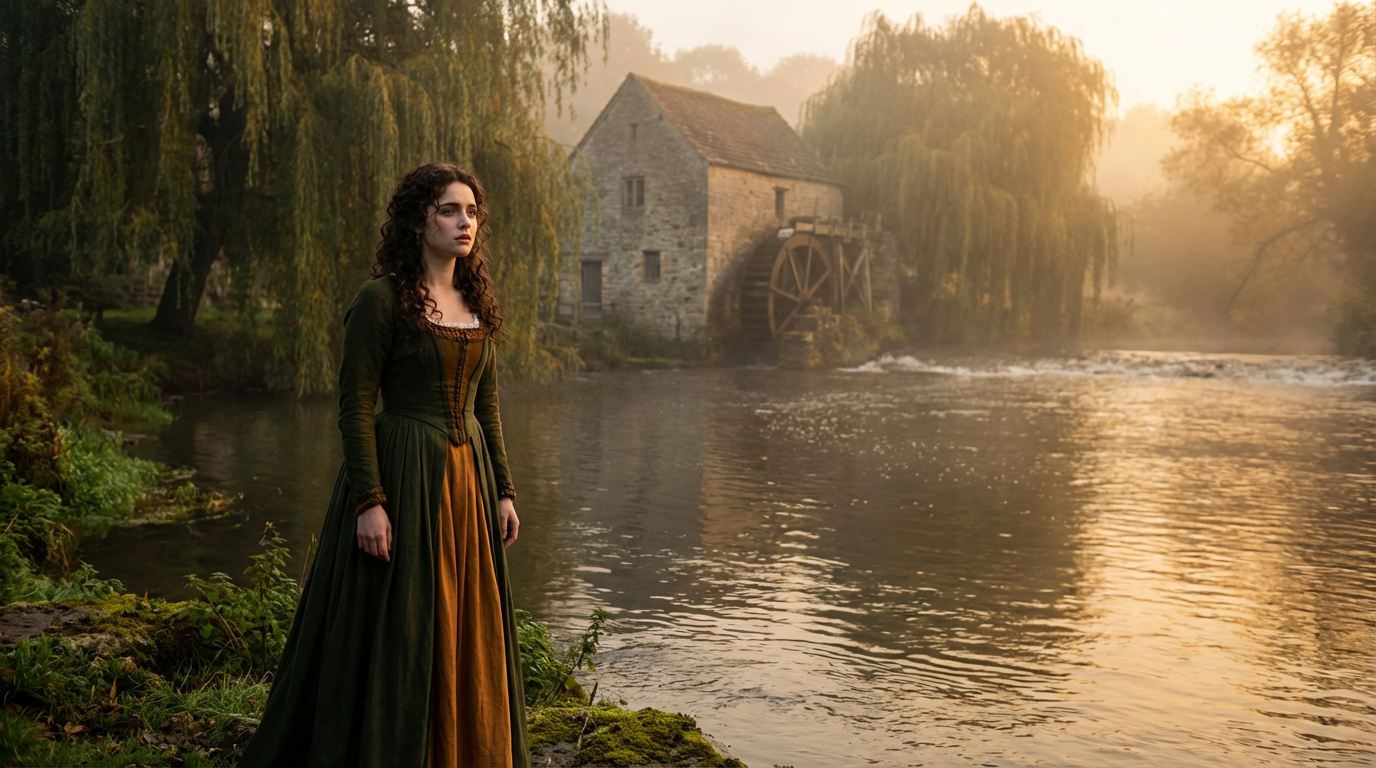
An excerpt from the original text.(complete · 2489 words)
the Lane
Maggie had been four days at her aunt Moss’s giving the early June
sunshine quite a new brightness in the care-dimmed eyes of that
affectionate woman, and making an epoch for her cousins great and
small, who were learning her words and actions by heart, as if she had
been a transient avatar of perfect wisdom and beauty.
She was standing on the causeway with her aunt and a group of cousins
feeding the chickens, at that quiet moment in the life of the farmyards
before the afternoon milking-time. The great buildings round the hollow
yard were as dreary and tumbledown as ever, but over the old
garden-wall the straggling rose-bushes were beginning to toss their
summer weight, and the gray wood and old bricks of the house, on its
higher level, had a look of sleepy age in the broad afternoon sunlight,
that suited the quiescent time. Maggie, with her bonnet over her arm,
was smiling down at the hatch of small fluffy chickens, when her aunt
exclaimed,—
“Goodness me! who is that gentleman coming in at the gate?”
It was a gentleman on a tall bay horse; and the flanks and neck of the
horse were streaked black with fast riding. Maggie felt a beating at
head and heart, horrible as the sudden leaping to life of a savage
enemy who had feigned death.
“Who is it, my dear?” said Mrs Moss, seeing in Maggie’s face the
evidence that she knew.
“It is Mr Stephen Guest,” said Maggie, rather faintly. “My cousin
Lucy’s—a gentleman who is very intimate at my cousin’s.”
Stephen was already close to them, had jumped off his horse, and now
raised his hat as he advanced.
“Hold the horse, Willy,” said Mrs Moss to the twelve-year-old boy.
“No, thank you,” said Stephen, pulling at the horse’s impatiently
tossing head. “I must be going again immediately. I have a message to
deliver to you, Miss Tulliver, on private business. May I take the
liberty of asking you to walk a few yards with me?”
He had a half-jaded, half-irritated look, such as a man gets when he
has been dogged by some care or annoyance that makes his bed and his
dinner of little use to him. He spoke almost abruptly, as if his errand
were too pressing for him to trouble himself about what would be
thought by Mrs Moss of his visit and request. Good Mrs Moss, rather
nervous in the presence of this apparently haughty gentleman, was
inwardly wondering whether she would be doing right or wrong to invite
him again to leave his horse and walk in, when Maggie, feeling all the
embarrassment of the situation, and unable to say anything, put on her
bonnet, and turned to walk toward the gate.
Stephen turned too, and walked by her side, leading his horse.
Not a word was spoken till they were out in the lane, and had walked
four or five yards, when Maggie, who had been looking straight before
her all the while, turned again to walk back, saying, with haughty
resentment,—
“There is no need for me to go any farther. I don’t know whether you
consider it gentlemanly and delicate conduct to place me in a position
that forced me to come out with you, or whether you wished to insult me
still further by thrusting an interview upon me in this way.”
“Of course you are angry with me for coming,” said Stephen, bitterly.
“Of course it is of no consequence what a man has to suffer; it is only
your woman’s dignity that you care about.”
Maggie gave a slight start, such as might have come from the slightest
possible electric shock.
“As if it were not enough that I’m entangled in this way; that I’m mad
with love for you; that I resist the strongest passion a man can feel,
because I try to be true to other claims; but you must treat me as if I
were a coarse brute, who would willingly offend you. And when, if I had
my own choice, I should ask you to take my hand and my fortune and my
whole life, and do what you liked with them! I know I forgot myself. I
took an unwarrantable liberty. I hate myself for having done it. But I
repented immediately; I’ve been repenting ever since. You ought not to
think it unpardonable; a man who loves with his whole soul, as I do
you, is liable to be mastered by his feelings for a moment; but you
know—you must believe—that the worst pain I could have is to have
pained you; that I would give the world to recall the error.”
Maggie dared not speak, dared not turn her head. The strength that had
come from resentment was all gone, and her lips were quivering visibly.
She could not trust herself to utter the full forgiveness that rose in
answer to that confession.
They were come nearly in front of the gate again, and she paused,
trembling.
“You must not say these things; I must not hear them,” she said,
looking down in misery, as Stephen came in front of her, to prevent her
from going farther toward the gate. “I’m very sorry for any pain you
have to go through; but it is of no use to speak.”
“Yes, it is of use,” said Stephen, impetuously. “It would be of use
if you would treat me with some sort of pity and consideration, instead
of doing me vile injustice in your mind. I could bear everything more
quietly if I knew you didn’t hate me for an insolent coxcomb. Look at
me; see what a hunted devil I am; I’ve been riding thirty miles every
day to get away from the thought of you.”
Maggie did not—dared not—look. She had already seen the harassed face.
But she said gently,—
“I don’t think any evil of you.”
“Then, dearest, look at me,” said Stephen, in deepest, tenderest tones
of entreaty. “Don’t go away from me yet. Give me a moment’s happiness;
make me feel you’ve forgiven me.”
“Yes, I do forgive you,” said Maggie, shaken by those tones, and all
the more frightened at herself. “But pray let me go in again. Pray go
away.”
A great tear fell from under her lowered eyelids.
“I can’t go away from you; I can’t leave you,” said Stephen, with still
more passionate pleading. “I shall come back again if you send me away
with this coldness; I can’t answer for myself. But if you will go with
me only a little way I can live on that. You see plainly enough that
your anger has only made me ten times more unreasonable.”
Maggie turned. But Tancred, the bay horse, began to make such spirited
remonstrances against this frequent change of direction, that Stephen,
catching sight of Willy Moss peeping through the gate, called out,
“Here! just come and hold my horse for five minutes.”
“Oh, no,” said Maggie, hurriedly, “my aunt will think it so strange.”
“Never mind,” Stephen answered impatiently; “they don’t know the people
at St Ogg’s. Lead him up and down just here for five minutes,” he added
to Willy, who was now close to them; and then he turned to Maggie’s
side, and they walked on. It was clear that she must go on now.
“Take my arm,” said Stephen, entreatingly; and she took it, feeling all
the while as if she were sliding downward in a nightmare.
“There is no end to this misery,” she began, struggling to repel the
influence by speech. “It is wicked—base—ever allowing a word or look
that Lucy—that others might not have seen. Think of Lucy.”
“I do think of her—bless her. If I didn’t——” Stephen had laid his hand
on Maggie’s that rested on his arm, and they both felt it difficult to
speak.
“And I have other ties,” Maggie went on, at last, with a desperate
effort, “even if Lucy did not exist.”
“You are engaged to Philip Wakem?” said Stephen, hastily. “Is it so?”
“I consider myself engaged to him; I don’t mean to marry any one else.”
Stephen was silent again until they had turned out of the sun into a
side lane, all grassy and sheltered. Then he burst out impetuously,—
“It is unnatural, it is horrible. Maggie, if you loved me as I love
you, we should throw everything else to the winds for the sake of
belonging to each other. We should break all these mistaken ties that
were made in blindness, and determine to marry each other.”
“I would rather die than fall into that temptation,” said Maggie, with
deep, slow distinctness, all the gathered spiritual force of painful
years coming to her aid in this extremity. She drew her arm from his as
she spoke.
“Tell me, then, that you don’t care for me,” he said, almost violently.
“Tell me that you love some one else better.”
It darted through Maggie’s mind that here was a mode of releasing
herself from outward struggle,—to tell Stephen that her whole heart was
Philip’s. But her lips would not utter that, and she was silent.
“If you do love me, dearest,” said Stephen, gently, taking her hand
again and laying it within his arm, “it is better—it is right that we
should marry each other. We can’t help the pain it will give. It is
come upon us without our seeking; it is natural; it has taken hold of
me in spite of every effort I have made to resist it. God knows, I’ve
been trying to be faithful to tacit engagements, and I’ve only made
things worse; I’d better have given way at first.”
Maggie was silent. If it were not wrong—if she were once convinced of
that, and need no longer beat and struggle against this current, soft
and yet strong as the summer stream!
“Say ‘yes,’ dearest,” said Stephen, leaning to look entreatingly in her
face. “What could we care about in the whole world beside, if we
belonged to each other?”
Her breath was on his face, his lips were very near hers, but there was
a great dread dwelling in his love for her.
Her lips and eyelids quivered; she opened her eyes full on his for an
instant, like a lovely wild animal timid and struggling under caresses,
and then turned sharp round toward home again.
“And after all,” he went on, in an impatient tone, trying to defeat his
own scruples as well as hers, “I am breaking no positive engagement; if
Lucy’s affections had been withdrawn from me and given to some one
else, I should have felt no right to assert a claim on her. If you are
not absolutely pledged to Philip, we are neither of us bound.”
“You don’t believe that; it is not your real feeling,” said Maggie,
earnestly. “You feel, as I do, that the real tie lies in the feelings
and expectations we have raised in other minds. Else all pledges might
be broken, when there was no outward penalty. There would be no such
thing as faithfulness.”
Stephen was silent; he could not pursue that argument; the opposite
conviction had wrought in him too strongly through his previous time of
struggle. But it soon presented itself in a new form.
“The pledge can’t be fulfilled,” he said, with impetuous insistence.
“It is unnatural; we can only pretend to give ourselves to any one
else. There is wrong in that too; there may be misery in it for them
as well as for us. Maggie, you must see that; you do see that.”
He was looking eagerly at her face for the least sign of compliance;
his large, firm, gentle grasp was on her hand. She was silent for a few
moments, with her eyes fixed on the ground; then she drew a deep
breath, and said, looking up at him with solemn sadness,—
“Oh, it is difficult,—life is very difficult! It seems right to me
sometimes that we should follow our strongest feeling; but then, such
feelings continually come across the ties that all our former life has
made for us,—the ties that have made others dependent on us,—and would
cut them in two. If life were quite easy and simple, as it might have
been in Paradise, and we could always see that one being first toward
whom—I mean, if life did not make duties for us before love comes, love
would be a sign that two people ought to belong to each other. But I
see—I feel it is not so now; there are things we must renounce in life;
some of us must resign love. Many things are difficult and dark to me;
but I see one thing quite clearly,—that I must not, cannot, seek my own
happiness by sacrificing others. Love is natural; but surely pity and
faithfulness and memory are natural too. And they would live in me
still, and punish me if I did not obey them. I should be haunted by the
suffering I had caused. Our love would be poisoned. Don’t urge me; help
me,—help me, because I love you.”
Maggie had become more and more earnest as she went on; her face had
become flushed, and her eyes fuller and fuller of appealing love.
Stephen had the fibre of nobleness in him that vibrated to her appeal;
but in the same moment—how could it be otherwise?—that pleading beauty
gained new power over him.
“Dearest,” he said, in scarcely more than a whisper, while his arm
stole round her, “I’ll do, I’ll bear anything you wish. But—one
kiss—one—the last—before we part.”
One kiss, and then a long look, until Maggie said tremulously, “Let me
go,—let me make haste back.”
She hurried along, and not another word was spoken. Stephen stood still
and beckoned when they came within sight of Willy and the horse, and
Maggie went on through the gate. Mrs Moss was standing alone at the
door of the old porch; she had sent all the cousins in, with kind
thoughtfulness. It might be a joyful thing that Maggie had a rich and
handsome lover, but she would naturally feel embarrassed at coming in
again; and it might not be joyful. In either case Mrs Moss waited
anxiously to receive Maggie by herself. The speaking face told plainly
enough that, if there was joy, it was of a very agitating, dubious
sort.
“Sit down here a bit, my dear.” She drew Maggie into the porch, and sat
down on the bench by her; there was no privacy in the house.
“Oh, aunt Gritty, I’m very wretched! I wish I could have died when I
was fifteen. It seemed so easy to give things up then; it is so hard
now.”
The poor child threw her arms round her aunt’s neck, and fell into
long, deep sobs.
Master this chapter. Complete your experience
Purchase the complete book to access all chapters and support classic literature
As an Amazon Associate, we earn a small commission from qualifying purchases at no additional cost to you.
Available in paperback, hardcover, and e-book formats
Let's Analyse the Pattern
The internal battle between immediate emotional desires and long-term ethical consequences, where the right choice often feels the hardest.
Why This Matters
Connect literature to life
This chapter teaches how to feel powerful attraction without being controlled by it, separating what you want from what you should do.
Practice This Today
This week, notice when someone frames desire as inevitability—'we can't help how we feel'—and practice responding with 'feeling it doesn't mean following it.'
Now let's explore the literary elements.
Key Quotes & Analysis
"I see one thing quite clearly—that I must not, cannot, seek my own happiness by sacrificing others."
Context: When Stephen begs her to choose him over duty to Lucy and Philip
This is Maggie's moral core speaking. She recognizes that true happiness can't be built on other people's pain. It shows her maturity and ethical strength, even when it costs her everything she wants.
In Today's Words:
I can't be happy knowing I destroyed other people's lives to get what I wanted.
"Maggie felt a beating at head and heart, horrible as the sudden leaping to life of a savage enemy who had feigned death."
Context: When Maggie sees Stephen approaching on horseback
This shows how Maggie's attraction to Stephen feels like a threat to her moral self. Her physical reaction reveals the power he has over her, even as she knows she must resist.
In Today's Words:
Her heart started pounding like when your ex shows up unexpectedly and all those feelings you buried come rushing back.
"Love is natural; but surely pity and faithfulness and memory are natural too."
Context: Arguing against Stephen's claim that they should follow their natural feelings
Maggie counters Stephen's argument by showing that humans have many natural instincts, not just romantic love. She's saying that loyalty and compassion are just as much part of human nature as desire.
In Today's Words:
Just because we have feelings doesn't mean we should act on them - caring about others is natural too.
Thematic Threads
Sacrifice
In This Chapter
Maggie chooses duty over desire, sacrificing her happiness to protect Lucy and Philip from betrayal
Development
Evolved from childhood sacrifices to this ultimate test of moral character
In Your Life:
You might face this when choosing between personal advancement and loyalty to colleagues or family.
Class
In This Chapter
Stephen's privilege allows him to pursue what he wants without considering consequences for others
Development
Continues the theme of how social position shapes moral choices
In Your Life:
You see this when wealthy people make decisions that hurt working-class communities without facing the fallout themselves.
Identity
In This Chapter
Maggie defines herself by her capacity to endure pain rather than cause it to others
Development
Her identity has solidified around moral strength despite personal cost
In Your Life:
You might struggle with whether you're someone who puts others first or fights for what you deserve.
Love
In This Chapter
Stephen argues that passionate love justifies breaking commitments and hurting others
Development
Contrasts with earlier portrayals of love as sacrifice and duty
In Your Life:
You might face this when attraction threatens existing relationships or family stability.
Manipulation
In This Chapter
Stephen uses emotional pressure, physical presence, and philosophical arguments to override Maggie's resistance
Development
Introduced here as a new dynamic in their relationship
In Your Life:
You encounter this when someone uses your feelings against your better judgment in relationships or workplace situations.
You now have the context. Time to form your own thoughts.
Discussion Questions
- 1
What arguments does Stephen use to try to convince Maggie to abandon their current commitments and be with him?
analysis • surface - 2
Why does Maggie say she can't seek her own happiness by sacrificing others, even though she clearly loves Stephen?
analysis • medium - 3
Where do you see this same battle between desire and duty playing out in modern relationships, careers, or family situations?
application • medium - 4
What strategies could Maggie have used to avoid being in this impossible situation in the first place?
application • deep - 5
What does Maggie's response reveal about how we can maintain our moral compass when our emotions are pulling us in the opposite direction?
reflection • deep
Critical Thinking Exercise
Map Your Own Desire vs. Duty Conflict
Think of a situation in your own life where what you want conflicts with what you know is right or responsible. Write down the immediate desire, then list who would be affected if you followed that desire. Finally, imagine yourself one year from now - would you be proud of the choice you made?
Consider:
- •Consider both obvious victims and less visible people who might be hurt
- •Think about whether the other person is using manipulation tactics similar to Stephen's
- •Remember that feeling torn doesn't make you weak - it makes you human
Journaling Prompt
Write about a time when you chose duty over desire, or desire over duty. What were the long-term consequences? What would you do differently now?
Coming Up Next...
Chapter 51: When Success Changes Everything
Maggie returns to face the consequences of her encounter with Stephen, but the emotional turmoil is far from over. A family gathering awaits, where keeping secrets becomes increasingly difficult.



