
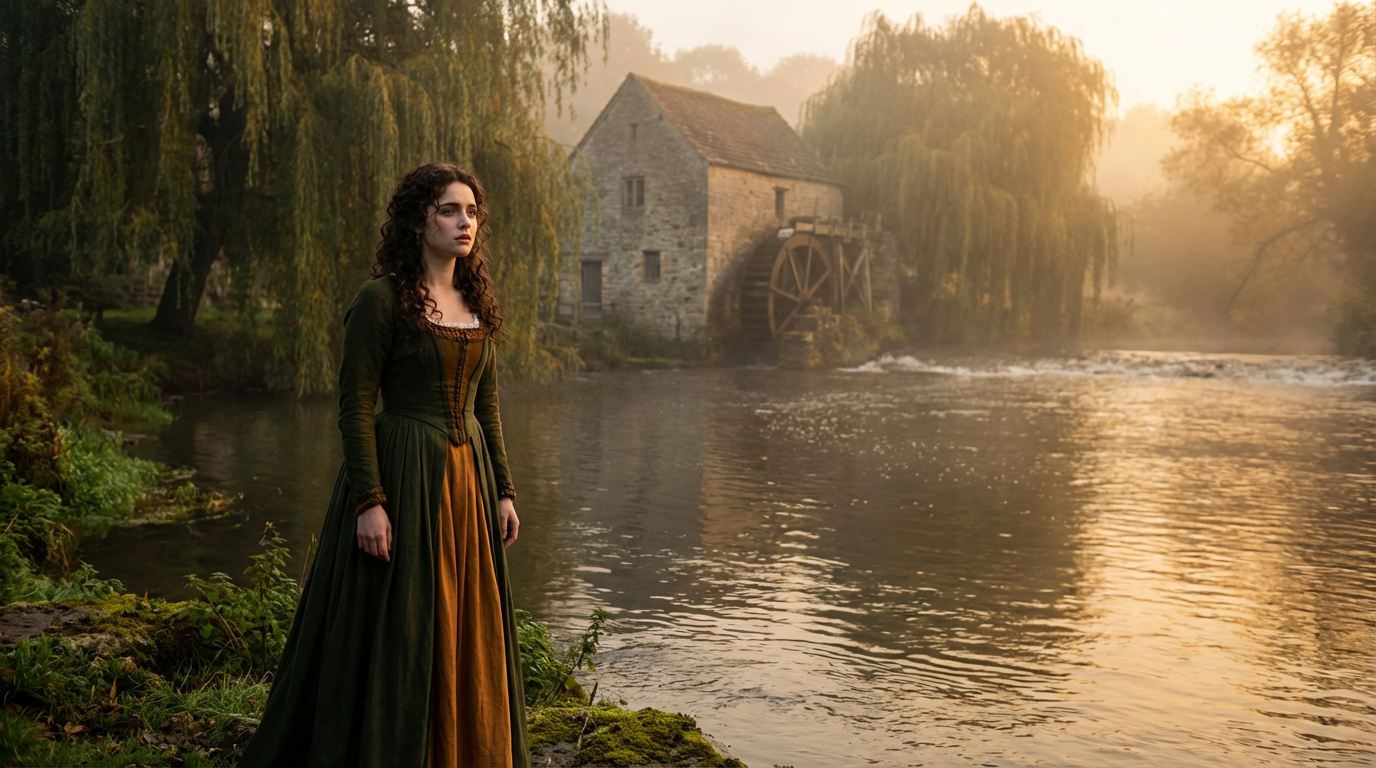
An excerpt from the original text.(complete · 4321 words)
aking
When Maggie was gone to sleep, Stephen, weary too with his unaccustomed
amount of rowing, and with the intense inward life of the last twelve
hours, but too restless to sleep, walked and lounged about the deck
with his cigar far on into midnight, not seeing the dark water, hardly
conscious there were stars, living only in the near and distant future.
At last fatigue conquered restlessness, and he rolled himself up in a
piece of tarpaulin on the deck near Maggie’s feet.
She had fallen asleep before nine, and had been sleeping for six hours
before the faintest hint of a midsummer daybreak was discernible. She
awoke from that vivid dreaming which makes the margin of our deeper
rest. She was in a boat on the wide water with Stephen, and in the
gathering darkness something like a star appeared, that grew and grew
till they saw it was the Virgin seated in St Ogg’s boat, and it came
nearer and nearer, till they saw the Virgin was Lucy and the boatman
was Philip,—no, not Philip, but her brother, who rowed past without
looking at her; and she rose to stretch out her arms and call to him,
and their own boat turned over with the movement, and they began to
sink, till with one spasm of dread she seemed to awake, and find she
was a child again in the parlour at evening twilight, and Tom was not
really angry. From the soothed sense of that false waking she passed to
the real waking,—to the plash of water against the vessel, and the
sound of a footstep on the deck, and the awful starlit sky. There was a
moment of utter bewilderment before her mind could get disentangled
from the confused web of dreams; but soon the whole terrible truth
urged itself upon her. Stephen was not by her now; she was alone with
her own memory and her own dread. The irrevocable wrong that must blot
her life had been committed; she had brought sorrow into the lives of
others,—into the lives that were knit up with hers by trust and love.
The feeling of a few short weeks had hurried her into the sins her
nature had most recoiled from,—breach of faith and cruel selfishness;
she had rent the ties that had given meaning to duty, and had made
herself an outlawed soul, with no guide but the wayward choice of her
own passion. And where would that lead her? Where had it led her now?
She had said she would rather die than fall into that temptation. She
felt it now,—now that the consequences of such a fall had come before
the outward act was completed. There was at least this fruit from all
her years of striving after the highest and best,—that her soul though
betrayed, beguiled, ensnared, could never deliberately consent to a
choice of the lower. And a choice of what? O God! not a choice of joy,
but of conscious cruelty and hardness; for could she ever cease to see
before her Lucy and Philip, with their murdered trust and hopes? Her
life with Stephen could have no sacredness; she must forever sink and
wander vaguely, driven by uncertain impulse; for she had let go the
clue of life,—that clue which once in the far-off years her young need
had clutched so strongly. She had renounced all delights then, before
she knew them, before they had come within her reach. Philip had been
right when he told her that she knew nothing of renunciation; she had
thought it was quiet ecstasy; she saw it face to face now,—that sad,
patient, loving strength which holds the clue of life,—and saw that the
thorns were forever pressing on its brow. The yesterday, which could
never be revoked,—if she could have changed it now for any length of
inward silent endurance, she would have bowed beneath that cross with a
sense of rest.
Day break came and the reddening eastern light, while her past life was
grasping her in this way, with that tightening clutch which comes in
the last moments of possible rescue. She could see Stephen now lying on
the deck still fast asleep, and with the sight of him there came a wave
of anguish that found its way in a long-suppressed sob. The worst
bitterness of parting—the thought that urged the sharpest inward cry
for help—was the pain it must give to him. But surmounting everything
was the horror at her own possible failure, the dread lest her
conscience should be benumbed again, and not rise to energy till it was
too late. Too late! it was too late already not to have caused misery;
too late for everything, perhaps, but to rush away from the last act of
baseness,—the tasting of joys that were wrung from crushed hearts.
The sun was rising now, and Maggie started up with the sense that a day
of resistance was beginning for her. Her eyelashes were still wet with
tears, as, with her shawl over her head, she sat looking at the slowly
rounding sun. Something roused Stephen too, and getting up from his
hard bed, he came to sit beside her. The sharp instinct of anxious love
saw something to give him alarm in the very first glance. He had a
hovering dread of some resistance in Maggie’s nature that he would be
unable to overcome. He had the uneasy consciousness that he had robbed
her of perfect freedom yesterday; there was too much native honour in
him, for him not to feel that, if her will should recoil, his conduct
would have been odious, and she would have a right to reproach him.
But Maggie did not feel that right; she was too conscious of fatal
weakness in herself, too full of the tenderness that comes with the
foreseen need for inflicting a wound. She let him take her hand when he
came to sit down beside her, and smiled at him, only with rather a sad
glance; she could say nothing to pain him till the moment of possible
parting was nearer. And so they drank their cup of coffee together, and
walked about the deck, and heard the captain’s assurance that they
should be in at Mudport by five o’clock, each with an inward burthen;
but in him it was an undefined fear, which he trusted to the coming
hours to dissipate; in her it was a definite resolve on which she was
trying silently to tighten her hold. Stephen was continually, through
the morning, expressing his anxiety at the fatigue and discomfort she
was suffering, and alluded to landing and to the change of motion and
repose she would have in a carriage, wanting to assure himself more
completely by presupposing that everything would be as he had arranged
it. For a long while Maggie contented herself with assuring him that
she had had a good night’s rest, and that she didn’t mind about being
on the vessel,—it was not like being on the open sea, it was only a
little less pleasant than being in a boat on the Floss. But a
suppressed resolve will betray itself in the eyes, and Stephen became
more and more uneasy as the day advanced, under the sense that Maggie
had entirely lost her passiveness. He longed, but did not dare, to
speak of their marriage, of where they would go after it, and the steps
he would take to inform his father, and the rest, of what had happened.
He longed to assure himself of a tacit assent from her. But each time
he looked at her, he gathered a stronger dread of the new, quiet
sadness with which she met his eyes. And they were more and more
silent.
“Here we are in sight of Mudport,” he said at last. “Now, dearest,” he
added, turning toward her with a look that was half beseeching, “the
worst part of your fatigue is over. On the land we can command
swiftness. In another hour and a half we shall be in a chaise together,
and that will seem rest to you after this.”
Maggie felt it was time to speak; it would only be unkind now to assent
by silence. She spoke in the lowest tone, as he had done, but with
distinct decision.
“We shall not be together; we shall have parted.”
The blood rushed to Stephen’s face.
“We shall not,” he said. “I’ll die first.”
It was as he had dreaded—there was a struggle coming. But neither of
them dared to say another word till the boat was let down, and they
were taken to the landing-place. Here there was a cluster of gazers and
passengers awaiting the departure of the steamboat to St Ogg’s. Maggie
had a dim sense, when she had landed, and Stephen was hurrying her
along on his arm, that some one had advanced toward her from that
cluster as if he were coming to speak to her. But she was hurried
along, and was indifferent to everything but the coming trial.
A porter guided them to the nearest inn and posting-house, and Stephen
gave the order for the chaise as they passed through the yard. Maggie
took no notice of this, and only said, “Ask them to show us into a room
where we can sit down.”
When they entered, Maggie did not sit down, and Stephen, whose face had
a desperate determination in it, was about to ring the bell, when she
said, in a firm voice,—
“I’m not going; we must part here.”
“Maggie,” he said, turning round toward her, and speaking in the tones
of a man who feels a process of torture beginning, “do you mean to kill
me? What is the use of it now? The whole thing is done.”
“No, it is not done,” said Maggie. “Too much is done,—more than we can
ever remove the trace of. But I will go no farther. Don’t try to
prevail with me again. I couldn’t choose yesterday.”
What was he to do? He dared not go near her; her anger might leap out,
and make a new barrier. He walked backward and forward in maddening
perplexity.
“Maggie,” he said at last, pausing before her, and speaking in a tone
of imploring wretchedness, “have some pity—hear me—forgive me for what
I did yesterday. I will obey you now; I will do nothing without your
full consent. But don’t blight our lives forever by a rash perversity
that can answer no good purpose to any one, that can only create new
evils. Sit down, dearest; wait—think what you are going to do. Don’t
treat me as if you couldn’t trust me.”
He had chosen the most effective appeal; but Maggie’s will was fixed
unswervingly on the coming wrench. She had made up her mind to suffer.
“We must not wait,” she said, in a low but distinct voice; “we must
part at once.”
“We can’t part, Maggie,” said Stephen, more impetuously. “I can’t
bear it. What is the use of inflicting that misery on me? The
blow—whatever it may have been—has been struck now. Will it help any
one else that you should drive me mad?”
“I will not begin any future, even for you,” said Maggie, tremulously,
“with a deliberate consent to what ought not to have been. What I told
you at Basset I feel now; I would rather have died than fall into this
temptation. It would have been better if we had parted forever then.
But we must part now.”
“We will not part,” Stephen burst out, instinctively placing his back
against the door, forgetting everything he had said a few moments
before; “I will not endure it. You’ll make me desperate; I sha’n’t know
what I do.”
Maggie trembled. She felt that the parting could not be effected
suddenly. She must rely on a slower appeal to Stephen’s better self;
she must be prepared for a harder task than that of rushing away while
resolution was fresh. She sat down. Stephen, watching her with that
look of desperation which had come over him like a lurid light,
approached slowly from the door, seated himself close beside her, and
grasped her hand. Her heart beat like the heart of a frightened bird;
but this direct opposition helped her. She felt her determination
growing stronger.
“Remember what you felt weeks ago,” she began, with beseeching
earnestness; “remember what we both felt,—that we owed ourselves to
others, and must conquer every inclination which could make us false to
that debt. We have failed to keep our resolutions; but the wrong
remains the same.”
“No, it does not remain the same,” said Stephen. “We have proved that
it was impossible to keep our resolutions. We have proved that the
feeling which draws us toward each other is too strong to be overcome.
That natural law surmounts every other; we can’t help what it clashes
with.”
“It is not so, Stephen; I’m quite sure that is wrong. I have tried to
think it again and again; but I see, if we judged in that way, there
would be a warrant for all treachery and cruelty; we should justify
breaking the most sacred ties that can ever be formed on earth. If the
past is not to bind us, where can duty lie? We should have no law but
the inclination of the moment.”
“But there are ties that can’t be kept by mere resolution,” said
Stephen, starting up and walking about again. “What is outward
faithfulness? Would they have thanked us for anything so hollow as
constancy without love?”
Maggie did not answer immediately. She was undergoing an inward as well
as an outward contest. At last she said, with a passionate assertion of
her conviction, as much against herself as against him,—
“That seems right—at first; but when I look further, I’m sure it is
not right. Faithfulness and constancy mean something else besides
doing what is easiest and pleasantest to ourselves. They mean
renouncing whatever is opposed to the reliance others have in
us,—whatever would cause misery to those whom the course of our lives
has made dependent on us. If we—if I had been better, nobler, those
claims would have been so strongly present with me,—I should have felt
them pressing on my heart so continually, just as they do now in the
moments when my conscience is awake,—that the opposite feeling would
never have grown in me, as it has done; it would have been quenched at
once, I should have prayed for help so earnestly, I should have rushed
away as we rush from hideous danger. I feel no excuse for myself, none.
I should never have failed toward Lucy and Philip as I have done, if I
had not been weak, selfish, and hard,—able to think of their pain
without a pain to myself that would have destroyed all temptation. Oh,
what is Lucy feeling now? She believed in me—she loved me—she was so
good to me. Think of her——”
Maggie’s voice was getting choked as she uttered these last words.
“I can’t think of her,” said Stephen, stamping as if with pain. “I
can think of nothing but you, Maggie. You demand of a man what is
impossible. I felt that once; but I can’t go back to it now. And where
is the use of your thinking of it, except to torture me? You can’t
save them from pain now; you can only tear yourself from me, and make
my life worthless to me. And even if we could go back, and both fulfil
our engagements,—if that were possible now,—it would be hateful,
horrible, to think of your ever being Philip’s wife,—of your ever being
the wife of a man you didn’t love. We have both been rescued from a
mistake.”
A deep flush came over Maggie’s face, and she couldn’t speak. Stephen
saw this. He sat down again, taking her hand in his, and looking at her
with passionate entreaty.
“Maggie! Dearest! If you love me, you are mine. Who can have so great a
claim on you as I have? My life is bound up in your love. There is
nothing in the past that can annul our right to each other; it is the
first time we have either of us loved with our whole heart and soul.”
Maggie was still silent for a little while, looking down. Stephen was
in a flutter of new hope; he was going to triumph. But she raised her
eyes and met his with a glance that was filled with the anguish of
regret, not with yielding.
“No, not with my whole heart and soul, Stephen,” she said with timid
resolution. “I have never consented to it with my whole mind. There are
memories, and affections, and longings after perfect goodness, that
have such a strong hold on me; they would never quit me for long; they
would come back and be pain to me—repentance. I couldn’t live in peace
if I put the shadow of a wilful sin between myself and God. I have
caused sorrow already—I know—I feel it; but I have never deliberately
consented to it; I have never said, ‘They shall suffer, that I may have
joy.’ It has never been my will to marry you; if you were to win
consent from the momentary triumph of my feeling for you, you would not
have my whole soul. If I could wake back again into the time before
yesterday, I would choose to be true to my calmer affections, and live
without the joy of love.”
Stephen loosed her hand, and rising impatiently, walked up and down the
room in suppressed rage.
“Good God!” he burst out at last, “what a miserable thing a woman’s
love is to a man’s! I could commit crimes for you,—and you can balance
and choose in that way. But you don’t love me; if you had a tithe of
the feeling for me that I have for you, it would be impossible to you
to think for a moment of sacrificing me. But it weighs nothing with you
that you are robbing me of my life’s happiness.”
Maggie pressed her fingers together almost convulsively as she held
them clasped on her lap. A great terror was upon her, as if she were
ever and anon seeing where she stood by great flashes of lightning, and
then again stretched forth her hands in the darkness.
“No, I don’t sacrifice you—I couldn’t sacrifice you,” she said, as soon
as she could speak again; “but I can’t believe in a good for you, that
I feel, that we both feel, is a wrong toward others. We can’t choose
happiness either for ourselves or for another; we can’t tell where that
will lie. We can only choose whether we will indulge ourselves in the
present moment, or whether we will renounce that, for the sake of
obeying the divine voice within us,—for the sake of being true to all
the motives that sanctify our lives. I know this belief is hard; it has
slipped away from me again and again; but I have felt that if I let it
go forever, I should have no light through the darkness of this life.”
“But, Maggie,” said Stephen, seating himself by her again, “is it
possible you don’t see that what happened yesterday has altered the
whole position of things? What infatuation is it, what obstinate
prepossession, that blinds you to that? It is too late to say what we
might have done or what we ought to have done. Admitting the very worst
view of what has been done, it is a fact we must act on now; our
position is altered; the right course is no longer what it was before.
We must accept our own actions and start afresh from them. Suppose we
had been married yesterday? It is nearly the same thing. The effect on
others would not have been different. It would only have made this
difference to ourselves,” Stephen added bitterly, “that you might have
acknowledged then that your tie to me was stronger than to others.”
Again a deep flush came over Maggie’s face, and she was silent. Stephen
thought again that he was beginning to prevail,—he had never yet
believed that he should not prevail; there are possibilities which
our minds shrink from too completely for us to fear them.
“Dearest,” he said, in his deepest, tenderest tone, leaning toward her,
and putting his arm round her, “you are mine now,—the world believes
it; duty must spring out of that now.
“In a few hours you will be legally mine, and those who had claims on
us will submit,—they will see that there was a force which declared
against their claims.”
Maggie’s eyes opened wide in one terrified look at the face that was
close to hers, and she started up, pale again.
“Oh, I can’t do it,” she said, in a voice almost of agony; “Stephen,
don’t ask me—don’t urge me. I can’t argue any longer,—I don’t know what
is wise; but my heart will not let me do it. I see,—I feel their
trouble now; it is as if it were branded on my mind. I have suffered,
and had no one to pity me; and now I have made others suffer. It would
never leave me; it would embitter your love to me. I do care for
Philip—in a different way; I remember all we said to each other; I know
how he thought of me as the one promise of his life. He was given to me
that I might make his lot less hard; and I have forsaken him. And
Lucy—she has been deceived; she who trusted me more than any one. I
cannot marry you; I cannot take a good for myself that has been wrung
out of their misery. It is not the force that ought to rule us,—this
that we feel for each other; it would rend me away from all that my
past life has made dear and holy to me. I can’t set out on a fresh
life, and forget that; I must go back to it, and cling to it, else I
shall feel as if there were nothing firm beneath my feet.”
“Good God, Maggie!” said Stephen, rising too and grasping her arm, “you
rave. How can you go back without marrying me? You don’t know what will
be said, dearest. You see nothing as it really is.”
“Yes, I do. But they will believe me. I will confess everything. Lucy
will believe me—she will forgive you, and—and—oh, some good will come
by clinging to the right. Dear, dear Stephen, let me go!—don’t drag me
into deeper remorse. My whole soul has never consented; it does not
consent now.”
Stephen let go her arm, and sank back on his chair, half-stunned by
despairing rage. He was silent a few moments, not looking at her; while
her eyes were turned toward him yearningly, in alarm at this sudden
change. At last he said, still without looking at her,—
“Go, then,—leave me; don’t torture me any longer,—I can’t bear it.”
Involuntarily she leaned toward him and put out her hand to touch his.
But he shrank from it as if it had been burning iron, and said again,—
“Leave me.”
Maggie was not conscious of a decision as she turned away from that
gloomy averted face, and walked out of the room; it was like an
automatic action that fulfils a forgotten intention. What came after? A
sense of stairs descended as if in a dream, of flagstones, of a chaise
and horses standing, then a street, and a turning into another street
where a stage-coach was standing, taking in passengers, and the darting
thought that that coach would take her away, perhaps toward home. But
she could ask nothing yet; she only got into the coach.
Home—where her mother and brother were, Philip, Lucy, the scene of her
very cares and trials—was the haven toward which her mind tended; the
sanctuary where sacred relics lay, where she would be rescued from more
falling. The thought of Stephen was like a horrible throbbing pain,
which yet, as such pains do, seemed to urge all other thoughts into
activity. But among her thoughts, what others would say and think of
her conduct was hardly present. Love and deep pity and remorseful
anguish left no room for that.
The coach was taking her to York, farther away from home; but she did
not learn that until she was set down in the old city at midnight. It
was no matter; she could sleep there, and start home the next day. She
had her purse in her pocket, with all her money in it,—a bank-note and
a sovereign; she had kept it in her pocket from forgetfulness, after
going out to make purchases the day before yesterday.
Did she lie down in the gloomy bedroom of the old inn that night with
her will bent unwaveringly on the path of penitent sacrifice? The great
struggles of life are not so easy as that; the great problems of life
are not so clear. In the darkness of that night she saw Stephen’s face
turned toward her in passionate, reproachful misery; she lived through
again all the tremulous delights of his presence with her that made
existence an easy floating in a stream of joy, instead of a quiet
resolved endurance and effort. The love she had renounced came back
upon her with a cruel charm; she felt herself opening her arms to
receive it once more; and then it seemed to slip away and fade and
vanish, leaving only the dying sound of a deep, thrilling voice that
said, “Gone, forever gone.”
BOOK SEVENTH
THE FINAL RESCUE.
Master this chapter. Complete your experience
Purchase the complete book to access all chapters and support classic literature
As an Amazon Associate, we earn a small commission from qualifying purchases at no additional cost to you.
Available in paperback, hardcover, and e-book formats
Let's Analyse the Pattern
The moment when doing what's right requires walking away from what we want most, and the strength to choose responsibility over desire.
Why This Matters
Connect literature to life
This chapter teaches how to identify the moment when personal desire conflicts with moral responsibility, and how to choose the harder right path.
Practice This Today
This week, notice when you feel yourself justifying something that doesn't sit right—pause and ask who gets hurt if you continue.
Now let's explore the literary elements.
Key Quotes & Analysis
"We have proved that it was impossible to keep our resolutions... We have proved that the feeling which draws us towards each other is too strong to be overcome."
Context: Stephen arguing that their passion justifies everything and they should continue with their elopement
Stephen uses their inability to resist temptation as proof that they should give in completely. He's making the classic argument that strong feelings justify breaking promises and hurting others.
In Today's Words:
We couldn't help ourselves, so we might as well go all the way with it.
"I have never deliberately consented to it. I have been led on by circumstances."
Context: Maggie explaining to Stephen that she never truly chose this path
Maggie recognizes that she let herself drift into this situation rather than making a conscious choice. She's taking responsibility while also acknowledging how she got swept along.
In Today's Words:
I never actually decided to do this - I just let things happen and didn't stop them.
"If we judged in that way, there would be a warrant for all treachery and cruelty."
Context: Maggie rejecting Stephen's argument that their love justifies their actions
This is Maggie's moral awakening - she sees that if everyone justified hurting others by claiming strong feelings, society would fall apart. She's choosing universal principles over personal desire.
In Today's Words:
If everyone used that excuse, people would just hurt each other whenever they felt like it.
Thematic Threads
Moral Responsibility
In This Chapter
Maggie chooses to honor her commitments to Lucy and Philip despite her feelings for Stephen
Development
Culmination of her moral growth throughout the novel
In Your Life:
When you have to choose between what feels good and what's right, even when no one would blame you for the easier choice.
Personal Growth
In This Chapter
Maggie demonstrates mature understanding that love without ethics becomes destructive
Development
Evolution from impulsive child to woman who can make hard choices
In Your Life:
Recognizing that true maturity means accepting consequences rather than avoiding them.
Social Expectations
In This Chapter
Maggie faces disgrace by returning home but chooses it over living with betrayal
Development
Shift from rebelling against expectations to choosing which ones align with her values
In Your Life:
When you have to decide whether others' opinions matter more than your own integrity.
Love and Sacrifice
In This Chapter
Maggie's love for Stephen becomes the very reason she must leave him
Development
Deepening understanding that true love sometimes requires letting go
In Your Life:
When loving someone means making choices that hurt in the short term but protect the relationship long term.
Identity
In This Chapter
Maggie chooses who she wants to be over who she could become with Stephen
Development
Final assertion of self-determined identity over external pressures
In Your Life:
When you have to decide if you'll compromise your core values for an opportunity or relationship.
You now have the context. Time to form your own thoughts.
Discussion Questions
- 1
What changes in Maggie's thinking between falling asleep on the boat and waking up? What specific realizations does she have?
analysis • surface - 2
Why does Stephen believe their love justifies everything, while Maggie sees it differently? What does each character value most?
analysis • medium - 3
Maggie says without moral boundaries, there would be 'no law but the inclination of the moment.' Where do you see this principle tested in modern workplaces or relationships?
application • medium - 4
Think of a time when doing the right thing meant walking away from something you really wanted. What helped you make that choice, or what made it harder?
application • deep - 5
What does this chapter suggest about the difference between feelings and character? Can someone be a good person while acting on every strong emotion they have?
reflection • deep
Critical Thinking Exercise
Map Your Moral Boundaries
Think about a current situation where you feel torn between what you want and what you think is right. Draw two columns: 'Easy Path' and 'Right Path.' Under each, list the immediate consequences and the long-term effects on yourself and others. Then write one sentence about what kind of person you want to be when this situation is resolved.
Consider:
- •Consider who gets hurt by each choice, not just yourself
- •Think about what you'd tell a friend in the same situation
- •Remember that moral courage gets stronger with practice
Journaling Prompt
Write about a time when you chose the harder right path over the easier wrong one. What did that choice cost you, and what did it teach you about yourself?
Coming Up Next...
Chapter 54: Coming Home to Judgment
Maggie's journey home will force her to face the consequences of her choices. How will Lucy and Philip react to her return? And what price will Maggie pay for choosing duty over desire?



