
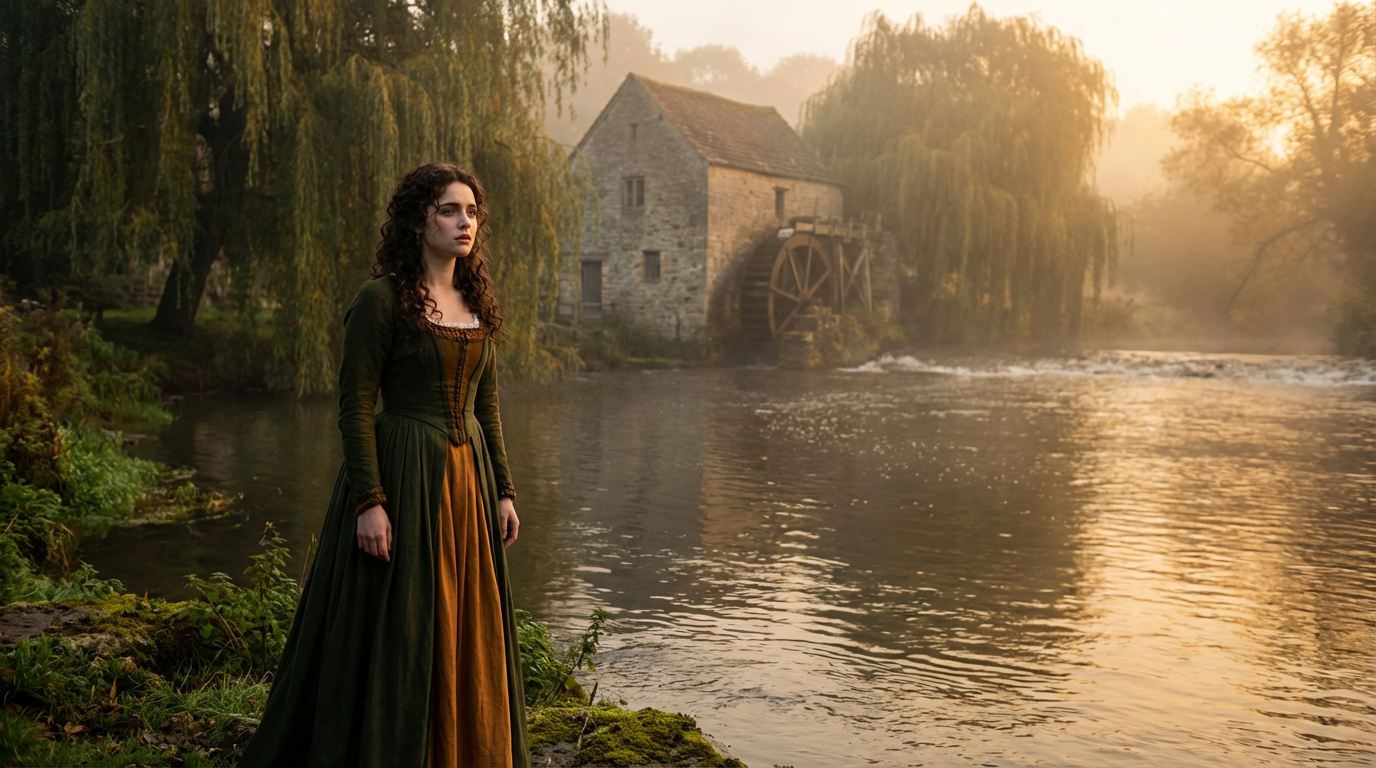
An excerpt from the original text.(complete · 3851 words)
om Comes Home
Tom was to arrive early in the afternoon, and there was another
fluttering heart besides Maggie’s when it was late enough for the sound
of the gig-wheels to be expected; for if Mrs Tulliver had a strong
feeling, it was fondness for her boy. At last the sound came,—that
quick light bowling of the gig-wheels,—and in spite of the wind, which
was blowing the clouds about, and was not likely to respect Mrs
Tulliver’s curls and cap-strings, she came outside the door, and even
held her hand on Maggie’s offending head, forgetting all the griefs of
the morning.
“There he is, my sweet lad! But, Lord ha’ mercy! he’s got never a
collar on; it’s been lost on the road, I’ll be bound, and spoilt the
set.”
Mrs Tulliver stood with her arms open; Maggie jumped first on one leg
and then on the other; while Tom descended from the gig, and said, with
masculine reticence as to the tender emotions, “Hallo! Yap—what! are
you there?”
Nevertheless he submitted to be kissed willingly enough, though Maggie
hung on his neck in rather a strangling fashion, while his blue-gray
eyes wandered toward the croft and the lambs and the river, where he
promised himself that he would begin to fish the first thing to-morrow
morning. He was one of those lads that grow everywhere in England, and
at twelve or thirteen years of age look as much alike as goslings,—a
lad with light-brown hair, cheeks of cream and roses, full lips,
indeterminate nose and eyebrows,—a physiognomy in which it seems
impossible to discern anything but the generic character to boyhood; as
different as possible from poor Maggie’s phiz, which Nature seemed to
have moulded and coloured with the most decided intention. But that
same Nature has the deep cunning which hides itself under the
appearance of openness, so that simple people think they can see
through her quite well, and all the while she is secretly preparing a
refutation of their confident prophecies. Under these average boyish
physiognomies that she seems to turn off by the gross, she conceals
some of her most rigid, inflexible purposes, some of her most
unmodifiable characters; and the dark-eyed, demonstrative, rebellious
girl may after all turn out to be a passive being compared with this
pink-and-white bit of masculinity with the indeterminate features.
“Maggie,” said Tom, confidentially, taking her into a corner, as soon
as his mother was gone out to examine his box and the warm parlour had
taken off the chill he had felt from the long drive, “you don’t know
what I’ve got in my pockets,” nodding his head up and down as a means
of rousing her sense of mystery.
“No,” said Maggie. “How stodgy they look, Tom! Is it marls (marbles) or
cobnuts?” Maggie’s heart sank a little, because Tom always said it was
“no good” playing with her at those games, she played so badly.
“Marls! no; I’ve swopped all my marls with the little fellows, and
cobnuts are no fun, you silly, only when the nuts are green. But see
here!” He drew something half out of his right-hand pocket.
“What is it?” said Maggie, in a whisper. “I can see nothing but a bit
of yellow.”
“Why, it’s—a—new—guess, Maggie!”
“Oh, I can’t guess, Tom,” said Maggie, impatiently.
“Don’t be a spitfire, else I won’t tell you,” said Tom, thrusting his
hand back into his pocket and looking determined.
“No, Tom,” said Maggie, imploringly, laying hold of the arm that was
held stiffly in the pocket. “I’m not cross, Tom; it was only because I
can’t bear guessing. Please be good to me.”
Tom’s arm slowly relaxed, and he said, “Well, then, it’s a new
fish-line—two new uns,—one for you, Maggie, all to yourself. I wouldn’t
go halves in the toffee and gingerbread on purpose to save the money;
and Gibson and Spouncer fought with me because I wouldn’t. And here’s
hooks; see here—I say, won’t we go and fish to-morrow down by the
Round Pool? And you shall catch your own fish, Maggie and put the worms
on, and everything; won’t it be fun?”
Maggie’s answer was to throw her arms round Tom’s neck and hug him, and
hold her cheek against his without speaking, while he slowly unwound
some of the line, saying, after a pause,—
“Wasn’t I a good brother, now, to buy you a line all to yourself? You
know, I needn’t have bought it, if I hadn’t liked.”
“Yes, very, very good—I do love you, Tom.”
Tom had put the line back in his pocket, and was looking at the hooks
one by one, before he spoke again.
“And the fellows fought me, because I wouldn’t give in about the
toffee.”
“Oh, dear! I wish they wouldn’t fight at your school, Tom. Didn’t it
hurt you?”
“Hurt me? no,” said Tom, putting up the hooks again, taking out a large
pocket-knife, and slowly opening the largest blade, which he looked at
meditatively as he rubbed his finger along it. Then he added,—
“I gave Spouncer a black eye, I know; that’s what he got by wanting to
leather me; I wasn’t going to go halves because anybody leathered
me.”
“Oh, how brave you are, Tom! I think you’re like Samson. If there came
a lion roaring at me, I think you’d fight him, wouldn’t you, Tom?”
“How can a lion come roaring at you, you silly thing? There’s no lions,
only in the shows.”
“No; but if we were in the lion countries—I mean in Africa, where it’s
very hot; the lions eat people there. I can show it you in the book
where I read it.”
“Well, I should get a gun and shoot him.”
“But if you hadn’t got a gun,—we might have gone out, you know, not
thinking, just as we go fishing; and then a great lion might run
towards us roaring, and we couldn’t get away from him. What should you
do, Tom?”
Tom paused, and at last turned away contemptuously, saying, “But the
lion isn’t coming. What’s the use of talking?”
“But I like to fancy how it would be,” said Maggie, following him.
“Just think what you would do, Tom.”
“Oh, don’t bother, Maggie! you’re such a silly. I shall go and see my
rabbits.”
Maggie’s heart began to flutter with fear. She dared not tell the sad
truth at once, but she walked after Tom in trembling silence as he went
out, thinking how she could tell him the news so as to soften at once
his sorrow and his anger; for Maggie dreaded Tom’s anger of all things;
it was quite a different anger from her own.
“Tom,” she said, timidly, when they were out of doors, “how much money
did you give for your rabbits?”
“Two half-crowns and a sixpence,” said Tom, promptly.
“I think I’ve got a great deal more than that in my steel purse
upstairs. I’ll ask mother to give it you.”
“What for?” said Tom. “I don’t want your money, you silly thing. I’ve
got a great deal more money than you, because I’m a boy. I always have
half-sovereigns and sovereigns for my Christmas boxes because I shall
be a man, and you only have five-shilling pieces, because you’re only a
girl.”
“Well, but, Tom—if mother would let me give you two half-crowns and a
sixpence out of my purse to put into your pocket and spend, you know,
and buy some more rabbits with it?”
“More rabbits? I don’t want any more.”
“Oh, but, Tom, they’re all dead.”
Tom stopped immediately in his walk and turned round toward Maggie.
“You forgot to feed ’em, then, and Harry forgot?” he said, his colour
heightening for a moment, but soon subsiding. “I’ll pitch into Harry.
I’ll have him turned away. And I don’t love you, Maggie. You sha’n’t go
fishing with me to-morrow. I told you to go and see the rabbits every
day.” He walked on again.
“Yes, but I forgot—and I couldn’t help it, indeed, Tom. I’m so very
sorry,” said Maggie, while the tears rushed fast.
“You’re a naughty girl,” said Tom, severely, “and I’m sorry I bought
you the fish-line. I don’t love you.”
“Oh, Tom, it’s very cruel,” sobbed Maggie. “I’d forgive you, if you
forgot anything—I wouldn’t mind what you did—I’d forgive you and love
you.”
“Yes, you’re silly; but I never do forget things, I don’t.”
“Oh, please forgive me, Tom; my heart will break,” said Maggie, shaking
with sobs, clinging to Tom’s arm, and laying her wet cheek on his
shoulder.
Tom shook her off, and stopped again, saying in a peremptory tone,
“Now, Maggie, you just listen. Aren’t I a good brother to you?”
“Ye-ye-es,” sobbed Maggie, her chin rising and falling convulsedly.
“Didn’t I think about your fish-line all this quarter, and mean to buy
it, and saved my money o’ purpose, and wouldn’t go halves in the
toffee, and Spouncer fought me because I wouldn’t?”
“Ye-ye-es—and I—lo-lo-love you so, Tom.”
“But you’re a naughty girl. Last holidays you licked the paint off my
lozenge-box, and the holidays before that you let the boat drag my
fish-line down when I’d set you to watch it, and you pushed your head
through my kite, all for nothing.”
“But I didn’t mean,” said Maggie; “I couldn’t help it.”
“Yes, you could,” said Tom, “if you’d minded what you were doing. And
you’re a naughty girl, and you sha’n’t go fishing with me to-morrow.”
With this terrible conclusion, Tom ran away from Maggie toward the
mill, meaning to greet Luke there, and complain to him of Harry.
Maggie stood motionless, except from her sobs, for a minute or two;
then she turned round and ran into the house, and up to her attic,
where she sat on the floor and laid her head against the worm-eaten
shelf, with a crushing sense of misery. Tom was come home, and she had
thought how happy she should be; and now he was cruel to her. What use
was anything if Tom didn’t love her? Oh, he was very cruel! Hadn’t she
wanted to give him the money, and said how very sorry she was? She knew
she was naughty to her mother, but she had never been naughty to
Tom—had never meant to be naughty to him.
“Oh, he is cruel!” Maggie sobbed aloud, finding a wretched pleasure in
the hollow resonance that came through the long empty space of the
attic. She never thought of beating or grinding her Fetish; she was too
miserable to be angry.
These bitter sorrows of childhood! when sorrow is all new and strange,
when hope has not yet got wings to fly beyond the days and weeks, and
the space from summer to summer seems measureless.
Maggie soon thought she had been hours in the attic, and it must be
tea-time, and they were all having their tea, and not thinking of her.
Well, then, she would stay up there and starve herself,—hide herself
behind the tub, and stay there all night,—and then they would all be
frightened, and Tom would be sorry. Thus Maggie thought in the pride of
her heart, as she crept behind the tub; but presently she began to cry
again at the idea that they didn’t mind her being there. If she went
down again to Tom now—would he forgive her? Perhaps her father would be
there, and he would take her part. But then she wanted Tom to forgive
her because he loved her, not because his father told him. No, she
would never go down if Tom didn’t come to fetch her. This resolution
lasted in great intensity for five dark minutes behind the tub; but
then the need of being loved—the strongest need in poor Maggie’s
nature—began to wrestle with her pride, and soon threw it. She crept
from behind her tub into the twilight of the long attic, but just then
she heard a quick foot-step on the stairs.
Tom had been too much interested in his talk with Luke, in going the
round of the premises, walking in and out where he pleased, and
whittling sticks without any particular reason,—except that he didn’t
whittle sticks at school,—to think of Maggie and the effect his anger
had produced on her. He meant to punish her, and that business having
been performed, he occupied himself with other matters, like a
practical person. But when he had been called in to tea, his father
said, “Why, where’s the little wench?” and Mrs Tulliver, almost at the
same moment, said, “Where’s your little sister?”—both of them having
supposed that Maggie and Tom had been together all the afternoon.
“I don’t know,” said Tom. He didn’t want to “tell” of Maggie, though he
was angry with her; for Tom Tulliver was a lad of honour.
“What! hasn’t she been playing with you all this while?” said the
father. “She’d been thinking o’ nothing but your coming home.”
“I haven’t seen her this two hours,” says Tom, commencing on the
plumcake.
“Goodness heart; she’s got drownded!” exclaimed Mrs Tulliver, rising
from her seat and running to the window.
“How could you let her do so?” she added, as became a fearful woman,
accusing she didn’t know whom of she didn’t know what.
“Nay, nay, she’s none drownded,” said Mr Tulliver. “You’ve been naughty
to her, I doubt, Tom?”
“I’m sure I haven’t, father,” said Tom, indignantly. “I think she’s in
the house.”
“Perhaps up in that attic,” said Mrs Tulliver, “a-singing and talking
to herself, and forgetting all about meal-times.”
“You go and fetch her down, Tom,” said Mr Tulliver, rather sharply,—his
perspicacity or his fatherly fondness for Maggie making him suspect
that the lad had been hard upon “the little un,” else she would never
have left his side. “And be good to her, do you hear? Else I’ll let you
know better.”
Tom never disobeyed his father, for Mr Tulliver was a peremptory man,
and, as he said, would never let anybody get hold of his whip-hand; but
he went out rather sullenly, carrying his piece of plumcake, and not
intending to reprieve Maggie’s punishment, which was no more than she
deserved. Tom was only thirteen, and had no decided views in grammar
and arithmetic, regarding them for the most part as open questions, but
he was particularly clear and positive on one point,—namely, that he
would punish everybody who deserved it. Why, he wouldn’t have minded
being punished himself if he deserved it; but, then, he never did
deserve it.
It was Tom’s step, then, that Maggie heard on the stairs, when her need
of love had triumphed over her pride, and she was going down with her
swollen eyes and dishevelled hair to beg for pity. At least her father
would stroke her head and say, “Never mind, my wench.” It is a
wonderful subduer, this need of love,—this hunger of the heart,—as
peremptory as that other hunger by which Nature forces us to submit to
the yoke, and change the face of the world.
But she knew Tom’s step, and her heart began to beat violently with the
sudden shock of hope. He only stood still at the top of the stairs and
said, “Maggie, you’re to come down.” But she rushed to him and clung
round his neck, sobbing, “Oh, Tom, please forgive me—I can’t bear it—I
will always be good—always remember things—do love me—please, dear
Tom!”
We learn to restrain ourselves as we get older. We keep apart when we
have quarrelled, express ourselves in well-bred phrases, and in this
way preserve a dignified alienation, showing much firmness on one side,
and swallowing much grief on the other. We no longer approximate in our
behaviour to the mere impulsiveness of the lower animals, but conduct
ourselves in every respect like members of a highly civilised society.
Maggie and Tom were still very much like young animals, and so she
could rub her cheek against his, and kiss his ear in a random sobbing
way; and there were tender fibres in the lad that had been used to
answer to Maggie’s fondling, so that he behaved with a weakness quite
inconsistent with his resolution to punish her as much as she deserved.
He actually began to kiss her in return, and say,—
“Don’t cry, then, Magsie; here, eat a bit o’ cake.”
Maggie’s sobs began to subside, and she put out her mouth for the cake
and bit a piece; and then Tom bit a piece, just for company, and they
ate together and rubbed each other’s cheeks and brows and noses
together, while they ate, with a humiliating resemblance to two
friendly ponies.
“Come along, Magsie, and have tea,” said Tom at last, when there was no
more cake except what was down-stairs.
So ended the sorrows of this day, and the next morning Maggie was
trotting with her own fishing-rod in one hand and a handle of the
basket in the other, stepping always, by a peculiar gift, in the
muddiest places, and looking darkly radiant from under her
beaver-bonnet because Tom was good to her. She had told Tom, however,
that she should like him to put the worms on the hook for her, although
she accepted his word when he assured her that worms couldn’t feel (it
was Tom’s private opinion that it didn’t much matter if they did). He
knew all about worms, and fish, and those things; and what birds were
mischievous, and how padlocks opened, and which way the handles of the
gates were to be lifted. Maggie thought this sort of knowledge was very
wonderful,—much more difficult than remembering what was in the books;
and she was rather in awe of Tom’s superiority, for he was the only
person who called her knowledge “stuff,” and did not feel surprised at
her cleverness. Tom, indeed, was of opinion that Maggie was a silly
little thing; all girls were silly,—they couldn’t throw a stone so as
to hit anything, couldn’t do anything with a pocket-knife, and were
frightened at frogs. Still, he was very fond of his sister, and meant
always to take care of her, make her his housekeeper, and punish her
when she did wrong.
They were on their way to the Round Pool,—that wonderful pool, which
the floods had made a long while ago. No one knew how deep it was; and
it was mysterious, too, that it should be almost a perfect round,
framed in with willows and tall reeds, so that the water was only to be
seen when you got close to the brink. The sight of the old favourite
spot always heightened Tom’s good humour, and he spoke to Maggie in the
most amicable whispers, as he opened the precious basket and prepared
their tackle. He threw her line for her, and put the rod into her hand.
Maggie thought it probable that the small fish would come to her hook,
and the large ones to Tom’s. But she had forgotten all about the fish,
and was looking dreamily at the glassy water, when Tom said, in a loud
whisper, “Look, look, Maggie!” and came running to prevent her from
snatching her line away.
Maggie was frightened lest she had been doing something wrong, as
usual, but presently Tom drew out her line and brought a large tench
bouncing on the grass.
Tom was excited.
“O Magsie, you little duck! Empty the basket.”
Maggie was not conscious of unusual merit, but it was enough that Tom
called her Magsie, and was pleased with her. There was nothing to mar
her delight in the whispers and the dreamy silences, when she listened
to the light dripping sounds of the rising fish, and the gentle
rustling, as if the willows and the reeds and the water had their happy
whisperings also. Maggie thought it would make a very nice heaven to
sit by the pool in that way, and never be scolded. She never knew she
had a bite till Tom told her; but she liked fishing very much.
It was one of their happy mornings. They trotted along and sat down
together, with no thought that life would ever change much for them;
they would only get bigger and not go to school, and it would always be
like the holidays; they would always live together and be fond of each
other. And the mill with its booming; the great chestnut-tree under
which they played at houses; their own little river, the Ripple, where
the banks seemed like home, and Tom was always seeing the water-rats,
while Maggie gathered the purple plumy tops of the reeds, which she
forgot and dropped afterward; above all, the great Floss, along which
they wandered with a sense of travel, to see the rushing spring-tide,
the awful Eagre, come up like a hungry monster, or to see the Great Ash
which had once wailed and groaned like a man, these things would always
be just the same to them. Tom thought people were at a disadvantage who
lived on any other spot of the globe; and Maggie, when she read about
Christiana passing “the river over which there is no bridge,” always
saw the Floss between the green pastures by the Great Ash.
Life did change for Tom and Maggie; and yet they were not wrong in
believing that the thoughts and loves of these first years would always
make part of their lives. We could never have loved the earth so well
if we had had no childhood in it,—if it were not the earth where the
same flowers come up again every spring that we used to gather with our
tiny fingers as we sat lisping to ourselves on the grass; the same hips
and haws on the autumn’s hedgerows; the same redbreasts that we used to
call “God’s birds,” because they did no harm to the precious crops.
What novelty is worth that sweet monotony where everything is known,
and loved because it is known?
The wood I walk in on this mild May day, with the young yellow-brown
foliage of the oaks between me and the blue sky, the white star-flowers
and the blue-eyed speedwell and the ground ivy at my feet, what grove
of tropic palms, what strange ferns or splendid broad-petalled
blossoms, could ever thrill such deep and delicate fibres within me as
this home scene? These familiar flowers, these well-remembered
bird-notes, this sky, with its fitful brightness, these furrowed and
grassy fields, each with a sort of personality given to it by the
capricious hedgerows,—such things as these are the mother-tongue of our
imagination, the language that is laden with all the subtle,
inextricable associations the fleeting hours of our childhood left
behind them. Our delight in the sunshine on the deep-bladed grass
to-day might be no more than the faint perception of wearied souls, if
it were not for the sunshine and the grass in the far-off years which
still live in us, and transform our perception into love.
Master this chapter. Complete your experience
Purchase the complete book to access all chapters and support classic literature
As an Amazon Associate, we earn a small commission from qualifying purchases at no additional cost to you.
Available in paperback, hardcover, and e-book formats
Let's Analyse the Pattern
When affection is given and withdrawn based on performance, creating power imbalances that damage both parties.
Why This Matters
Connect literature to life
This chapter teaches how to recognize when love is being used as a reward system rather than offered as consistent support.
Practice This Today
This week, notice when someone's warmth toward you changes dramatically based on your performance—that's a red flag worth examining.
Now let's explore the literary elements.
Key Quotes & Analysis
"She was too entirely humble to have any resentment rising in her mind, except against herself: the only weight she could bear was the weight of his displeasure."
Context: When Tom refuses to take Maggie fishing as punishment for letting his rabbits die
Shows how Maggie has learned to blame herself rather than question Tom's harsh judgment. Her complete acceptance of his authority reveals an unhealthy dynamic where she has no sense of her own worth apart from his approval.
In Today's Words:
She was so used to putting herself down that she couldn't even get mad at him - only at herself.
"We learn to restrain ourselves as we get older. We keep apart when we have quarrelled, express ourselves in well-bred phrases, and in this way preserve a dignified alienation, showing much firmness on one side, and swallowing much grief on the other."
Context: Contrasting adult behavior with how quickly the children reconcile
Eliot suggests that adult 'maturity' often means holding grudges and playing games instead of the honest, immediate forgiveness children show. Adults mistake pride for dignity and end up more alienated from each other.
In Today's Words:
Adults hold grudges and give each other the silent treatment, thinking they're being mature when really they're just being stubborn.
"These familiar flowers, these well-remembered bird-notes, this sky with its fitful brightness, these furrowed and grassy fields, each with a sort of personality given to it by the capricious hedgerows - such things as these are the mother tongue of our imagination."
Context: Describing how childhood landscapes shape us forever
One of Eliot's most beautiful insights about how place and memory work together. Our childhood environment doesn't just provide backdrop - it becomes the emotional language we use to understand all future experiences.
In Today's Words:
The places where we grew up become part of how we see and feel about everything else for the rest of our lives.
Thematic Threads
Power Dynamics
In This Chapter
Tom uses Maggie's love for him as a tool of control, positioning himself as moral authority
Development
Introduced here - establishes the sibling power structure that will define their relationship
In Your Life:
You might see this in relationships where someone uses your feelings for them to control your behavior
Emotional Dependency
In This Chapter
Maggie's devastating reaction to Tom's withdrawal shows her complete emotional dependence on his approval
Development
Builds on earlier chapters showing Maggie's desperate need for love and acceptance
In Your Life:
You might recognize this need to have one person's opinion matter more than your own self-worth
Moral Rigidity
In This Chapter
Tom believes wrongdoing must be punished, showing early signs of inflexible moral thinking
Development
Introduced here - Tom's black-and-white worldview begins to emerge
In Your Life:
You might see this in people who can't separate mistakes from character flaws
Forgiveness
In This Chapter
The siblings reconcile quickly and completely, like 'young animals' who cannot sustain anger
Development
Introduced here - shows both the resilience and fragility of their bond
In Your Life:
You might notice how some relationships can bounce back from hurt while others hold grudges
Formative Experience
In This Chapter
Eliot describes how childhood landscapes become the 'mother-tongue of our imagination'
Development
Introduced here - the idea that early experiences shape our entire worldview
In Your Life:
You might recognize how your childhood relationships still influence how you connect with people today
You now have the context. Time to form your own thoughts.
Discussion Questions
- 1
What exactly does Tom do when he finds out about the rabbits, and how does Maggie react?
analysis • surface - 2
Why does Tom withdraw his love instead of just being angry about the rabbits? What does this accomplish for him?
analysis • medium - 3
Where do you see this pattern of conditional love in modern relationships - at work, in families, or between friends?
application • medium - 4
If you were Maggie's friend, what would you tell her about how Tom treats her? How could she protect herself while still loving her brother?
application • deep - 5
What does this chapter reveal about how children learn to use love as power? How do these patterns follow us into adulthood?
reflection • deep
Critical Thinking Exercise
Spot the Conditional Love Pattern
Think of a relationship where someone's affection toward you seemed to depend on your performance or behavior. Write down the specific actions they took when you disappointed them versus when you pleased them. Then identify what they gained by making their love conditional - what did this dynamic give them?
Consider:
- •Notice the difference between someone being upset about your actions versus withdrawing their care for you as a person
- •Consider how this pattern made you feel about yourself and your worth
- •Think about whether you've ever used conditional love as a tool with others
Journaling Prompt
Write about a time when you felt like you had to earn someone's love back. What would you tell that younger version of yourself now?
Coming Up Next...
Chapter 6: Family Politics and Childhood Fairness
The extended Tulliver family gathers, bringing with them a web of opinions, judgments, and social expectations that will soon complicate the simple world Tom and Maggie have known.



