
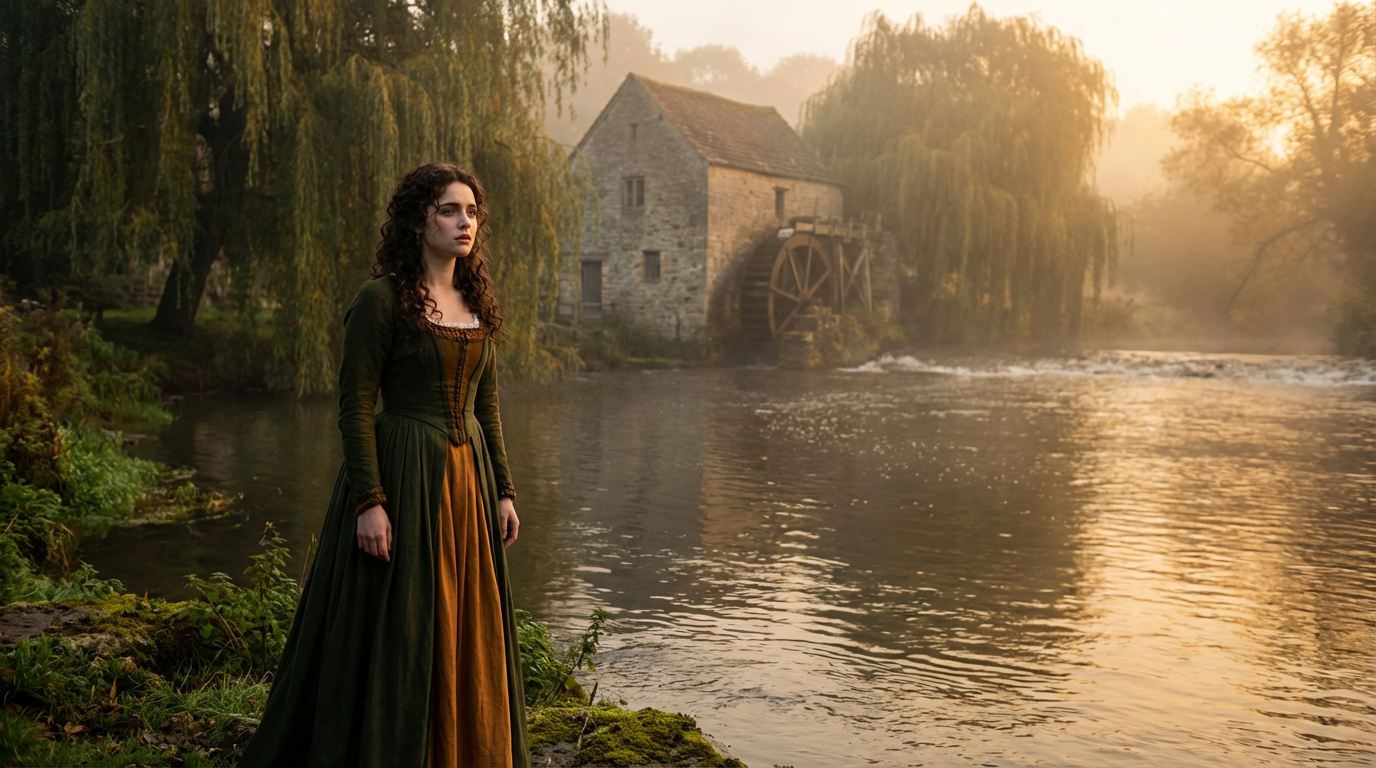
An excerpt from the original text.(complete · 2035 words)
om Is Expected
It was a heavy disappointment to Maggie that she was not allowed to go
with her father in the gig when he went to fetch Tom home from the
academy; but the morning was too wet, Mrs Tulliver said, for a little
girl to go out in her best bonnet. Maggie took the opposite view very
strongly, and it was a direct consequence of this difference of opinion
that when her mother was in the act of brushing out the reluctant black
crop Maggie suddenly rushed from under her hands and dipped her head in
a basin of water standing near, in the vindictive determination that
there should be no more chance of curls that day.
“Maggie, Maggie!” exclaimed Mrs Tulliver, sitting stout and helpless
with the brushes on her lap, “what is to become of you if you’re so
naughty? I’ll tell your aunt Glegg and your aunt Pullet when they come
next week, and they’ll never love you any more. Oh dear, oh dear! look
at your clean pinafore, wet from top to bottom. Folks ’ull think it’s a
judgment on me as I’ve got such a child,—they’ll think I’ve done summat
wicked.”
Before this remonstrance was finished, Maggie was already out of
hearing, making her way toward the great attic that ran under the old
high-pitched roof, shaking the water from her black locks as she ran,
like a Skye terrier escaped from his bath. This attic was Maggie’s
favourite retreat on a wet day, when the weather was not too cold; here
she fretted out all her ill humours, and talked aloud to the worm-eaten
floors and the worm-eaten shelves, and the dark rafters festooned with
cobwebs; and here she kept a Fetish which she punished for all her
misfortunes. This was the trunk of a large wooden doll, which once
stared with the roundest of eyes above the reddest of cheeks; but was
now entirely defaced by a long career of vicarious suffering. Three
nails driven into the head commemorated as many crises in Maggie’s nine
years of earthly struggle; that luxury of vengeance having been
suggested to her by the picture of Jael destroying Sisera in the old
Bible. The last nail had been driven in with a fiercer stroke than
usual, for the Fetish on that occasion represented aunt Glegg. But
immediately afterward Maggie had reflected that if she drove many nails
in she would not be so well able to fancy that the head was hurt when
she knocked it against the wall, nor to comfort it, and make believe to
poultice it, when her fury was abated; for even aunt Glegg would be
pitiable when she had been hurt very much, and thoroughly humiliated,
so as to beg her niece’s pardon. Since then she had driven no more
nails in, but had soothed herself by alternately grinding and beating
the wooden head against the rough brick of the great chimneys that made
two square pillars supporting the roof. That was what she did this
morning on reaching the attic, sobbing all the while with a passion
that expelled every other form of consciousness,—even the memory of the
grievance that had caused it. As at last the sobs were getting quieter,
and the grinding less fierce, a sudden beam of sunshine, falling
through the wire lattice across the worm-eaten shelves, made her throw
away the Fetish and run to the window. The sun was really breaking out;
the sound of the mill seemed cheerful again; the granary doors were
open; and there was Yap, the queer white-and-brown terrier, with one
ear turned back, trotting about and sniffing vaguely, as if he were in
search of a companion. It was irresistible. Maggie tossed her hair back
and ran downstairs, seized her bonnet without putting it on, peeped,
and then dashed along the passage lest she should encounter her mother,
and was quickly out in the yard, whirling round like a Pythoness, and
singing as she whirled, “Yap, Yap, Tom’s coming home!” while Yap danced
and barked round her, as much as to say, if there was any noise wanted
he was the dog for it.
“Hegh, hegh, Miss! you’ll make yourself giddy, an’ tumble down i’ the
dirt,” said Luke, the head miller, a tall, broad-shouldered man of
forty, black-eyed and black-haired, subdued by a general mealiness,
like an auricula.
Maggie paused in her whirling and said, staggering a little, “Oh no, it
doesn’t make me giddy, Luke; may I go into the mill with you?”
Maggie loved to linger in the great spaces of the mill, and often came
out with her black hair powdered to a soft whiteness that made her dark
eyes flash out with new fire. The resolute din, the unresting motion of
the great stones, giving her a dim, delicious awe as at the presence of
an uncontrollable force; the meal forever pouring, pouring; the fine
white powder softening all surfaces, and making the very spidernets
look like a faery lace-work; the sweet, pure scent of the meal,—all
helped to make Maggie feel that the mill was a little world apart from
her outside everyday life. The spiders were especially a subject of
speculation with her. She wondered if they had any relatives outside
the mill, for in that case there must be a painful difficulty in their
family intercourse,—a fat and floury spider, accustomed to take his fly
well dusted with meal, must suffer a little at a cousin’s table where
the fly was au naturel, and the lady spiders must be mutually shocked
at each other’s appearance. But the part of the mill she liked best was
the topmost story,—the corn-hutch, where there were the great heaps of
grain, which she could sit on and slide down continually. She was in
the habit of taking this recreation as she conversed with Luke, to whom
she was very communicative, wishing him to think well of her
understanding, as her father did.
Perhaps she felt it necessary to recover her position with him on the
present occasion for, as she sat sliding on the heap of grain near
which he was busying himself, she said, at that shrill pitch which was
requisite in mill-society,—
“I think you never read any book but the Bible, did you, Luke?”
“Nay, Miss, an’ not much o’ that,” said Luke, with great frankness.
“I’m no reader, I aren’t.”
“But if I lent you one of my books, Luke? I’ve not got any very
pretty books that would be easy for you to read; but there’s ‘Pug’s
Tour of Europe,’—that would tell you all about the different sorts of
people in the world, and if you didn’t understand the reading, the
pictures would help you; they show the looks and ways of the people,
and what they do. There are the Dutchmen, very fat, and smoking, you
know, and one sitting on a barrel.”
“Nay, Miss, I’n no opinion o’ Dutchmen. There ben’t much good i’
knowin’ about them.”
“But they’re our fellow-creatures, Luke; we ought to know about our
fellow-creatures.”
“Not much o’ fellow-creaturs, I think, Miss; all I know—my old master,
as war a knowin’ man, used to say, says he, ‘If e’er I sow my wheat
wi’out brinin’, I’m a Dutchman,’ says he; an’ that war as much as to
say as a Dutchman war a fool, or next door. Nay, nay, I aren’t goin’ to
bother mysen about Dutchmen. There’s fools enoo, an’ rogues enoo,
wi’out lookin’ i’ books for ’em.”
“Oh, well,” said Maggie, rather foiled by Luke’s unexpectedly decided
views about Dutchmen, “perhaps you would like ‘Animated Nature’ better;
that’s not Dutchmen, you know, but elephants and kangaroos, and the
civet-cat, and the sunfish, and a bird sitting on its tail,—I forget
its name. There are countries full of those creatures, instead of
horses and cows, you know. Shouldn’t you like to know about them,
Luke?”
“Nay, Miss, I’n got to keep count o’ the flour an’ corn; I can’t do wi’
knowin’ so many things besides my work. That’s what brings folks to the
gallows,—knowin’ everything but what they’n got to get their bread by.
An’ they’re mostly lies, I think, what’s printed i’ the books: them
printed sheets are, anyhow, as the men cry i’ the streets.”
“Why, you’re like my brother Tom, Luke,” said Maggie, wishing to turn
the conversation agreeably; “Tom’s not fond of reading. I love Tom so
dearly, Luke,—better than anybody else in the world. When he grows up I
shall keep his house, and we shall always live together. I can tell him
everything he doesn’t know. But I think Tom’s clever, for all he
doesn’t like books; he makes beautiful whipcord and rabbit-pens.”
“Ah,” said Luke, “but he’ll be fine an’ vexed, as the rabbits are all
dead.”
“Dead!” screamed Maggie, jumping up from her sliding seat on the corn.
“Oh dear, Luke! What! the lop-eared one, and the spotted doe that Tom
spent all his money to buy?”
“As dead as moles,” said Luke, fetching his comparison from the
unmistakable corpses nailed to the stable wall.
“Oh dear, Luke,” said Maggie, in a piteous tone, while the big tears
rolled down her cheek; “Tom told me to take care of ’em, and I forgot.
What shall I do?”
“Well, you see, Miss, they were in that far tool-house, an’ it was
nobody’s business to see to ’em. I reckon Master Tom told Harry to feed
’em, but there’s no countin’ on Harry; he’s a offal creatur as iver
come about the primises, he is. He remembers nothing but his own
inside—an’ I wish it ’ud gripe him.”
“Oh, Luke, Tom told me to be sure and remember the rabbits every day;
but how could I, when they didn’t come into my head, you know? Oh, he
will be so angry with me, I know he will, and so sorry about his
rabbits, and so am I sorry. Oh, what shall I do?”
“Don’t you fret, Miss,” said Luke, soothingly; “they’re nash things,
them lop-eared rabbits; they’d happen ha’ died, if they’d been fed.
Things out o’ natur niver thrive: God A’mighty doesn’t like ’em. He
made the rabbits’ ears to lie back, an’ it’s nothin’ but contrairiness
to make ’em hing down like a mastiff dog’s. Master Tom ’ull know better
nor buy such things another time. Don’t you fret, Miss. Will you come
along home wi’ me, and see my wife? I’m a-goin’ this minute.”
The invitation offered an agreeable distraction to Maggie’s grief, and
her tears gradually subsided as she trotted along by Luke’s side to his
pleasant cottage, which stood with its apple and pear trees, and with
the added dignity of a lean-to pigsty, at the other end of the Mill
fields. Mrs Moggs, Luke’s wife, was a decidedly agreeable acquaintance.
She exhibited her hospitality in bread and treacle, and possessed
various works of art. Maggie actually forgot that she had any special
cause of sadness this morning, as she stood on a chair to look at a
remarkable series of pictures representing the Prodigal Son in the
costume of Sir Charles Grandison, except that, as might have been
expected from his defective moral character, he had not, like that
accomplished hero, the taste and strength of mind to dispense with a
wig. But the indefinable weight the dead rabbits had left on her mind
caused her to feel more than usual pity for the career of this weak
young man, particularly when she looked at the picture where he leaned
against a tree with a flaccid appearance, his knee-breeches unbuttoned
and his wig awry, while the swine apparently of some foreign breed,
seemed to insult him by their good spirits over their feast of husks.
“I’m very glad his father took him back again, aren’t you, Luke?” she
said. “For he was very sorry, you know, and wouldn’t do wrong again.”
“Eh, Miss,” said Luke, “he’d be no great shakes, I doubt, let’s feyther
do what he would for him.”
That was a painful thought to Maggie, and she wished much that the
subsequent history of the young man had not been left a blank.
Master this chapter. Complete your experience
Purchase the complete book to access all chapters and support classic literature
As an Amazon Associate, we earn a small commission from qualifying purchases at no additional cost to you.
Available in paperback, hardcover, and e-book formats
Let's Analyse the Pattern
When overwhelmed by emotions we can't directly address, we instinctively seek control through unrelated but manageable actions.
Why This Matters
Connect literature to life
This chapter teaches how to identify when we're channeling feelings about one situation into seemingly unrelated actions.
Practice This Today
This week, notice when you feel compelled to control something minor after feeling powerless about something major—then pause and name what you're really upset about.
Now let's explore the literary elements.
Key Quotes & Analysis
"Folks 'ull think it's a judgment on me as I've got such a child,—they'll think I've done summat wicked."
Context: After Maggie dunks her head in water and ruins her clean clothes
This reveals how much social pressure parents felt to produce 'good' children. Mrs. Tulliver fears that Maggie's wildness reflects her own moral failures in the eyes of their community.
In Today's Words:
People are going to think I'm a terrible mother because my kid acts out like this.
"Things out of nature never thrive."
Context: Explaining to Maggie why the rabbits died when kept in an unnatural environment
Luke's practical wisdom suggests that forcing situations or creatures into unnatural circumstances leads to failure. It's both literal advice about pet care and metaphorical wisdom about life.
In Today's Words:
If you try to force something that isn't natural, it's not going to work out.
"This attic was Maggie's favourite retreat on a wet day, when the weather was not tempting her out of doors."
Context: Describing where Maggie goes to escape after her confrontation with her mother
Everyone needs a private space to process emotions. Maggie's attic represents the human need for solitude and a place where we can be ourselves without judgment.
In Today's Words:
This was Maggie's safe space where she could go to deal with her feelings.
Thematic Threads
Control
In This Chapter
Maggie seeks control over her appearance and possessions when denied control over important decisions
Development
Building from earlier chapters where adult authority felt arbitrary
In Your Life:
You might recognize this when you obsess over small details after feeling powerless in bigger situations
Responsibility
In This Chapter
The dead rabbits represent crushing weight of disappointing someone you love
Development
Introduced here as Maggie's first major failure of care
In Your Life:
That sick feeling when you've let down someone who trusted you with something important
Emotional Intensity
In This Chapter
Maggie's feelings are described as more intense than adults remember experiencing
Development
Continuing pattern of Maggie feeling everything more deeply than those around her
In Your Life:
When people tell you you're 'too sensitive' but your feelings are genuinely overwhelming
Class Awareness
In This Chapter
Luke's practical worldview contrasts with Maggie's emotional approach to problems
Development
Expanding from family dynamics to show different ways of processing reality
In Your Life:
When your emotional response to problems feels dismissed by more 'practical' people
Refuge
In This Chapter
The attic serves as Maggie's safe space for processing difficult emotions
Development
Introduced here as essential coping mechanism
In Your Life:
Everyone needs a place where they can fall apart safely without judgment
You now have the context. Time to form your own thoughts.
Discussion Questions
- 1
What specific actions does Maggie take when she's told she can't fetch Tom from school, and what happens to the rabbits?
analysis • surface - 2
Why does Maggie choose to ruin her curls and beat the wooden doll instead of directly confronting the adults who disappointed her?
analysis • medium - 3
When have you seen someone (including yourself) take control of something small when they felt powerless about something big?
application • medium - 4
If you were Maggie's parent, how would you help her process her anger while still maintaining necessary boundaries?
application • deep - 5
What does Maggie's need for a secret attic space and her ritual with the doll reveal about how humans cope with overwhelming emotions?
reflection • deep
Critical Thinking Exercise
Map Your Pressure Release Valves
Think about the last time you felt frustrated or powerless in one situation but found yourself taking extra control in a completely different area. Draw or write out the connection between what you couldn't control and what you did control instead. Then identify three healthy outlets you could use next time you feel this way.
Consider:
- •Notice if your control behaviors help you feel better or just distract you temporarily
- •Consider whether your outlets affect other people (like Maggie's rabbits)
- •Think about the difference between healthy release and harmful displacement
Journaling Prompt
Write about a time when you felt responsible for something that went wrong despite your best efforts. How did you handle the guilt, and what would you tell your younger self about managing that kind of responsibility?
Coming Up Next...
Chapter 5: Tom Comes Home
Tom finally comes home from school, but will Maggie's joy at seeing her brother survive the devastating news about his beloved rabbits? The reunion she's been anticipating may not go as she hoped.



