
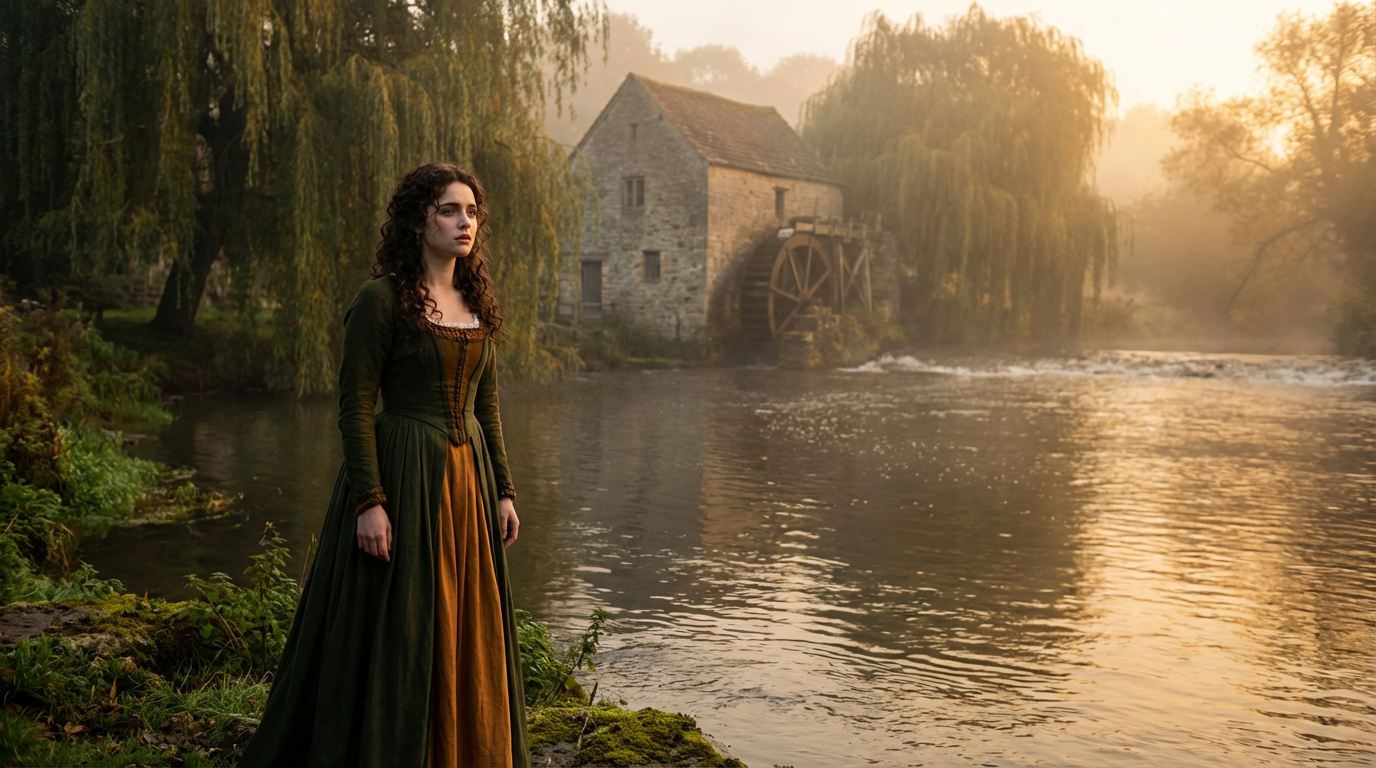
An excerpt from the original text.(complete · 4522 words)
he Aunts and Uncles Are Coming
It was Easter week, and Mrs Tulliver’s cheesecakes were more
exquisitely light than usual. “A puff o’ wind ’ud make ’em blow about
like feathers,” Kezia the housemaid said, feeling proud to live under a
mistress who could make such pastry; so that no season or circumstances
could have been more propitious for a family party, even if it had not
been advisable to consult sister Glegg and sister Pullet about Tom’s
going to school.
“I’d as lief not invite sister Deane this time,” said Mrs Tulliver,
“for she’s as jealous and having as can be, and’s allays trying to make
the worst o’ my poor children to their aunts and uncles.”
“Yes, yes,” said Mr Tulliver, “ask her to come. I never hardly get a
bit o’ talk with Deane now; we haven’t had him this six months. What’s
it matter what she says? My children need be beholding to nobody.”
“That’s what you allays say, Mr Tulliver; but I’m sure there’s nobody
o’ your side, neither aunt nor uncle, to leave ’em so much as a
five-pound note for a leggicy. And there’s sister Glegg, and sister
Pullet too, saving money unknown, for they put by all their own
interest and butter-money too; their husbands buy ’em everything.” Mrs
Tulliver was a mild woman, but even a sheep will face about a little
when she has lambs.
“Tchuh!” said Mr Tulliver. “It takes a big loaf when there’s many to
breakfast. What signifies your sisters’ bits o’ money when they’ve got
half-a-dozen nevvies and nieces to divide it among? And your sister
Deane won’t get ’em to leave all to one, I reckon, and make the country
cry shame on ’em when they are dead?”
“I don’t know what she won’t get ’em to do,” said Mrs Tulliver, “for my
children are so awk’ard wi’ their aunts and uncles. Maggie’s ten times
naughtier when they come than she is other days, and Tom doesn’t like
’em, bless him!—though it’s more nat’ral in a boy than a gell. And
there’s Lucy Deane’s such a good child,—you may set her on a stool, and
there she’ll sit for an hour together, and never offer to get off. I
can’t help loving the child as if she was my own; and I’m sure she’s
more like my child than sister Deane’s, for she’d allays a very poor
colour for one of our family, sister Deane had.”
“Well, well, if you’re fond o’ the child, ask her father and mother to
bring her with ’em. And won’t you ask their aunt and uncle Moss too,
and some o’ their children?”
“Oh, dear, Mr Tulliver, why, there’d be eight people besides the
children, and I must put two more leaves i’ the table, besides reaching
down more o’ the dinner-service; and you know as well as I do as my
sisters and your sister don’t suit well together.”
“Well, well, do as you like, Bessy,” said Mr Tulliver, taking up his
hat and walking out to the mill. Few wives were more submissive than
Mrs Tulliver on all points unconnected with her family relations; but
she had been a Miss Dodson, and the Dodsons were a very respectable
family indeed,—as much looked up to as any in their own parish, or the
next to it. The Miss Dodsons had always been thought to hold up their
heads very high, and no one was surprised the two eldest had married so
well,—not at an early age, for that was not the practice of the Dodson
family. There were particular ways of doing everything in that family:
particular ways of bleaching the linen, of making the cowslip wine,
curing the hams, and keeping the bottled gooseberries; so that no
daughter of that house could be indifferent to the privilege of having
been born a Dodson, rather than a Gibson or a Watson. Funerals were
always conducted with peculiar propriety in the Dodson family: the
hat-bands were never of a blue shade, the gloves never split at the
thumb, everybody was a mourner who ought to be, and there were always
scarfs for the bearers. When one of the family was in trouble or
sickness, all the rest went to visit the unfortunate member, usually at
the same time, and did not shrink from uttering the most disagreeable
truths that correct family feeling dictated; if the illness or trouble
was the sufferer’s own fault, it was not in the practice of the Dodson
family to shrink from saying so. In short, there was in this family a
peculiar tradition as to what was the right thing in household
management and social demeanour, and the only bitter circumstance
attending this superiority was a painful inability to approve the
condiments or the conduct of families ungoverned by the Dodson
tradition. A female Dodson, when in “strange houses,” always ate dry
bread with her tea, and declined any sort of preserves, having no
confidence in the butter, and thinking that the preserves had probably
begun to ferment from want of due sugar and boiling. There were some
Dodsons less like the family than others, that was admitted; but in so
far as they were “kin,” they were of necessity better than those who
were “no kin.” And it is remarkable that while no individual Dodson was
satisfied with any other individual Dodson, each was satisfied, not
only with him or herself, but with the Dodsons collectively. The
feeblest member of a family—the one who has the least character—is
often the merest epitome of the family habits and traditions; and Mrs
Tulliver was a thorough Dodson, though a mild one, as small-beer, so
long as it is anything, is only describable as very weak ale: and
though she had groaned a little in her youth under the yoke of her
elder sisters, and still shed occasional tears at their sisterly
reproaches, it was not in Mrs Tulliver to be an innovator on the family
ideas. She was thankful to have been a Dodson, and to have one child
who took after her own family, at least in his features and complexion,
in liking salt and in eating beans, which a Tulliver never did.
In other respects the true Dodson was partly latent in Tom, and he was
as far from appreciating his “kin” on the mother’s side as Maggie
herself, generally absconding for the day with a large supply of the
most portable food, when he received timely warning that his aunts and
uncles were coming,—a moral symptom from which his aunt Glegg deduced
the gloomiest views of his future. It was rather hard on Maggie that
Tom always absconded without letting her into the secret, but the
weaker sex are acknowledged to be serious impedimenta in cases of
flight.
On Wednesday, the day before the aunts and uncles were coming, there
were such various and suggestive scents, as of plumcakes in the oven
and jellies in the hot state, mingled with the aroma of gravy, that it
was impossible to feel altogether gloomy: there was hope in the air.
Tom and Maggie made several inroads into the kitchen, and, like other
marauders, were induced to keep aloof for a time only by being allowed
to carry away a sufficient load of booty.
“Tom,” said Maggie, as they sat on the boughs of the elder-tree, eating
their jam-puffs, “shall you run away to-morrow?”
“No,” said Tom, slowly, when he had finished his puff, and was eying
the third, which was to be divided between them,—“no, I sha’n’t.”
“Why, Tom? Because Lucy’s coming?”
“No,” said Tom, opening his pocket-knife and holding it over the puff,
with his head on one side in a dubitative manner. (It was a difficult
problem to divide that very irregular polygon into two equal parts.)
“What do I care about Lucy? She’s only a girl,—she can’t play at
bandy.”
“Is it the tipsy-cake, then?” said Maggie, exerting her hypothetic
powers, while she leaned forward toward Tom with her eyes fixed on the
hovering knife.
“No, you silly, that’ll be good the day after. It’s the pudden. I know
what the pudden’s to be,—apricot roll-up—O my buttons!”
With this interjection, the knife descended on the puff, and it was in
two, but the result was not satisfactory to Tom, for he still eyed the
halves doubtfully. At last he said,—
“Shut your eyes, Maggie.”
“What for?”
“You never mind what for. Shut ’em when I tell you.”
Maggie obeyed.
“Now, which’ll you have, Maggie,—right hand or left?”
“I’ll have that with the jam run out,” said Maggie, keeping her eyes
shut to please Tom.
“Why, you don’t like that, you silly. You may have it if it comes to
you fair, but I sha’n’t give it you without. Right or left,—you choose,
now. Ha-a-a!” said Tom, in a tone of exasperation, as Maggie peeped.
“You keep your eyes shut, now, else you sha’n’t have any.”
Maggie’s power of sacrifice did not extend so far; indeed, I fear she
cared less that Tom should enjoy the utmost possible amount of puff,
than that he should be pleased with her for giving him the best bit. So
she shut her eyes quite close, till Tom told her to “say which,” and
then she said, “Left hand.”
“You’ve got it,” said Tom, in rather a bitter tone.
“What! the bit with the jam run out?”
“No; here, take it,” said Tom, firmly, handing, decidedly the best
piece to Maggie.
“Oh, please, Tom, have it; I don’t mind—I like the other; please take
this.”
“No, I sha’n’t,” said Tom, almost crossly, beginning on his own
inferior piece.
Maggie, thinking it was no use to contend further, began too, and ate
up her half puff with considerable relish as well as rapidity. But Tom
had finished first, and had to look on while Maggie ate her last morsel
or two, feeling in himself a capacity for more. Maggie didn’t know Tom
was looking at her; she was seesawing on the elder-bough, lost to
almost everything but a vague sense of jam and idleness.
“Oh, you greedy thing!” said Tom, when she had swallowed the last
morsel. He was conscious of having acted very fairly, and thought she
ought to have considered this, and made up to him for it. He would have
refused a bit of hers beforehand, but one is naturally at a different
point of view before and after one’s own share of puff is swallowed.
Maggie turned quite pale. “Oh, Tom, why didn’t you ask me?”
“I wasn’t going to ask you for a bit, you greedy. You might have
thought of it without, when you knew I gave you the best bit.”
“But I wanted you to have it; you know I did,” said Maggie, in an
injured tone.
“Yes, but I wasn’t going to do what wasn’t fair, like Spouncer. He
always takes the best bit, if you don’t punch him for it; and if you
choose the best with your eyes shut, he changes his hands. But if I go
halves, I’ll go ’em fair; only I wouldn’t be a greedy.”
With this cutting innuendo, Tom jumped down from his bough, and threw a
stone with a “hoigh!” as a friendly attention to Yap, who had also been
looking on while the eatables vanished, with an agitation of his ears
and feelings which could hardly have been without bitterness. Yet the
excellent dog accepted Tom’s attention with as much alacrity as if he
had been treated quite generously.
But Maggie, gifted with that superior power of misery which
distinguishes the human being, and places him at a proud distance from
the most melancholy chimpanzee, sat still on her bough, and gave
herself up to the keen sense of unmerited reproach. She would have
given the world not to have eaten all her puff, and to have saved some
of it for Tom. Not but that the puff was very nice, for Maggie’s palate
was not at all obtuse, but she would have gone without it many times
over, sooner than Tom should call her greedy and be cross with her. And
he had said he wouldn’t have it, and she ate it without thinking; how
could she help it? The tears flowed so plentifully that Maggie saw
nothing around her for the next ten minutes; but by that time
resentment began to give way to the desire of reconciliation, and she
jumped from her bough to look for Tom. He was no longer in the paddock
behind the rickyard; where was he likely to be gone, and Yap with him?
Maggie ran to the high bank against the great holly-tree, where she
could see far away toward the Floss. There was Tom; but her heart sank
again as she saw how far off he was on his way to the great river, and
that he had another companion besides Yap,—naughty Bob Jakin, whose
official, if not natural, function of frightening the birds was just
now at a standstill. Maggie felt sure that Bob was wicked, without very
distinctly knowing why; unless it was because Bob’s mother was a
dreadfully large fat woman, who lived at a queer round house down the
river; and once, when Maggie and Tom had wandered thither, there rushed
out a brindled dog that wouldn’t stop barking; and when Bob’s mother
came out after it, and screamed above the barking to tell them not to
be frightened, Maggie thought she was scolding them fiercely, and her
heart beat with terror. Maggie thought it very likely that the round
house had snakes on the floor, and bats in the bedroom; for she had
seen Bob take off his cap to show Tom a little snake that was inside
it, and another time he had a handful of young bats: altogether, he was
an irregular character, perhaps even slightly diabolical, judging from
his intimacy with snakes and bats; and to crown all, when Tom had Bob
for a companion, he didn’t mind about Maggie, and would never let her
go with him.
It must be owned that Tom was fond of Bob’s company. How could it be
otherwise? Bob knew, directly he saw a bird’s egg, whether it was a
swallow’s, or a tomtit’s, or a yellow-hammer’s; he found out all the
wasps’ nests, and could set all sorts of traps; he could climb the trees
like a squirrel, and had quite a magical power of detecting hedgehogs
and stoats; and he had courage to do things that were rather naughty,
such as making gaps in the hedgerows, throwing stones after the sheep,
and killing a cat that was wandering incognito. Such qualities in an
inferior, who could always be treated with authority in spite of his
superior knowingness, had necessarily a fatal fascination for Tom; and
every holiday-time Maggie was sure to have days of grief because he had
gone off with Bob.
Well! there was no hope for it; he was gone now, and Maggie could think
of no comfort but to sit down by the hollow, or wander by the hedgerow,
and fancy it was all different, refashioning her little world into just
what she should like it to be.
Maggie’s was a troublous life, and this was the form in which she took
her opium.
Meanwhile Tom, forgetting all about Maggie and the sting of reproach
which he had left in her heart, was hurrying along with Bob, whom he
had met accidentally, to the scene of a great rat-catching in a
neighbouring barn. Bob knew all about this particular affair, and spoke
of the sport with an enthusiasm which no one who is not either divested
of all manly feeling, or pitiably ignorant of rat-catching, can fail to
imagine. For a person suspected of preternatural wickedness, Bob was
really not so very villanous-looking; there was even something
agreeable in his snub-nosed face, with its close-curled border of red
hair. But then his trousers were always rolled up at the knee, for the
convenience of wading on the slightest notice; and his virtue,
supposing it to exist, was undeniably “virtue in rags,” which, on the
authority even of bilious philosophers, who think all well-dressed
merit overpaid, is notoriously likely to remain unrecognised (perhaps
because it is seen so seldom).
“I know the chap as owns the ferrets,” said Bob, in a hoarse treble
voice, as he shuffled along, keeping his blue eyes fixed on the river,
like an amphibious animal who foresaw occasion for darting in. “He
lives up the Kennel Yard at Sut Ogg’s, he does. He’s the biggest
rot-catcher anywhere, he is. I’d sooner, be a rot-catcher nor anything,
I would. The moles is nothing to the rots. But Lors! you mun ha’
ferrets. Dogs is no good. Why, there’s that dog, now!” Bob continued,
pointing with an air of disgust toward Yap, “he’s no more good wi’ a
rot nor nothin’. I see it myself, I did, at the rot-catchin’ i’ your
feyther’s barn.”
Yap, feeling the withering influence of this scorn, tucked his tail in
and shrank close to Tom’s leg, who felt a little hurt for him, but had
not the superhuman courage to seem behindhand with Bob in contempt for
a dog who made so poor a figure.
“No, no,” he said, “Yap’s no good at sport. I’ll have regular good dogs
for rats and everything, when I’ve done school.”
“Hev ferrets, Measter Tom,” said Bob, eagerly,—“them white ferrets wi’
pink eyes; Lors, you might catch your own rots, an’ you might put a rot
in a cage wi’ a ferret, an’ see ’em fight, you might. That’s what I’d
do, I know, an’ it ’ud be better fun a’most nor seein’ two chaps
fight,—if it wasn’t them chaps as sold cakes an’ oranges at the Fair,
as the things flew out o’ their baskets, an’ some o’ the cakes was
smashed—But they tasted just as good,” added Bob, by way of note or
addendum, after a moment’s pause.
“But, I say, Bob,” said Tom, in a tone of deliberation, “ferrets are
nasty biting things,—they’ll bite a fellow without being set on.”
“Lors! why that’s the beauty on ’em. If a chap lays hold o’ your
ferret, he won’t be long before he hollows out a good un, he won’t.”
At this moment a striking incident made the boys pause suddenly in
their walk. It was the plunging of some small body in the water from
among the neighbouring bulrushes; if it was not a water-rat, Bob
intimated that he was ready to undergo the most unpleasant
consequences.
“Hoigh! Yap,—hoigh! there he is,” said Tom, clapping his hands, as the
little black snout made its arrowy course to the opposite bank. “Seize
him, lad! seize him!”
Yap agitated his ears and wrinkled his brows, but declined to plunge,
trying whether barking would not answer the purpose just as well.
“Ugh! you coward!” said Tom, and kicked him over, feeling humiliated as
a sportsman to possess so poor-spirited an animal. Bob abstained from
remark and passed on, choosing, however, to walk in the shallow edge of
the overflowing river by way of change.
“He’s none so full now, the Floss isn’t,” said Bob, as he kicked the
water up before him, with an agreeable sense of being insolent to it.
“Why, last ’ear, the meadows was all one sheet o’ water, they was.”
“Ay, but,” said Tom, whose mind was prone to see an opposition between
statements that were really accordant,—“but there was a big flood once,
when the Round Pool was made. I know there was, ’cause father says
so. And the sheep and cows all drowned, and the boats went all over the
fields ever such a way.”
“I don’t care about a flood comin’,” said Bob; “I don’t mind the
water, no more nor the land. I’d swim, I would.”
“Ah, but if you got nothing to eat for ever so long?” said Tom, his
imagination becoming quite active under the stimulus of that dread.
“When I’m a man, I shall make a boat with a wooden house on the top of
it, like Noah’s ark, and keep plenty to eat in it,—rabbits and
things,—all ready. And then if the flood came, you know, Bob, I
shouldn’t mind. And I’d take you in, if I saw you swimming,” he added,
in the tone of a benevolent patron.
“I aren’t frighted,” said Bob, to whom hunger did not appear so
appalling. “But I’d get in an’ knock the rabbits on th’ head when you
wanted to eat ’em.”
“Ah, and I should have halfpence, and we’d play at heads-and-tails,”
said Tom, not contemplating the possibility that this recreation might
have fewer charms for his mature age. “I’d divide fair to begin with,
and then we’d see who’d win.”
“I’ve got a halfpenny o’ my own,” said Bob, proudly, coming out of the
water and tossing his halfpenny in the air. “Yeads or tails?”
“Tails,” said Tom, instantly fired with the desire to win.
“It’s yeads,” said Bob, hastily, snatching up the halfpenny as it fell.
“It wasn’t,” said Tom, loudly and peremptorily. “You give me the
halfpenny; I’ve won it fair.”
“I sha’n’t,” said Bob, holding it tight in his pocket.
“Then I’ll make you; see if I don’t,” said Tom.
“You can’t make me do nothing, you can’t,” said Bob.
“Yes, I can.”
“No, you can’t.”
“I’m master.”
“I don’t care for you.”
“But I’ll make you care, you cheat,” said Tom, collaring Bob and
shaking him.
“You get out wi’ you,” said Bob, giving Tom a kick.
Tom’s blood was thoroughly up: he went at Bob with a lunge and threw
him down, but Bob seized hold and kept it like a cat, and pulled Tom
down after him. They struggled fiercely on the ground for a moment or
two, till Tom, pinning Bob down by the shoulders, thought he had the
mastery.
“You, say you’ll give me the halfpenny now,” he said, with
difficulty, while he exerted himself to keep the command of Bob’s arms.
But at this moment Yap, who had been running on before, returned
barking to the scene of action, and saw a favourable opportunity for
biting Bob’s bare leg not only with inpunity but with honour. The pain
from Yap’s teeth, instead of surprising Bob into a relaxation of his
hold, gave it a fiercer tenacity, and with a new exertion of his force
he pushed Tom backward and got uppermost. But now Yap, who could get no
sufficient purchase before, set his teeth in a new place, so that Bob,
harassed in this way, let go his hold of Tom, and, almost throttling
Yap, flung him into the river. By this time Tom was up again, and
before Bob had quite recovered his balance after the act of swinging
Yap, Tom fell upon him, threw him down, and got his knees firmly on
Bob’s chest.
“You give me the halfpenny now,” said Tom.
“Take it,” said Bob, sulkily.
“No, I sha’n’t take it; you give it me.”
Bob took the halfpenny out of his pocket, and threw it away from him on
the ground.
Tom loosed his hold, and left Bob to rise.
“There the halfpenny lies,” he said. “I don’t want your halfpenny; I
wouldn’t have kept it. But you wanted to cheat; I hate a cheat. I
sha’n’t go along with you any more,” he added, turning round homeward,
not without casting a regret toward the rat-catching and other
pleasures which he must relinquish along with Bob’s society.
“You may let it alone, then,” Bob called out after him. “I shall cheat
if I like; there’s no fun i’ playing else; and I know where there’s a
goldfinch’s nest, but I’ll take care you don’t. An’ you’re a nasty
fightin’ turkey-cock, you are——”
Tom walked on without looking around, and Yap followed his example, the
cold bath having moderated his passions.
“Go along wi’ you, then, wi’ your drowned dog; I wouldn’t own such a
dog—I wouldn’t,” said Bob, getting louder, in a last effort to
sustain his defiance. But Tom was not to be provoked into turning
round, and Bob’s voice began to falter a little as he said,—
“An’ I’n gi’en you everything, an’ showed you everything, an’ niver
wanted nothin’ from you. An’ there’s your horn-handed knife, then as
you gi’en me.” Here Bob flung the knife as far as he could after Tom’s
retreating footsteps. But it produced no effect, except the sense in
Bob’s mind that there was a terrible void in his lot, now that knife
was gone.
He stood still till Tom had passed through the gate and disappeared
behind the hedge. The knife would do no good on the ground there; it
wouldn’t vex Tom; and pride or resentment was a feeble passion in Bob’s
mind compared with the love of a pocket-knife. His very fingers sent
entreating thrills that he would go and clutch that familiar rough
buck’s-horn handle, which they had so often grasped for mere affection,
as it lay idle in his pocket. And there were two blades, and they had
just been sharpened! What is life without a pocket-knife to him who has
once tasted a higher existence? No; to throw the handle after the
hatchet is a comprehensible act of desperation, but to throw one’s
pocket-knife after an implacable friend is clearly in every sense a
hyperbole, or throwing beyond the mark. So Bob shuffled back to the
spot where the beloved knife lay in the dirt, and felt quite a new
pleasure in clutching it again after the temporary separation, in
opening one blade after the other, and feeling their edge with his
well-hardened thumb. Poor Bob! he was not sensitive on the point of
honour, not a chivalrous character. That fine moral aroma would not
have been thought much of by the public opinion of Kennel Yard, which
was the very focus or heart of Bob’s world, even if it could have made
itself perceptible there; yet, for all that, he was not utterly a sneak
and a thief as our friend Tom had hastily decided.
But Tom, you perceive, was rather a Rhadamanthine personage, having
more than the usual share of boy’s justice in him,—the justice that
desires to hurt culprits as much as they deserve to be hurt, and is
troubled with no doubts concerning the exact amount of their deserts.
Maggie saw a cloud on his brow when he came home, which checked her joy
at his coming so much sooner than she had expected, and she dared
hardly speak to him as he stood silently throwing the small
gravel-stones into the mill-dam. It is not pleasant to give up a
rat-catching when you have set your mind on it. But if Tom had told his
strongest feeling at that moment, he would have said, “I’d do just the
same again.” That was his usual mode of viewing his past actions;
whereas Maggie was always wishing she had done something different.
Master this chapter. Complete your experience
Purchase the complete book to access all chapters and support classic literature
As an Amazon Associate, we earn a small commission from qualifying purchases at no additional cost to you.
Available in paperback, hardcover, and e-book formats
Let's Analyse the Pattern
Acting generously while secretly expecting specific responses or gratitude, then feeling betrayed when those unspoken expectations aren't met.
Why This Matters
Connect literature to life
This chapter teaches how to recognize when kindness comes with invisible price tags that create resentment.
Practice This Today
This week, notice when you feel bitter after helping someone—ask yourself what unspoken expectation you created and whether you were truly giving freely.
Now let's explore the literary elements.
Key Quotes & Analysis
"My children need be beholding to nobody."
Context: He's responding to his wife's concerns about impressing her wealthy sisters
This shows Mr. Tulliver's pride and his desire for independence, but also reveals the family's precarious financial situation. His pride may actually hurt his children's future prospects.
In Today's Words:
My kids don't need to depend on anyone else for help.
"It takes a big loaf when there's many to breakfast."
Context: He's dismissing his wife's worries about the wealthy relatives
He's using a practical metaphor to say that wealth gets divided among many heirs, so the sisters may not have as much to leave as his wife thinks. It shows his realistic but perhaps overly dismissive attitude.
In Today's Words:
When there are lots of people to feed, everyone gets a smaller piece.
"O Tom, why didn't you ask me?"
Context: She's upset after Tom calls her greedy for eating all her jam puffs
This reveals Maggie's impulsive nature and her deep need for Tom's approval. She acted without thinking but is devastated by his criticism, showing how much his opinion matters to her.
In Today's Words:
Why didn't you tell me what you wanted me to do?
Thematic Threads
Class Anxiety
In This Chapter
Mrs. Tulliver desperately prepares to impress her Dodson sisters, caught between loyalty to her husband and securing advantages for her children
Development
Building from earlier hints about family tensions and social positioning
In Your Life:
You might recognize this when you change how you act around certain family members or coworkers to maintain their good opinion
Moral Rigidity
In This Chapter
Tom takes an inflexible stance against Bob's gambling, ending their friendship over different views of fairness
Development
Tom's black-and-white thinking patterns becoming more pronounced
In Your Life:
You see this when someone cuts off relationships over moral disagreements without trying to understand different perspectives
Emotional Vulnerability
In This Chapter
Maggie is devastated by Tom's criticism, showing her deep need for his approval and acceptance
Development
Continuing Maggie's pattern of being deeply affected by others' opinions
In Your Life:
This appears when criticism from certain people hits you harder than it should, revealing whose approval you desperately need
Social Boundaries
In This Chapter
Tom's friendship with working-class Bob Jakin reveals the invisible lines that separate social classes, even in childhood
Development
Introduced here as a new dimension of class consciousness
In Your Life:
You might notice this in how certain friendships or relationships feel constrained by unspoken social expectations
Hidden Scorekeeping
In This Chapter
Tom's fair division of jam puffs becomes a test of Maggie's gratitude that she fails unknowingly
Development
Introduced here as a pattern in their sibling relationship
In Your Life:
This shows up when you find yourself mentally tallying who does what in relationships, keeping invisible scorecards others don't know exist
You now have the context. Time to form your own thoughts.
Discussion Questions
- 1
What invisible expectations did Tom create when he fairly divided the jam puffs with Maggie?
analysis • surface - 2
Why does Tom feel justified in calling Maggie greedy, even though he chose to share his portion?
analysis • medium - 3
Where do you see this pattern of 'invisible contracts' in your workplace, family, or friendships?
application • medium - 4
How can you tell the difference between genuine generosity and keeping score when you help others?
application • deep - 5
What does this chapter reveal about how we create resentment in relationships without meaning to?
reflection • deep
Critical Thinking Exercise
Audit Your Invisible Contracts
Think of a recent time you felt unappreciated after helping someone. Write down what you did, what you expected in return (even if you didn't say it), and whether the other person knew about your expectations. Then rewrite the situation: how could you have either given freely or made your expectations clear upfront?
Consider:
- •Notice the difference between what you said and what you secretly hoped for
- •Consider whether your expectations were reasonable or communicated
- •Examine if your generosity came with strings attached
Journaling Prompt
Write about a relationship where you often feel like you give more than you receive. What invisible contracts might you be creating? How could you either give more freely or negotiate more openly?
Coming Up Next...
Chapter 7: Family Tensions and First Impressions
The dreaded aunts and uncles finally arrive, bringing their judgmental eyes and sharp tongues to evaluate the Tulliver children. Maggie and Tom must face the family tribunal that will shape their futures.



