
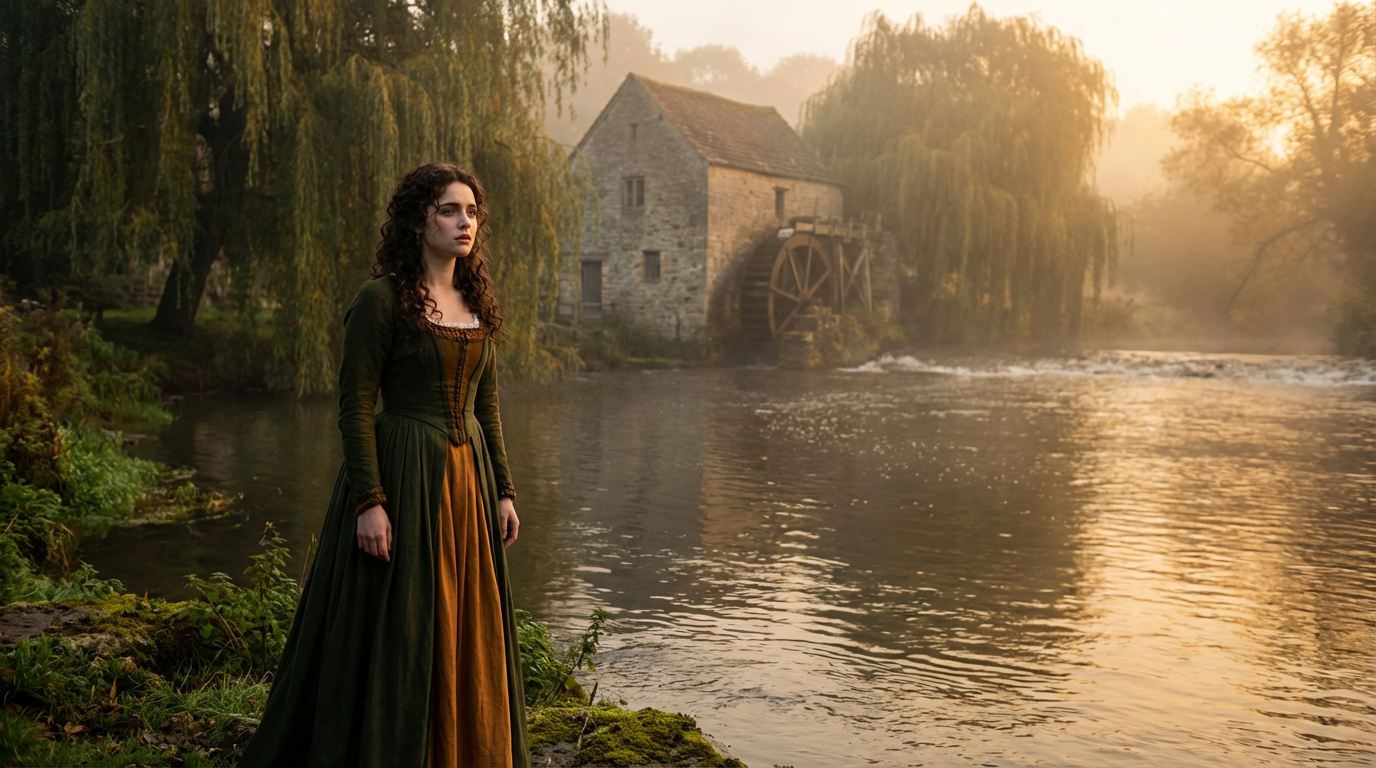
An excerpt from the original text.(complete · 4801 words)
om Applies His Knife to the Oyster
The next day, at ten o’clock, Tom was on his way to St Ogg’s, to see
his uncle Deane, who was to come home last night, his aunt had said;
and Tom had made up his mind that his uncle Deane was the right person
to ask for advice about getting some employment. He was in a great way
of business; he had not the narrow notions of uncle Glegg; and he had
risen in the world on a scale of advancement which accorded with Tom’s
ambition.
It was a dark, chill, misty morning, likely to end in rain,—one of
those mornings when even happy people take refuge in their hopes. And
Tom was very unhappy; he felt the humiliation as well as the
prospective hardships of his lot with all the keenness of a proud
nature; and with all his resolute dutifulness toward his father there
mingled an irrepressible indignation against him which gave misfortune
the less endurable aspect of a wrong. Since these were the consequences
of going to law, his father was really blamable, as his aunts and
uncles had always said he was; and it was a significant indication of
Tom’s character, that though he thought his aunts ought to do something
more for his mother, he felt nothing like Maggie’s violent resentment
against them for showing no eager tenderness and generosity. There were
no impulses in Tom that led him to expect what did not present itself
to him as a right to be demanded. Why should people give away their
money plentifully to those who had not taken care of their own money?
Tom saw some justice in severity; and all the more, because he had
confidence in himself that he should never deserve that just severity.
It was very hard upon him that he should be put at this disadvantage in
life by his father’s want of prudence; but he was not going to complain
and to find fault with people because they did not make everything easy
for him. He would ask no one to help him, more than to give him work
and pay him for it. Poor Tom was not without his hopes to take refuge
in under the chill damp imprisonment of the December fog, which seemed
only like a part of his home troubles. At sixteen, the mind that has
the strongest affinity for fact cannot escape illusion and
self-flattery; and Tom, in sketching his future, had no other guide in
arranging his facts than the suggestions of his own brave
self-reliance. Both Mr Glegg and Mr Deane, he knew, had been very poor
once; he did not want to save money slowly and retire on a moderate
fortune like his uncle Glegg, but he would be like his uncle Deane—get
a situation in some great house of business and rise fast. He had
scarcely seen anything of his uncle Deane for the last three years—the
two families had been getting wider apart; but for this very reason Tom
was the more hopeful about applying to him. His uncle Glegg, he felt
sure, would never encourage any spirited project, but he had a vague
imposing idea of the resources at his uncle Deane’s command. He had
heard his father say, long ago, how Deane had made himself so valuable
to Guest & Co. that they were glad enough to offer him a share in the
business; that was what Tom resolved he would do. It was intolerable
to think of being poor and looked down upon all one’s life. He would
provide for his mother and sister, and make every one say that he was a
man of high character. He leaped over the years in this way, and, in
the haste of strong purpose and strong desire, did not see how they
would be made up of slow days, hours, and minutes.
By the time he had crossed the stone bridge over the Floss and was
entering St Ogg’s, he was thinking that he would buy his father’s mill
and land again when he was rich enough, and improve the house and live
there; he should prefer it to any smarter, newer place, and he could
keep as many horses and dogs as he liked.
Walking along the street with a firm, rapid step, at this point in his
reverie he was startled by some one who had crossed without his notice,
and who said to him in a rough, familiar voice:
“Why, Master Tom, how’s your father this morning?” It was a publican of
St Ogg’s, one of his father’s customers.
Tom disliked being spoken to just then; but he said civilly, “He’s
still very ill, thank you.”
“Ay, it’s been a sore chance for you, young man, hasn’t it,—this
lawsuit turning out against him?” said the publican, with a confused,
beery idea of being good-natured.
Tom reddened and passed on; he would have felt it like the handling of
a bruise, even if there had been the most polite and delicate reference
to his position.
“That’s Tulliver’s son,” said the publican to a grocer standing on the
adjacent door-step.
“Ah!” said the grocer, “I thought I knew his features. He takes after
his mother’s family; she was a Dodson. He’s a fine, straight youth;
what’s he been brought up to?”
“Oh! to turn up his nose at his father’s customers, and be a fine
gentleman,—not much else, I think.”
Tom, roused from his dream of the future to a thorough consciousness of
the present, made all the greater haste to reach the warehouse offices
of Guest & Co., where he expected to find his uncle Deane. But this was
Mr Deane’s morning at the bank, a clerk told him, and with some
contempt for his ignorance; Mr Deane was not to be found in River
Street on a Thursday morning.
At the bank Tom was admitted into the private room where his uncle was,
immediately after sending in his name. Mr Deane was auditing accounts;
but he looked up as Tom entered, and putting out his hand, said, “Well,
Tom, nothing fresh the matter at home, I hope? How’s your father?”
“Much the same, thank you, uncle,” said Tom, feeling nervous. “But I
want to speak to you, please, when you’re at liberty.”
“Sit down, sit down,” said Mr Deane, relapsing into his accounts, in
which he and the managing-clerk remained so absorbed for the next
half-hour that Tom began to wonder whether he should have to sit in
this way till the bank closed,—there seemed so little tendency toward a
conclusion in the quiet, monotonous procedure of these sleek,
prosperous men of business. Would his uncle give him a place in the
bank? It would be very dull, prosy work, he thought, writing there
forever to the loud ticking of a timepiece. He preferred some other way
of getting rich. But at last there was a change; his uncle took a pen
and wrote something with a flourish at the end.
“You’ll just step up to Torry’s now, Mr Spence, will you?” said Mr
Deane, and the clock suddenly became less loud and deliberate in Tom’s
ears.
“Well, Tom,” said Mr Deane, when they were alone, turning his
substantial person a little in his chair, and taking out his snuff-box;
“what’s the business, my boy; what’s the business?” Mr Deane, who had
heard from his wife what had passed the day before, thought Tom was
come to appeal to him for some means of averting the sale.
“I hope you’ll excuse me for troubling you, uncle,” said Tom,
colouring, but speaking in a tone which, though, tremulous, had a
certain proud independence in it; “but I thought you were the best
person to advise me what to do.”
“Ah!” said Mr Deane, reserving his pinch of snuff, and looking at Tom
with new attention, “let us hear.”
“I want to get a situation, uncle, so that I may earn some money,” said
Tom, who never fell into circumlocution.
“A situation?” said Mr Deane, and then took his pinch of snuff with
elaborate justice to each nostril. Tom thought snuff-taking a most
provoking habit.
“Why, let me see, how old are you?” said Mr Deane, as he threw himself
backward again.
“Sixteen; I mean, I am going in seventeen,” said Tom, hoping his uncle
noticed how much beard he had.
“Let me see; your father had some notion of making you an engineer, I
think?”
“But I don’t think I could get any money at that for a long while,
could I?”
“That’s true; but people don’t get much money at anything, my boy, when
they’re only sixteen. You’ve had a good deal of schooling, however; I
suppose you’re pretty well up in accounts, eh? You understand book
keeping?”
“No,” said Tom, rather falteringly. “I was in Practice. But Mr Stelling
says I write a good hand, uncle. That’s my writing,” added Tom, laying
on the table a copy of the list he had made yesterday.
“Ah! that’s good, that’s good. But, you see, the best hand in the
world’ll not get you a better place than a copying-clerk’s, if you know
nothing of book-keeping,—nothing of accounts. And a copying-clerk’s a
cheap article. But what have you been learning at school, then?”
Mr Deane had not occupied himself with methods of education, and had no
precise conception of what went forward in expensive schools.
“We learned Latin,” said Tom, pausing a little between each item, as if
he were turning over the books in his school-desk to assist his
memory,—“a good deal of Latin; and the last year I did Themes, one week
in Latin and one in English; and Greek and Roman history; and Euclid;
and I began Algebra, but I left it off again; and we had one day every
week for Arithmetic. Then I used to have drawing-lessons; and there
were several other books we either read or learned out of,—English
Poetry, and Horæ Paulinæ and Blair’s Rhetoric, the last half.”
Mr Deane tapped his snuff-box again and screwed up his mouth; he felt
in the position of many estimable persons when they had read the New
Tariff, and found how many commodities were imported of which they knew
nothing; like a cautious man of business, he was not going to speak
rashly of a raw material in which he had had no experience. But the
presumption was, that if it had been good for anything, so successful a
man as himself would hardly have been ignorant of it.
About Latin he had an opinion, and thought that in case of another war,
since people would no longer wear hair-powder, it would be well to put
a tax upon Latin, as a luxury much run upon by the higher classes, and
not telling at all on the ship-owning department. But, for what he
knew, the Horæ Paulinæ might be something less neutral. On the whole,
this list of acquirements gave him a sort of repulsion toward poor Tom.
“Well,” he said at last, in rather a cold, sardonic tone, “you’ve had
three years at these things,—you must be pretty strong in ’em. Hadn’t
you better take up some line where they’ll come in handy?”
Tom coloured, and burst out, with new energy:
“I’d rather not have any employment of that sort, uncle. I don’t like
Latin and those things. I don’t know what I could do with them unless I
went as usher in a school; and I don’t know them well enough for that!
besides, I would as soon carry a pair of panniers. I don’t want to be
that sort of person. I should like to enter into some business where I
can get on,—a manly business, where I should have to look after things,
and get credit for what I did. And I shall want to keep my mother and
sister.”
“Ah, young gentleman,” said Mr Deane, with that tendency to repress
youthful hopes which stout and successful men of fifty find one of
their easiest duties, “that’s sooner said than done,—sooner said than
done.”
“But didn’t you get on in that way, uncle?” said Tom, a little
irritated that Mr Deane did not enter more rapidly into his views. “I
mean, didn’t you rise from one place to another through your abilities
and good conduct?”
“Ay, ay, sir,” said Mr Deane, spreading himself in his chair a little,
and entering with great readiness into a retrospect of his own career.
“But I’ll tell you how I got on. It wasn’t by getting astride a stick
and thinking it would turn into a horse if I sat on it long enough. I
kept my eyes and ears open, sir, and I wasn’t too fond of my own back,
and I made my master’s interest my own. Why, with only looking into
what went on in the mill, I found out how there was a waste of five
hundred a-year that might be hindered. Why, sir, I hadn’t more
schooling to begin with than a charity boy; but I saw pretty soon that
I couldn’t get on far enough without mastering accounts, and I learned
’em between working hours, after I’d been unlading. Look here.” Mr
Deane opened a book and pointed to the page. “I write a good hand
enough, and I’ll match anybody at all sorts of reckoning by the head;
and I got it all by hard work, and paid for it out of my own
earnings,—often out of my own dinner and supper. And I looked into the
nature of all the things we had to do in the business, and picked up
knowledge as I went about my work, and turned it over in my head. Why,
I’m no mechanic,—I never pretended to be—but I’ve thought of a thing or
two that the mechanics never thought of, and it’s made a fine
difference in our returns. And there isn’t an article shipped or
unshipped at our wharf but I know the quality of it. If I got places,
sir, it was because I made myself fit for ’em. If you want to slip into
a round hole, you must make a ball of yourself; that’s where it is.”
Mr Deane tapped his box again. He had been led on by pure enthusiasm in
his subject, and had really forgotten what bearing this retrospective
survey had on his listener. He had found occasion for saying the same
thing more than once before, and was not distinctly aware that he had
not his port-wine before him.
“Well, uncle,” said Tom, with a slight complaint in his tone, “that’s
what I should like to do. Can’t I get on in the same way?”
“In the same way?” said Mr Deane, eyeing Tom with quiet deliberation.
“There go two or three questions to that, Master Tom. That depends on
what sort of material you are, to begin with, and whether you’ve been
put into the right mill. But I’ll tell you what it is. Your poor father
went the wrong way to work in giving you an education. It wasn’t my
business, and I didn’t interfere; but it is as I thought it would be.
You’ve had a sort of learning that’s all very well for a young fellow
like our Mr Stephen Guest, who’ll have nothing to do but sign checks
all his life, and may as well have Latin inside his head as any other
sort of stuffing.”
“But, uncle,” said Tom, earnestly, “I don’t see why the Latin need
hinder me from getting on in business. I shall soon forget it all; it
makes no difference to me. I had to do my lessons at school, but I
always thought they’d never be of any use to me afterward; I didn’t
care about them.”
“Ay, ay, that’s all very well,” said Mr Deane; “but it doesn’t alter
what I was going to say. Your Latin and rigmarole may soon dry off you,
but you’ll be but a bare stick after that. Besides, it’s whitened your
hands and taken the rough work out of you. And what do you know? Why,
you know nothing about book-keeping, to begin with, and not so much of
reckoning as a common shopman. You’ll have to begin at a low round of
the ladder, let me tell you, if you mean to get on in life. It’s no use
forgetting the education your father’s been paying for, if you don’t
give yourself a new un.”
Tom bit his lips hard; he felt as if the tears were rising, and he
would rather die than let them.
“You want me to help you to a situation,” Mr Deane went on; “well, I’ve
no fault to find with that. I’m willing to do something for you. But
you youngsters nowadays think you’re to begin with living well and
working easy; you’ve no notion of running afoot before you get
horseback. Now, you must remember what you are,—you’re a lad of
sixteen, trained to nothing particular. There’s heaps of your sort,
like so many pebbles, made to fit in nowhere. Well, you might be
apprenticed to some business,—a chemist’s and druggist’s perhaps; your
Latin might come in a bit there——”
Tom was going to speak, but Mr Deane put up his hand and said:
“Stop! hear what I’ve got to say. You don’t want to be a ’prentice,—I
know, I know,—you want to make more haste, and you don’t want to stand
behind a counter. But if you’re a copying-clerk, you’ll have to stand
behind a desk, and stare at your ink and paper all day; there isn’t
much out-look there, and you won’t be much wiser at the end of the year
than at the beginning. The world isn’t made of pen, ink, and paper, and
if you’re to get on in the world, young man, you must know what the
world’s made of. Now the best chance for you ’ud be to have a place on
a wharf, or in a warehouse, where you’d learn the smell of things, but
you wouldn’t like that, I’ll be bound; you’d have to stand cold and
wet, and be shouldered about by rough fellows. You’re too fine a
gentleman for that.”
Mr Deane paused and looked hard at Tom, who certainly felt some inward
struggle before he could reply.
“I would rather do what will be best for me in the end, sir; I would
put up with what was disagreeable.”
“That’s well, if you can carry it out. But you must remember it isn’t
only laying hold of a rope, you must go on pulling. It’s the mistake
you lads make that have got nothing either in your brains or your
pocket, to think you’ve got a better start in the world if you stick
yourselves in a place where you can keep your coats clean, and have the
shopwenches take you for fine gentlemen. That wasn’t the way I
started, young man; when I was sixteen, my jacket smelt of tar, and I
wasn’t afraid of handling cheeses. That’s the reason I can wear good
broadcloth now, and have my legs under the same table with the heads of
the best firms in St Ogg’s.”
Uncle Deane tapped his box, and seemed to expand a little under his
waistcoat and gold chain, as he squared his shoulders in the chair.
“Is there any place at liberty that you know of now, uncle, that I
should do for? I should like to set to work at once,” said Tom, with a
slight tremor in his voice.
“Stop a bit, stop a bit; we mustn’t be in too great a hurry. You must
bear in mind, if I put you in a place you’re a bit young for, because
you happen to be my nephew, I shall be responsible for you. And there’s
no better reason, you know, than your being my nephew; because it
remains to be seen whether you’re good for anything.”
“I hope I shall never do you any discredit, uncle,” said Tom, hurt, as
all boys are at the statement of the unpleasant truth that people feel
no ground for trusting them. “I care about my own credit too much for
that.”
“Well done, Tom, well done! That’s the right spirit, and I never refuse
to help anybody if they’ve a mind to do themselves justice. There’s a
young man of two-and-twenty I’ve got my eye on now. I shall do what I
can for that young man; he’s got some pith in him. But then, you see,
he’s made good use of his time,—a first-rate calculator,—can tell you
the cubic contents of anything in no time, and put me up the other day
to a new market for Swedish bark; he’s uncommonly knowing in
manufactures, that young fellow.”
“I’d better set about learning book-keeping, hadn’t I, uncle?” said
Tom, anxious to prove his readiness to exert himself.
“Yes, yes, you can’t do amiss there. But—Ah, Spence, you’re back again.
Well Tom, there’s nothing more to be said just now, I think, and I must
go to business again. Good-by. Remember me to your mother.”
Mr Deane put out his hand, with an air of friendly dismissal, and Tom
had not courage to ask another question, especially in the presence of
Mr Spence. So he went out again into the cold damp air. He had to call
at his uncle Glegg’s about the money in the Savings Bank, and by the
time he set out again the mist had thickened, and he could not see very
far before him; but going along River Street again, he was startled,
when he was within two yards of the projecting side of a shop-window,
by the words “Dorlcote Mill” in large letters on a hand-bill, placed as
if on purpose to stare at him. It was the catalogue of the sale to take
place the next week; it was a reason for hurrying faster out of the
town.
Poor Tom formed no visions of the distant future as he made his way
homeward; he only felt that the present was very hard. It seemed a
wrong toward him that his uncle Deane had no confidence in him,—did not
see at once that he should acquit himself well, which Tom himself was
as certain of as of the daylight. Apparently he, Tom Tulliver, was
likely to be held of small account in the world; and for the first time
he felt a sinking of heart under the sense that he really was very
ignorant, and could do very little. Who was that enviable young man
that could tell the cubic contents of things in no time, and make
suggestions about Swedish bark! Tom had been used to be so entirely
satisfied with himself, in spite of his breaking down in a
demonstration, and construing nunc illas promite vires as “now
promise those men”; but now he suddenly felt at a disadvantage, because
he knew less than some one else knew. There must be a world of things
connected with that Swedish bark, which, if he only knew them, might
have helped him to get on. It would have been much easier to make a
figure with a spirited horse and a new saddle.
Two hours ago, as Tom was walking to St Ogg’s, he saw the distant
future before him as he might have seen a tempting stretch of smooth
sandy beach beyond a belt of flinty shingles; he was on the grassy bank
then, and thought the shingles might soon be passed. But now his feet
were on the sharp stones; the belt of shingles had widened, and the
stretch of sand had dwindled into narrowness.
“What did my Uncle Deane say, Tom?” said Maggie, putting her arm
through Tom’s as he was warming himself rather drearily by the kitchen
fire. “Did he say he would give you a situation?”
“No, he didn’t say that. He didn’t quite promise me anything; he seemed
to think I couldn’t have a very good situation. I’m too young.”
“But didn’t he speak kindly, Tom?”
“Kindly? Pooh! what’s the use of talking about that? I wouldn’t care
about his speaking kindly, if I could get a situation. But it’s such a
nuisance and bother; I’ve been at school all this while learning Latin
and things,—not a bit of good to me,—and now my uncle says I must set
about learning book-keeping and calculation, and those things. He seems
to make out I’m good for nothing.”
Tom’s mouth twitched with a bitter expression as he looked at the fire.
“Oh, what a pity we haven’t got Dominie Sampson!” said Maggie, who
couldn’t help mingling some gayety with their sadness. “If he had
taught me book-keeping by double entry and after the Italian method, as
he did Lucy Bertram, I could teach you, Tom.”
“You teach! Yes, I dare say. That’s always the tone you take,” said
Tom.
“Dear Tom, I was only joking,” said Maggie, putting her cheek against
his coat-sleeve.
“But it’s always the same, Maggie,” said Tom, with the little frown he
put on when he was about to be justifiably severe. “You’re always
setting yourself up above me and every one else, and I’ve wanted to
tell you about it several times. You ought not to have spoken as you
did to my uncles and aunts; you should leave it to me to take care of
my mother and you, and not put yourself forward. You think you know
better than any one, but you’re almost always wrong. I can judge much
better than you can.”
Poor Tom! he had just come from being lectured and made to feel his
inferiority; the reaction of his strong, self-asserting nature must
take place somehow; and here was a case in which he could justly show
himself dominant. Maggie’s cheek flushed and her lip quivered with
conflicting resentment and affection, and a certain awe as well as
admiration of Tom’s firmer and more effective character. She did not
answer immediately; very angry words rose to her lips, but they were
driven back again, and she said at last:
“You often think I’m conceited, Tom, when I don’t mean what I say at
all in that way. I don’t mean to put myself above you; I know you
behaved better than I did yesterday. But you are always so harsh to me,
Tom.”
With the last words the resentment was rising again.
“No, I’m not harsh,” said Tom, with severe decision. “I’m always kind
to you, and so I shall be; I shall always take care of you. But you
must mind what I say.”
Their mother came in now, and Maggie rushed away, that her burst of
tears, which she felt must come, might not happen till she was safe
upstairs. They were very bitter tears; everybody in the world seemed so
hard and unkind to Maggie; there was no indulgence, no fondness, such
as she imagined when she fashioned the world afresh in her own
thoughts. In books there were people who were always agreeable or
tender, and delighted to do things that made one happy, and who did not
show their kindness by finding fault. The world outside the books was
not a happy one, Maggie felt; it seemed to be a world where people
behaved the best to those they did not pretend to love, and that did
not belong to them. And if life had no love in it, what else was there
for Maggie? Nothing but poverty and the companionship of her mother’s
narrow griefs, perhaps of her father’s heart-cutting childish
dependence. There is no hopelessness so sad as that of early youth,
when the soul is made up of wants, and has no long memories, no
superadded life in the life of others; though we who looked on think
lightly of such premature despair, as if our vision of the future
lightened the blind sufferer’s present.
Maggie, in her brown frock, with her eyes reddened and her heavy hair
pushed back, looking from the bed where her father lay to the dull
walls of this sad chamber which was the centre of her world, was a
creature full of eager, passionate longings for all that was beautiful
and glad; thirsty for all knowledge; with an ear straining after dreamy
music that died away and would not come near to her; with a blind,
unconscious yearning for something that would link together the
wonderful impressions of this mysterious life, and give her soul a
sense of home in it.
No wonder, when there is this contrast between the outward and the
inward, that painful collisions come of it.
Master this chapter. Complete your experience
Purchase the complete book to access all chapters and support classic literature
As an Amazon Associate, we earn a small commission from qualifying purchases at no additional cost to you.
Available in paperback, hardcover, and e-book formats
Let's Analyse the Pattern
When our training and expectations don't match the reality we actually face, creating vulnerability and forcing painful recalibration.
Why This Matters
Connect literature to life
This chapter teaches how to spot when impressive qualifications mask practical incompetence—in yourself and others.
Practice This Today
This week, notice when someone's resume doesn't match their actual performance, or when your own expertise feels useless in real situations.
Now let's explore the literary elements.
Key Quotes & Analysis
"It was a dark, chill, misty morning, likely to end in rain,—one of those mornings when even happy people take refuge in their hopes."
Context: As Tom walks to see Uncle Deane on a gloomy morning
The weather mirrors Tom's emotional state and uncertain future. Even the narrator acknowledges that hope becomes a refuge when reality looks bleak.
In Today's Words:
It was one of those depressing mornings when even optimistic people have to force themselves to stay positive.
"Since these were the consequences of going to law, his father was really blamable, as his aunts and uncles had always said he was."
Context: Tom reflecting on his family's financial ruin
Shows how financial crisis forces Tom to see his father's flaws clearly for the first time. The relatives he once dismissed were right about his father's poor judgment.
In Today's Words:
Now that they were broke because of Dad's legal mess, Tom had to admit the family was right to criticize him.
"I think you must come down a peg or two, and try to get on by doing what other people won't do."
Context: Advising Tom about finding work despite his lack of practical skills
Deane bluntly tells Tom his grand ambitions don't match his abilities. Success requires humility and willingness to do unglamorous work.
In Today's Words:
You need to lower your expectations and be willing to take jobs other people think are beneath them.
Thematic Threads
Class Mobility
In This Chapter
Tom discovers his expensive education actually hinders rather than helps his prospects for advancement
Development
Builds on earlier themes of the family's fall from middle-class respectability
In Your Life:
You might face this when your background doesn't match the unwritten rules of where you want to go.
Pride
In This Chapter
Tom's wounded pride from Uncle Deane's rejection makes him cruel to Maggie at home
Development
Shows how pride becomes destructive when challenged by reality
In Your Life:
You might recognize this when you take out your professional frustrations on your family.
Practical vs. Theoretical Knowledge
In This Chapter
Tom's classical education proves worthless compared to practical business skills like bookkeeping
Development
Introduced here as a major tension between status education and useful skills
In Your Life:
You might see this gap between what sounds impressive and what actually pays the bills.
Gender Power Dynamics
In This Chapter
Tom asserts his authority over Maggie as 'the man of the family' when feeling powerless elsewhere
Development
Escalates from earlier subtle dynamics to overt dominance
In Your Life:
You might notice this when someone uses whatever power they have to compensate for where they feel powerless.
Escape Through Fantasy
In This Chapter
Maggie retreats to her books where characters are kinder than real people
Development
Continues her pattern of using literature to cope with harsh reality
In Your Life:
You might recognize this when you prefer fictional worlds to dealing with actual problems.
You now have the context. Time to form your own thoughts.
Discussion Questions
- 1
What specific reality check does Uncle Deane give Tom about his education and job prospects?
analysis • surface - 2
Why does Tom's expensive classical education actually hurt rather than help his chances of finding work?
analysis • medium - 3
Where do you see this same pattern today - people discovering their preparation doesn't match what employers actually need?
application • medium - 4
If you were Tom's friend, what practical advice would you give him for moving forward after this harsh reality check?
application • deep - 5
What does Tom's reaction to Maggie reveal about how wounded pride affects our treatment of people closest to us?
reflection • deep
Critical Thinking Exercise
Skills Gap Reality Check
Think about your current job or career goal. Make two lists: what you've been taught or trained in versus what employers in that field actually need right now. Look at job postings, talk to people in the industry, or research current trends. Identify the biggest gap between your preparation and market reality.
Consider:
- •Be brutally honest about what you don't know - pride won't pay bills
- •Look for patterns in job postings about what skills appear most often
- •Consider both technical skills and soft skills that employers value
Journaling Prompt
Write about a time when you discovered something you thought would help you actually didn't matter. How did you handle the disappointment, and what did you do to bridge the gap between expectation and reality?
Coming Up Next...
Chapter 26: When Old Friends Return in Dark Times
A pocket-knife becomes an unexpected catalyst for change, challenging assumptions about gifts, relationships, and what truly matters in times of hardship.



