
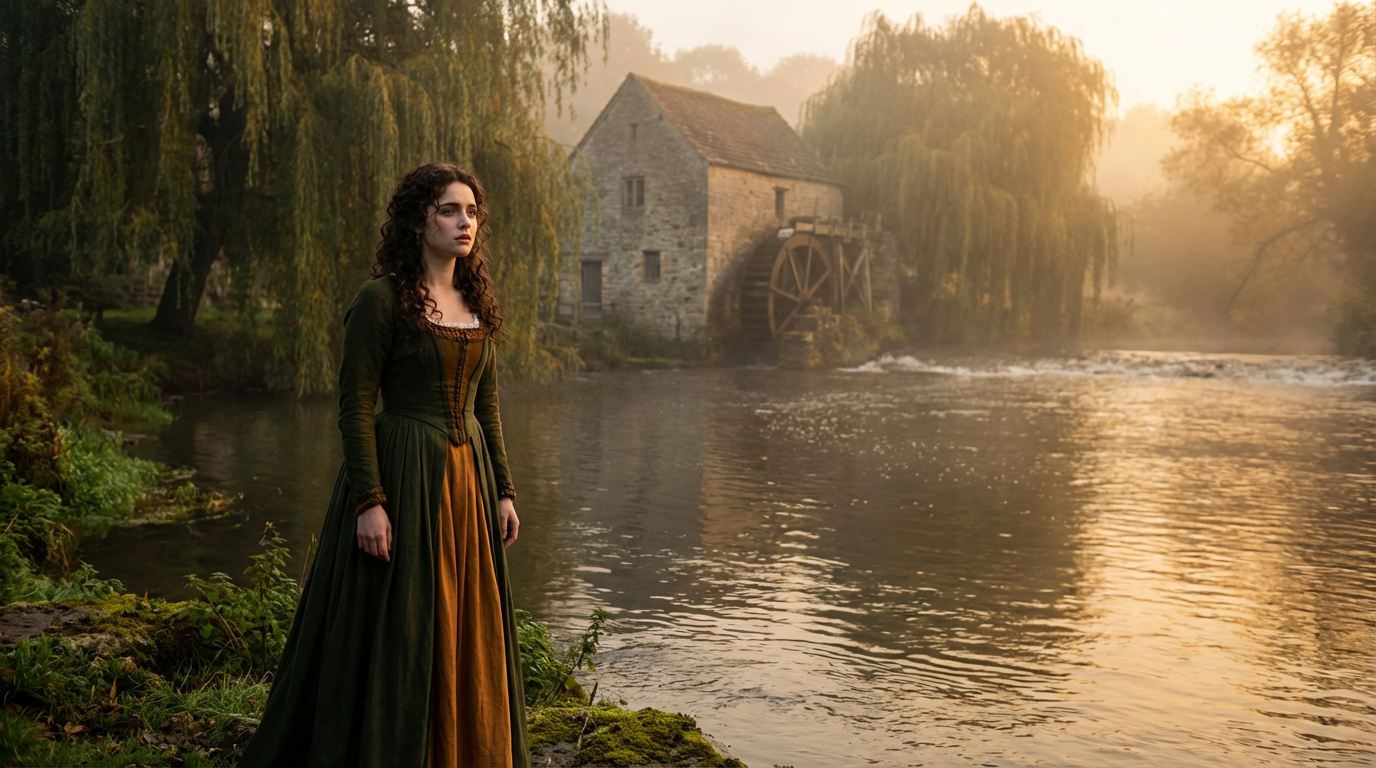
An excerpt from the original text.(complete · 1434 words)
Vanishing Gleam
Mr Tulliver, even between the fits of spasmodic rigidity which had
recurred at intervals ever since he had been found fallen from his
horse, was usually in so apathetic a condition that the exits and
entrances into his room were not felt to be of great importance. He had
lain so still, with his eyes closed, all this morning, that Maggie told
her aunt Moss she must not expect her father to take any notice of
them.
They entered very quietly, and Mrs Moss took her seat near the head of
the bed, while Maggie sat in her old place on the bed, and put her hand
on her father’s without causing any change in his face.
Mr Glegg and Tom had also entered, treading softly, and were busy
selecting the key of the old oak chest from the bunch which Tom had
brought from his father’s bureau. They succeeded in opening the
chest,—which stood opposite the foot of Mr Tulliver’s bed,—and propping
the lid with the iron holder, without much noise.
“There’s a tin box,” whispered Mr Glegg; “he’d most like put a small
thing like a note in there. Lift it out, Tom; but I’ll just lift up
these deeds,—they’re the deeds o’ the house and mill, I suppose,—and
see what there is under ’em.”
Mr Glegg had lifted out the parchments, and had fortunately drawn back
a little, when the iron holder gave way, and the heavy lid fell with a
loud bang that resounded over the house.
Perhaps there was something in that sound more than the mere fact of
the strong vibration that produced the instantaneous effect on the
frame of the prostrate man, and for the time completely shook off the
obstruction of paralysis. The chest had belonged to his father and his
father’s father, and it had always been rather a solemn business to
visit it. All long-known objects, even a mere window fastening or a
particular door-latch, have sounds which are a sort of recognised voice
to us,—a voice that will thrill and awaken, when it has been used to
touch deep-lying fibres. In the same moment, when all the eyes in the
room were turned upon him, he started up and looked at the chest, the
parchments in Mr Glegg’s hand, and Tom holding the tin box, with a
glance of perfect consciousness and recognition.
“What are you going to do with those deeds?” he said, in his ordinary
tone of sharp questioning whenever he was irritated. “Come here, Tom.
What do you do, going to my chest?”
Tom obeyed, with some trembling; it was the first time his father had
recognised him. But instead of saying anything more to him, his father
continued to look with a growing distinctness of suspicion at Mr Glegg
and the deeds.
“What’s been happening, then?” he said sharply. “What are you meddling
with my deeds for? Is Wakem laying hold of everything? Why don’t you
tell me what you’ve been a-doing?” he added impatiently, as Mr Glegg
advanced to the foot of the bed before speaking.
“No, no, friend Tulliver,” said Mr Glegg, in a soothing tone. “Nobody’s
getting hold of anything as yet. We only came to look and see what was
in the chest. You’ve been ill, you know, and we’ve had to look after
things a bit. But let’s hope you’ll soon be well enough to attend to
everything yourself.”
Mr Tulliver looked around him meditatively, at Tom, at Mr Glegg, and at
Maggie; then suddenly appearing aware that some one was seated by his
side at the head of the bed he turned sharply round and saw his sister.
“Eh, Gritty!” he said, in the half-sad, affectionate tone in which he
had been wont to speak to her. “What! you’re there, are you? How could
you manage to leave the children?”
“Oh, brother!” said good Mrs Moss, too impulsive to be prudent, “I’m
thankful I’m come now to see you yourself again; I thought you’d never
know us any more.”
“What! have I had a stroke?” said Mr Tulliver, anxiously, looking at Mr
Glegg.
“A fall from your horse—shook you a bit,—that’s all, I think,” said Mr
Glegg. “But you’ll soon get over it, let’s hope.”
Mr Tulliver fixed his eyes on the bed-clothes, and remained silent for
two or three minutes. A new shadow came over his face. He looked up at
Maggie first, and said in a lower tone, “You got the letter, then, my
wench?”
“Yes, father,” she said, kissing him with a full heart. She felt as if
her father were come back to her from the dead, and her yearning to
show him how she had always loved him could be fulfilled.
“Where’s your mother?” he said, so preoccupied that he received the
kiss as passively as some quiet animal might have received it.
“She’s downstairs with my aunts, father. Shall I fetch her?”
“Ay, ay; poor Bessy!” and his eyes turned toward Tom as Maggie left the
room.
“You’ll have to take care of ’em both if I die, you know, Tom. You’ll
be badly off, I doubt. But you must see and pay everybody. And
mind,—there’s fifty pound o’ Luke’s as I put into the business,—he gave
me a bit at a time, and he’s got nothing to show for it. You must pay
him first thing.”
Uncle Glegg involuntarily shook his head, and looked more concerned
than ever, but Tom said firmly:
“Yes, father. And haven’t you a note from my uncle Moss for three
hundred pounds? We came to look for that. What do you wish to be done
about it, father?”
“Ah! I’m glad you thought o’ that, my lad,” said Mr Tulliver. “I allays
meant to be easy about that money, because o’ your aunt. You mustn’t
mind losing the money, if they can’t pay it,—and it’s like enough they
can’t. The note’s in that box, mind! I allays meant to be good to you,
Gritty,” said Mr Tulliver, turning to his sister; “but you know you
aggravated me when you would have Moss.”
At this moment Maggie re-entered with her mother, who came in much
agitated by the news that her husband was quite himself again.
“Well, Bessy,” he said, as she kissed him, “you must forgive me if
you’re worse off than you ever expected to be.
But it’s the fault o’ the law,—it’s none o’ mine,” he added angrily.
“It’s the fault o’ raskills. Tom, you mind this: if ever you’ve got the
chance, you make Wakem smart. If you don’t, you’re a good-for-nothing
son. You might horse-whip him, but he’d set the law on you,—the law’s
made to take care o’ raskills.”
Mr Tulliver was getting excited, and an alarming flush was on his face.
Mr Glegg wanted to say something soothing, but he was prevented by Mr
Tulliver’s speaking again to his wife. “They’ll make a shift to pay
everything, Bessy,” he said, “and yet leave you your furniture; and
your sisters’ll do something for you—and Tom’ll grow up—though what
he’s to be I don’t know—I’ve done what I could—I’ve given him a
eddication—and there’s the little wench, she’ll get married—but it’s a
poor tale——”
The sanative effect of the strong vibration was exhausted, and with the
last words the poor man fell again, rigid and insensible. Though this
was only a recurrence of what had happened before, it struck all
present as if it had been death, not only from its contrast with the
completeness of the revival, but because his words had all had
reference to the possibility that his death was near. But with poor
Tulliver death was not to be a leap; it was to be a long descent under
thickening shadows.
Mr Turnbull was sent for; but when he heard what had passed, he said
this complete restoration, though only temporary, was a hopeful sign,
proving that there was no permanent lesion to prevent ultimate
recovery.
Among the threads of the past which the stricken man had gathered up,
he had omitted the bill of sale; the flash of memory had only lit up
prominent ideas, and he sank into forgetfulness again with half his
humiliation unlearned.
But Tom was clear upon two points,—that his uncle Moss’s note must be
destroyed; and that Luke’s money must be paid, if in no other way, out
of his own and Maggie’s money now in the savings bank. There were
subjects, you perceive, on which Tom was much quicker than on the
niceties of classical construction, or the relations of a mathematical
demonstration.
Master this chapter. Complete your experience
Purchase the complete book to access all chapters and support classic literature
As an Amazon Associate, we earn a small commission from qualifying purchases at no additional cost to you.
Available in paperback, hardcover, and e-book formats
Let's Analyse the Pattern
Crisis strips away pretense and reveals people's core values and true character.
Why This Matters
Connect literature to life
This chapter teaches how to recognize someone's true values by observing what they prioritize when under extreme pressure.
Practice This Today
This week, notice when someone is stressed or facing a deadline—watch what they protect first and what they're willing to sacrifice, because that reveals their real priorities.
Now let's explore the literary elements.
Key Quotes & Analysis
"Luke must be paid first from any remaining money, even though Luke has no written proof of what he's owed."
Context: Tulliver gives final instructions about settling debts during his moment of consciousness
This reveals Tulliver's core values: loyalty to working people comes before family financial security. He understands that Luke, having no written contract, is most vulnerable and deserves protection. It shows how a person's true character emerges in crisis.
In Today's Words:
Pay the guy who's been loyal to us first, even if we don't have it in writing - he's counting on us.
"Forgive the three-hundred-pound debt that Mrs. Moss's family owes."
Context: Tulliver instructs Tom about family debts while on his deathbed
Despite their own financial ruin, Tulliver chooses family loyalty over money. This decision will make Tom's situation harder, but it reflects the dying man's belief that blood relationships matter more than financial recovery.
In Today's Words:
Don't make your aunt pay us back - family doesn't squeeze family when they're struggling.
"Make Wakem smart someday."
Context: His final command to Tom about seeking revenge on their enemy
This dying wish reveals how hatred can consume someone even in their final moments. Tulliver's need for revenge becomes Tom's inheritance, showing how family grudges get passed down through generations like toxic heirlooms.
In Today's Words:
Make sure that bastard gets what's coming to him - don't let him think he won.
"The heavy lid fell with a loud bang that jolted him back to consciousness."
Context: The familiar sound of the chest awakens the unconscious Tulliver
This moment shows how deeply we're connected to the physical spaces and sounds of our lives. The chest represents Tulliver's world of business and responsibility, and its sound calls him back for one final reckoning with his affairs.
In Today's Words:
That crash woke him up like nothing else could - some sounds just hit different when they're tied to your whole life.
Thematic Threads
Loyalty
In This Chapter
Tulliver prioritizes paying Luke and forgiving Mrs. Moss's debt over his own financial recovery
Development
Developed from earlier themes of family obligation and working-class solidarity
In Your Life:
Notice who you protect when resources are scarce—that reveals your real loyalties.
Class
In This Chapter
Tulliver insists Luke be paid first despite having no written contract, showing respect for working people
Development
Continues the book's exploration of how class shapes relationships and obligations
In Your Life:
Your treatment of people with less power than you reveals more about your character than how you treat equals.
Revenge
In This Chapter
Tulliver's dying wish is for Tom to 'make Wakem smart,' showing how hatred persists even in final moments
Development
Escalates from earlier conflicts with Wakem into a legacy of vengeance
In Your Life:
The grudges you hold onto when everything else falls away might be poisoning more than you realize.
Recognition
In This Chapter
A familiar sound from his father's chest jolts Tulliver back to consciousness, showing deep emotional connections
Development
Builds on themes of memory and family heritage from earlier chapters
In Your Life:
Sometimes the smallest familiar details can reach people when everything else fails.
Legacy
In This Chapter
Tulliver shapes Tom's future through his final instructions about debts and enemies
Development
Introduced here as Tulliver faces mortality and considers what he'll leave behind
In Your Life:
What you ask of people in your vulnerable moments becomes part of what they carry forever.
You now have the context. Time to form your own thoughts.
Discussion Questions
- 1
What does Tulliver prioritize when he regains consciousness, and what does this reveal about his true character?
analysis • surface - 2
Why does Tulliver insist on paying Luke first and forgiving Mrs. Moss's debt, even though his family is facing financial ruin?
analysis • medium - 3
Think about a crisis you've witnessed or experienced. How did it reveal people's true priorities and values?
application • medium - 4
When you're under pressure or facing a difficult decision, what helps you identify what really matters versus what just seems important?
application • deep - 5
What does Tulliver's final moments teach us about the difference between who we appear to be and who we actually are?
reflection • deep
Critical Thinking Exercise
Crisis Values Inventory
Think of a recent stressful situation in your life - a work crisis, family emergency, or financial pressure. Write down what you actually prioritized during that time versus what you normally say matters to you. Look for gaps between your stated values and your crisis actions.
Consider:
- •Notice what you protected first when resources were limited
- •Consider who you reached out to or worried about most
- •Observe what you were willing to sacrifice and what you absolutely wouldn't give up
Journaling Prompt
Write about a time when pressure revealed something unexpected about your own character - either something you're proud of or something that surprised you. How has this awareness changed how you approach decisions?
Coming Up Next...
Chapter 25: Tom Seeks His Fortune
Tom faces his first real test of character as he must decide how to handle his father's debts and wishes. With the family's financial ruin now clear, he'll need to prove whether he has the strength to carry the burdens his father is placing on his young shoulders.



