
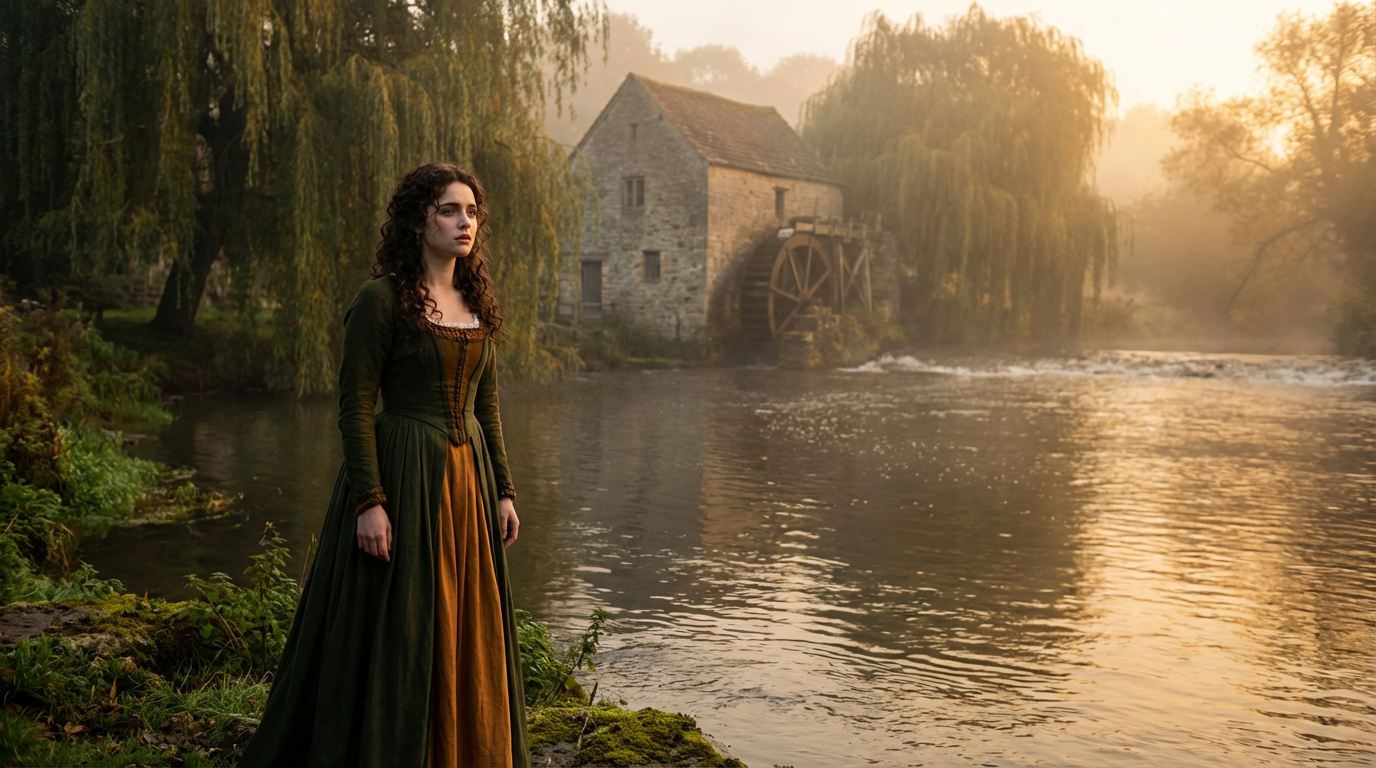
An excerpt from the original text.(complete · 6267 words)
he Family Council
It was at eleven o’clock the next morning that the aunts and uncles
came to hold their consultation. The fire was lighted in the large
parlour, and poor Mrs Tulliver, with a confused impression that it was
a great occasion, like a funeral, unbagged the bell-rope tassels, and
unpinned the curtains, adjusting them in proper folds, looking round
and shaking her head sadly at the polished tops and legs of the tables,
which sister Pullet herself could not accuse of insufficient
brightness.
Mr Deane was not coming, he was away on business; but Mrs Deane
appeared punctually in that handsome new gig with the head to it, and
the livery-servant driving it, which had thrown so clear a light on
several traits in her character to some of her female friends in St
Ogg’s. Mr Deane had been advancing in the world as rapidly as Mr
Tulliver had been going down in it; and in Mrs Deane’s house the Dodson
linen and plate were beginning to hold quite a subordinate position, as
a mere supplement to the handsomer articles of the same kind, purchased
in recent years,—a change which had caused an occasional coolness in
the sisterly intercourse between her and Mrs Glegg, who felt that Susan
was getting “like the rest,” and there would soon be little of the true
Dodson spirit surviving except in herself, and, it might be hoped, in
those nephews who supported the Dodson name on the family land, far
away in the Wolds.
People who live at a distance are naturally less faulty than those
immediately under our own eyes; and it seems superfluous, when we
consider the remote geographical position of the Ethiopians, and how
very little the Greeks had to do with them, to inquire further why
Homer calls them “blameless.”
Mrs Deane was the first to arrive; and when she had taken her seat in
the large parlour, Mrs Tulliver came down to her with her comely face a
little distorted, nearly as it would have been if she had been crying.
She was not a woman who could shed abundant tears, except in moments
when the prospect of losing her furniture became unusually vivid, but
she felt how unfitting it was to be quite calm under present
circumstances.
“Oh, sister, what a world this is!” she exclaimed as she entered; “what
trouble, oh dear!”
Mrs Deane was a thin-lipped woman, who made small well-considered
speeches on peculiar occasions, repeating them afterward to her
husband, and asking him if she had not spoken very properly.
“Yes, sister,” she said deliberately, “this is a changing world, and we
don’t know to-day what may happen tomorrow. But it’s right to be
prepared for all things, and if trouble’s sent, to remember as it isn’t
sent without a cause. I’m very sorry for you as a sister, and if the
doctor orders jelly for Mr Tulliver, I hope you’ll let me know. I’ll
send it willingly; for it is but right he should have proper attendance
while he’s ill.”
“Thank you, Susan,” said Mrs Tulliver, rather faintly, withdrawing her
fat hand from her sister’s thin one. “But there’s been no talk o’ jelly
yet.” Then after a moment’s pause she added, “There’s a dozen o’ cut
jelly-glasses upstairs—I shall never put jelly into ’em no more.”
Her voice was rather agitated as she uttered the last words, but the
sound of wheels diverted her thoughts. Mr and Mrs Glegg were come, and
were almost immediately followed by Mr and Mrs Pullet.
Mrs Pullet entered crying, as a compendious mode, at all times, of
expressing what were her views of life in general, and what, in brief,
were the opinions she held concerning the particular case before her.
Mrs Glegg had on her fuzziest front, and garments which appeared to
have had a recent resurrection from rather a creasy form of burial; a
costume selected with the high moral purpose of instilling perfect
humility into Bessy and her children.
“Mrs G., won’t you come nearer the fire?” said her husband, unwilling
to take the more comfortable seat without offering it to her.
“You see I’ve seated myself here, Mr Glegg,” returned this superior
woman; “you can roast yourself, if you like.”
“Well,” said Mr Glegg, seating himself good-humouredly, “and how’s the
poor man upstairs?”
“Dr Turnbull thought him a deal better this morning,” said Mrs
Tulliver; “he took more notice, and spoke to me; but he’s never known
Tom yet,—looks at the poor lad as if he was a stranger, though he said
something once about Tom and the pony. The doctor says his memory’s
gone a long way back, and he doesn’t know Tom because he’s thinking of
him when he was little. Eh dear, eh dear!”
“I doubt it’s the water got on his brain,” said aunt Pullet, turning
round from adjusting her cap in a melancholy way at the pier-glass.
“It’s much if he ever gets up again; and if he does, he’ll most like be
childish, as Mr Carr was, poor man! They fed him with a spoon as if
he’d been a babby for three year. He’d quite lost the use of his limbs;
but then he’d got a Bath chair, and somebody to draw him; and that’s
what you won’t have, I doubt, Bessy.”
“Sister Pullet,” said Mrs Glegg, severely, “if I understand right,
we’ve come together this morning to advise and consult about what’s to
be done in this disgrace as has fallen upon the family, and not to talk
o’ people as don’t belong to us. Mr Carr was none of our blood, nor
noways connected with us, as I’ve ever heared.”
“Sister Glegg,” said Mrs Pullet, in a pleading tone, drawing on her
gloves again, and stroking the fingers in an agitated manner, “if
you’ve got anything disrespectful to say o’ Mr Carr, I do beg of you as
you won’t say it to me. I know what he was,” she added, with a sigh;
“his breath was short to that degree as you could hear him two rooms
off.”
“Sophy!” said Mrs Glegg, with indignant disgust, “you do talk o’
people’s complaints till it’s quite undecent. But I say again, as I
said before, I didn’t come away from home to talk about acquaintances,
whether they’d short breath or long. If we aren’t come together for one
to hear what the other ’ull do to save a sister and her children from
the parish, I shall go back. One can’t act without the other, I
suppose; it isn’t to be expected as I should do everything.”
“Well, Jane,” said Mrs Pullet, “I don’t see as you’ve been so very
forrard at doing. So far as I know, this is the first time as here
you’ve been, since it’s been known as the bailiff’s in the house; and I
was here yesterday, and looked at all Bessy’s linen and things, and I
told her I’d buy in the spotted tablecloths. I couldn’t speak fairer;
for as for the teapot as she doesn’t want to go out o’ the family, it
stands to sense I can’t do with two silver teapots, not if it hadn’t
a straight spout, but the spotted damask I was allays fond on.”
“I wish it could be managed so as my teapot and chany and the best
castors needn’t be put up for sale,” said poor Mrs Tulliver,
beseechingly, “and the sugar-tongs the first things ever I bought.”
“But that can’t be helped, you know,” said Mr Glegg. “If one o’ the
family chooses to buy ’em in, they can, but one thing must be bid for
as well as another.”
“And it isn’t to be looked for,” said uncle Pullet, with unwonted
independence of idea, “as your own family should pay more for things
nor they’ll fetch. They may go for an old song by auction.”
“Oh dear, oh dear,” said Mrs Tulliver, “to think o’ my chany being sold
i’ that way, and I bought it when I was married, just as you did yours,
Jane and Sophy; and I know you didn’t like mine, because o’ the sprig,
but I was fond of it; and there’s never been a bit broke, for I’ve
washed it myself; and there’s the tulips on the cups, and the roses, as
anybody might go and look at ’em for pleasure. You wouldn’t like your
chany to go for an old song and be broke to pieces, though yours has
got no colour in it, Jane,—it’s all white and fluted, and didn’t cost
so much as mine. And there’s the castors, sister Deane, I can’t think
but you’d like to have the castors, for I’ve heard you say they’re
pretty.”
“Well, I’ve no objection to buy some of the best things,” said Mrs
Deane, rather loftily; “we can do with extra things in our house.”
“Best things!” exclaimed Mrs Glegg, with severity, which had gathered
intensity from her long silence. “It drives me past patience to hear
you all talking o’ best things, and buying in this, that, and the
other, such as silver and chany. You must bring your mind to your
circumstances, Bessy, and not be thinking o’ silver and chany; but
whether you shall get so much as a flock-bed to lie on, and a blanket
to cover you, and a stool to sit on. You must remember, if you get ’em,
it’ll be because your friends have bought ’em for you, for you’re
dependent upon them for everything; for your husband lies there
helpless, and hasn’t got a penny i’ the world to call his own. And it’s
for your own good I say this, for it’s right you should feel what your
state is, and what disgrace your husband’s brought on your own family,
as you’ve got to look to for everything, and be humble in your mind.”
Mrs Glegg paused, for speaking with much energy for the good of others
is naturally exhausting.
Mrs Tulliver, always borne down by the family predominance of sister
Jane, who had made her wear the yoke of a younger sister in very tender
years, said pleadingly:
“I’m sure, sister, I’ve never asked anybody to do anything, only buy
things as it ’ud be a pleasure to ’em to have, so as they mightn’t go
and be spoiled i’ strange houses. I never asked anybody to buy the
things in for me and my children; though there’s the linen I spun, and
I thought when Tom was born,—I thought one o’ the first things when he
was lying i’ the cradle, as all the things I’d bought wi’ my own money,
and been so careful of, ’ud go to him. But I’ve said nothing as I
wanted my sisters to pay their money for me. What my husband has done
for his sister’s unknown, and we should ha’ been better off this day
if it hadn’t been as he’s lent money and never asked for it again.”
“Come, come,” said Mr Glegg, kindly, “don’t let us make things too
dark. What’s done can’t be undone. We shall make a shift among us to
buy what’s sufficient for you; though, as Mrs G. says, they must be
useful, plain things. We mustn’t be thinking o’ what’s unnecessary. A
table, and a chair or two, and kitchen things, and a good bed, and
such-like. Why, I’ve seen the day when I shouldn’t ha’ known myself if
I’d lain on sacking i’stead o’ the floor. We get a deal o’ useless
things about us, only because we’ve got the money to spend.”
“Mr Glegg,” said Mrs G., “if you’ll be kind enough to let me speak,
i’stead o’ taking the words out o’ my mouth,—I was going to say, Bessy,
as it’s fine talking for you to say as you’ve never asked us to buy
anything for you; let me tell you, you ought to have asked us. Pray,
how are you to be purvided for, if your own family don’t help you? You
must go to the parish, if they didn’t. And you ought to know that, and
keep it in mind, and ask us humble to do what we can for you, i’stead
o’ saying, and making a boast, as you’ve never asked us for anything.”
“You talked o’ the Mosses, and what Mr Tulliver’s done for ’em,” said
uncle Pullet, who became unusually suggestive where advances of money
were concerned. “Haven’t they been anear you? They ought to do
something as well as other folks; and if he’s lent ’em money, they
ought to be made to pay it back.”
“Yes, to be sure,” said Mrs Deane; “I’ve been thinking so. How is it Mr
and Mrs Moss aren’t here to meet us? It is but right they should do
their share.”
“Oh, dear!” said Mrs Tulliver, “I never sent ’em word about Mr
Tulliver, and they live so back’ard among the lanes at Basset, they
niver hear anything only when Mr Moss comes to market. But I niver gave
’em a thought. I wonder Maggie didn’t, though, for she was allays so
fond of her aunt Moss.”
“Why don’t your children come in, Bessy?” said Mrs Pullet, at the
mention of Maggie. “They should hear what their aunts and uncles have
got to say; and Maggie,—when it’s me as have paid for half her
schooling, she ought to think more of her aunt Pullet than of aunt
Moss. I may go off sudden when I get home to-day; there’s no telling.”
“If I’d had my way,” said Mrs Glegg, “the children ’ud ha’ been in
the room from the first. It’s time they knew who they’ve to look to,
and it’s right as somebody should talk to ’em, and let ’em know their
condition i’ life, and what they’re come down to, and make ’em feel as
they’ve got to suffer for their father’s faults.”
“Well, I’ll go and fetch ’em, sister,” said Mrs Tulliver, resignedly.
She was quite crushed now, and thought of the treasures in the
storeroom with no other feeling than blank despair.
She went upstairs to fetch Tom and Maggie, who were both in their
father’s room, and was on her way down again, when the sight of the
storeroom door suggested a new thought to her. She went toward it, and
left the children to go down by themselves.
The aunts and uncles appeared to have been in warm discussion when the
brother and sister entered,—both with shrinking reluctance; for though
Tom, with a practical sagacity which had been roused into activity by
the strong stimulus of the new emotions he had undergone since
yesterday, had been turning over in his mind a plan which he meant to
propose to one of his aunts or uncles, he felt by no means amicably
toward them, and dreaded meeting them all at once as he would have
dreaded a large dose of concentrated physic, which was but just
endurable in small draughts. As for Maggie, she was peculiarly
depressed this morning; she had been called up, after brief rest, at
three o’clock, and had that strange dreamy weariness which comes from
watching in a sick-room through the chill hours of early twilight and
breaking day,—in which the outside day-light life seems to have no
importance, and to be a mere margin to the hours in the darkened
chamber. Their entrance interrupted the conversation. The shaking of
hands was a melancholy and silent ceremony, till uncle Pullet observed,
as Tom approached him:
“Well, young sir, we’ve been talking as we should want your pen and
ink; you can write rarely now, after all your schooling, I should
think.”
“Ay, ay,” said uncle Glegg, with admonition which he meant to be kind,
“we must look to see the good of all this schooling, as your father’s
sunk so much money in, now,—
‘When land is gone and money’s spent,
Then learning is most excellent.’
Now’s the time, Tom, to let us see the good o’ your learning. Let us
see whether you can do better than I can, as have made my fortin
without it. But I began wi’ doing with little, you see; I could live on
a basin o’ porridge and a crust o’ bread-and-cheese. But I doubt high
living and high learning ’ull make it harder for you, young man, nor it
was for me.”
“But he must do it,” interposed aunt Glegg, energetically, “whether
it’s hard or no. He hasn’t got to consider what’s hard; he must
consider as he isn’t to trusten to his friends to keep him in idleness
and luxury; he’s got to bear the fruits of his father’s misconduct, and
bring his mind to fare hard and to work hard. And he must be humble and
grateful to his aunts and uncles for what they’re doing for his mother
and father, as must be turned out into the streets and go to the
workhouse if they didn’t help ’em. And his sister, too,” continued Mrs
Glegg, looking severely at Maggie, who had sat down on the sofa by her
aunt Deane, drawn to her by the sense that she was Lucy’s mother, “she
must make up her mind to be humble and work; for there’ll be no
servants to wait on her any more,—she must remember that. She must do
the work o’ the house, and she must respect and love her aunts as have
done so much for her, and saved their money to leave to their nepheys
and nieces.”
Tom was still standing before the table in the centre of the group.
There was a heightened colour in his face, and he was very far from
looking humbled, but he was preparing to say, in a respectful tone,
something he had previously meditated, when the door opened and his
mother re-entered.
Poor Mrs Tulliver had in her hands a small tray, on which she had
placed her silver teapot, a specimen teacup and saucer, the castors,
and sugar-tongs.
“See here, sister,” she said, looking at Mrs Deane, as she set the tray
on the table, “I thought, perhaps, if you looked at the teapot
again,—it’s a good while since you saw it,—you might like the pattern
better; it makes beautiful tea, and there’s a stand and everything; you
might use it for every day, or else lay it by for Lucy when she goes to
housekeeping. I should be so loath for ’em to buy it at the Golden
Lion,” said the poor woman, her heart swelling, and the tears
coming,—“my teapot as I bought when I was married, and to think of its
being scratched, and set before the travellers and folks, and my
letters on it,—see here, E. D.,—and everybody to see ’em.”
“Ah, dear, dear!” said aunt Pullet, shaking her head with deep sadness,
“it’s very bad,—to think o’ the family initials going about
everywhere—it niver was so before; you’re a very unlucky sister, Bessy.
But what’s the use o’ buying the teapot, when there’s the linen and
spoons and everything to go, and some of ’em with your full name,—and
when it’s got that straight spout, too.”
“As to disgrace o’ the family,” said Mrs Glegg, “that can’t be helped
wi’ buying teapots. The disgrace is, for one o’ the family to ha’
married a man as has brought her to beggary. The disgrace is, as
they’re to be sold up. We can’t hinder the country from knowing that.”
Maggie had started up from the sofa at the allusion to her father, but
Tom saw her action and flushed face in time to prevent her from
speaking. “Be quiet, Maggie,” he said authoritatively, pushing her
aside. It was a remarkable manifestation of self-command and practical
judgment in a lad of fifteen, that when his aunt Glegg ceased, he began
to speak in a quiet and respectful manner, though with a good deal of
trembling in his voice; for his mother’s words had cut him to the
quick.
“Then, aunt,” he said, looking straight at Mrs Glegg, “if you think
it’s a disgrace to the family that we should be sold up, wouldn’t it be
better to prevent it altogether? And if you and aunt Pullet,” he
continued, looking at the latter, “think of leaving any money to me and
Maggie, wouldn’t it be better to give it now, and pay the debt we’re
going to be sold up for, and save my mother from parting with her
furniture?”
There was silence for a few moments, for every one, including Maggie,
was astonished at Tom’s sudden manliness of tone. Uncle Glegg was the
first to speak.
“Ay, ay, young man, come now! You show some notion o’ things. But
there’s the interest, you must remember; your aunts get five per cent
on their money, and they’d lose that if they advanced it; you haven’t
thought o’ that.”
“I could work and pay that every year,” said Tom, promptly. “I’d do
anything to save my mother from parting with her things.”
“Well done!” said uncle Glegg, admiringly. He had been drawing Tom out,
rather than reflecting on the practicability of his proposal. But he
had produced the unfortunate result of irritating his wife.
“Yes, Mr Glegg!” said that lady, with angry sarcasm. “It’s pleasant
work for you to be giving my money away, as you’ve pretended to leave
at my own disposal. And my money, as was my own father’s gift, and not
yours, Mr Glegg; and I’ve saved it, and added to it myself, and had
more to put out almost every year, and it’s to go and be sunk in other
folks’ furniture, and encourage ’em in luxury and extravagance as
they’ve no means of supporting; and I’m to alter my will, or have a
codicil made, and leave two or three hundred less behind me when I
die,—me as have allays done right and been careful, and the eldest o’
the family; and my money’s to go and be squandered on them as have had
the same chance as me, only they’ve been wicked and wasteful. Sister
Pullet, you may do as you like, and you may let your husband rob you
back again o’ the money he’s given you, but that isn’t my sperrit.”
“La, Jane, how fiery you are!” said Mrs Pullet. “I’m sure you’ll have
the blood in your head, and have to be cupped. I’m sorry for Bessy and
her children,—I’m sure I think of ’em o’ nights dreadful, for I sleep
very bad wi’ this new medicine,—but it’s no use for me to think o’
doing anything, if you won’t meet me half-way.”
“Why, there’s this to be considered,” said Mr Glegg. “It’s no use to
pay off this debt and save the furniture, when there’s all the law
debts behind, as ’ud take every shilling, and more than could be made
out o’ land and stock, for I’ve made that out from Lawyer Gore. We’d
need save our money to keep the poor man with, instead o’ spending it
on furniture as he can neither eat nor drink. You will be so hasty,
Jane, as if I didn’t know what was reasonable.”
“Then speak accordingly, Mr Glegg!” said his wife, with slow, loud
emphasis, bending her head toward him significantly.
Tom’s countenance had fallen during this conversation, and his lip
quivered; but he was determined not to give way. He would behave like a
man. Maggie, on the contrary, after her momentary delight in Tom’s
speech, had relapsed into her state of trembling indignation. Her
mother had been standing close by Tom’s side, and had been clinging to
his arm ever since he had last spoken; Maggie suddenly started up and
stood in front of them, her eyes flashing like the eyes of a young
lioness.
“Why do you come, then,” she burst out, “talking and interfering with
us and scolding us, if you don’t mean to do anything to help my poor
mother—your own sister,—if you’ve no feeling for her when she’s in
trouble, and won’t part with anything, though you would never miss it,
to save her from pain? Keep away from us then, and don’t come to find
fault with my father,—he was better than any of you; he was kind,—he
would have helped you, if you had been in trouble. Tom and I don’t
ever want to have any of your money, if you won’t help my mother. We’d
rather not have it! We’ll do without you.”
Maggie, having hurled her defiance at aunts and uncles in this way,
stood still, with her large dark eyes glaring at them, as if she were
ready to await all consequences.
Mrs Tulliver was frightened; there was something portentous in this mad
outbreak; she did not see how life could go on after it. Tom was vexed;
it was no use to talk so. The aunts were silent with surprise for
some moments. At length, in a case of aberration such as this, comment
presented itself as more expedient than any answer.
“You haven’t seen the end o’ your trouble wi’ that child, Bessy,” said
Mrs Pullet; “she’s beyond everything for boldness and unthankfulness.
It’s dreadful. I might ha’ let alone paying for her schooling, for
she’s worse nor ever.”
“It’s no more than what I’ve allays said,” followed Mrs Glegg. “Other
folks may be surprised, but I’m not. I’ve said over and over
again,—years ago I’ve said,—‘Mark my words; that child ’ull come to no
good; there isn’t a bit of our family in her.’ And as for her having so
much schooling, I never thought well o’ that. I’d my reasons when I
said I wouldn’t pay anything toward it.”
“Come, come,” said Mr Glegg, “let’s waste no more time in
talking,—let’s go to business. Tom, now, get the pen and ink——”
While Mr Glegg was speaking, a tall dark figure was seen hurrying past
the window.
“Why, there’s Mrs Moss,” said Mrs Tulliver. “The bad news must ha’
reached her, then”; and she went out to open the door, Maggie eagerly
following her.
“That’s fortunate,” said Mrs Glegg. “She can agree to the list o’
things to be bought in. It’s but right she should do her share when
it’s her own brother.”
Mrs Moss was in too much agitation to resist Mrs Tulliver’s movement,
as she drew her into the parlour automatically, without reflecting that
it was hardly kind to take her among so many persons in the first
painful moment of arrival. The tall, worn, dark-haired woman was a
strong contrast to the Dodson sisters as she entered in her shabby
dress, with her shawl and bonnet looking as if they had been hastily
huddled on, and with that entire absence of self-consciousness which
belongs to keenly felt trouble. Maggie was clinging to her arm; and Mrs
Moss seemed to notice no one else except Tom, whom she went straight up
to and took by the hand.
“Oh, my dear children,” she burst out, “you’ve no call to think well o’
me; I’m a poor aunt to you, for I’m one o’ them as take all and give
nothing. How’s my poor brother?”
“Mr Turnbull thinks he’ll get better,” said Maggie. “Sit down, aunt
Gritty. Don’t fret.”
“Oh, my sweet child, I feel torn i’ two,” said Mrs Moss, allowing
Maggie to lead her to the sofa, but still not seeming to notice the
presence of the rest. “We’ve three hundred pounds o’ my brother’s
money, and now he wants it, and you all want it, poor things!—and yet
we must be sold up to pay it, and there’s my poor children,—eight of
’em, and the little un of all can’t speak plain. And I feel as if I was
a robber. But I’m sure I’d no thought as my brother——”
The poor woman was interrupted by a rising sob.
“Three hundred pounds! oh dear, dear,” said Mrs Tulliver, who, when she
had said that her husband had done “unknown” things for his sister, had
not had any particular sum in her mind, and felt a wife’s irritation at
having been kept in the dark.
“What madness, to be sure!” said Mrs Glegg. “A man with a family! He’d
no right to lend his money i’ that way; and without security, I’ll be
bound, if the truth was known.”
Mrs Glegg’s voice had arrested Mrs Moss’s attention, and looking up,
she said:
“Yes, there was security; my husband gave a note for it. We’re not
that sort o’ people, neither of us, as ’ud rob my brother’s children;
and we looked to paying back the money, when the times got a bit
better.”
“Well, but now,” said Mr Glegg, gently, “hasn’t your husband no way o’
raising this money? Because it ’ud be a little fortin, like, for these
folks, if we can do without Tulliver’s being made a bankrupt. Your
husband’s got stock; it is but right he should raise the money, as it
seems to me,—not but what I’m sorry for you, Mrs Moss.”
“Oh, sir, you don’t know what bad luck my husband’s had with his stock.
The farm’s suffering so as never was for want o’ stock; and we’ve sold
all the wheat, and we’re behind with our rent,—not but what we’d like
to do what’s right, and I’d sit up and work half the night, if it ’ud
be any good; but there’s them poor children,—four of ’em such little
uns——”
“Don’t cry so, aunt; don’t fret,” whispered Maggie, who had kept hold
of Mrs Moss’s hand.
“Did Mr Tulliver let you have the money all at once?” said Mrs
Tulliver, still lost in the conception of things which had been “going
on” without her knowledge.
“No; at twice,” said Mrs Moss, rubbing her eyes and making an effort to
restrain her tears. “The last was after my bad illness four years ago,
as everything went wrong, and there was a new note made then. What with
illness and bad luck, I’ve been nothing but cumber all my life.”
“Yes, Mrs Moss,” said Mrs Glegg, with decision, “yours is a very
unlucky family; the more’s the pity for my sister.”
“I set off in the cart as soon as ever I heard o’ what had happened,”
said Mrs Moss, looking at Mrs Tulliver. “I should never ha’ stayed away
all this while, if you’d thought well to let me know. And it isn’t as
I’m thinking all about ourselves, and nothing about my brother, only
the money was so on my mind, I couldn’t help speaking about it. And my
husband and me desire to do the right thing, sir,” she added, looking
at Mr Glegg, “and we’ll make shift and pay the money, come what will,
if that’s all my brother’s got to trust to. We’ve been used to trouble,
and don’t look for much else. It’s only the thought o’ my poor children
pulls me i’ two.”
“Why, there’s this to be thought on, Mrs Moss,” said Mr Glegg, “and
it’s right to warn you,—if Tulliver’s made a bankrupt, and he’s got a
note-of-hand of your husband’s for three hundred pounds, you’ll be
obliged to pay it; th’ assignees ’ull come on you for it.”
“Oh dear, oh dear!” said Mrs Tulliver, thinking of the bankruptcy, and
not of Mrs Moss’s concern in it. Poor Mrs Moss herself listened in
trembling submission, while Maggie looked with bewildered distress at
Tom to see if he showed any signs of understanding this trouble, and
caring about poor aunt Moss. Tom was only looking thoughtful, with his
eyes on the tablecloth.
“And if he isn’t made bankrupt,” continued Mr Glegg, “as I said before,
three hundred pounds ’ud be a little fortin for him, poor man. We don’t
know but what he may be partly helpless, if he ever gets up again. I’m
very sorry if it goes hard with you, Mrs Moss, but my opinion is,
looking at it one way, it’ll be right for you to raise the money; and
looking at it th’ other way, you’ll be obliged to pay it. You won’t
think ill o’ me for speaking the truth.”
“Uncle,” said Tom, looking up suddenly from his meditative view of the
tablecloth, “I don’t think it would be right for my aunt Moss to pay
the money if it would be against my father’s will for her to pay it;
would it?”
Mr Glegg looked surprised for a moment or two before he said: “Why, no,
perhaps not, Tom; but then he’d ha’ destroyed the note, you know. We
must look for the note. What makes you think it ’ud be against his
will?”
“Why,” said Tom, colouring, but trying to speak firmly, in spite of a
boyish tremor, “I remember quite well, before I went to school to Mr
Stelling, my father said to me one night, when we were sitting by the
fire together, and no one else was in the room——”
Tom hesitated a little, and then went on.
“He said something to me about Maggie, and then he said: ‘I’ve always
been good to my sister, though she married against my will, and I’ve
lent Moss money; but I shall never think of distressing him to pay it;
I’d rather lose it. My children must not mind being the poorer for
that.’ And now my father’s ill, and not able to speak for himself, I
shouldn’t like anything to be done contrary to what he said to me.”
“Well, but then, my boy,” said Uncle Glegg, whose good feeling led him
to enter into Tom’s wish, but who could not at once shake off his
habitual abhorrence of such recklessness as destroying securities, or
alienating anything important enough to make an appreciable difference
in a man’s property, “we should have to make away wi’ the note, you
know, if we’re to guard against what may happen, supposing your
father’s made bankrupt——”
“Mr Glegg,” interrupted his wife, severely, “mind what you’re saying.
You’re putting yourself very forrard in other folks’s business. If you
speak rash, don’t say it was my fault.”
“That’s such a thing as I never heared of before,” said uncle Pullet,
who had been making haste with his lozenge in order to express his
amazement,—“making away with a note! I should think anybody could set
the constable on you for it.”
“Well, but,” said Mrs Tulliver, “if the note’s worth all that money,
why can’t we pay it away, and save my things from going away? We’ve no
call to meddle with your uncle and aunt Moss, Tom, if you think your
father ’ud be angry when he gets well.”
Mrs Tulliver had not studied the question of exchange, and was
straining her mind after original ideas on the subject.
“Pooh, pooh, pooh! you women don’t understand these things,” said uncle
Glegg. “There’s no way o’ making it safe for Mr and Mrs Moss but
destroying the note.”
“Then I hope you’ll help me do it, uncle,” said Tom, earnestly. “If my
father shouldn’t get well, I should be very unhappy to think anything
had been done against his will that I could hinder. And I’m sure he
meant me to remember what he said that evening. I ought to obey my
father’s wish about his property.”
Even Mrs Glegg could not withhold her approval from Tom’s words; she
felt that the Dodson blood was certainly speaking in him, though, if
his father had been a Dodson, there would never have been this wicked
alienation of money. Maggie would hardly have restrained herself from
leaping on Tom’s neck, if her aunt Moss had not prevented her by
herself rising and taking Tom’s hand, while she said, with rather a
choked voice:
“You’ll never be the poorer for this, my dear boy, if there’s a God
above; and if the money’s wanted for your father, Moss and me ’ull pay
it, the same as if there was ever such security. We’ll do as we’d be
done by; for if my children have got no other luck, they’ve got an
honest father and mother.”
“Well,” said Mr Glegg, who had been meditating after Tom’s words, “we
shouldn’t be doing any wrong by the creditors, supposing your father
was bankrupt. I’ve been thinking o’ that, for I’ve been a creditor
myself, and seen no end o’ cheating. If he meant to give your aunt the
money before ever he got into this sad work o’ lawing, it’s the same as
if he’d made away with the note himself; for he’d made up his mind to
be that much poorer. But there’s a deal o’ things to be considered,
young man,” Mr Glegg added, looking admonishingly at Tom, “when you
come to money business, and you may be taking one man’s dinner away to
make another man’s breakfast. You don’t understand that, I doubt?”
“Yes, I do,” said Tom, decidedly. “I know if I owe money to one man,
I’ve no right to give it to another. But if my father had made up his
mind to give my aunt the money before he was in debt, he had a right to
do it.”
“Well done, young man! I didn’t think you’d been so sharp,” said uncle
Glegg, with much candor. “But perhaps your father did make away with
the note. Let us go and see if we can find it in the chest.”
“It’s in my father’s room. Let us go too, aunt Gritty,” whispered
Maggie.
Master this chapter. Complete your experience
Purchase the complete book to access all chapters and support classic literature
As an Amazon Associate, we earn a small commission from qualifying purchases at no additional cost to you.
Available in paperback, hardcover, and e-book formats
Let's Analyse the Pattern
When resources become scarce or pressure mounts, people's true priorities and character are revealed, often contradicting their stated values.
Why This Matters
Connect literature to life
This chapter teaches how to distinguish between genuine allies and fair-weather supporters by observing behavior during pressure rather than comfort.
Practice This Today
This week, notice when someone offers advice instead of assistance, or creates rules that conveniently protect their own interests while others struggle.
Now let's explore the literary elements.
Key Quotes & Analysis
"I'm not going to pretend to love people when they've been acting like enemies"
Context: When she explodes at the relatives for their conditional help and judgmental attitudes
This shows Maggie's refusal to play family politics or fake gratitude for help that comes with humiliation. She values honesty over keeping peace, even when it costs her.
In Today's Words:
I'm not going to kiss up to people who are treating us badly
"We must humble ourselves and be thankful if there's anything left us to call our own"
Context: Her lecture about accepting their reduced circumstances gracefully
Mrs. Glegg frames acceptance of poverty as moral virtue while positioning herself as generous. It's a way of maintaining power while appearing helpful.
In Today's Words:
You should be grateful for whatever scraps you get and stop complaining
"My father said he'd never distress his sister for the money"
Context: When deciding whether to demand payment from Aunt Moss or forgive the debt
Tom remembers his father's compassionate values and chooses family loyalty over money. This moment shows his moral growth and understanding of what really matters.
In Today's Words:
Dad always said family comes before money
Thematic Threads
Class
In This Chapter
The family council reveals how class solidarity crumbles when money is at stake—the comfortable relatives protect their position while lecturing the fallen
Development
Deepened from earlier subtle class tensions to explicit abandonment during crisis
In Your Life:
You might see this when middle-class family members offer advice but not financial help during your struggles
Loyalty
In This Chapter
True loyalty emerges in Tom's defense of Aunt Moss versus the aunts' conditional, self-serving 'help'
Development
Contrasts with earlier chapters showing loyalty tested by self-interest
In Your Life:
You discover who your real friends are when you need actual support, not just sympathy
Moral Courage
In This Chapter
Both Maggie and Tom show moral courage—she by rejecting hypocritical charity, he by choosing compassion over debt collection
Development
Building on their earlier moral struggles, now tested by family pressure
In Your Life:
You face moments where doing right means standing up to family expectations or financial pressure
Social Expectations
In This Chapter
The relatives impose expectations of gratitude and submission on the Tullivers while offering minimal actual help
Development
Evolved from earlier genteel social rules to explicit power dynamics during crisis
In Your Life:
You might experience people expecting gratitude for inadequate help while maintaining their own comfort
Identity
In This Chapter
The Tullivers must choose between accepting a diminished identity imposed by relatives or maintaining dignity through resistance
Development
Intensified from earlier identity conflicts to a direct challenge to self-worth
In Your Life:
You face pressure to accept others' definitions of what you deserve based on your current circumstances
You now have the context. Time to form your own thoughts.
Discussion Questions
- 1
What specific actions did the aunts and uncles take during the family council, and how did their behavior change when Tom asked for real financial help?
analysis • surface - 2
Why do you think the relatives focused on buying back household items rather than preventing the auction entirely, even though they had the means to help more substantially?
analysis • medium - 3
Where have you seen this pattern of people offering advice or small gestures instead of meaningful help when someone faces a real crisis?
application • medium - 4
If you were in Tom's position, how would you approach family members who could help but seem more concerned with protecting their own comfort?
application • deep - 5
What does the contrast between the relatives' response and Tom's decision about Aunt Moss's debt reveal about how people choose between self-interest and compassion?
reflection • deep
Critical Thinking Exercise
Crisis Character Map
Think of a time when you or someone close to you faced a real crisis that required help from others. Create a simple chart listing the people who could have helped, what they actually did versus what they said, and what their actions revealed about their true priorities. Then consider: who showed up authentically, and who protected their comfort while offering empty sympathy?
Consider:
- •Look at actions, not words - what did people actually sacrifice to help?
- •Notice the difference between advice-givers and resource-sharers
- •Consider how you responded when others needed help from you
Journaling Prompt
Write about someone who surprised you by either showing up when you needed help or disappearing when you expected support. What did that experience teach you about recognizing genuine allies before you need them?
Coming Up Next...
Chapter 24: When the Past Calls Back
The search for the promissory note in Mr. Tulliver's room may hold the key to the Moss family's fate, but what they discover could change everything about the family's understanding of their father's true intentions.



