
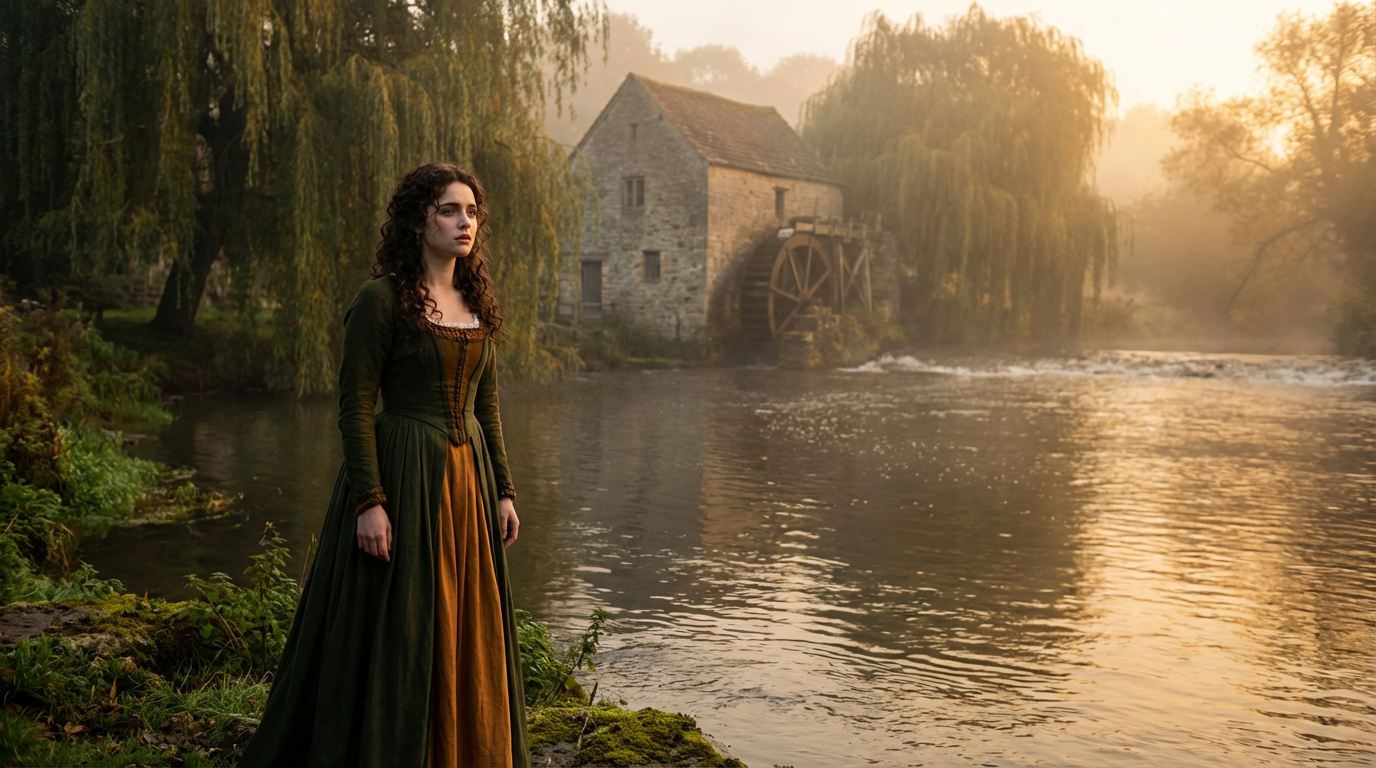
An excerpt from the original text.(complete · 2453 words)
r Tulliver, of Dorlcote Mill, Declares His Resolution about Tom
“What I want, you know,” said Mr Tulliver,—“what I want is to give Tom
a good eddication; an eddication as’ll be a bread to him. That was what
I was thinking of when I gave notice for him to leave the academy at
Lady-day. I mean to put him to a downright good school at Midsummer.
The two years at th’ academy ’ud ha’ done well enough, if I’d meant to
make a miller and farmer of him, for he’s had a fine sight more
schoolin’ nor I ever got. All the learnin’ my father ever paid for
was a bit o’ birch at one end and the alphabet at th’ other. But I
should like Tom to be a bit of a scholard, so as he might be up to the
tricks o’ these fellows as talk fine and write with a flourish. It ’ud
be a help to me wi’ these lawsuits, and arbitrations, and things. I
wouldn’t make a downright lawyer o’ the lad,—I should be sorry for him
to be a raskill,—but a sort o’ engineer, or a surveyor, or an
auctioneer and vallyer, like Riley, or one o’ them smartish businesses
as are all profits and no outlay, only for a big watch-chain and a high
stool. They’re pretty nigh all one, and they’re not far off being even
wi’ the law, I believe; for Riley looks Lawyer Wakem i’ the face as
hard as one cat looks another. He’s none frightened at him.”
Mr Tulliver was speaking to his wife, a blond comely woman in a
fan-shaped cap (I am afraid to think how long it is since fan-shaped
caps were worn, they must be so near coming in again. At that time,
when Mrs Tulliver was nearly forty, they were new at St Ogg’s, and
considered sweet things).
“Well, Mr Tulliver, you know best: I’ve no objections. But hadn’t I
better kill a couple o’ fowl, and have th’ aunts and uncles to dinner
next week, so as you may hear what sister Glegg and sister Pullet have
got to say about it? There’s a couple o’ fowl wants killing!”
“You may kill every fowl i’ the yard if you like, Bessy; but I shall
ask neither aunt nor uncle what I’m to do wi’ my own lad,” said Mr
Tulliver, defiantly.
“Dear heart!” said Mrs Tulliver, shocked at this sanguinary rhetoric,
“how can you talk so, Mr Tulliver? But it’s your way to speak
disrespectful o’ my family; and sister Glegg throws all the blame upo’
me, though I’m sure I’m as innocent as the babe unborn. For nobody’s
ever heard me say as it wasn’t lucky for my children to have aunts and
uncles as can live independent. Howiver, if Tom’s to go to a new
school, I should like him to go where I can wash him and mend him; else
he might as well have calico as linen, for they’d be one as yallow as
th’ other before they’d been washed half-a-dozen times. And then, when
the box is goin’ back’ard and forrard, I could send the lad a cake, or
a pork-pie, or an apple; for he can do with an extry bit, bless him!
whether they stint him at the meals or no. My children can eat as much
victuals as most, thank God!”
“Well, well, we won’t send him out o’ reach o’ the carrier’s cart, if
other things fit in,” said Mr Tulliver. “But you mustn’t put a spoke i’
the wheel about the washin,’ if we can’t get a school near enough.
That’s the fault I have to find wi’ you, Bessy; if you see a stick i’
the road, you’re allays thinkin’ you can’t step over it. You’d want me
not to hire a good wagoner, ’cause he’d got a mole on his face.”
“Dear heart!” said Mrs Tulliver, in mild surprise, “when did I iver
make objections to a man because he’d got a mole on his face? I’m sure
I’m rether fond o’ the moles; for my brother, as is dead an’ gone, had
a mole on his brow. But I can’t remember your iver offering to hire a
wagoner with a mole, Mr Tulliver. There was John Gibbs hadn’t a mole on
his face no more nor you have, an’ I was all for having you hire him;
an’ so you did hire him, an’ if he hadn’t died o’ th’ inflammation, as
we paid Dr Turnbull for attending him, he’d very like ha’ been drivin’
the wagon now. He might have a mole somewhere out o’ sight, but how was
I to know that, Mr Tulliver?”
“No, no, Bessy; I didn’t mean justly the mole; I meant it to stand for
summat else; but niver mind—it’s puzzling work, talking is. What I’m
thinking on, is how to find the right sort o’ school to send Tom to,
for I might be ta’en in again, as I’ve been wi’ th’ academy. I’ll have
nothing to do wi’ a ’cademy again: whativer school I send Tom to, it
sha’n’t be a ’cademy; it shall be a place where the lads spend their
time i’ summat else besides blacking the family’s shoes, and getting up
the potatoes. It’s an uncommon puzzling thing to know what school to
pick.”
Mr Tulliver paused a minute or two, and dived with both hands into his
breeches pockets as if he hoped to find some suggestion there.
Apparently he was not disappointed, for he presently said, “I know what
I’ll do: I’ll talk it over wi’ Riley; he’s coming to-morrow, t’
arbitrate about the dam.”
“Well, Mr Tulliver, I’ve put the sheets out for the best bed, and
Kezia’s got ’em hanging at the fire. They aren’t the best sheets, but
they’re good enough for anybody to sleep in, be he who he will; for as
for them best Holland sheets, I should repent buying ’em, only they’ll
do to lay us out in. An’ if you was to die to-morrow, Mr Tulliver,
they’re mangled beautiful, an’ all ready, an’ smell o’ lavender as it
’ud be a pleasure to lay ’em out; an’ they lie at the left-hand corner
o’ the big oak linen-chest at the back: not as I should trust anybody
to look ’em out but myself.”
As Mrs Tulliver uttered the last sentence, she drew a bright bunch of
keys from her pocket, and singled out one, rubbing her thumb and finger
up and down it with a placid smile while she looked at the clear fire.
If Mr Tulliver had been a susceptible man in his conjugal relation, he
might have supposed that she drew out the key to aid her imagination in
anticipating the moment when he would be in a state to justify the
production of the best Holland sheets. Happily he was not so; he was
only susceptible in respect of his right to water-power; moreover, he
had the marital habit of not listening very closely, and since his
mention of Mr Riley, had been apparently occupied in a tactile
examination of his woollen stockings.
“I think I’ve hit it, Bessy,” was his first remark after a short
silence. “Riley’s as likely a man as any to know o’ some school; he’s
had schooling himself, an’ goes about to all sorts o’ places,
arbitratin’ and vallyin’ and that. And we shall have time to talk it
over to-morrow night when the business is done. I want Tom to be such a
sort o’ man as Riley, you know,—as can talk pretty nigh as well as if
it was all wrote out for him, and knows a good lot o’ words as don’t
mean much, so as you can’t lay hold of ’em i’ law; and a good solid
knowledge o’ business too.”
“Well,” said Mrs Tulliver, “so far as talking proper, and knowing
everything, and walking with a bend in his back, and setting his hair
up, I shouldn’t mind the lad being brought up to that. But them
fine-talking men from the big towns mostly wear the false shirt-fronts;
they wear a frill till it’s all a mess, and then hide it with a bib; I
know Riley does. And then, if Tom’s to go and live at Mudport, like
Riley, he’ll have a house with a kitchen hardly big enough to turn in,
an’ niver get a fresh egg for his breakfast, an’ sleep up three pair o’
stairs,—or four, for what I know,—and be burnt to death before he can
get down.”
“No, no,” said Mr Tulliver, “I’ve no thoughts of his going to Mudport:
I mean him to set up his office at St Ogg’s, close by us, an’ live at
home. But,” continued Mr Tulliver after a pause, “what I’m a bit afraid
on is, as Tom hasn’t got the right sort o’ brains for a smart fellow. I
doubt he’s a bit slowish. He takes after your family, Bessy.”
“Yes, that he does,” said Mrs Tulliver, accepting the last proposition
entirely on its own merits; “he’s wonderful for liking a deal o’ salt
in his broth. That was my brother’s way, and my father’s before him.”
“It seems a bit a pity, though,” said Mr Tulliver, “as the lad should
take after the mother’s side instead o’ the little wench. That’s the
worst on’t wi’ crossing o’ breeds: you can never justly calkilate
what’ll come on’t. The little un takes after my side, now: she’s twice
as ’cute as Tom. Too ’cute for a woman, I’m afraid,” continued Mr
Tulliver, turning his head dubiously first on one side and then on the
other. “It’s no mischief much while she’s a little un; but an
over-’cute woman’s no better nor a long-tailed sheep,—she’ll fetch none
the bigger price for that.”
“Yes, it is a mischief while she’s a little un, Mr Tulliver, for it
runs to naughtiness. How to keep her in a clean pinafore two hours
together passes my cunning. An’ now you put me i’ mind,” continued Mrs
Tulliver, rising and going to the window, “I don’t know where she is
now, an’ it’s pretty nigh tea-time. Ah, I thought so,—wanderin’ up an’
down by the water, like a wild thing: She’ll tumble in some day.”
Mrs Tulliver rapped the window sharply, beckoned, and shook her head,—a
process which she repeated more than once before she returned to her
chair.
“You talk o’ ’cuteness, Mr Tulliver,” she observed as she sat down,
“but I’m sure the child’s half an idiot i’ some things; for if I send
her upstairs to fetch anything, she forgets what she’s gone for, an’
perhaps ’ull sit down on the floor i’ the sunshine an’ plait her hair
an’ sing to herself like a Bedlam creatur’, all the while I’m waiting
for her downstairs. That niver run i’ my family, thank God! no more nor
a brown skin as makes her look like a mulatter. I don’t like to fly i’
the face o’ Providence, but it seems hard as I should have but one
gell, an’ her so comical.”
“Pooh, nonsense!” said Mr Tulliver; “she’s a straight, black-eyed wench
as anybody need wish to see. I don’t know i’ what she’s behind other
folks’s children; and she can read almost as well as the parson.”
“But her hair won’t curl all I can do with it, and she’s so franzy
about having it put i’ paper, and I’ve such work as never was to make
her stand and have it pinched with th’ irons.”
“Cut it off—cut it off short,” said the father, rashly.
“How can you talk so, Mr Tulliver? She’s too big a gell—gone nine, and
tall of her age—to have her hair cut short; an’ there’s her cousin
Lucy’s got a row o’ curls round her head, an’ not a hair out o’ place.
It seems hard as my sister Deane should have that pretty child; I’m
sure Lucy takes more after me nor my own child does. Maggie, Maggie,”
continued the mother, in a tone of half-coaxing fretfulness, as this
small mistake of nature entered the room, “where’s the use o’ my
telling you to keep away from the water? You’ll tumble in and be
drownded some day, an’ then you’ll be sorry you didn’t do as mother
told you.”
Maggie’s hair, as she threw off her bonnet, painfully confirmed her
mother’s accusation. Mrs Tulliver, desiring her daughter to have a
curled crop, “like other folks’s children,” had had it cut too short in
front to be pushed behind the ears; and as it was usually straight an
hour after it had been taken out of paper, Maggie was incessantly
tossing her head to keep the dark, heavy locks out of her gleaming
black eyes,—an action which gave her very much the air of a small
Shetland pony.
“Oh, dear, oh, dear, Maggie, what are you thinkin’ of, to throw your
bonnet down there? Take it upstairs, there’s a good gell, an’ let your
hair be brushed, an’ put your other pinafore on, an’ change your shoes,
do, for shame; an’ come an’ go on with your patchwork, like a little
lady.”
“Oh, mother,” said Maggie, in a vehemently cross tone, “I don’t want
to do my patchwork.”
“What! not your pretty patchwork, to make a counterpane for your aunt
Glegg?”
“It’s foolish work,” said Maggie, with a toss of her mane,—“tearing
things to pieces to sew ’em together again. And I don’t want to do
anything for my aunt Glegg. I don’t like her.”
Exit Maggie, dragging her bonnet by the string, while Mr Tulliver
laughs audibly.
“I wonder at you, as you’ll laugh at her, Mr Tulliver,” said the
mother, with feeble fretfulness in her tone. “You encourage her i’
naughtiness. An’ her aunts will have it as it’s me spoils her.”
Mrs Tulliver was what is called a good-tempered person,—never cried,
when she was a baby, on any slighter ground than hunger and pins; and
from the cradle upward had been healthy, fair, plump, and dull-witted;
in short, the flower of her family for beauty and amiability. But milk
and mildness are not the best things for keeping, and when they turn
only a little sour, they may disagree with young stomachs seriously. I
have often wondered whether those early Madonnas of Raphael, with the
blond faces and somewhat stupid expression, kept their placidity
undisturbed when their strong-limbed, strong-willed boys got a little
too old to do without clothing. I think they must have been given to
feeble remonstrance, getting more and more peevish as it became more
and more ineffectual.
Master this chapter. Complete your experience
Purchase the complete book to access all chapters and support classic literature
As an Amazon Associate, we earn a small commission from qualifying purchases at no additional cost to you.
Available in paperback, hardcover, and e-book formats
Let's Analyse the Pattern
When our desire to protect someone leads us to push them toward solutions that serve our fears rather than their actual needs or abilities.
Why This Matters
Connect literature to life
This chapter teaches how to recognize when family members project their own fears and limitations onto your life choices.
Practice This Today
This week, notice when someone gives you advice based on their own experiences rather than your actual situation, and practice asking gentle questions to understand their underlying concerns.
Now let's explore the literary elements.
Key Quotes & Analysis
"What I want is to give Tom a good eddication; an eddication as'll be a bread to him."
Context: Opening his explanation of why he's taking Tom out of the local academy
This reveals both his love for his son and his understanding that education is economic survival. The dialect shows his own limited schooling, making his ambitions both touching and ironic.
In Today's Words:
I want to give Tom the kind of education that'll actually pay the bills.
"I should like Tom to be a bit of a scholard, so as he might be up to the tricks o' these fellows as talk fine and write with a flourish."
Context: Explaining his educational goals for Tom
Shows his awareness that educated people use their skills to manipulate others. He wants Tom to have those same weapons of class warfare - the ability to match wits with smooth talkers.
In Today's Words:
I want Tom to be educated enough so these slick professionals can't bamboozle him.
"It's a pity she wasn't made o' commoner stuff - she'll be thrown away, I doubt."
Context: Observing Maggie's quick intelligence
Reveals the tragedy of wasted potential in a society that doesn't value intelligent women. He recognizes her gifts but sees them as a burden rather than an asset.
In Today's Words:
She's too smart for her own good - it's going to cause her problems.
Thematic Threads
Class Anxiety
In This Chapter
Mr. Tulliver's fear of being outsmarted by educated professionals drives his educational plans for Tom
Development
Introduced here - shows how class insecurity shapes family decisions
In Your Life:
You might feel this when you worry about not sounding smart enough in meetings or being taken advantage of by professionals.
Gender Expectations
In This Chapter
Maggie's intelligence is seen as problematic because she's a girl, while Tom's slower nature concerns his father
Development
Introduced here - establishes how gender shapes what families value
In Your Life:
You might see this in families where boys are pushed toward leadership roles while girls are steered toward 'helping' careers.
Education as Weapon
In This Chapter
Mr. Tulliver views education not as enrichment but as armor against being cheated or outsmarted
Development
Introduced here - shows education seen through lens of social warfare
In Your Life:
You might recognize this when someone pushes you to get credentials not because you're interested, but because they think you need to 'protect yourself.'
Parental Projection
In This Chapter
Mr. Tulliver wants Tom to have the tools he wishes he'd had, regardless of Tom's actual abilities or interests
Development
Introduced here - shows how parents' wounds shape their children's paths
In Your Life:
You might see this when a parent pushes their child toward opportunities they never had, even if the child isn't suited for them.
Practical vs. Ambitious
In This Chapter
Mrs. Tulliver worries about laundry and food while Mr. Tulliver dreams of social advancement
Development
Introduced here - shows tension between daily reality and big dreams
In Your Life:
You might feel this tension when someone in your life has big plans that ignore the practical details you'll have to handle.
You now have the context. Time to form your own thoughts.
Discussion Questions
- 1
What does Mr. Tulliver want for Tom, and why does he think education will solve his problems?
analysis • surface - 2
Why does Mr. Tulliver see Maggie's intelligence as a problem rather than an asset?
analysis • medium - 3
Where do you see parents today pushing their children toward success without understanding what that path really requires?
application • medium - 4
How would you help someone recognize when their protection might be creating new problems?
application • deep - 5
What does this chapter reveal about how fear shapes the choices we make for people we love?
reflection • deep
Critical Thinking Exercise
Map the Protective Parent Pattern
Think of someone who has pushed you toward their vision of success, or someone you've tried to protect this way. Draw two columns: what they feared would happen if you didn't follow their path, and what they hoped would happen if you did. Then add a third column: what you actually needed or wanted.
Consider:
- •Notice whether their fears were based on their own experiences or actual current risks
- •Look for gaps between their understanding of the path and what it actually requires
- •Consider whether their protection addressed the real problem or just the symptoms
Journaling Prompt
Write about a time when someone's attempt to protect or guide you created unexpected challenges. What would have been more helpful?
Coming Up Next...
Chapter 3: When Friends Give Advice
Mr. Riley arrives to help settle a business dispute, but Mr. Tulliver has bigger plans—he wants Riley's advice on schools for Tom. What kind of education will Riley recommend, and how will his counsel shape the Tulliver family's future?



