
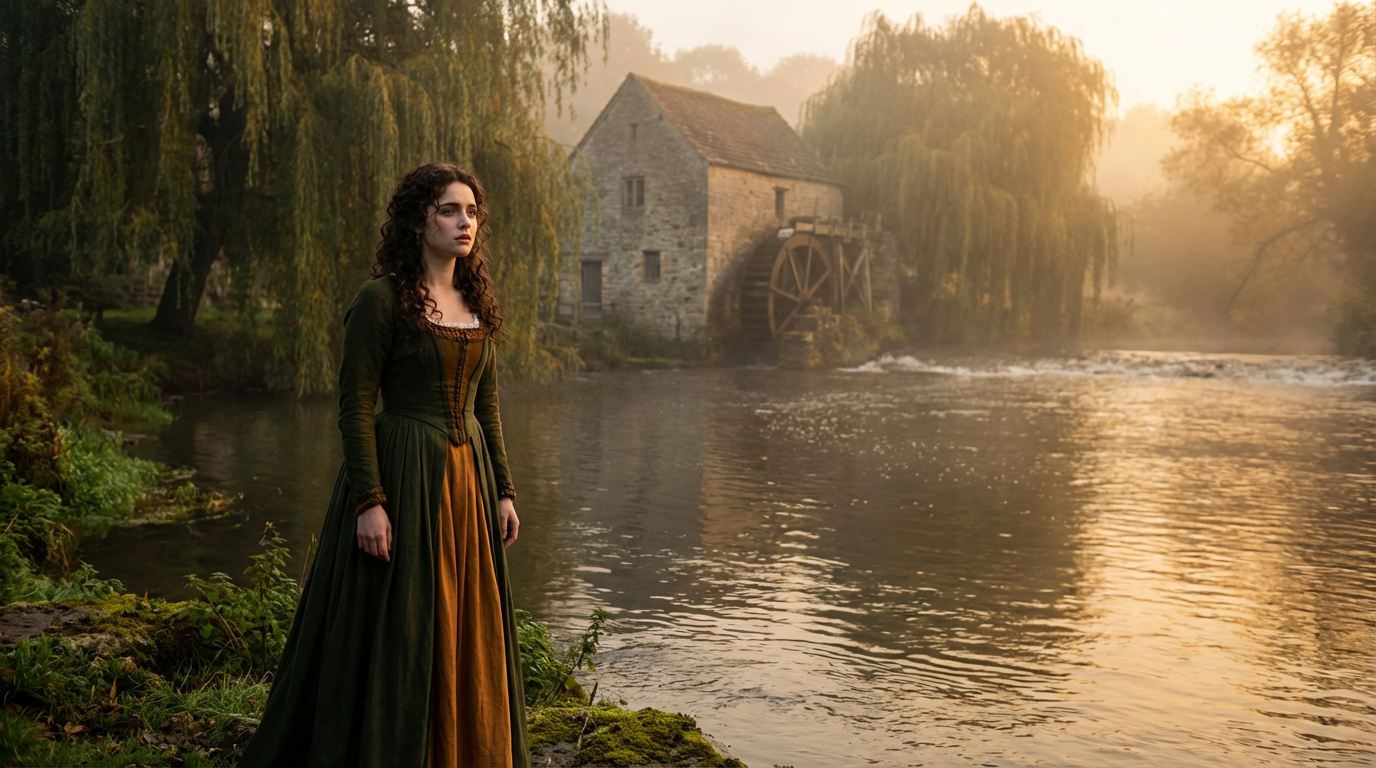
An excerpt from the original text.(complete · 883 words)
utside Dorlcote Mill
A wide plain, where the broadening Floss hurries on between its green
banks to the sea, and the loving tide, rushing to meet it, checks its
passage with an impetuous embrace. On this mighty tide the black
ships—laden with the fresh-scented fir-planks, with rounded sacks of
oil-bearing seed, or with the dark glitter of coal—are borne along to
the town of St Ogg’s, which shows its aged, fluted red roofs and the
broad gables of its wharves between the low wooded hill and the
river-brink, tingeing the water with a soft purple hue under the
transient glance of this February sun. Far away on each hand stretch
the rich pastures, and the patches of dark earth made ready for the
seed of broad-leaved green crops, or touched already with the tint of
the tender-bladed autumn-sown corn. There is a remnant still of last
year’s golden clusters of beehive-ricks rising at intervals beyond the
hedgerows; and everywhere the hedgerows are studded with trees; the
distant ships seem to be lifting their masts and stretching their
red-brown sails close among the branches of the spreading ash. Just by
the red-roofed town the tributary Ripple flows with a lively current
into the Floss. How lovely the little river is, with its dark changing
wavelets! It seems to me like a living companion while I wander along
the bank, and listen to its low, placid voice, as to the voice of one
who is deaf and loving. I remember those large dipping willows. I
remember the stone bridge.
And this is Dorlcote Mill. I must stand a minute or two here on the
bridge and look at it, though the clouds are threatening, and it is far
on in the afternoon. Even in this leafless time of departing February
it is pleasant to look at,—perhaps the chill, damp season adds a charm
to the trimly kept, comfortable dwelling-house, as old as the elms and
chestnuts that shelter it from the northern blast. The stream is
brimful now, and lies high in this little withy plantation, and half
drowns the grassy fringe of the croft in front of the house. As I look
at the full stream, the vivid grass, the delicate bright-green powder
softening the outline of the great trunks and branches that gleam from
under the bare purple boughs, I am in love with moistness, and envy the
white ducks that are dipping their heads far into the water here among
the withes, unmindful of the awkward appearance they make in the drier
world above.
The rush of the water and the booming of the mill bring a dreamy
deafness, which seems to heighten the peacefulness of the scene. They
are like a great curtain of sound, shutting one out from the world
beyond. And now there is the thunder of the huge covered wagon coming
home with sacks of grain. That honest wagoner is thinking of his
dinner, getting sadly dry in the oven at this late hour; but he will
not touch it till he has fed his horses,—the strong, submissive,
meek-eyed beasts, who, I fancy, are looking mild reproach at him from
between their blinkers, that he should crack his whip at them in that
awful manner as if they needed that hint! See how they stretch their
shoulders up the slope toward the bridge, with all the more energy
because they are so near home. Look at their grand shaggy feet that
seem to grasp the firm earth, at the patient strength of their necks,
bowed under the heavy collar, at the mighty muscles of their struggling
haunches! I should like well to hear them neigh over their
hardly-earned feed of corn, and see them, with their moist necks freed
from the harness, dipping their eager nostrils into the muddy pond. Now
they are on the bridge, and down they go again at a swifter pace, and
the arch of the covered wagon disappears at the turning behind the
trees.
Now I can turn my eyes toward the mill again, and watch the unresting
wheel sending out its diamond jets of water. That little girl is
watching it too; she has been standing on just the same spot at the
edge of the water ever since I paused on the bridge. And that queer
white cur with the brown ear seems to be leaping and barking in
ineffectual remonstrance with the wheel; perhaps he is jealous because
his playfellow in the beaver bonnet is so rapt in its movement. It is
time the little playfellow went in, I think; and there is a very bright
fire to tempt her: the red light shines out under the deepening gray of
the sky. It is time, too, for me to leave off resting my arms on the
cold stone of this bridge....
Ah, my arms are really benumbed. I have been pressing my elbows on the
arms of my chair, and dreaming that I was standing on the bridge in
front of Dorlcote Mill, as it looked one February afternoon many years
ago. Before I dozed off, I was going to tell you what Mr and Mrs
Tulliver were talking about, as they sat by the bright fire in the
left-hand parlour, on that very afternoon I have been dreaming of.
Master this chapter. Complete your experience
Purchase the complete book to access all chapters and support classic literature
As an Amazon Associate, we earn a small commission from qualifying purchases at no additional cost to you.
Available in paperback, hardcover, and e-book formats
Let's Analyse the Pattern
We unconsciously navigate present situations by comparing them to emotional maps created from past experiences in similar settings or relationships.
Why This Matters
Connect literature to life
This chapter teaches how to identify when past experiences are unconsciously shaping present reactions and decisions.
Practice This Today
This week, notice when you have a strong emotional reaction to a place or situation—ask yourself what it's reminding you of from your past.
Now let's explore the literary elements.
Key Quotes & Analysis
"A wide plain, where the broadening Floss hurries on between its green banks to the sea, and the loving tide, rushing to meet it, checks its passage with an impetuous embrace."
Context: Opening description of the landscape around Dorlcote Mill
Eliot personifies the river and tide as lovers meeting, immediately establishing that this will be a story about powerful forces colliding. The romantic language hints that passion and conflict will drive the human drama to come.
In Today's Words:
Picture a river rushing toward the ocean, but the tide pushes back against it - like two strong personalities who can't help but clash.
"It seems to me like a living companion while I wander along the bank, and listen to its low, placid voice, as to the voice of one who is deaf and loving."
Context: Describing the tributary river Ripple
The narrator treats nature as a friend who understands without judgment. This establishes the deep emotional connection between people and place that will make the coming changes so painful.
In Today's Words:
The river feels like that friend who doesn't need to talk much but somehow gets you completely.
"I remember those large dipping willows. I remember the stone bridge."
Context: Revealing this is all a memory from years past
The simple repetition of 'I remember' signals that we're about to hear a story that left permanent marks on someone's heart. It makes everything we've just seen feel precious and lost.
In Today's Words:
You know how certain places stick with you forever, and you can close your eyes and see every detail? That's what this is.
Thematic Threads
Memory
In This Chapter
The narrator reconstructs a childhood scene with vivid sensory detail, showing how the past lives actively in present consciousness
Development
Introduced here as the foundational framework for the entire story
In Your Life:
You might find yourself avoiding certain restaurants or neighborhoods because they remind you of difficult relationships or painful periods.
Place
In This Chapter
The mill and river aren't just settings but characters themselves, shaping the people who live and work around them
Development
Introduced here as the physical and emotional center of the story world
In Your Life:
Your childhood home, first apartment, or workplace probably shaped your sense of identity more than you realize.
Class
In This Chapter
The description subtly establishes the working mill community—laborers, horses, cargo ships—as the social world we'll inhabit
Development
Introduced here through environmental details rather than explicit commentary
In Your Life:
You might notice how your comfort level changes when you enter spaces that signal different social classes than your own.
Observation
In This Chapter
The narrator demonstrates intense, loving attention to detail—suggesting that how we look determines what we see and understand
Development
Introduced here as a key skill for navigating relationships and social situations
In Your Life:
You probably understand your coworkers or family members better when you pay attention to small details rather than just listening to their words.
You now have the context. Time to form your own thoughts.
Discussion Questions
- 1
Why does Eliot start her story with a dreamy description of the countryside instead of jumping straight into action with characters talking?
analysis • surface - 2
What's the difference between the narrator just describing a place versus describing it as a memory from 'many years ago'?
analysis • medium - 3
Think about a place from your past that you remember vividly. How does that memory affect how you feel about similar places now?
application • medium - 4
When you're trying to understand a new person or situation, how do you use your past experiences as a guide? Can you think of a time when this helped you or led you astray?
application • deep - 5
What does this opening suggest about how our minds work when we're trying to make sense of our lives?
reflection • deep
Critical Thinking Exercise
Map Your Memory Triggers
Choose a place that immediately makes you feel a certain way when you enter it—maybe your childhood kitchen, your old school, or even a type of store. Write down what you see, hear, and smell there. Then identify what emotion it triggers and what memory it connects to. Finally, think about how this memory map influences your behavior in similar places today.
Consider:
- •Notice physical details that trigger the strongest emotional responses
- •Separate what actually happened from how you felt about it
- •Consider whether this memory map is helping or limiting you in current situations
Journaling Prompt
Write about a time when a place made you react strongly to a person or situation. Looking back, was your reaction about the present moment or about something from your past?
Coming Up Next...
Chapter 2: Father's Ambitions for His Son
Now we'll step inside that cozy parlor where Mr. and Mrs. Tulliver are having a heated discussion about their son Tom's future—a conversation that will set the entire family's fate in motion.



