An excerpt from the original text.(complete · 4457 words)
. de Boville had indeed met the funeral procession which was taking
Valentine to her last home on earth. The weather was dull and stormy, a
cold wind shook the few remaining yellow leaves from the boughs of the
trees, and scattered them among the crowd which filled the boulevards.
M. de Villefort, a true Parisian, considered the cemetery of
Père-Lachaise alone worthy of receiving the mortal remains of a
Parisian family; there alone the corpses belonging to him would be
surrounded by worthy associates. He had therefore purchased a vault,
which was quickly occupied by members of his family. On the front of
the monument was inscribed: “The families of Saint-Méran and
Villefort,” for such had been the last wish expressed by poor Renée,
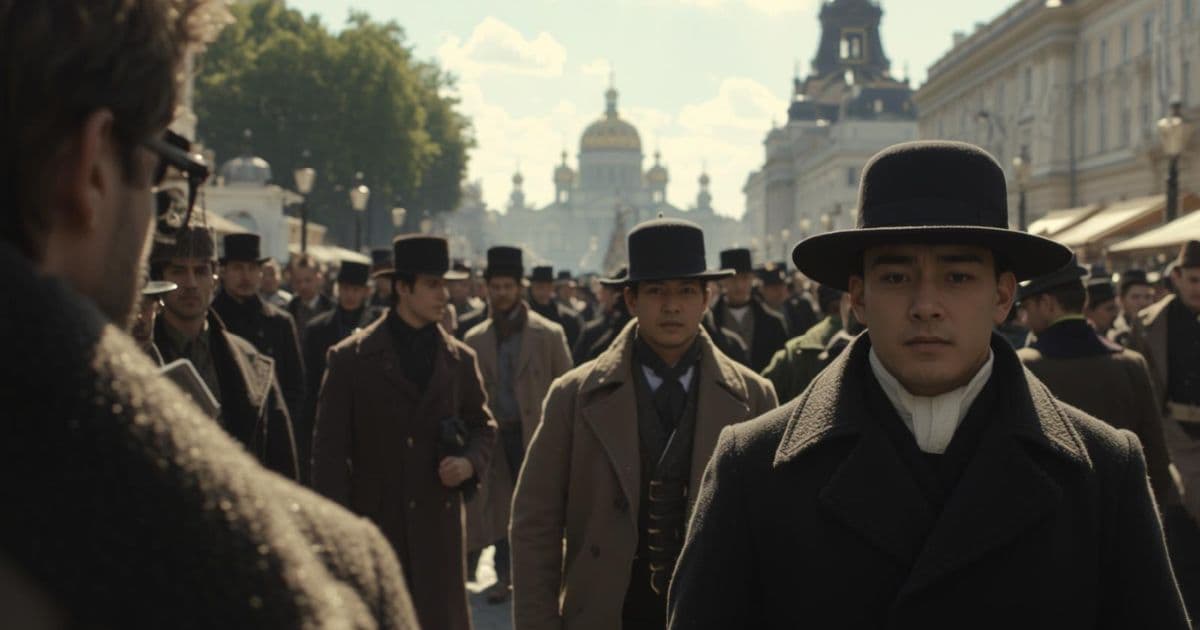
Valentine’s mother. The pompous procession therefore wended its way
towards Père-Lachaise from the Faubourg Saint-Honoré. Having crossed
Paris, it passed through the Faubourg du Temple, then leaving the
exterior boulevards, it reached the cemetery. More than fifty private
carriages followed the twenty mourning-coaches, and behind them more
than five hundred persons joined in the procession on foot.
50117m
These last consisted of all the young people whom Valentine’s death had
struck like a thunderbolt, and who, notwithstanding the raw chilliness
of the season, could not refrain from paying a last tribute to the
memory of the beautiful, chaste, and adorable girl, thus cut off in the
flower of her youth.
As they left Paris, an equipage with four horses, at full speed, was
seen to draw up suddenly; it contained Monte Cristo. The count left the
carriage and mingled in the crowd who followed on foot. Château-Renaud
perceived him and immediately alighting from his coupé, joined him;
Beauchamp did the same.
The count looked attentively through every opening in the crowd; he was
evidently watching for someone, but his search ended in disappointment.
50119m
“Where is Morrel?” he asked; “do either of these gentlemen know where
he is?”
“We have already asked that question,” said Château-Renaud, “for none
of us has seen him.”
The count was silent, but continued to gaze around him. At length they
arrived at the cemetery. The piercing eye of Monte Cristo glanced
through clusters of bushes and trees, and was soon relieved from all
anxiety, for seeing a shadow glide between the yew-trees, Monte Cristo
recognized him whom he sought.
One funeral is generally very much like another in this magnificent
metropolis. Black figures are seen scattered over the long white
avenues; the silence of earth and heaven is alone broken by the noise
made by the crackling branches of hedges planted around the monuments;
then follows the melancholy chant of the priests, mingled now and then
with a sob of anguish, escaping from some woman concealed behind a mass
of flowers.
The shadow Monte Cristo had noticed passed rapidly behind the tomb of
Abélard and Héloïse, placed itself close to the heads of the horses
belonging to the hearse, and following the undertaker’s men, arrived
with them at the spot appointed for the burial. Each person’s attention
was occupied. Monte Cristo saw nothing but the shadow, which no one
else observed. Twice the count left the ranks to see whether the object
of his interest had any concealed weapon beneath his clothes. When the
procession stopped, this shadow was recognized as Morrel, who, with his
coat buttoned up to his throat, his face livid, and convulsively
crushing his hat between his fingers, leaned against a tree, situated
on an elevation commanding the mausoleum, so that none of the funeral
details could escape his observation.
Everything was conducted in the usual manner. A few men, the least
impressed of all by the scene, pronounced a discourse, some deploring
this premature death, others expatiating on the grief of the father,
and one very ingenious person quoting the fact that Valentine had
solicited pardon of her father for criminals on whom the arm of justice
was ready to fall—until at length they exhausted their stores of
metaphor and mournful speeches, elaborate variations on the stanzas of
Malherbe to Du Périer.
Monte Cristo heard and saw nothing, or rather he only saw Morrel, whose
calmness had a frightful effect on those who knew what was passing in
his heart.
“See,” said Beauchamp, pointing out Morrel to Debray. “What is he doing
up there?” And they called Château-Renaud’s attention to him.
“How pale he is!” said Château-Renaud, shuddering.
“He is cold,” said Debray.
“Not at all,” said Château-Renaud, slowly; “I think he is violently
agitated. He is very susceptible.”
“Bah,” said Debray; “he scarcely knew Mademoiselle de Villefort; you
said so yourself.”
“True. Still I remember he danced three times with her at Madame de
Morcerf’s. Do you recollect that ball, count, where you produced such
an effect?”
50121m
“No, I do not,” replied Monte Cristo, without even knowing of what or
to whom he was speaking, so much was he occupied in watching Morrel,
who was holding his breath with emotion.
“The discourse is over; farewell, gentlemen,” said the count,
unceremoniously.
And he disappeared without anyone seeing whither he went.
The funeral being over, the guests returned to Paris. Château-Renaud
looked for a moment for Morrel; but while they were watching the
departure of the count, Morrel had quitted his post, and
Château-Renaud, failing in his search, joined Debray and Beauchamp.
Monte Cristo concealed himself behind a large tomb and awaited the
arrival of Morrel, who by degrees approached the tomb now abandoned by
spectators and workmen. Morrel threw a glance around, but before it
reached the spot occupied by Monte Cristo the latter had advanced yet
nearer, still unperceived. The young man knelt down. The count, with
outstretched neck and glaring eyes, stood in an attitude ready to
pounce upon Morrel upon the first occasion. Morrel bent his head till
it touched the stone, then clutching the grating with both hands, he
murmured:
“Oh, Valentine!”
The count’s heart was pierced by the utterance of these two words; he
stepped forward, and touching the young man’s shoulder, said:
“I was looking for you, my friend.” Monte Cristo expected a burst of
passion, but he was deceived, for Morrel turning round, said calmly,—
“You see I was praying.” The scrutinizing glance of the count searched
the young man from head to foot. He then seemed more easy.
“Shall I drive you back to Paris?” he asked.
“No, thank you.”
“Do you wish anything?”
“Leave me to pray.”
The count withdrew without opposition, but it was only to place himself
in a situation where he could watch every movement of Morrel, who at
length arose, brushed the dust from his knees, and turned towards
Paris, without once looking back. He walked slowly down the Rue de la
Roquette. The count, dismissing his carriage, followed him about a
hundred paces behind. Maximilian crossed the canal and entered the Rue
Meslay by the boulevards.
Five minutes after the door had been closed on Morrel’s entrance, it
was again opened for the count. Julie was at the entrance of the
garden, where she was attentively watching Penelon, who, entering with
zeal into his profession of gardener, was very busy grafting some
Bengal roses. “Ah, count,” she exclaimed, with the delight manifested
by every member of the family whenever he visited the Rue Meslay.
“Maximilian has just returned, has he not, madame?” asked the count.
50123m
“Yes, I think I saw him pass; but pray, call Emmanuel.”
“Excuse me, madame, but I must go up to Maximilian’s room this
instant,” replied Monte Cristo, “I have something of the greatest
importance to tell him.”
“Go, then,” she said with a charming smile, which accompanied him until
he had disappeared.
Monte Cristo soon ran up the staircase conducting from the ground floor
to Maximilian’s room; when he reached the landing he listened
attentively, but all was still. Like many old houses occupied by a
single family, the room door was panelled with glass; but it was
locked, Maximilian was shut in, and it was impossible to see what was
passing in the room, because a red curtain was drawn before the glass.
The count’s anxiety was manifested by a bright color which seldom
appeared on the face of that imperturbable man.
“What shall I do!” he uttered, and reflected for a moment; “shall I
ring? No, the sound of a bell, announcing a visitor, will but
accelerate the resolution of one in Maximilian’s situation, and then
the bell would be followed by a louder noise.”
Monte Cristo trembled from head to foot and as if his determination had
been taken with the rapidity of lightning, he struck one of the panes
of glass with his elbow; the glass was shivered to atoms, then
withdrawing the curtain he saw Morrel, who had been writing at his
desk, bound from his seat at the noise of the broken window.
“I beg a thousand pardons,” said the count, “there is nothing the
matter, but I slipped down and broke one of your panes of glass with my
elbow. Since it is opened, I will take advantage of it to enter your
room; do not disturb yourself—do not disturb yourself!”
And passing his hand through the broken glass, the count opened the
door. Morrel, evidently discomposed, came to meet Monte Cristo less
with the intention of receiving him than to exclude his entry.
“Ma foi,” said Monte Cristo, rubbing his elbow, “it’s all your
servant’s fault; your stairs are so polished, it is like walking on
glass.”
“Are you hurt, sir?” coldly asked Morrel.
“I believe not. But what are you about there? You were writing.”
“I?”
“Your fingers are stained with ink.”
“Ah, true, I was writing. I do sometimes, soldier though I am.”
Monte Cristo advanced into the room; Maximilian was obliged to let him
pass, but he followed him.
“You were writing?” said Monte Cristo with a searching look.
“I have already had the honor of telling you I was,” said Morrel.
The count looked around him.
“Your pistols are beside your desk,” said Monte Cristo, pointing with
his finger to the pistols on the table.
“I am on the point of starting on a journey,” replied Morrel
disdainfully.
“My friend,” exclaimed Monte Cristo in a tone of exquisite sweetness.
“Sir?”
“My friend, my dear Maximilian, do not make a hasty resolution, I
entreat you.”
“I make a hasty resolution?” said Morrel, shrugging his shoulders; “is
there anything extraordinary in a journey?”
50125m
“Maximilian,” said the count, “let us both lay aside the mask we have
assumed. You no more deceive me with that false calmness than I impose
upon you with my frivolous solicitude. You can understand, can you not,
that to have acted as I have done, to have broken that glass, to have
intruded on the solitude of a friend—you can understand that, to have
done all this, I must have been actuated by real uneasiness, or rather
by a terrible conviction. Morrel, you are going to destroy yourself!”
“Indeed, count,” said Morrel, shuddering; “what has put this into your
head?”
“I tell you that you are about to destroy yourself,” continued the
count, “and here is proof of what I say;” and, approaching the desk, he
removed the sheet of paper which Morrel had placed over the letter he
had begun, and took the latter in his hands.
Morrel rushed forward to tear it from him, but Monte Cristo perceiving
his intention, seized his wrist with his iron grasp.
“You wish to destroy yourself,” said the count; “you have written it.”
“Well,” said Morrel, changing his expression of calmness for one of
violence—“well, and if I do intend to turn this pistol against myself,
who shall prevent me—who will dare prevent me? All my hopes are
blighted, my heart is broken, my life a burden, everything around me is
sad and mournful; earth has become distasteful to me, and human voices
distract me. It is a mercy to let me die, for if I live I shall lose my
reason and become mad. When, sir, I tell you all this with tears of
heartfelt anguish, can you reply that I am wrong, can you prevent my
putting an end to my miserable existence? Tell me, sir, could you have
the courage to do so?”
“Yes, Morrel,” said Monte Cristo, with a calmness which contrasted
strangely with the young man’s excitement; “yes, I would do so.”
“You?” exclaimed Morrel, with increasing anger and reproach—“you, who
have deceived me with false hopes, who have cheered and soothed me with
vain promises, when I might, if not have saved her, at least have seen
her die in my arms! You, who pretend to understand everything, even the
hidden sources of knowledge,—and who enact the part of a guardian angel
upon earth, and could not even find an antidote to a poison
administered to a young girl! Ah, sir, indeed you would inspire me with
pity, were you not hateful in my eyes.”
“Morrel——”
“Yes; you tell me to lay aside the mask, and I will do so, be
satisfied! When you spoke to me at the cemetery, I answered you—my
heart was softened; when you arrived here, I allowed you to enter. But
since you abuse my confidence, since you have devised a new torture
after I thought I had exhausted them all, then, Count of Monte Cristo
my pretended benefactor—then, Count of Monte Cristo, the universal
guardian, be satisfied, you shall witness the death of your friend;”
and Morrel, with a maniacal laugh, again rushed towards the pistols.
“And I again repeat, you shall not commit suicide.”
“Prevent me, then!” replied Morrel, with another struggle, which, like
the first, failed in releasing him from the count’s iron grasp.
“I will prevent you.”
50127m
“And who are you, then, that arrogate to yourself this tyrannical right
over free and rational beings?”
“Who am I?” repeated Monte Cristo. “Listen; I am the only man in the
world having the right to say to you, ‘Morrel, your father’s son shall
not die today;’” and Monte Cristo, with an expression of majesty and
sublimity, advanced with arms folded toward the young man, who,
involuntarily overcome by the commanding manner of this man, recoiled a
step.
“Why do you mention my father?” stammered he; “why do you mingle a
recollection of him with the affairs of today?”
“Because I am he who saved your father’s life when he wished to destroy
himself, as you do today—because I am the man who sent the purse to
your young sister, and the Pharaon to old Morrel—because I am the
Edmond Dantès who nursed you, a child, on my knees.”
Morrel made another step back, staggering, breathless, crushed; then
all his strength give way, and he fell prostrate at the feet of Monte
Cristo. Then his admirable nature underwent a complete and sudden
revulsion; he arose, rushed out of the room and to the stairs,
exclaiming energetically, “Julie, Julie—Emmanuel, Emmanuel!”
Monte Cristo endeavored also to leave, but Maximilian would have died
rather than relax his hold of the handle of the door, which he closed
upon the count. Julie, Emmanuel, and some of the servants, ran up in
alarm on hearing the cries of Maximilian. Morrel seized their hands,
and opening the door exclaimed in a voice choked with sobs:
“On your knees—on your knees—he is our benefactor—the saviour of our
father! He is——”
He would have added “Edmond Dantès,” but the count seized his arm and
prevented him.
Julie threw herself into the arms of the count; Emmanuel embraced him
as a guardian angel; Morrel again fell on his knees, and struck the
ground with his forehead. Then the iron-hearted man felt his heart
swell in his breast; a flame seemed to rush from his throat to his
eyes, he bent his head and wept. For a while nothing was heard in the
room but a succession of sobs, while the incense from their grateful
hearts mounted to heaven. Julie had scarcely recovered from her deep
emotion when she rushed out of the room, descended to the next floor,
ran into the drawing-room with childlike joy and raised the crystal
globe which covered the purse given by the unknown of the Allées de
Meilhan. Meanwhile, Emmanuel in a broken voice said to the count:
“Oh, count, how could you, hearing us so often speak of our unknown
benefactor, seeing us pay such homage of gratitude and adoration to his
memory,—how could you continue so long without discovering yourself to
us? Oh, it was cruel to us, and—dare I say it?—to you also.”
“Listen, my friends,” said the count—“I may call you so since we have
really been friends for the last eleven years—the discovery of this
secret has been occasioned by a great event which you must never know.
I wished to bury it during my whole life in my own bosom, but your
brother Maximilian wrested it from me by a violence he repents of now,
I am sure.”
Then turning around, and seeing that Morrel, still on his knees, had
thrown himself into an armchair, he added in a low voice, pressing
Emmanuel’s hand significantly, “Watch over him.”
“Why so?” asked the young man, surprised.
“I cannot explain myself; but watch over him.” Emmanuel looked around
the room and caught sight of the pistols; his eyes rested on the
weapons, and he pointed to them. Monte Cristo bent his head. Emmanuel
went towards the pistols.
“Leave them,” said Monte Cristo. Then walking towards Morrel, he took
his hand; the tumultuous agitation of the young man was succeeded by a
profound stupor. Julie returned, holding the silken purse in her hands,
while tears of joy rolled down her cheeks, like dewdrops on the rose.
“Here is the relic,” she said; “do not think it will be less dear to us
now we are acquainted with our benefactor!”
“My child,” said Monte Cristo, coloring, “allow me to take back that
purse? Since you now know my face, I wish to be remembered alone
through the affection I hope you will grant me.
“Oh,” said Julie, pressing the purse to her heart, “no, no, I beseech
you do not take it, for some unhappy day you will leave us, will you
not?”
“You have guessed rightly, madame,” replied Monte Cristo, smiling; “in
a week I shall have left this country, where so many persons who merit
the vengeance of Heaven lived happily, while my father perished of
hunger and grief.”
While announcing his departure, the count fixed his eyes on Morrel, and
remarked that the words, “I shall have left this country,” had failed
to rouse him from his lethargy. He then saw that he must make another
struggle against the grief of his friend, and taking the hands of
Emmanuel and Julie, which he pressed within his own, he said with the
mild authority of a father:
“My kind friends, leave me alone with Maximilian.”
Julie saw the means offered of carrying off her precious relic, which
Monte Cristo had forgotten. She drew her husband to the door. “Let us
leave them,” she said.
The count was alone with Morrel, who remained motionless as a statue.
“Come,” said Monte-Cristo, touching his shoulder with his finger, “are
you a man again, Maximilian?”
“Yes; for I begin to suffer again.”
The count frowned, apparently in gloomy hesitation.
“Maximilian, Maximilian,” he said, “the ideas you yield to are unworthy
of a Christian.”
“Oh, do not fear, my friend,” said Morrel, raising his head, and
smiling with a sweet expression on the count; “I shall no longer
attempt my life.”
“Then we are to have no more pistols—no more despair?”
“No; I have found a better remedy for my grief than either a bullet or
a knife.”
“Poor fellow, what is it?”
“My grief will kill me of itself.”
“My friend,” said Monte Cristo, with an expression of melancholy equal
to his own, “listen to me. One day, in a moment of despair like yours,
since it led to a similar resolution, I also wished to kill myself; one
day your father, equally desperate, wished to kill himself too. If
anyone had said to your father, at the moment he raised the pistol to
his head—if anyone had told me, when in my prison I pushed back the
food I had not tasted for three days—if anyone had said to either of us
then, ‘Live—the day will come when you will be happy, and will bless
life!’—no matter whose voice had spoken, we should have heard him with
the smile of doubt, or the anguish of incredulity,—and yet how many
times has your father blessed life while embracing you—how often have I
myself——”
“Ah,” exclaimed Morrel, interrupting the count, “you had only lost your
liberty, my father had only lost his fortune, but I have lost
Valentine.”
“Look at me,” said Monte Cristo, with that expression which sometimes
made him so eloquent and persuasive—“look at me. There are no tears in
my eyes, nor is there fever in my veins, yet I see you suffer—you,
Maximilian, whom I love as my own son. Well, does not this tell you
that in grief, as in life, there is always something to look forward to
beyond? Now, if I entreat, if I order you to live, Morrel, it is in the
conviction that one day you will thank me for having preserved your
life.”
“Oh, heavens,” said the young man, “oh, heavens—what are you saying,
count? Take care. But perhaps you have never loved!”
“Child!” replied the count.
“I mean, as I love. You see, I have been a soldier ever since I
attained manhood. I reached the age of twenty-nine without loving, for
none of the feelings I before then experienced merit the appellation of
love. Well, at twenty-nine I saw Valentine; for two years I have loved
her, for two years I have seen written in her heart, as in a book, all
the virtues of a daughter and wife. Count, to possess Valentine would
have been a happiness too infinite, too ecstatic, too complete, too
divine for this world, since it has been denied me; but without
Valentine the earth is desolate.”
“I have told you to hope,” said the count.
“Then have a care, I repeat, for you seek to persuade me, and if you
succeed I should lose my reason, for I should hope that I could again
behold Valentine.”
The count smiled.
“My friend, my father,” said Morrel with excitement, “have a care, I
again repeat, for the power you wield over me alarms me. Weigh your
words before you speak, for my eyes have already become brighter, and
my heart beats strongly; be cautious, or you will make me believe in
supernatural agencies. I must obey you, though you bade me call forth
the dead or walk upon the water.”
“Hope, my friend,” repeated the count.
“Ah,” said Morrel, falling from the height of excitement to the abyss
of despair—“ah, you are playing with me, like those good, or rather
selfish mothers who soothe their children with honeyed words, because
their screams annoy them. No, my friend, I was wrong to caution you; do
not fear, I will bury my grief so deep in my heart, I will disguise it
so, that you shall not even care to sympathize with me. Adieu, my
friend, adieu!”
“On the contrary,” said the count, “after this time you must live with
me—you must not leave me, and in a week we shall have left France
behind us.”
“And you still bid me hope?”
“I tell you to hope, because I have a method of curing you.”
“Count, you render me sadder than before, if it be possible. You think
the result of this blow has been to produce an ordinary grief, and you
would cure it by an ordinary remedy—change of scene.” And Morrel
dropped his head with disdainful incredulity.
“What can I say more?” asked Monte Cristo. “I have confidence in the
remedy I propose, and only ask you to permit me to assure you of its
efficacy.”
“Count, you prolong my agony.”
“Then,” said the count, “your feeble spirit will not even grant me the
trial I request? Come—do you know of what the Count of Monte Cristo is
capable? do you know that he holds terrestrial beings under his
control? nay, that he can almost work a miracle? Well, wait for the
miracle I hope to accomplish, or——”
“Or?” repeated Morrel.
“Or, take care, Morrel, lest I call you ungrateful.”
“Have pity on me, count!”
“I feel so much pity towards you, Maximilian, that—listen to me
attentively—if I do not cure you in a month, to the day, to the very
hour, mark my words, Morrel, I will place loaded pistols before you,
and a cup of the deadliest Italian poison—a poison more sure and prompt
than that which has killed Valentine.”
“Will you promise me?”
“Yes; for I am a man, and have suffered like yourself, and also
contemplated suicide; indeed, often since misfortune has left me I have
longed for the delights of an eternal sleep.”
“But you are sure you will promise me this?” said Morrel, intoxicated.
“I not only promise, but swear it!” said Monte Cristo extending his
hand.
“In a month, then, on your honor, if I am not consoled, you will let me
take my life into my own hands, and whatever may happen you will not
call me ungrateful?”
“In a month, to the day, the very hour and the date is a sacred one,
Maximilian. I do not know whether you remember that this is the 5th of
September; it is ten years today since I saved your father’s life, who
wished to die.”
Morrel seized the count’s hand and kissed it; the count allowed him to
pay the homage he felt due to him.
“In a month you will find on the table, at which we shall be then
sitting, good pistols and a delicious draught; but, on the other hand,
you must promise me not to attempt your life before that time.”
“Oh, I also swear it!”
Monte Cristo drew the young man towards him, and pressed him for some
time to his heart. “And now,” he said, “after today, you will come and
live with me; you can occupy Haydée’s apartment, and my daughter will
at least be replaced by my son.”
“Haydée?” said Morrel, “what has become of her?”
“She departed last night.”
“To leave you?”
“To wait for me. Hold yourself ready then to join me at the
Champs-Élysées, and lead me out of this house without anyone seeing my
departure.”
Maximilian hung his head, and obeyed with childlike reverence.
Master this chapter. Complete your experience
Purchase the complete book to access all chapters and support classic literature
As an Amazon Associate, we earn a small commission from qualifying purchases at no additional cost to you.
Available in paperback, hardcover, and e-book formats
Let's Analyse the Pattern
When someone who truly knew us sees through our constructed personas, all our defenses instantly crumble, forcing us to confront who we've actually become.
Why This Matters
Connect literature to life
This chapter teaches us to identify when our justified anger has transformed us into someone we no longer recognize or want to be.
Practice This Today
This week, notice when your anger feels righteous but leaves you feeling empty afterward - that's the signal that revenge is consuming more than it's healing.
Now let's explore the literary elements.
Key Quotes & Analysis
"Mercédès! It is indeed you. Then you believe in the resurrection of the dead?"
Context: When Mercédès finally recognizes him despite his transformation
This quote captures the surreal nature of their reunion. Edmond has been so consumed by revenge that he's become like a ghost of his former self. The reference to resurrection suggests he's been dead inside, living only for vengeance.
In Today's Words:
You actually recognize me after all this time? I thought the person you loved was gone forever.
"I have been a coward! I have denied my love, and like Peter, I have denied my master three times."
Context: When she admits her failure to wait for Edmond
Mercédès compares herself to Peter's betrayal of Jesus, showing she understands the gravity of giving up on Edmond. She's not making excuses but taking full responsibility for choosing security over faith and love.
In Today's Words:
I was scared and gave up on us. I betrayed everything I said I believed in about our love.
"I have been happy to live, and I am happy to die by the side of him I have always loved."
Context: When she accepts whatever fate Edmond chooses for her
This shows that despite everything, her love for Edmond never truly died. She's willing to face the consequences of her choices and finds peace in finally being honest about her feelings, even if it costs her everything.
In Today's Words:
I've made my peace with my choices. If this is the end, at least I'm being real about who I've always loved.
Thematic Threads
Identity
In This Chapter
Edmond's multiple personas collapse when Mercédès recognizes his true voice, revealing the gap between who he was and who he's become
Development
Evolution from earlier themes of assumed identities - now showing the psychological cost of living behind masks
In Your Life:
You might recognize this when someone from your past sees through the professional or social persona you've built.
Accountability
In This Chapter
Mercédès takes full responsibility for her choices without making excuses or blaming circumstances
Development
Contrasts with earlier chapters where characters justified their actions - here we see radical honesty
In Your Life:
You face this when you stop making excuses for your choices and own the consequences, even when it's painful.
Revenge
In This Chapter
Edmond's carefully planned vengeance wavers when confronted with the human cost to innocent people like Albert
Development
Shows revenge's diminishing returns - what felt justified now creates new moral dilemmas
In Your Life:
You might see this when holding grudges starts hurting people you care about, not just your original target.
Love
In This Chapter
The love between Edmond and Mercédès still exists but has been transformed by time and choices into something painful and complex
Development
Reveals that love doesn't disappear but changes form - sometimes becoming a source of pain rather than comfort
In Your Life:
You experience this when reconnecting with someone you once loved deeply but can't return to that relationship.
Time
In This Chapter
Twenty-five years have changed both characters so fundamentally that they're strangers who share a profound history
Development
Culminates the book's exploration of how time transforms everything, making some losses irreversible
In Your Life:
You feel this when realizing that some relationships or opportunities can't be recovered, no matter how much you want them back.
You now have the context. Time to form your own thoughts.
Discussion Questions
- 1
Why does Mercédès recognize Edmond by his voice rather than his appearance, and what does this tell us about how well people can really know each other?
analysis • surface - 2
Mercédès takes full responsibility for her choices without making excuses. Why is this response more powerful than if she had tried to justify her actions?
analysis • medium - 3
Think about social media or dating profiles. Where do you see people today constructing elaborate personas like Edmond did, and what happens when someone sees through them?
application • medium - 4
When someone from your past recognizes the 'real you' beneath whatever image you've built, how do you handle that moment of vulnerability?
application • deep - 5
Edmond realizes his revenge quest has cost him his capacity for the very love he thought he was protecting. What does this reveal about how pursuing justice can sometimes destroy what we're fighting for?
reflection • deep
Critical Thinking Exercise
Map Your Mask Moments
Think of three different versions of yourself you present in different settings - work, family, social media, dating, etc. Write down what masks or personas you wear in each situation. Then identify one person from your past who would see right through these constructed versions to who you really are.
Consider:
- •What specific behaviors or language do you change in each setting?
- •Which version feels most authentic to who you actually are?
- •What would happen if these different versions of yourself met in one room?
Journaling Prompt
Write about a time when someone recognized the real you beneath whatever image you were projecting. How did it feel to be truly seen? What did that moment teach you about the masks you wear and why you wear them?
Coming Up Next...
Chapter 106: Dividing the Proceeds
With his identity exposed and Mercédès's plea weighing on his conscience, the Count must decide whether to continue his planned destruction of the Mondego family or find another path forward. The duel with Albert looms, and Edmond faces his most difficult choice yet.