
An excerpt from the original text.(complete · 2124 words)
hen Edna entered the dining-room one evening a little late, as was her
habit, an unusually animated conversation seemed to be going on.
Several persons were talking at once, and Victor’s voice was
predominating, even over that of his mother. Edna had returned late
from her bath, had dressed in some haste, and her face was flushed. Her
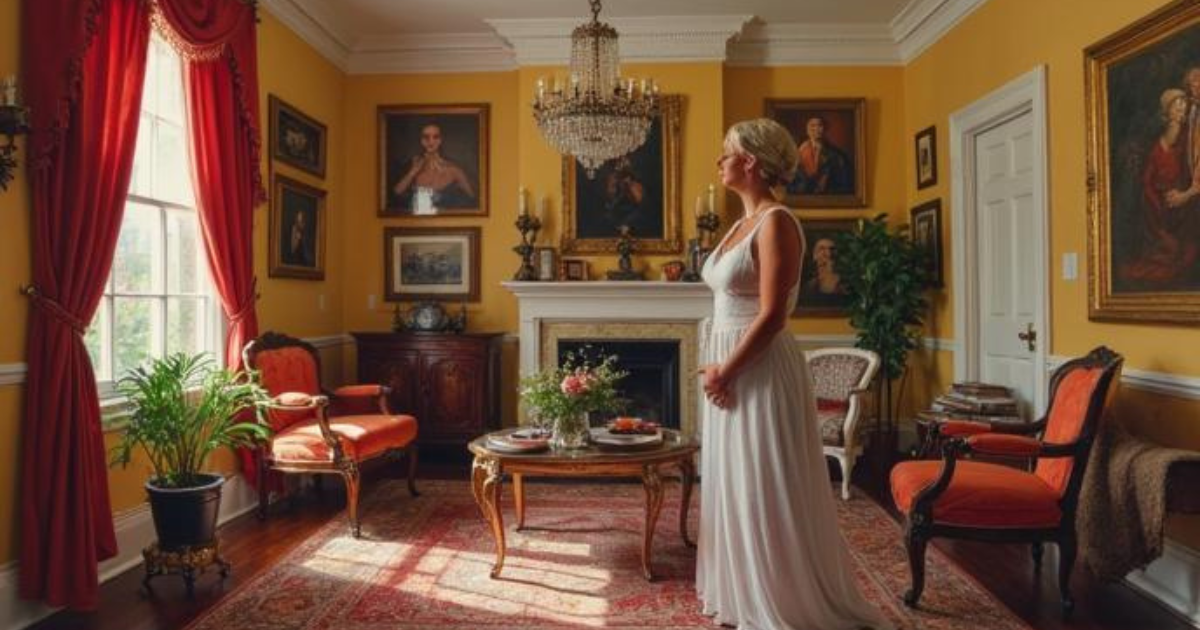
head, set off by her dainty white gown, suggested a rich, rare blossom.
She took her seat at table between old Monsieur Farival and Madame
Ratignolle.
As she seated herself and was about to begin to eat her soup, which had
been served when she entered the room, several persons informed her
simultaneously that Robert was going to Mexico. She laid her spoon down
and looked about her bewildered. He had been with her, reading to her
all the morning, and had never even mentioned such a place as Mexico.
She had not seen him during the afternoon; she had heard some one say
he was at the house, upstairs with his mother. This she had thought
nothing of, though she was surprised when he did not join her later in
the afternoon, when she went down to the beach.
She looked across at him, where he sat beside Madame Lebrun, who
presided. Edna’s face was a blank picture of bewilderment, which she
never thought of disguising. He lifted his eyebrows with the pretext of
a smile as he returned her glance. He looked embarrassed and uneasy.
“When is he going?” she asked of everybody in general, as if Robert
were not there to answer for himself.
“To-night!” “This very evening!” “Did you ever!” “What possesses him!”
were some of the replies she gathered, uttered simultaneously in French
and English.
“Impossible!” she exclaimed. “How can a person start off from Grand
Isle to Mexico at a moment’s notice, as if he were going over to
Klein’s or to the wharf or down to the beach?”
“I said all along I was going to Mexico; I’ve been saying so for
years!” cried Robert, in an excited and irritable tone, with the air of
a man defending himself against a swarm of stinging insects.
Madame Lebrun knocked on the table with her knife handle.
“Please let Robert explain why he is going, and why he is going
to-night,” she called out. “Really, this table is getting to be more
and more like Bedlam every day, with everybody talking at once.
Sometimes—I hope God will forgive me—but positively, sometimes I wish
Victor would lose the power of speech.”
Victor laughed sardonically as he thanked his mother for her holy wish,
of which he failed to see the benefit to anybody, except that it might
afford her a more ample opportunity and license to talk herself.
Monsieur Farival thought that Victor should have been taken out in
mid-ocean in his earliest youth and drowned. Victor thought there would
be more logic in thus disposing of old people with an established claim
for making themselves universally obnoxious. Madame Lebrun grew a
trifle hysterical; Robert called his brother some sharp, hard names.
“There’s nothing much to explain, mother,” he said; though he
explained, nevertheless—looking chiefly at Edna—that he could only meet
the gentleman whom he intended to join at Vera Cruz by taking such and
such a steamer, which left New Orleans on such a day; that Beaudelet
was going out with his lugger-load of vegetables that night, which gave
him an opportunity of reaching the city and making his vessel in time.
“But when did you make up your mind to all this?” demanded Monsieur
Farival.
“This afternoon,” returned Robert, with a shade of annoyance.
“At what time this afternoon?” persisted the old gentleman, with
nagging determination, as if he were cross-questioning a criminal in a
court of justice.
“At four o’clock this afternoon, Monsieur Farival,” Robert replied, in
a high voice and with a lofty air, which reminded Edna of some
gentleman on the stage.
She had forced herself to eat most of her soup, and now she was picking
the flaky bits of a court bouillon with her fork.
The lovers were profiting by the general conversation on Mexico to
speak in whispers of matters which they rightly considered were
interesting to no one but themselves. The lady in black had once
received a pair of prayer-beads of curious workmanship from Mexico,
with very special indulgence attached to them, but she had never been
able to ascertain whether the indulgence extended outside the Mexican
border. Father Fochel of the Cathedral had attempted to explain it; but
he had not done so to her satisfaction. And she begged that Robert
would interest himself, and discover, if possible, whether she was
entitled to the indulgence accompanying the remarkably curious Mexican
prayer-beads.
Madame Ratignolle hoped that Robert would exercise extreme caution in
dealing with the Mexicans, who, she considered, were a treacherous
people, unscrupulous and revengeful. She trusted she did them no
injustice in thus condemning them as a race. She had known personally
but one Mexican, who made and sold excellent tamales, and whom she
would have trusted implicitly, so soft-spoken was he. One day he was
arrested for stabbing his wife. She never knew whether he had been
hanged or not.
Victor had grown hilarious, and was attempting to tell an anecdote
about a Mexican girl who served chocolate one winter in a restaurant in
Dauphine Street. No one would listen to him but old Monsieur Farival,
who went into convulsions over the droll story.
Edna wondered if they had all gone mad, to be talking and clamoring at
that rate. She herself could think of nothing to say about Mexico or
the Mexicans.
“At what time do you leave?” she asked Robert.
“At ten,” he told her. “Beaudelet wants to wait for the moon.”
“Are you all ready to go?”
“Quite ready. I shall only take a hand-bag, and shall pack my trunk in
the city.”
He turned to answer some question put to him by his mother, and Edna,
having finished her black coffee, left the table.
She went directly to her room. The little cottage was close and stuffy
after leaving the outer air. But she did not mind; there appeared to be
a hundred different things demanding her attention indoors. She began
to set the toilet-stand to rights, grumbling at the negligence of the
quadroon, who was in the adjoining room putting the children to bed.
She gathered together stray garments that were hanging on the backs of
chairs, and put each where it belonged in closet or bureau drawer. She
changed her gown for a more comfortable and commodious wrapper. She
rearranged her hair, combing and brushing it with unusual energy. Then
she went in and assisted the quadroon in getting the boys to bed.
They were very playful and inclined to talk—to do anything but lie
quiet and go to sleep. Edna sent the quadroon away to her supper and
told her she need not return. Then she sat and told the children a
story. Instead of soothing it excited them, and added to their
wakefulness. She left them in heated argument, speculating about the
conclusion of the tale which their mother promised to finish the
following night.
The little black girl came in to say that Madame Lebrun would like to
have Mrs. Pontellier go and sit with them over at the house till Mr.
Robert went away. Edna returned answer that she had already undressed,
that she did not feel quite well, but perhaps she would go over to the
house later. She started to dress again, and got as far advanced as to
remove her peignoir. But changing her mind once more she resumed the
peignoir, and went outside and sat down before her door. She was
overheated and irritable, and fanned herself energetically for a while.
Madame Ratignolle came down to discover what was the matter.
“All that noise and confusion at the table must have upset me,” replied
Edna, “and moreover, I hate shocks and surprises. The idea of Robert
starting off in such a ridiculously sudden and dramatic way! As if it
were a matter of life and death! Never saying a word about it all
morning when he was with me.”
“Yes,” agreed Madame Ratignolle. “I think it was showing us all—you
especially—very little consideration. It wouldn’t have surprised me in
any of the others; those Lebruns are all given to heroics. But I must
say I should never have expected such a thing from Robert. Are you not
coming down? Come on, dear; it doesn’t look friendly.”
“No,” said Edna, a little sullenly. “I can’t go to the trouble of
dressing again; I don’t feel like it.”
“You needn’t dress; you look all right; fasten a belt around your
waist. Just look at me!”
“No,” persisted Edna; “but you go on. Madame Lebrun might be offended
if we both stayed away.”
Madame Ratignolle kissed Edna good-night, and went away, being in truth
rather desirous of joining in the general and animated conversation
which was still in progress concerning Mexico and the Mexicans.
Somewhat later Robert came up, carrying his hand-bag.
“Aren’t you feeling well?” he asked.
“Oh, well enough. Are you going right away?”
He lit a match and looked at his watch. “In twenty minutes,” he said.
The sudden and brief flare of the match emphasized the darkness for a
while. He sat down upon a stool which the children had left out on the
porch.
“Get a chair,” said Edna.
“This will do,” he replied. He put on his soft hat and nervously took
it off again, and wiping his face with his handkerchief, complained of
the heat.
“Take the fan,” said Edna, offering it to him.
“Oh, no! Thank you. It does no good; you have to stop fanning some
time, and feel all the more uncomfortable afterward.”
“That’s one of the ridiculous things which men always say. I have never
known one to speak otherwise of fanning. How long will you be gone?”
“Forever, perhaps. I don’t know. It depends upon a good many things.”
“Well, in case it shouldn’t be forever, how long will it be?”
“I don’t know.”
“This seems to me perfectly preposterous and uncalled for. I don’t like
it. I don’t understand your motive for silence and mystery, never
saying a word to me about it this morning.” He remained silent, not
offering to defend himself. He only said, after a moment:
“Don’t part from me in any ill humor. I never knew you to be out of
patience with me before.”
“I don’t want to part in any ill humor,” she said. “But can’t you
understand? I’ve grown used to seeing you, to having you with me all
the time, and your action seems unfriendly, even unkind. You don’t even
offer an excuse for it. Why, I was planning to be together, thinking of
how pleasant it would be to see you in the city next winter.”
“So was I,” he blurted. “Perhaps that’s the—” He stood up suddenly and
held out his hand. “Good-by, my dear Mrs. Pontellier; good-by. You
won’t—I hope you won’t completely forget me.” She clung to his hand,
striving to detain him.
“Write to me when you get there, won’t you, Robert?” she entreated.
“I will, thank you. Good-by.”
How unlike Robert! The merest acquaintance would have said something
more emphatic than “I will, thank you; good-by,” to such a request.
He had evidently already taken leave of the people over at the house,
for he descended the steps and went to join Beaudelet, who was out
there with an oar across his shoulder waiting for Robert. They walked
away in the darkness. She could only hear Beaudelet’s voice; Robert had
apparently not even spoken a word of greeting to his companion.
Edna bit her handkerchief convulsively, striving to hold back and to
hide, even from herself as she would have hidden from another, the
emotion which was troubling—tearing—her. Her eyes were brimming with
tears.
For the first time she recognized the symptoms of infatuation which she
had felt incipiently as a child, as a girl in her earliest teens, and
later as a young woman. The recognition did not lessen the reality, the
poignancy of the revelation by any suggestion or promise of
instability. The past was nothing to her; offered no lesson which she
was willing to heed. The future was a mystery which she never attempted
to penetrate. The present alone was significant; was hers, to torture
her as it was doing then with the biting conviction that she had lost
that which she had held, that she had been denied that which her
impassioned, newly awakened being demanded.
Master this chapter. Complete your experience
Purchase the complete book to access all chapters and support classic literature
As an Amazon Associate, we earn a small commission from qualifying purchases at no additional cost to you.
Available in paperback, hardcover, and e-book formats
Let's Analyse the Pattern
When emotional stakes get too high, some people choose sudden departure over difficult conversations.
Why This Matters
Connect literature to life
This chapter teaches how to identify when people manufacture sudden departures to escape emotional intensity rather than face difficult conversations.
Practice This Today
This week, notice when someone creates a 'sudden emergency' or 'amazing opportunity' right after an emotionally charged interaction—the timing reveals the real motive.
Now let's explore the literary elements.
Key Quotes & Analysis
"Edna's face was a blank picture of bewilderment, which she never thought of disguising."
Context: When Edna learns Robert is leaving for Mexico
This shows Edna's growing authenticity - she's not performing the expected social grace of hiding her feelings. Her shock is genuine and visible, which would have been considered improper for a lady.
In Today's Words:
She looked completely stunned and didn't even try to hide it.
"I hate shocks and surprises. They knock one off their balance."
Context: When Madame Ratignolle invites her to join the farewell gathering
Edna is learning to name her needs and boundaries. She's recognizing that she doesn't have to pretend to be okay with things that hurt her, even if society expects her to.
In Today's Words:
I can't handle being blindsided like this - it throws me completely off.
"Write to me when you get there, won't you, Robert?"
Context: Her desperate plea as Robert says goodbye
This shows her vulnerability and need for connection. She's clinging to any thread of continued contact, revealing how much his departure means to her.
In Today's Words:
Please don't just disappear from my life completely.
Thematic Threads
Avoidance
In This Chapter
Robert fabricates a sudden Mexico trip rather than acknowledge the growing intimacy with Edna
Development
Escalated from earlier subtle evasions to outright flight
In Your Life:
You might recognize this when someone important suddenly becomes 'too busy' just as your relationship deepens.
Recognition
In This Chapter
Edna finally admits to herself that she's in love with Robert, but only after losing him
Development
Her self-awareness has been building throughout; this is the breakthrough moment
In Your Life:
You might find yourself understanding your true feelings only when someone pulls away.
Timing
In This Chapter
The cruel irony of Robert leaving just as Edna discovers her feelings
Development
Introduced here as a central tension
In Your Life:
You might experience the frustration of emotional breakthroughs coming too late to change outcomes.
Powerlessness
In This Chapter
Edna can only cling to Robert's hand and beg him to write, unable to stop his departure
Development
Her growing agency from earlier chapters meets its first major limitation
In Your Life:
You might feel this helplessness when someone you care about makes unilateral decisions that affect you deeply.
Emotional Labor
In This Chapter
Edna must manage her devastation while putting children to bed and maintaining social appearances
Development
Continues the pattern of women managing emotions while performing duties
In Your Life:
You might recognize having to function normally while processing major emotional upheaval.
You now have the context. Time to form your own thoughts.
Discussion Questions
- 1
What clues tell us that Robert's departure isn't really about a long-planned business opportunity?
analysis • surface - 2
Why does Robert choose to flee rather than have an honest conversation with Edna about their growing connection?
analysis • medium - 3
Where do you see this 'sudden departure' pattern in modern relationships - romantic, workplace, or family situations?
application • medium - 4
When someone important to you makes an abrupt exit with flimsy explanations, what's the most effective way to respond?
application • deep - 5
What does Robert's behavior reveal about how some people handle emotional intensity and vulnerability?
reflection • deep
Critical Thinking Exercise
Decode the Exit Strategy
Think of a time when someone important made a sudden, unexplained exit from your life - a friend who went silent, a coworker who transferred departments, a family member who created drama and left. Write down their stated reason, then identify the real emotional trigger they were avoiding. What pattern of escalating intimacy or conflict preceded their departure?
Consider:
- •Look for the gap between their official explanation and the timeline of events
- •Notice if they seemed increasingly uncomfortable with emotional closeness or difficult conversations
- •Consider whether they had a history of fleeing when stakes got high in other relationships
Journaling Prompt
Write about how you would handle a similar situation now, knowing what you know about the sudden departure pattern. What boundaries would you set? How would you protect your own emotional energy while keeping the door open for their return?
Coming Up Next...
Chapter 16: Missing What We Can't Have
With Robert gone, Edna must navigate life at Grand Isle without the companion who had become central to her daily existence. How will his absence change her awakening journey?



