
An excerpt from the original text.(complete · 4636 words)
ugust 25th.—I am now quite settled down to my usual routine of steady
occupations and quiet amusements—tolerably contented and cheerful, but
still looking forward to spring with the hope of returning to town, not
for its gaieties and dissipations, but for the chance of meeting Mr.
Huntingdon once again; for still he is always in my thoughts and in my
dreams. In all my employments, whatever I do, or see, or hear, has an
ultimate reference to him; whatever skill or knowledge I acquire is
some day to be turned to his advantage or amusement; whatever new
beauties in nature or art I discover are to be depicted to meet his
eye, or stored in my memory to be told him at some future period. This,
at least, is the hope that I cherish, the fancy that lights me on my
lonely way. It may be only an ignis fatuus, after all, but it can do no
harm to follow it with my eyes and rejoice in its lustre, as long as it
does not lure me from the path I ought to keep; and I think it will
not, for I have thought deeply on my aunt’s advice, and I see clearly,
now, the folly of throwing myself away on one that is unworthy of all
the love I have to give, and incapable of responding to the best and
deepest feelings of my inmost heart—so clearly, that even if I should
see him again, and if he should remember me and love me still (which,
alas! is too little probable, considering how he is situated, and by
whom surrounded), and if he should ask me to marry him—I am determined
not to consent until I know for certain whether my aunt’s opinion of
him or mine is nearest the truth; for if mine is altogether wrong, it
is not he that I love; it is a creature of my own imagination. But I
think it is not wrong—no, no—there is a secret something—an inward
instinct that assures me I am right. There is essential goodness in
him;—and what delight to unfold it! If he has wandered, what bliss to
recall him! If he is now exposed to the baneful influence of corrupting
and wicked companions, what glory to deliver him from them! Oh! if I
could but believe that Heaven has designed me for this!
* * * * *
To-day is the first of September; but my uncle has ordered the
gamekeeper to spare the partridges till the gentlemen come. “What
gentlemen?” I asked when I heard it. A small party he had invited to
shoot. His friend Mr. Wilmot was one, and my aunt’s friend, Mr.
Boarham, another. This struck me as terrible news at the moment; but
all regret and apprehension vanished like a dream when I heard that Mr.
Huntingdon was actually to be a third! My aunt is greatly against his
coming, of course: she earnestly endeavoured to dissuade my uncle from
asking him; but he, laughing at her objections, told her it was no use
talking, for the mischief was already done: he had invited Huntingdon
and his friend Lord Lowborough before we left London, and nothing now
remained but to fix the day for their coming. So he is safe, and I am
sure of seeing him. I cannot express my joy. I find it very difficult
to conceal it from my aunt; but I don’t wish to trouble her with my
feelings till I know whether I ought to indulge them or not. If I find
it my absolute duty to suppress them, they shall trouble no one but
myself; and if I can really feel myself justified in indulging this
attachment, I can dare anything, even the anger and grief of my best
friend, for its object—surely, I shall soon know. But they are not
coming till about the middle of the month.
We are to have two lady visitors also: Mr. Wilmot is to bring his niece
and her cousin Milicent. I suppose my aunt thinks the latter will
benefit me by her society, and the salutary example of her gentle
deportment and lowly and tractable spirit; and the former I suspect she
intends as a species of counter-attraction to win Mr. Huntingdon’s
attention from me. I don’t thank her for this; but I shall be glad of
Milicent’s company: she is a sweet, good girl, and I wish I were like
her—more like her, at least, than I am.
* * * * *
19th.—They are come. They came the day before yesterday. The gentlemen
are all gone out to shoot, and the ladies are with my aunt, at work in
the drawing-room. I have retired to the library, for I am very unhappy,
and I want to be alone. Books cannot divert me; so having opened my
desk, I will try what may be done by detailing the cause of my
uneasiness. This paper will serve instead of a confidential friend into
whose ear I might pour forth the overflowings of my heart. It will not
sympathise with my distresses, but then it will not laugh at them, and,
if I keep it close, it cannot tell again; so it is, perhaps, the best
friend I could have for the purpose.
First, let me speak of his arrival—how I sat at my window, and watched
for nearly two hours, before his carriage entered the park-gates—for
they all came before him,—and how deeply I was disappointed at every
arrival, because it was not his. First came Mr. Wilmot and the ladies.
When Milicent had got into her room, I quitted my post a few minutes to
look in upon her and have a little private conversation, for she was
now my intimate friend, several long epistles having passed between us
since our parting. On returning to my window, I beheld another carriage
at the door. Was it his? No; it was Mr. Boarham’s plain dark chariot;
and there stood he upon the steps, carefully superintending the
dislodging of his various boxes and packages. What a collection! One
would have thought he projected a visit of six months at least. A
considerable time after, came Lord Lowborough in his barouche. Is he
one of the profligate friends, I wonder? I should think not; for no one
could call him a jolly companion, I’m sure,—and, besides, he appears
too sober and gentlemanly in his demeanour to merit such suspicions. He
is a tall, thin, gloomy-looking man, apparently between thirty and
forty, and of a somewhat sickly, careworn aspect.
At last, Mr. Huntingdon’s light phaeton came bowling merrily up the
lawn. I had but a transient glimpse of him: for the moment it stopped,
he sprang out over the side on to the portico steps, and disappeared
into the house.
I now submitted to be dressed for dinner—a duty which Rachel had been
urging upon me for the last twenty minutes; and when that important
business was completed, I repaired to the drawing-room, where I found
Mr. and Miss Wilmot and Milicent Hargrave already assembled. Shortly
after, Lord Lowborough entered, and then Mr. Boarham, who seemed quite
willing to forget and forgive my former conduct, and to hope that a
little conciliation and steady perseverance on his part might yet
succeed in bringing me to reason. While I stood at the window,
conversing with Milicent, he came up to me, and was beginning to talk
in nearly his usual strain, when Mr. Huntingdon entered the room.
“How will he greet me, I wonder?” said my bounding heart; and, instead
of advancing to meet him, I turned to the window to hide or subdue my
emotion. But having saluted his host and hostess, and the rest of the
company, he came to me, ardently squeezed my hand, and murmured he was
glad to see me once again. At that moment dinner was announced: my aunt
desired him to take Miss Hargrave into the dining-room, and odious Mr.
Wilmot, with unspeakable grimaces, offered his arm to me; and I was
condemned to sit between himself and Mr. Boarham. But afterwards, when
we were all again assembled in the drawing-room, I was indemnified for
so much suffering by a few delightful minutes of conversation with Mr.
Huntingdon.
In the course of the evening, Miss Wilmot was called upon to sing and
play for the amusement of the company, and I to exhibit my drawings,
and, though he likes music, and she is an accomplished musician, I
think I am right in affirming, that he paid more attention to my
drawings than to her music.
So far so good;—but hearing him pronounce, sotto voce, but with
peculiar emphasis, concerning one of the pieces, “THIS is better than
all!”—I looked up, curious to see which it was, and, to my horror,
beheld him complacently gazing at the back of the picture:—it was his
own face that I had sketched there and forgotten to rub out! To make
matters worse, in the agony of the moment, I attempted to snatch it
from his hand; but he prevented me, and exclaiming, “No—by George, I’ll
keep it!” placed it against his waistcoat and buttoned his coat upon it
with a delighted chuckle.
Then, drawing a candle close to his elbow, he gathered all the drawings
to himself, as well what he had seen as the others, and muttering, “I
must look at both sides now,” he eagerly commenced an examination,
which I watched, at first, with tolerable composure, in the confidence
that his vanity would not be gratified by any further discoveries; for,
though I must plead guilty to having disfigured the backs of several
with abortive attempts to delineate that too fascinating physiognomy, I
was sure that, with that one unfortunate exception, I had carefully
obliterated all such witnesses of my infatuation. But the pencil
frequently leaves an impression upon cardboard that no amount of
rubbing can efface. Such, it seems, was the case with most of these;
and, I confess, I trembled when I saw him holding them so close to the
candle, and poring so intently over the seeming blanks; but still, I
trusted, he would not be able to make out these dim traces to his own
satisfaction. I was mistaken, however. Having ended his scrutiny, he
quietly remarked,—“I perceive the backs of young ladies’ drawings, like
the postscripts of their letters, are the most important and
interesting part of the concern.”
Then, leaning back in his chair, he reflected a few minutes in silence,
complacently smiling to himself, and while I was concocting some
cutting speech wherewith to check his gratification, he rose, and
passing over to where Annabella Wilmot sat vehemently coquetting with
Lord Lowborough, seated himself on the sofa beside her, and attached
himself to her for the rest of the evening.
“So then,” thought I, “he despises me, because he knows I love him.”
And the reflection made me so miserable I knew not what to do. Milicent
came and began to admire my drawings, and make remarks upon them; but I
could not talk to her—I could talk to no one, and, upon the
introduction of tea, I took advantage of the open door and the slight
diversion caused by its entrance to slip out—for I was sure I could not
take any—and take refuge in the library. My aunt sent Thomas in quest
of me, to ask if I were not coming to tea; but I bade him say I should
not take any to-night, and, happily, she was too much occupied with her
guests to make any further inquiries at the time.
As most of the company had travelled far that day, they retired early
to rest; and having heard them all, as I thought, go up-stairs, I
ventured out, to get my candlestick from the drawing-room sideboard.
But Mr. Huntingdon had lingered behind the rest. He was just at the
foot of the stairs when I opened the door, and hearing my step in the
hall—though I could hardly hear it myself—he instantly turned back.
“Helen, is that you?” said he. “Why did you run away from us?”
“Good-night, Mr. Huntingdon,” said I, coldly, not choosing to answer
the question. And I turned away to enter the drawing-room.
“But you’ll shake hands, won’t you?” said he, placing himself in the
doorway before me. And he seized my hand and held it, much against my
will.
“Let me go, Mr. Huntingdon,” said I. “I want to get a candle.”
“The candle will keep,” returned he.
I made a desperate effort to free my hand from his grasp.
“Why are you in such a hurry to leave me, Helen?” he said, with a smile
of the most provoking self-sufficiency. “You don’t hate me, you
know.”
“Yes, I do—at this moment.”
“Not you. It is Annabella Wilmot you hate, not me.”
“I have nothing to do with Annabella Wilmot,” said I, burning with
indignation.
“But I have, you know,” returned he, with peculiar emphasis.
“That is nothing to me, sir,” I retorted.
“Is it nothing to you, Helen? Will you swear it? Will you?”
“No I won’t, Mr. Huntingdon! and I will go,” cried I, not knowing
whether to laugh, or to cry, or to break out into a tempest of fury.
“Go, then, you vixen!” he said; but the instant he released my hand he
had the audacity to put his arm round my neck, and kiss me.
Trembling with anger and agitation, and I don’t know what besides, I
broke away, and got my candle, and rushed up-stairs to my room. He
would not have done so but for that hateful picture. And there he had
it still in his possession, an eternal monument to his pride and my
humiliation.
It was but little sleep I got that night, and in the morning I rose
perplexed and troubled with the thoughts of meeting him at breakfast. I
knew not how it was to be done. An assumption of dignified, cold
indifference would hardly do, after what he knew of my devotion—to his
face, at least. Yet something must be done to check his presumption—I
would not submit to be tyrannised over by those bright, laughing eyes.
And, accordingly, I received his cheerful morning salutation as calmly
and coldly as my aunt could have wished, and defeated with brief
answers his one or two attempts to draw me into conversation, while I
comported myself with unusual cheerfulness and complaisance towards
every other member of the party, especially Annabella Wilmot, and even
her uncle and Mr. Boarham were treated with an extra amount of civility
on the occasion, not from any motives of coquetry, but just to show him
that my particular coolness and reserve arose from no general
ill-humour or depression of spirits.
He was not, however, to be repelled by such acting as this. He did not
talk much to me, but when he did speak it was with a degree of freedom
and openness, and kindliness too, that plainly seemed to intimate he
knew his words were music to my ears; and when his looks met mine it
was with a smile—presumptuous, it might be—but oh! so sweet, so bright,
so genial, that I could not possibly retain my anger; every vestige of
displeasure soon melted away beneath it like morning clouds before the
summer sun.
Soon after breakfast all the gentlemen save one, with boyish eagerness,
set out on their expedition against the hapless partridges; my uncle
and Mr. Wilmot on their shooting ponies, Mr. Huntingdon and Lord
Lowborough on their legs: the one exception being Mr. Boarham, who, in
consideration of the rain that had fallen during the night, thought it
prudent to remain behind a little and join them in a while when the sun
had dried the grass. And he favoured us all with a long and minute
disquisition upon the evils and dangers attendant upon damp feet,
delivered with the most imperturbable gravity, amid the jeers and
laughter of Mr. Huntingdon and my uncle, who, leaving the prudent
sportsman to entertain the ladies with his medical discussions, sallied
forth with their guns, bending their steps to the stables first, to
have a look at the horses and let out the dogs.
Not desirous of sharing Mr. Boarham’s company for the whole of the
morning, I betook myself to the library, and there brought forth my
easel and began to paint. The easel and the painting apparatus would
serve as an excuse for abandoning the drawing-room if my aunt should
come to complain of the desertion, and besides I wanted to finish the
picture. It was one I had taken great pains with, and I intended it to
be my masterpiece, though it was somewhat presumptuous in the design.
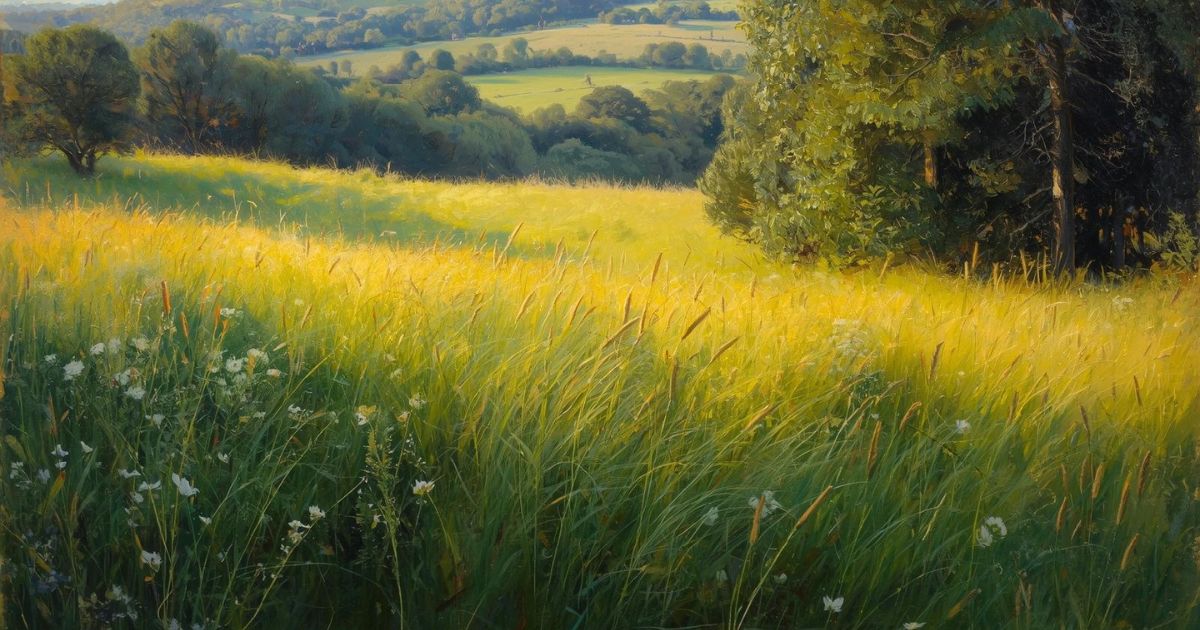
By the bright azure of the sky, and by the warm and brilliant lights
and deep long shadows, I had endeavoured to convey the idea of a sunny
morning. I had ventured to give more of the bright verdure of spring or
early summer to the grass and foliage than is commonly attempted in
painting. The scene represented was an open glade in a wood. A group of
dark Scotch firs was introduced in the middle distance to relieve the
prevailing freshness of the rest; but in the foreground was part of the
gnarled trunk and of the spreading boughs of a large forest-tree, whose
foliage was of a brilliant golden green—not golden from autumnal
mellowness, but from the sunshine and the very immaturity of the scarce
expanded leaves. Upon this bough, that stood out in bold relief against
the sombre firs, were seated an amorous pair of turtle doves, whose
soft sad-coloured plumage afforded a contrast of another nature; and
beneath it a young girl was kneeling on the daisy-spangled turf, with
head thrown back and masses of fair hair falling on her shoulders, her
hands clasped, lips parted, and eyes intently gazing upward in pleased
yet earnest contemplation of those feathered lovers—too deeply absorbed
in each other to notice her.
I had scarcely settled to my work, which, however, wanted but a few
touches to the finishing, when the sportsmen passed the window on their
return from the stables. It was partly open, and Mr. Huntingdon must
have seen me as he went by, for in half a minute he came back, and
setting his gun against the wall, threw up the sash and sprang in, and
set himself before my picture.
“Very pretty, i’faith,” said he, after attentively regarding it for a
few seconds; “and a very fitting study for a young lady. Spring just
opening into summer—morning just approaching noon—girlhood just
ripening into womanhood, and hope just verging on fruition. She’s a
sweet creature! but why didn’t you make her black hair?”
“I thought light hair would suit her better. You see I have made her
blue-eyed and plump, and fair and rosy.”
“Upon my word—a very Hebe! I should fall in love with her if I hadn’t
the artist before me. Sweet innocent! she’s thinking there will come a
time when she will be wooed and won like that pretty hen-dove by as
fond and fervent a lover; and she’s thinking how pleasant it will be,
and how tender and faithful he will find her.”
“And perhaps,” suggested I, “how tender and faithful she shall find
him.”
“Perhaps, for there is no limit to the wild extravagance of Hope’s
imaginings at such an age.”
“Do you call that, then, one of her wild, extravagant delusions?”
“No; my heart tells me it is not. I might have thought so once, but
now, I say, give me the girl I love, and I will swear eternal constancy
to her and her alone, through summer and winter, through youth and age,
and life and death! if age and death must come.”
He spoke this in such serious earnest that my heart bounded with
delight; but the minute after he changed his tone, and asked, with a
significant smile, if I had “any more portraits.”
“No,” replied I, reddening with confusion and wrath.
But my portfolio was on the table: he took it up, and coolly sat down
to examine its contents.
“Mr. Huntingdon, those are my unfinished sketches,” cried I, “and I
never let any one see them.”
And I placed my hand on the portfolio to wrest it from him, but he
maintained his hold, assuring me that he “liked unfinished sketches of
all things.”
“But I hate them to be seen,” returned I. “I can’t let you have it,
indeed!”
“Let me have its bowels then,” said he; and just as I wrenched the
portfolio from his hand, he deftly abstracted the greater part of its
contents, and after turning them over a moment he cried out,—“Bless my
stars, here’s another;” and slipped a small oval of ivory paper into
his waistcoat pocket—a complete miniature portrait that I had sketched
with such tolerable success as to be induced to colour it with great
pains and care. But I was determined he should not keep it.
“Mr. Huntingdon,” cried I, “I insist upon having that back! It is
mine, and you have no right to take it. Give it me directly—I’ll
never forgive you if you don’t!”
But the more vehemently I insisted, the more he aggravated my distress
by his insulting, gleeful laugh. At length, however, he restored it to
me, saying,—“Well, well, since you value it so much, I’ll not deprive
you of it.”
To show him how I valued it, I tore it in two and threw it into the
fire. He was not prepared for this. His merriment suddenly ceasing, he
stared in mute amazement at the consuming treasure; and then, with a
careless “Humph! I’ll go and shoot now,” he turned on his heel and
vacated the apartment by the window as he came, and setting on his hat
with an air, took up his gun and walked away, whistling as he went—and
leaving me not too much agitated to finish my picture, for I was glad,
at the moment, that I had vexed him.
When I returned to the drawing-room, I found Mr. Boarham had ventured
to follow his comrades to the field; and shortly after lunch, to which
they did not think of returning, I volunteered to accompany the ladies
in a walk, and show Annabella and Milicent the beauties of the country.
We took a long ramble, and re-entered the park just as the sportsmen
were returning from their expedition. Toil-spent and travel-stained,
the main body of them crossed over the grass to avoid us, but Mr.
Huntingdon, all spattered and splashed as he was, and stained with the
blood of his prey—to the no small offence of my aunt’s strict sense of
propriety—came out of his way to meet us, with cheerful smiles and
words for all but me, and placing himself between Annabella Wilmot and
myself, walked up the road and began to relate the various exploits and
disasters of the day, in a manner that would have convulsed me with
laughter if I had been on good terms with him; but he addressed himself
entirely to Annabella, and I, of course, left all the laughter and all
the badinage to her, and affecting the utmost indifference to whatever
passed between them, walked along a few paces apart, and looking every
way but theirs, while my aunt and Milicent went before, linked arm in
arm and gravely discoursing together. At length Mr. Huntingdon turned
to me, and addressing me in a confidential whisper, said,—“Helen, why
did you burn my picture?”
“Because I wished to destroy it,” I answered, with an asperity it is
useless now to lament.
“Oh, very good!” was the reply; “if you don’t value me, I must turn
to somebody that will.”
I thought it was partly in jest—a half-playful mixture of mock
resignation and pretended indifference: but immediately he resumed his
place beside Miss Wilmot, and from that hour to this—during all that
evening, and all the next day, and the next, and the next, and all this
morning (the 22nd), he has never given me one kind word or one pleasant
look—never spoken to me, but from pure necessity—never glanced towards
me but with a cold, unfriendly look I thought him quite incapable of
assuming.
My aunt observes the change, and though she has not inquired the cause
or made any remark to me on the subject, I see it gives her pleasure.
Miss Wilmot observes it, too, and triumphantly ascribes it to her own
superior charms and blandishments; but I am truly miserable—more so
than I like to acknowledge to myself. Pride refuses to aid me. It has
brought me into the scrape, and will not help me out of it.
He meant no harm—it was only his joyous, playful spirit; and I, by my
acrimonious resentment—so serious, so disproportioned to the
offence—have so wounded his feelings, so deeply offended him, that I
fear he will never forgive me—and all for a mere jest! He thinks I
dislike him, and he must continue to think so. I must lose him for
ever, and Annabella may win him, and triumph as she will.
But it is not my loss nor her triumph that I deplore so greatly as the
wreck of my fond hopes for his advantage, and her unworthiness of his
affection, and the injury he will do himself by trusting his happiness
to her. She does not love him: she thinks only of herself. She cannot
appreciate the good that is in him: she will neither see it, nor value
it, nor cherish it. She will neither deplore his faults nor attempt
their amendment, but rather aggravate them by her own. And I doubt
whether she will not deceive him after all. I see she is playing double
between him and Lord Lowborough, and while she amuses herself with the
lively Huntingdon, she tries her utmost to enslave his moody friend;
and should she succeed in bringing both to her feet, the fascinating
commoner will have but little chance against the lordly peer. If he
observes her artful by-play, it gives him no uneasiness, but rather
adds new zest to his diversion by opposing a stimulating check to his
otherwise too easy conquest.
Messrs. Wilmot and Boarham have severally taken occasion by his neglect
of me to renew their advances; and if I were like Annabella and some
others I should take advantage of their perseverance to endeavour to
pique him into a revival of affection; but, justice and honesty apart,
I could not bear to do it. I am annoyed enough by their present
persecutions without encouraging them further; and even if I did it
would have precious little effect upon him. He sees me suffering under
the condescending attentions and prosaic discourses of the one, and the
repulsive obtrusions of the other, without so much as a shadow of
commiseration for me, or resentment against my tormentors. He never
could have loved me, or he would not have resigned me so willingly, and
he would not go on talking to everybody else so cheerfully as he
does—laughing and jesting with Lord Lowborough and my uncle, teasing
Milicent Hargrave, and flirting with Annabella Wilmot—as if nothing
were on his mind. Oh! why can’t I hate him? I must be infatuated, or I
should scorn to regret him as I do. But I must rally all the powers I
have remaining, and try to tear him from my heart. There goes the
dinner-bell, and here comes my aunt to scold me for sitting here at my
desk all day, instead of staying with the company: wish the company
were—gone.
Master this chapter. Complete your experience
Purchase the complete book to access all chapters and support classic literature
As an Amazon Associate, we earn a small commission from qualifying purchases at no additional cost to you.
Available in paperback, hardcover, and e-book formats
Let's Analyse the Pattern
When someone discovers your feelings, they gain power over you that they can choose to honor or exploit.
Why This Matters
Connect literature to life
This chapter teaches how to recognize when someone uses your emotional investment as a weapon against you.
Practice This Today
This week, notice when someone mentions other options right after you've shown interest—whether it's a potential employer mentioning other candidates or a friend suddenly name-dropping their busy social calendar.
Now let's explore the literary elements.
Key Quotes & Analysis
"In all my employments, whatever I do, or see, or hear, has an ultimate reference to him"
Context: Helen is describing in her diary how completely Huntingdon occupies her thoughts
This reveals how consuming her feelings are - she can't do anything without it somehow connecting to him in her mind. It shows the intensity of first love but also hints at an unhealthy obsession where her entire identity revolves around another person.
In Today's Words:
Everything I do somehow comes back to thinking about him
"It may be only an ignis fatuus, after all, but it can do no harm to follow it with my eyes and rejoice in its lustre"
Context: Helen acknowledging that her hope of reuniting with Huntingdon might be false hope
This shows Helen's self-awareness - she knows she might be fooling herself, but she's choosing to hold onto hope anyway. The metaphor reveals she understands the danger but feels powerless to resist the attraction.
In Today's Words:
This might be total wishful thinking, but what's the harm in daydreaming about it?
"I see clearly, now, the folly of throwing myself away on one that is unworthy of all the love I have to give"
Context: Helen reflecting on her aunt's advice about not wasting her love on Huntingdon
Helen demonstrates intellectual understanding of her situation - she can see the problem clearly. But the fact that she's still completely absorbed in thoughts of him shows the gap between knowing what's right and being able to act on it emotionally.
In Today's Words:
I totally get now how stupid it would be to waste all my feelings on someone who doesn't deserve them
Thematic Threads
Power
In This Chapter
Huntingdon uses Helen's revealed feelings as leverage to control her through strategic attention and indifference
Development
Power dynamics have shifted from social class differences to emotional vulnerability imbalances
In Your Life:
You might recognize this when someone starts treating you worse after you've shown you care about them
Pride
In This Chapter
Helen's pride prevents her from apologizing or admitting her feelings, trapping her in silence while losing Huntingdon
Development
Pride has evolved from social status protection to emotional self-protection that backfires
In Your Life:
Your pride might keep you from fixing relationships that could be saved with honest conversation
Manipulation
In This Chapter
Both Huntingdon and Annabella use emotional games—jealousy, indifference, and strategic attention—to control others
Development
Manipulation tactics are becoming more sophisticated and calculated in romantic contexts
In Your Life:
You might notice people using your reactions against you or playing hot-and-cold to keep you hooked
Identity
In This Chapter
Helen's sense of self becomes tied to Huntingdon's approval, making his rejection devastating to her core identity
Development
Helen's identity is shifting from independent artist to someone defined by romantic validation
In Your Life:
You might find your self-worth fluctuating based on how one important person treats you on any given day
Social Expectations
In This Chapter
Helen must navigate the impossible standards of showing interest without appearing desperate or forward
Development
Social rules around courtship create double-binds that trap women regardless of their choices
In Your Life:
You might feel caught between being authentic and following unwritten rules about how much to reveal or pursue
You now have the context. Time to form your own thoughts.
Discussion Questions
- 1
What exactly did Huntingdon discover, and how did Helen react when he found it?
analysis • surface - 2
Why does Huntingdon turn his attention to Annabella immediately after discovering Helen's feelings for him?
analysis • medium - 3
Where have you seen this pattern of someone using another person's feelings against them in modern relationships or workplaces?
application • medium - 4
If you were Helen's friend, what advice would you give her about handling this situation without losing her dignity?
application • deep - 5
What does this chapter reveal about how emotional investment affects power in relationships?
reflection • deep
Critical Thinking Exercise
Map Your Own Vulnerability Patterns
Think of a recent situation where you cared more than the other person did—at work, in a friendship, or with family. Write down what you revealed about your feelings and how the other person responded. Did they use your caring against you or reciprocate it? Map out the power shifts that happened.
Consider:
- •Notice whether you gave away your feelings all at once or gradually
- •Identify what the other person gained by knowing how much you cared
- •Consider whether maintaining some emotional distance might have changed the outcome
Journaling Prompt
Write about a time when someone discovered how much you needed or wanted something from them. How did their behavior change? What would you do differently now?
Coming Up Next...
Chapter 19: The Confession in the Library
The tension reaches a breaking point as Helen faces a night of reckoning. Something significant happens that she can barely bring herself to record, leaving her sleepless and questioning everything she's done.



