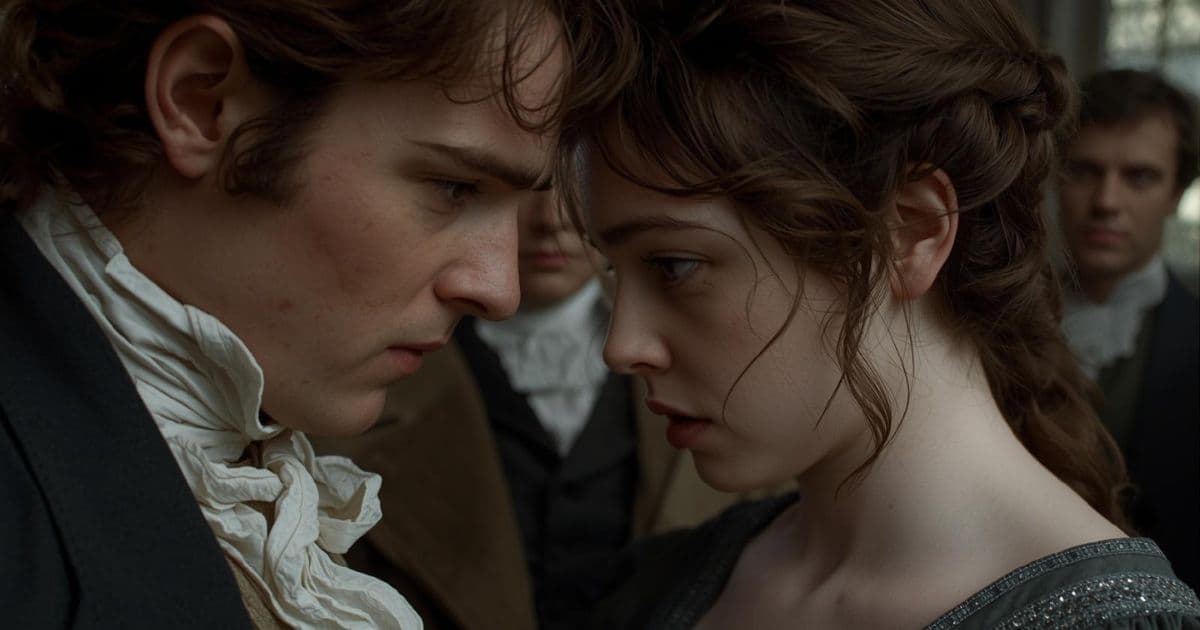
An excerpt from the original text.(complete · 4194 words)
IX.
Unaccountable, however, as the circumstances of his release might
appear to the whole family, it was certain that Edward was free; and to
what purpose that freedom would be employed was easily pre-determined
by all;—for after experiencing the blessings of one imprudent
engagement, contracted without his mother’s consent, as he had already
done for more than four years, nothing less could be expected of him in
the failure of that, than the immediate contraction of another.
His errand at Barton, in fact, was a simple one. It was only to ask
Elinor to marry him;—and considering that he was not altogether
inexperienced in such a question, it might be strange that he should
feel so uncomfortable in the present case as he really did, so much in
need of encouragement and fresh air.
How soon he had walked himself into the proper resolution, however, how
soon an opportunity of exercising it occurred, in what manner he
expressed himself, and how he was received, need not be particularly
told. This only need be said;—that when they all sat down to table at
four o’clock, about three hours after his arrival, he had secured his
lady, engaged her mother’s consent, and was not only in the rapturous
profession of the lover, but, in the reality of reason and truth, one
of the happiest of men. His situation indeed was more than commonly
joyful. He had more than the ordinary triumph of accepted love to swell
his heart, and raise his spirits. He was released without any reproach
to himself, from an entanglement which had long formed his misery, from
a woman whom he had long ceased to love;—and elevated at once to that
security with another, which he must have thought of almost with
despair, as soon as he had learnt to consider it with desire. He was
brought, not from doubt or suspense, but from misery to happiness;—and
the change was openly spoken in such a genuine, flowing, grateful
cheerfulness, as his friends had never witnessed in him before.
His heart was now open to Elinor, all its weaknesses, all its errors
confessed, and his first boyish attachment to Lucy treated with all the
philosophic dignity of twenty-four.
“It was a foolish, idle inclination on my side,” said he, “the
consequence of ignorance of the world, and want of employment. Had my
mother given me some active profession when I was removed at eighteen
from the care of Mr. Pratt, I think, nay, I am sure, it would never
have happened; for though I left Longstaple with what I thought, at the
time, a most unconquerable preference for his niece, yet had I then had
any pursuit, any object to engage my time and keep me at a distance
from her for a few months, I should very soon have outgrown the fancied
attachment, especially by mixing more with the world, as in such case I
must have done. But instead of having any thing to do, instead of
having any profession chosen for me, or being allowed to chuse any
myself, I returned home to be completely idle; and for the first
twelvemonth afterwards I had not even the nominal employment, which
belonging to the university would have given me; for I was not entered
at Oxford till I was nineteen. I had therefore nothing in the world to
do, but to fancy myself in love; and as my mother did not make my home
in every respect comfortable, as I had no friend, no companion in my
brother, and disliked new acquaintance, it was not unnatural for me to
be very often at Longstaple, where I always felt myself at home, and
was always sure of a welcome; and accordingly I spent the greatest part
of my time there from eighteen to nineteen: Lucy appeared everything
that was amiable and obliging. She was pretty too—at least I thought so
then; and I had seen so little of other women, that I could make no
comparisons, and see no defects. Considering everything, therefore, I
hope, foolish as our engagement was, foolish as it has since in every
way been proved, it was not at the time an unnatural or an inexcusable
piece of folly.”
The change which a few hours had wrought in the minds and the happiness
of the Dashwoods, was such—so great—as promised them all, the
satisfaction of a sleepless night. Mrs. Dashwood, too happy to be
comfortable, knew not how to love Edward, nor praise Elinor enough, how
to be enough thankful for his release without wounding his delicacy,
nor how at once to give them leisure for unrestrained conversation
together, and yet enjoy, as she wished, the sight and society of both.
Marianne could speak her happiness only by tears. Comparisons would
occur—regrets would arise; and her joy, though sincere as her love for
her sister, was of a kind to give her neither spirits nor language.
But Elinor—how are her feelings to be described? From the moment of
learning that Lucy was married to another, that Edward was free, to the
moment of his justifying the hopes which had so instantly followed, she
was every thing by turns but tranquil. But when the second moment had
passed, when she found every doubt, every solicitude removed, compared
her situation with what so lately it had been,—saw him honourably
released from his former engagement,—saw him instantly profiting by the
release, to address herself and declare an affection as tender, as
constant as she had ever supposed it to be,—she was oppressed, she was
overcome by her own felicity; and happily disposed as is the human mind
to be easily familiarized with any change for the better, it required
several hours to give sedateness to her spirits, or any degree of
tranquillity to her heart.
Edward was now fixed at the cottage at least for a week;—for whatever
other claims might be made on him, it was impossible that less than a
week should be given up to the enjoyment of Elinor’s company, or
suffice to say half that was to be said of the past, the present, and
the future;—for though a very few hours spent in the hard labor of
incessant talking will despatch more subjects than can really be in
common between any two rational creatures, yet with lovers it is
different. Between them no subject is finished, no communication is
even made, till it has been made at least twenty times over.
Lucy’s marriage, the unceasing and reasonable wonder among them all,
formed of course one of the earliest discussions of the lovers;—and
Elinor’s particular knowledge of each party made it appear to her in
every view, as one of the most extraordinary and unaccountable
circumstances she had ever heard. How they could be thrown together,
and by what attraction Robert could be drawn on to marry a girl, of
whose beauty she had herself heard him speak without any admiration,—a
girl too already engaged to his brother, and on whose account that
brother had been thrown off by his family—it was beyond her
comprehension to make out. To her own heart it was a delightful affair,
to her imagination it was even a ridiculous one, but to her reason, her
judgment, it was completely a puzzle.
Edward could only attempt an explanation by supposing, that, perhaps,
at first accidentally meeting, the vanity of the one had been so worked
on by the flattery of the other, as to lead by degrees to all the rest.
Elinor remembered what Robert had told her in Harley Street, of his
opinion of what his own mediation in his brother’s affairs might have
done, if applied to in time. She repeated it to Edward.
“That was exactly like Robert,” was his immediate observation. “And
that,” he presently added, “might perhaps be in his head when the
acquaintance between them first began. And Lucy perhaps at first might
think only of procuring his good offices in my favour. Other designs
might afterward arise.”
How long it had been carrying on between them, however, he was equally
at a loss with herself to make out; for at Oxford, where he had
remained for choice ever since his quitting London, he had had no means
of hearing of her but from herself, and her letters to the very last
were neither less frequent, nor less affectionate than usual. Not the
smallest suspicion, therefore, had ever occurred to prepare him for
what followed;—and when at last it burst on him in a letter from Lucy
herself, he had been for some time, he believed, half stupified between
the wonder, the horror, and the joy of such a deliverance. He put the
letter into Elinor’s hands.
“DEAR SIR,
“Being very sure I have long lost your affections, I have thought
myself at liberty to bestow my own on another, and have no doubt of
being as happy with him as I once used to think I might be with
you; but I scorn to accept a hand while the heart was another’s.
Sincerely wish you happy in your choice, and it shall not be my
fault if we are not always good friends, as our near relationship
now makes proper. I can safely say I owe you no ill-will, and am
sure you will be too generous to do us any ill offices. Your
brother has gained my affections entirely, and as we could not live
without one another, we are just returned from the altar, and are
now on our way to Dawlish for a few weeks, which place your dear
brother has great curiosity to see, but thought I would first
trouble you with these few lines, and shall always remain,
“Your sincere well-wisher, friend, and sister,
“LUCY FERRARS.
“I have burnt all your letters, and will return your picture the first
opportunity. Please to destroy my scrawls—but the ring with my hair you
are very welcome to keep.”
Elinor read and returned it without any comment.
“I will not ask your opinion of it as a composition,” said Edward.—“For
worlds would not I have had a letter of hers seen by you in former
days.—In a sister it is bad enough, but in a wife!—how I have blushed
over the pages of her writing!—and I believe I may say that since the
first half year of our foolish—business—this is the only letter I ever
received from her, of which the substance made me any amends for the
defect of the style.”
“However it may have come about,” said Elinor, after a pause,—“they are
certainly married. And your mother has brought on herself a most
appropriate punishment. The independence she settled on Robert, through
resentment against you, has put it in his power to make his own choice;
and she has actually been bribing one son with a thousand a-year, to do
the very deed which she disinherited the other for intending to do. She
will hardly be less hurt, I suppose, by Robert’s marrying Lucy, than
she would have been by your marrying her.”
“She will be more hurt by it, for Robert always was her favourite.—She
will be more hurt by it, and on the same principle will forgive him
much sooner.”
In what state the affair stood at present between them, Edward knew
not, for no communication with any of his family had yet been attempted
by him. He had quitted Oxford within four and twenty hours after Lucy’s
letter arrived, and with only one object before him, the nearest road
to Barton, had had no leisure to form any scheme of conduct, with which
that road did not hold the most intimate connection. He could do
nothing till he were assured of his fate with Miss Dashwood; and by his
rapidity in seeking that fate, it is to be supposed, in spite of the
jealousy with which he had once thought of Colonel Brandon, in spite of
the modesty with which he rated his own deserts, and the politeness
with which he talked of his doubts, he did not, upon the whole, expect
a very cruel reception. It was his business, however, to say that he
did, and he said it very prettily. What he might say on the subject a
twelvemonth after, must be referred to the imagination of husbands and
wives.
That Lucy had certainly meant to deceive, to go off with a flourish of
malice against him in her message by Thomas, was perfectly clear to
Elinor; and Edward himself, now thoroughly enlightened on her
character, had no scruple in believing her capable of the utmost
meanness of wanton ill-nature. Though his eyes had been long opened,
even before his acquaintance with Elinor began, to her ignorance and a
want of liberality in some of her opinions—they had been equally
imputed, by him, to her want of education; and till her last letter
reached him, he had always believed her to be a well-disposed,
good-hearted girl, and thoroughly attached to himself. Nothing but such
a persuasion could have prevented his putting an end to an engagement,
which, long before the discovery of it laid him open to his mother’s
anger, had been a continual source of disquiet and regret to him.
“I thought it my duty,” said he, “independent of my feelings, to give
her the option of continuing the engagement or not, when I was
renounced by my mother, and stood to all appearance without a friend in
the world to assist me. In such a situation as that, where there seemed
nothing to tempt the avarice or the vanity of any living creature, how
could I suppose, when she so earnestly, so warmly insisted on sharing
my fate, whatever it might be, that any thing but the most
disinterested affection was her inducement? And even now, I cannot
comprehend on what motive she acted, or what fancied advantage it could
be to her, to be fettered to a man for whom she had not the smallest
regard, and who had only two thousand pounds in the world. She could
not foresee that Colonel Brandon would give me a living.”
“No; but she might suppose that something would occur in your favour;
that your own family might in time relent. And at any rate, she lost
nothing by continuing the engagement, for she has proved that it
fettered neither her inclination nor her actions. The connection was
certainly a respectable one, and probably gained her consideration
among her friends; and, if nothing more advantageous occurred, it would
be better for her to marry you than be single.”
Edward was, of course, immediately convinced that nothing could have
been more natural than Lucy’s conduct, nor more self-evident than the
motive of it.
Elinor scolded him, harshly as ladies always scold the imprudence which
compliments themselves, for having spent so much time with them at
Norland, when he must have felt his own inconstancy.
“Your behaviour was certainly very wrong,” said she; “because—to say
nothing of my own conviction, our relations were all led away by it to
fancy and expect what, as you were then situated, could never be.”
He could only plead an ignorance of his own heart, and a mistaken
confidence in the force of his engagement.
“I was simple enough to think, that because my faith was plighted to
another, there could be no danger in my being with you; and that the
consciousness of my engagement was to keep my heart as safe and sacred
as my honour. I felt that I admired you, but I told myself it was only
friendship; and till I began to make comparisons between yourself and
Lucy, I did not know how far I was got. After that, I suppose, I was
wrong in remaining so much in Sussex, and the arguments with which I
reconciled myself to the expediency of it, were no better than
these:—The danger is my own; I am doing no injury to anybody but
myself.”
Elinor smiled, and shook her head.
Edward heard with pleasure of Colonel Brandon’s being expected at the
Cottage, as he really wished not only to be better acquainted with him,
but to have an opportunity of convincing him that he no longer resented
his giving him the living of Delaford—“Which, at present,” said he,
“after thanks so ungraciously delivered as mine were on the occasion,
he must think I have never forgiven him for offering.”
Now he felt astonished himself that he had never yet been to the
place. But so little interest had he taken in the matter, that he owed
all his knowledge of the house, garden, and glebe, extent of the
parish, condition of the land, and rate of the tithes, to Elinor
herself, who had heard so much of it from Colonel Brandon, and heard it
with so much attention, as to be entirely mistress of the subject.
One question after this only remained undecided, between them, one
difficulty only was to be overcome. They were brought together by
mutual affection, with the warmest approbation of their real friends;
their intimate knowledge of each other seemed to make their happiness
certain—and they only wanted something to live upon. Edward had two
thousand pounds, and Elinor one, which, with Delaford living, was all
that they could call their own; for it was impossible that Mrs.
Dashwood should advance anything; and they were neither of them quite
enough in love to think that three hundred and fifty pounds a-year
would supply them with the comforts of life.
Edward was not entirely without hopes of some favourable change in his
mother towards him; and on that he rested for the residue of their
income. But Elinor had no such dependence; for since Edward would still
be unable to marry Miss Morton, and his chusing herself had been spoken
of in Mrs. Ferrars’s flattering language as only a lesser evil than his
chusing Lucy Steele, she feared that Robert’s offence would serve no
other purpose than to enrich Fanny.
About four days after Edward’s arrival Colonel Brandon appeared, to
complete Mrs. Dashwood’s satisfaction, and to give her the dignity of
having, for the first time since her living at Barton, more company
with her than her house would hold. Edward was allowed to retain the
privilege of first comer, and Colonel Brandon therefore walked every
night to his old quarters at the Park; from whence he usually returned
in the morning, early enough to interrupt the lovers’ first tête-à-tête
before breakfast.
A three weeks’ residence at Delaford, where, in his evening hours at
least, he had little to do but to calculate the disproportion between
thirty-six and seventeen, brought him to Barton in a temper of mind
which needed all the improvement in Marianne’s looks, all the kindness
of her welcome, and all the encouragement of her mother’s language, to
make it cheerful. Among such friends, however, and such flattery, he
did revive. No rumour of Lucy’s marriage had yet reached him:—he knew
nothing of what had passed; and the first hours of his visit were
consequently spent in hearing and in wondering. Every thing was
explained to him by Mrs. Dashwood, and he found fresh reason to rejoice
in what he had done for Mr. Ferrars, since eventually it promoted the
interest of Elinor.
It would be needless to say, that the gentlemen advanced in the good
opinion of each other, as they advanced in each other’s acquaintance,
for it could not be otherwise. Their resemblance in good principles and
good sense, in disposition and manner of thinking, would probably have
been sufficient to unite them in friendship, without any other
attraction; but their being in love with two sisters, and two sisters
fond of each other, made that mutual regard inevitable and immediate,
which might otherwise have waited the effect of time and judgment.
The letters from town, which a few days before would have made every
nerve in Elinor’s body thrill with transport, now arrived to be read
with less emotion than mirth. Mrs. Jennings wrote to tell the wonderful
tale, to vent her honest indignation against the jilting girl, and pour
forth her compassion towards poor Mr. Edward, who, she was sure, had
quite doted upon the worthless hussy, and was now, by all accounts,
almost broken-hearted, at Oxford. “I do think,” she continued, “nothing
was ever carried on so sly; for it was but two days before Lucy called
and sat a couple of hours with me. Not a soul suspected anything of the
matter, not even Nancy, who, poor soul! came crying to me the day
after, in a great fright for fear of Mrs. Ferrars, as well as not
knowing how to get to Plymouth; for Lucy it seems borrowed all her
money before she went off to be married, on purpose we suppose to make
a show with, and poor Nancy had not seven shillings in the world; so I
was very glad to give her five guineas to take her down to Exeter,
where she thinks of staying three or four weeks with Mrs. Burgess, in
hopes, as I tell her, to fall in with the Doctor again. And I must say
that Lucy’s crossness not to take them along with them in the chaise is
worse than all. Poor Mr. Edward! I cannot get him out of my head, but
you must send for him to Barton, and Miss Marianne must try to comfort
him.”
Mr. Dashwood’s strains were more solemn. Mrs. Ferrars was the most
unfortunate of women—poor Fanny had suffered agonies of sensibility—and
he considered the existence of each, under such a blow, with grateful
wonder. Robert’s offence was unpardonable, but Lucy’s was infinitely
worse. Neither of them were ever again to be mentioned to Mrs. Ferrars;
and even, if she might hereafter be induced to forgive her son, his
wife should never be acknowledged as her daughter, nor be permitted to
appear in her presence. The secrecy with which everything had been
carried on between them, was rationally treated as enormously
heightening the crime, because, had any suspicion of it occurred to the
others, proper measures would have been taken to prevent the marriage;
and he called on Elinor to join with him in regretting that Lucy’s
engagement with Edward had not rather been fulfilled, than that she
should thus be the means of spreading misery farther in the family. He
thus continued:—
“Mrs. Ferrars has never yet mentioned Edward’s name, which does not
surprise us; but, to our great astonishment, not a line has been
received from him on the occasion. Perhaps, however, he is kept silent
by his fear of offending, and I shall, therefore, give him a hint, by a
line to Oxford, that his sister and I both think a letter of proper
submission from him, addressed perhaps to Fanny, and by her shown to
her mother, might not be taken amiss; for we all know the tenderness of
Mrs. Ferrars’s heart, and that she wishes for nothing so much as to be
on good terms with her children.”
This paragraph was of some importance to the prospects and conduct of
Edward. It determined him to attempt a reconciliation, though not
exactly in the manner pointed out by their brother and sister.
“A letter of proper submission!” repeated he; “would they have me beg
my mother’s pardon for Robert’s ingratitude to her, and breach of
honour to me? I can make no submission. I am grown neither humble nor
penitent by what has passed. I am grown very happy; but that would not
interest. I know of no submission that is proper for me to make.”
“You may certainly ask to be forgiven,” said Elinor, “because you have
offended;—and I should think you might now venture so far as to
profess some concern for having ever formed the engagement which drew
on you your mother’s anger.”
He agreed that he might.
“And when she has forgiven you, perhaps a little humility may be
convenient while acknowledging a second engagement, almost as imprudent
in her eyes as the first.”
He had nothing to urge against it, but still resisted the idea of a
letter of proper submission; and therefore, to make it easier to him,
as he declared a much greater willingness to make mean concessions by
word of mouth than on paper, it was resolved that, instead of writing
to Fanny, he should go to London, and personally intreat her good
offices in his favour. “And if they really do interest themselves,”
said Marianne, in her new character of candour, “in bringing about a
reconciliation, I shall think that even John and Fanny are not entirely
without merit.”
After a visit on Colonel Brandon’s side of only three or four days, the
two gentlemen quitted Barton together. They were to go immediately to
Delaford, that Edward might have some personal knowledge of his future
home, and assist his patron and friend in deciding on what improvements
were needed to it; and from thence, after staying there a couple of
nights, he was to proceed on his journey to town.
Master this chapter. Complete your experience
Purchase the complete book to access all chapters and support classic literature
As an Amazon Associate, we earn a small commission from qualifying purchases at no additional cost to you.
Available in paperback, hardcover, and e-book formats
Let's Analyse the Pattern
Real relationships require someone to risk vulnerability first by taking full responsibility for their mistakes without defensiveness.
Why This Matters
Connect literature to life
This chapter teaches how to distinguish between genuine accountability and manipulation disguised as remorse.
Practice This Today
Next time someone apologizes to you, notice whether they lead with 'I was wrong' or with explanations of why they had to act that way.
Now let's explore the literary elements.
Key Quotes & Analysis
"I was simple enough to think, that because my faith was plighted to another, there could be no danger in my being with you."
Context: Edward explains to Elinor why he continued to visit and spend time with her despite being engaged to Lucy
This reveals Edward's naivety about emotions and his own heart. He thought he could compartmentalize his feelings, but being around Elinor made him realize what real love felt like versus duty-bound obligation.
In Today's Words:
I was stupid enough to think I could hang around you without falling for you just because I was already committed to someone else.
"I never deserved her, but I thought that while I was so unhappy myself, it would be cruel to disappoint her too."
Context: Edward explaining why he didn't break his engagement to Lucy even though he was miserable
Shows Edward's misguided sense of honor - he thought staying in a loveless engagement was kinder than being honest. This reveals how duty without wisdom can harm everyone involved.
In Today's Words:
I knew we weren't right for each other, but I thought breaking up with her would be mean when I was already feeling terrible.
"Her thoughts were silently fixed on the irreparable injury which too early an independence and its consequent habits of idleness, dissipation, and luxury, had made in the mind, the character, the happiness of a man."
Context: Describing Elinor's thoughts about how Edward's upbringing contributed to his poor choices
Austen shows how privilege without purpose can damage character. Edward's lack of direction in youth led to his entanglement with Lucy. This insight reveals Elinor's deep understanding of human nature.
In Today's Words:
She was thinking about how having too much money and no real responsibilities had messed up his judgment and made him unhappy.
Thematic Threads
Vulnerability
In This Chapter
Edward strips away all pretense and admits his failures directly to Elinor
Development
Introduced here as the key to authentic connection
In Your Life:
You might recognize this when you're avoiding a difficult conversation that could actually strengthen a relationship.
Personal Growth
In This Chapter
Edward demonstrates how suffering has taught him to value what truly matters
Development
Culmination of his character arc from passive to purposeful
In Your Life:
You might see this in how your own mistakes have clarified your priorities and values.
Social Expectations
In This Chapter
Edward had to break free from the engagement trap created by social duty
Development
Continues the theme of characters choosing authenticity over social convenience
In Your Life:
You might face this when family or social pressure conflicts with what you know is right for you.
Communication
In This Chapter
The chapter shows how honest dialogue can heal what seemed irreparably broken
Development
Builds on Elinor's consistent pattern of listening beneath surface actions
In Your Life:
You might apply this when you need to move past hurt feelings through direct, honest conversation.
Second Chances
In This Chapter
Both characters get the opportunity to rebuild their connection on more solid ground
Development
Reinforces Austen's belief in redemption through genuine change
In Your Life:
You might recognize this when someone you care about is ready to do the real work of making amends.
You now have the context. Time to form your own thoughts.
Discussion Questions
- 1
What finally allows Edward to have an honest conversation with Elinor, and how does he approach taking responsibility for his past mistakes?
analysis • surface - 2
Why do you think Edward chooses to show up in person rather than sending a letter or avoiding the conversation entirely?
analysis • medium - 3
Where do you see people in your life avoiding difficult conversations that need to happen, and what are they usually protecting by staying silent?
application • medium - 4
If you had to have a conversation where you needed to take full responsibility for a mistake, how would you approach it to create the best chance for real healing?
application • deep - 5
What does Edward and Elinor's reunion teach us about the difference between explaining your actions and making excuses for them?
reflection • deep
Critical Thinking Exercise
Practice the Honest Reckoning Framework
Think of a situation in your life where you've been avoiding a difficult conversation because you made a mistake or hurt someone. Write down what you would say using Edward's approach: start with taking responsibility, explain without making excuses, and focus on what you've learned rather than why you did it.
Consider:
- •Notice the difference between 'I'm sorry you were hurt' and 'I'm sorry I hurt you'
- •Ask yourself what you're really protecting by avoiding this conversation
- •Consider how the other person might feel hearing genuine accountability versus defensiveness
Journaling Prompt
Write about a time when someone took full responsibility for hurting you without making excuses. How did their honesty change how you felt about them and the situation?
Coming Up Next...
Chapter 50: Happiness
With hearts laid bare and truths finally spoken, Edward and Elinor must decide if understanding the past is enough to build a future together. The final chapter awaits to show us how love, tested by time and trial, can emerge stronger than ever.