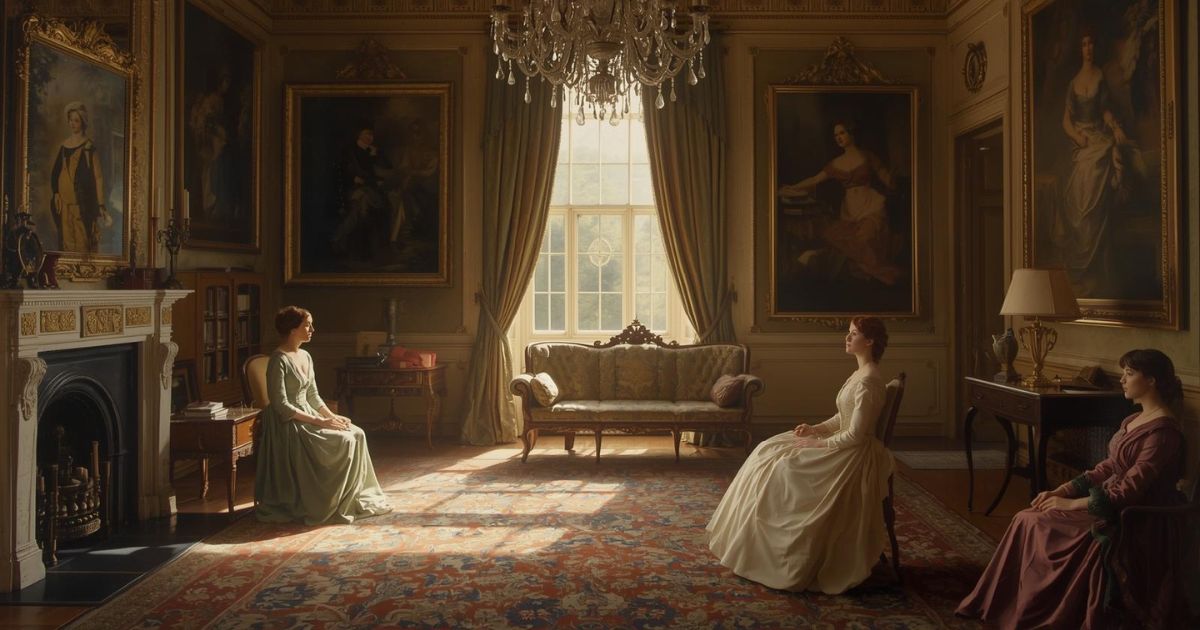
An excerpt from the original text.(complete · 1791 words)
II.
One other short call in Harley Street, in which Elinor received her
brother’s congratulations on their travelling so far towards Barton
without any expense, and on Colonel Brandon’s being to follow them to
Cleveland in a day or two, completed the intercourse of the brother and
sisters in town;—and a faint invitation from Fanny, to come to Norland
whenever it should happen to be in their way, which of all things was
the most unlikely to occur, with a more warm, though less public,
assurance, from John to Elinor, of the promptitude with which he should
come to see her at Delaford, was all that foretold any meeting in the
country.
It amused her to observe that all her friends seemed determined to send
her to Delaford;—a place, in which, of all others, she would now least
chuse to visit, or wish to reside; for not only was it considered as
her future home by her brother and Mrs. Jennings, but even Lucy, when
they parted, gave her a pressing invitation to visit her there.
Very early in April, and tolerably early in the day, the two parties
from Hanover Square and Berkeley Street set out from their respective
homes, to meet, by appointment, on the road. For the convenience of
Charlotte and her child, they were to be more than two days on their
journey, and Mr. Palmer, travelling more expeditiously with Colonel
Brandon, was to join them at Cleveland soon after their arrival.
Marianne, few as had been her hours of comfort in London, and eager as
she had long been to quit it, could not, when it came to the point, bid
adieu to the house in which she had for the last time enjoyed those
hopes, and that confidence, in Willoughby, which were now extinguished
for ever, without great pain. Nor could she leave the place in which
Willoughby remained, busy in new engagements, and new schemes, in which
she could have no share, without shedding many tears.
Elinor’s satisfaction, at the moment of removal, was more positive. She
had no such object for her lingering thoughts to fix on, she left no
creature behind, from whom it would give her a moment’s regret to be
divided for ever, she was pleased to be free herself from the
persecution of Lucy’s friendship, she was grateful for bringing her
sister away unseen by Willoughby since his marriage, and she looked
forward with hope to what a few months of tranquility at Barton might
do towards restoring Marianne’s peace of mind, and confirming her own.
Their journey was safely performed. The second day brought them into
the cherished, or the prohibited, county of Somerset, for as such was
it dwelt on by turns in Marianne’s imagination; and in the forenoon of
the third they drove up to Cleveland.
Cleveland was a spacious, modern-built house, situated on a sloping
lawn. It had no park, but the pleasure-grounds were tolerably
extensive; and like every other place of the same degree of importance,
it had its open shrubbery, and closer wood walk, a road of smooth
gravel winding round a plantation, led to the front, the lawn was
dotted over with timber, the house itself was under the guardianship of
the fir, the mountain-ash, and the acacia, and a thick screen of them
altogether, interspersed with tall Lombardy poplars, shut out the
offices.
Marianne entered the house with a heart swelling with emotion from the
consciousness of being only eighty miles from Barton, and not thirty
from Combe Magna; and before she had been five minutes within its
walls, while the others were busily helping Charlotte to show her child
to the housekeeper, she quitted it again, stealing away through the
winding shrubberies, now just beginning to be in beauty, to gain a
distant eminence; where, from its Grecian temple, her eye, wandering
over a wide tract of country to the south-east, could fondly rest on
the farthest ridge of hills in the horizon, and fancy that from their
summits Combe Magna might be seen.
In such moments of precious, invaluable misery, she rejoiced in tears
of agony to be at Cleveland; and as she returned by a different circuit
to the house, feeling all the happy privilege of country liberty, of
wandering from place to place in free and luxurious solitude, she
resolved to spend almost every hour of every day while she remained
with the Palmers, in the indulgence of such solitary rambles.
She returned just in time to join the others as they quitted the house,
on an excursion through its more immediate premises; and the rest of
the morning was easily whiled away, in lounging round the kitchen
garden, examining the bloom upon its walls, and listening to the
gardener’s lamentations upon blights, in dawdling through the
green-house, where the loss of her favourite plants, unwarily exposed,
and nipped by the lingering frost, raised the laughter of
Charlotte,—and in visiting her poultry-yard, where, in the disappointed
hopes of her dairy-maid, by hens forsaking their nests, or being stolen
by a fox, or in the rapid decrease of a promising young brood, she
found fresh sources of merriment.
The morning was fine and dry, and Marianne, in her plan of employment
abroad, had not calculated for any change of weather during their stay
at Cleveland. With great surprise therefore, did she find herself
prevented by a settled rain from going out again after dinner. She had
depended on a twilight walk to the Grecian temple, and perhaps all over
the grounds, and an evening merely cold or damp would not have deterred
her from it; but a heavy and settled rain even she could not fancy
dry or pleasant weather for walking.
Their party was small, and the hours passed quietly away. Mrs. Palmer
had her child, and Mrs. Jennings her carpet-work; they talked of the
friends they had left behind, arranged Lady Middleton’s engagements,
and wondered whether Mr. Palmer and Colonel Brandon would get farther
than Reading that night. Elinor, however little concerned in it, joined
in their discourse; and Marianne, who had the knack of finding her way
in every house to the library, however it might be avoided by the
family in general, soon procured herself a book.
Nothing was wanting on Mrs. Palmer’s side that constant and friendly
good humour could do, to make them feel themselves welcome. The
openness and heartiness of her manner more than atoned for that want of
recollection and elegance which made her often deficient in the forms
of politeness; her kindness, recommended by so pretty a face, was
engaging; her folly, though evident was not disgusting, because it was
not conceited; and Elinor could have forgiven every thing but her
laugh.
The two gentlemen arrived the next day to a very late dinner, affording
a pleasant enlargement of the party, and a very welcome variety to
their conversation, which a long morning of the same continued rain had
reduced very low.
Elinor had seen so little of Mr. Palmer, and in that little had seen so
much variety in his address to her sister and herself, that she knew
not what to expect to find him in his own family. She found him,
however, perfectly the gentleman in his behaviour to all his visitors,
and only occasionally rude to his wife and her mother; she found him
very capable of being a pleasant companion, and only prevented from
being so always, by too great an aptitude to fancy himself as much
superior to people in general, as he must feel himself to be to Mrs.
Jennings and Charlotte. For the rest of his character and habits, they
were marked, as far as Elinor could perceive, with no traits at all
unusual in his sex and time of life. He was nice in his eating,
uncertain in his hours; fond of his child, though affecting to slight
it; and idled away the mornings at billiards, which ought to have been
devoted to business. She liked him, however, upon the whole, much
better than she had expected, and in her heart was not sorry that she
could like him no more;—not sorry to be driven by the observation of
his Epicurism, his selfishness, and his conceit, to rest with
complacency on the remembrance of Edward’s generous temper, simple
taste, and diffident feelings.
Of Edward, or at least of some of his concerns, she now received
intelligence from Colonel Brandon, who had been into Dorsetshire
lately; and who, treating her at once as the disinterested friend of
Mr. Ferrars, and the kind confidante of himself, talked to her a great
deal of the parsonage at Delaford, described its deficiencies, and told
her what he meant to do himself towards removing them.—His behaviour to
her in this, as well as in every other particular, his open pleasure in
meeting her after an absence of only ten days, his readiness to
converse with her, and his deference for her opinion, might very well
justify Mrs. Jennings’s persuasion of his attachment, and would have
been enough, perhaps, had not Elinor still, as from the first, believed
Marianne his real favourite, to make her suspect it herself. But as it
was, such a notion had scarcely ever entered her head, except by Mrs.
Jennings’s suggestion; and she could not help believing herself the
nicest observer of the two;—she watched his eyes, while Mrs. Jennings
thought only of his behaviour;—and while his looks of anxious
solicitude on Marianne’s feeling, in her head and throat, the beginning
of a heavy cold, because unexpressed by words, entirely escaped the
latter lady’s observation;—she could discover in them the quick
feelings, and needless alarm of a lover.
Two delightful twilight walks on the third and fourth evenings of her
being there, not merely on the dry gravel of the shrubbery, but all
over the grounds, and especially in the most distant parts of them,
where there was something more of wildness than in the rest, where the
trees were the oldest, and the grass was the longest and wettest,
had—assisted by the still greater imprudence of sitting in her wet
shoes and stockings—given Marianne a cold so violent as, though for a
day or two trifled with or denied, would force itself by increasing
ailments on the concern of every body, and the notice of herself.
Prescriptions poured in from all quarters, and as usual, were all
declined. Though heavy and feverish, with a pain in her limbs, and a
cough, and a sore throat, a good night’s rest was to cure her entirely;
and it was with difficulty that Elinor prevailed on her, when she went
to bed, to try one or two of the simplest of the remedies.
Master this chapter. Complete your experience
Purchase the complete book to access all chapters and support classic literature
As an Amazon Associate, we earn a small commission from qualifying purchases at no additional cost to you.
Available in paperback, hardcover, and e-book formats
Let's Analyse the Pattern
Choosing to do the right thing despite immediate costs often creates conditions for authentic relationships and long-term happiness.
Why This Matters
Connect literature to life
This chapter teaches how people's true nature emerges when they face difficult choices between self-interest and doing right.
Practice This Today
This week, notice how people behave when it costs them something to be honest—those moments reveal who they really are.
Now let's explore the literary elements.
Key Quotes & Analysis
"I was simple enough to think, that because my faith was plighted to another, there could be no danger in my being with you."
Context: Edward explains to Elinor how he justified spending time with her despite being engaged to Lucy
This reveals Edward's internal struggle - he was drawn to Elinor but felt bound by honor to Lucy. It shows his moral conflict and explains his sometimes confusing behavior.
In Today's Words:
I thought it was safe to hang out with you since I was already committed to someone else - I was kidding myself.
"I never was so happy in my life as when I heard of her marriage."
Context: Edward describes his reaction to learning Lucy eloped with his brother
This admission proves Edward was never truly in love with Lucy. His joy at her betrayal shows the engagement was a burden, not a blessing.
In Today's Words:
Finding out she cheated on me was the best news I ever got.
"What I felt on hearing that your sister was to marry Mr. Willoughby, I cannot describe."
Context: Edward reveals he was jealous when he thought Marianne would marry Willoughby
This shows Edward was paying attention to the Dashwood family and felt protective of them, even while engaged to Lucy. It reveals the depth of his connection to their household.
In Today's Words:
I was really upset when I heard your sister was getting married - I cared about your whole family.
Thematic Threads
Integrity
In This Chapter
Edward's refusal to break his engagement dishonorably, despite losing everything, ultimately leads to freedom and true love
Development
Culmination of Edward's moral consistency shown throughout the novel
In Your Life:
Your reputation for keeping promises, even inconvenient ones, determines who trusts you with important opportunities.
Class
In This Chapter
Edward chooses love over money, while Lucy abandons him for his wealthier brother, showing how financial status affects romantic choices
Development
Resolution of the novel's central tension between marrying for love versus marrying for security
In Your Life:
You'll constantly navigate whether to prioritize financial stability or personal fulfillment in major life decisions.
Patience
In This Chapter
Elinor's quiet faith in Edward's character is finally rewarded after months of uncertainty and pain
Development
Vindication of Elinor's steady approach contrasted with Marianne's impulsive romanticism throughout the story
In Your Life:
The best relationships and opportunities often require you to wait through periods of uncertainty without giving up.
Authenticity
In This Chapter
Edward admits he was never truly attached to Lucy, revealing how obligation masqueraded as love
Development
Edward finally speaks his truth after chapters of being constrained by duty and circumstances
In Your Life:
You might stay in situations that look right on paper but feel wrong emotionally, mistaking obligation for genuine commitment.
Recognition
In This Chapter
Edward and Elinor finally see and choose each other clearly, free from external pressures and misunderstandings
Development
Fulfillment of the mutual understanding that's been building between them since their first meeting
In Your Life:
True compatibility becomes clear when you can be completely honest about who you are and what you want.
You now have the context. Time to form your own thoughts.
Discussion Questions
- 1
What unexpected turn of events finally freed Edward from his engagement to Lucy, and how did this change everything for him and Elinor?
analysis • surface - 2
Why do you think Lucy chose to elope with Robert instead of staying engaged to Edward, and what does this reveal about her true motivations?
analysis • medium - 3
Where have you seen the pattern of someone doing the right thing despite immediate costs, only to be rewarded later in unexpected ways?
application • medium - 4
If you were in Edward's position - engaged to someone you didn't love but felt obligated to marry - how would you handle the situation while maintaining your integrity?
application • deep - 5
What does Edward's story teach us about the relationship between moral choices and long-term happiness, and why might patient integrity be more powerful than quick fixes?
reflection • deep
Critical Thinking Exercise
Map Your Integrity Timeline
Think of a time when you chose to do the right thing even though it cost you something - money, convenience, popularity, or opportunity. Draw a simple timeline showing the immediate consequences versus the long-term results. Mark the moments when your choice either paid off or created new opportunities you couldn't have predicted.
Consider:
- •Consider both obvious rewards and subtle changes in how people treated you
- •Notice if your reputation or relationships shifted in ways you didn't expect
- •Think about what this pattern suggests about your future choices
Journaling Prompt
Write about a current situation where you're tempted to take a shortcut instead of doing what you know is right. Based on your integrity timeline, what would patient integrity look like in this situation?
Coming Up Next...
Chapter 43: Edward's Confession
The news of Edward and Elinor's engagement spreads, bringing unexpected reactions from family and friends. Some celebrate the match, while others worry about their financial prospects - but one person's response will surprise everyone.