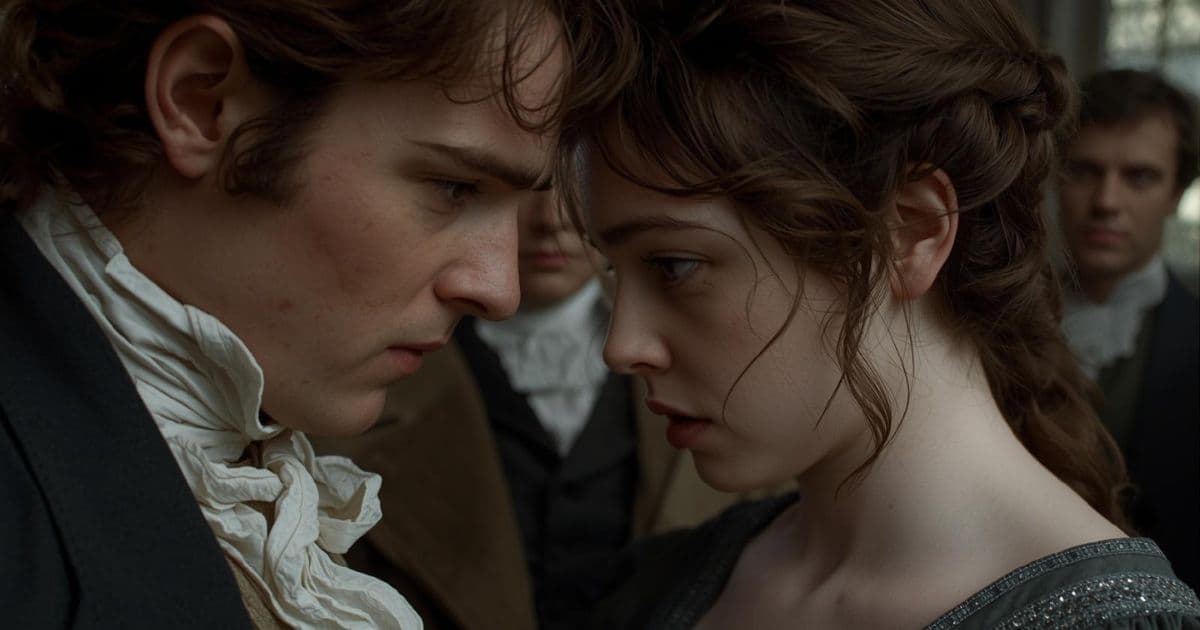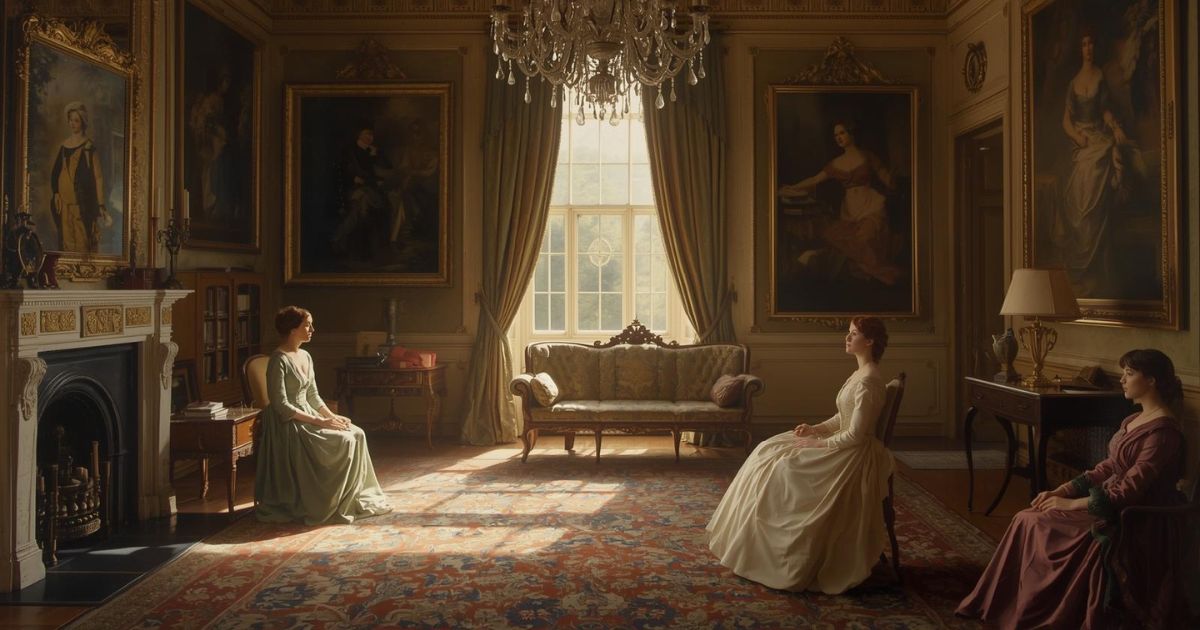
An excerpt from the original text.(complete · 2579 words)
I.
Edward, having carried his thanks to Colonel Brandon, proceeded with
his happiness to Lucy; and such was the excess of it by the time he
reached Bartlett’s Buildings, that she was able to assure Mrs.
Jennings, who called on her again the next day with her
congratulations, that she had never seen him in such spirits before in
her life.
Her own happiness, and her own spirits, were at least very certain; and
she joined Mrs. Jennings most heartily in her expectation of their
being all comfortably together in Delaford Parsonage before Michaelmas.
So far was she, at the same time, from any backwardness to give Elinor
that credit which Edward would give her, that she spoke of her
friendship for them both with the most grateful warmth, was ready to
own all their obligation to her, and openly declared that no exertion
for their good on Miss Dashwood’s part, either present or future, would
ever surprise her, for she believed her capable of doing any thing in
the world for those she really valued. As for Colonel Brandon, she was
not only ready to worship him as a saint, but was moreover truly
anxious that he should be treated as one in all worldly concerns;
anxious that his tithes should be raised to the utmost; and secretly
resolved to avail herself, at Delaford, as far as she possibly could,
of his servants, his carriage, his cows, and his poultry.
It was now above a week since John Dashwood had called in Berkeley
Street, and as since that time no notice had been taken by them of his
wife’s indisposition, beyond one verbal enquiry, Elinor began to feel
it necessary to pay her a visit.—This was an obligation, however, which
not only opposed her own inclination, but which had not the assistance
of any encouragement from her companions. Marianne, not contented with
absolutely refusing to go herself, was very urgent to prevent her
sister’s going at all; and Mrs. Jennings, though her carriage was
always at Elinor’s service, so very much disliked Mrs. John Dashwood,
that not even her curiosity to see how she looked after the late
discovery, nor her strong desire to affront her by taking Edward’s
part, could overcome her unwillingness to be in her company again. The
consequence was, that Elinor set out by herself to pay a visit, for
which no one could really have less inclination, and to run the risk of
a tête-à-tête with a woman, whom neither of the others had so much
reason to dislike.
Mrs. Dashwood was denied; but before the carriage could turn from the
house, her husband accidentally came out. He expressed great pleasure
in meeting Elinor, told her that he had been just going to call in
Berkeley Street, and, assuring her that Fanny would be very glad to see
her, invited her to come in.
They walked up stairs in to the drawing-room.—Nobody was there.
“Fanny is in her own room, I suppose,” said he: “I will go to her
presently, for I am sure she will not have the least objection in the
world to seeing you. Very far from it, indeed. Now especially there
cannot be—but however, you and Marianne were always great favourites.
Why would not Marianne come?”
Elinor made what excuse she could for her.
“I am not sorry to see you alone,” he replied, “for I have a good deal
to say to you. This living of Colonel Brandon’s—can it be true?—has he
really given it to Edward?—I heard it yesterday by chance, and was
coming to you on purpose to enquire farther about it.”
“It is perfectly true.—Colonel Brandon has given the living of Delaford
to Edward.”
“Really!—Well, this is very astonishing!—no relationship!—no connection
between them!—and now that livings fetch such a price!—what was the
value of this?”
“About two hundred a year.”
“Very well—and for the next presentation to a living of that
value—supposing the late incumbent to have been old and sickly, and
likely to vacate it soon—he might have got I dare say—fourteen hundred
pounds. And how came he not to have settled that matter before this
person’s death? Now, indeed it would be too late to sell it, but a
man of Colonel Brandon’s sense! I wonder he should be so improvident in
a point of such common, such natural, concern! Well, I am convinced
that there is a vast deal of inconsistency in almost every human
character. I suppose, however—on recollection—that the case may
probably be this. Edward is only to hold the living till the person
to whom the Colonel has really sold the presentation, is old enough to
take it. Aye, aye, that is the fact, depend upon it.”
Elinor contradicted it, however, very positively; and by relating that
she had herself been employed in conveying the offer from Colonel
Brandon to Edward, and, therefore, must understand the terms on which
it was given, obliged him to submit to her authority.
“It is truly astonishing!”—he cried, after hearing what she said—“what
could be the Colonel’s motive?”
“A very simple one—to be of use to Mr. Ferrars.”
“Well, well; whatever Colonel Brandon may be, Edward is a very lucky
man.—You will not mention the matter to Fanny, however, for though I
have broke it to her, and she bears it vastly well,—she will not like
to hear it much talked of.”
Elinor had some difficulty here to refrain from observing, that she
thought Fanny might have borne with composure, an acquisition of wealth
to her brother, by which neither she nor her child could be possibly
impoverished.
“Mrs. Ferrars,” added he, lowering his voice to the tone becoming so
important a subject, “knows nothing about it at present, and I believe
it will be best to keep it entirely concealed from her as long as may
be. When the marriage takes place, I fear she must hear of it all.”
“But why should such precaution be used? Though it is not to be
supposed that Mrs. Ferrars can have the smallest satisfaction in
knowing that her son has money enough to live upon, for that must be
quite out of the question; yet why, upon her late behaviour, is she
supposed to feel at all? She has done with her son,—she cast him off
for ever, and has made all those over whom she had any influence, cast
him off likewise. Surely, after doing so, she cannot be imagined liable
to any impression of sorrow or of joy on his account: she cannot be
interested in any thing that befalls him. She would not be so weak as
to throw away the comfort of a child, and yet retain the anxiety of a
parent!”
“Ah! Elinor,” said John, “your reasoning is very good, but it is
founded on ignorance of human nature. When Edward’s unhappy match takes
place, depend upon it his mother will feel as much as if she had never
discarded him; and, therefore every circumstance that may accelerate
that dreadful event, must be concealed from her as much as possible.
Mrs. Ferrars can never forget that Edward is her son.”
“You surprise me; I should think it must nearly have escaped her memory
by this time.”
“You wrong her exceedingly. Mrs. Ferrars is one of the most
affectionate mothers in the world.”
Elinor was silent.
“We think now,”—said Mr. Dashwood, after a short pause, “of
Robert’s marrying Miss Morton.”
Elinor, smiling at the grave and decisive importance of her brother’s
tone, calmly replied,—
“The lady, I suppose, has no choice in the affair.”
“Choice!—how do you mean?”
“I only mean that I suppose, from your manner of speaking, it must be
the same to Miss Morton whether she marry Edward or Robert.”
“Certainly, there can be no difference; for Robert will now to all
intents and purposes be considered as the eldest son;—and as to any
thing else, they are both very agreeable young men: I do not know that
one is superior to the other.”
Elinor said no more, and John was also for a short time silent.—His
reflections ended thus.
“Of one thing, my dear sister,” kindly taking her hand, and speaking
in an awful whisper, “I may assure you;—and I will do it, because I
know it must gratify you. I have good reason to think—indeed I have it
from the best authority, or I should not repeat it, for otherwise it
would be very wrong to say any thing about it,—but I have it from the
very best authority,—not that I ever precisely heard Mrs. Ferrars say
it herself—but her daughter did, and I have it from her,—that in
short, whatever objections there might be against a certain—a certain
connection, you understand me,—it would have been far preferable to
her,—it would not have given her half the vexation that this does. I
was exceedingly pleased to hear that Mrs. Ferrars considered it in that
light; a very gratifying circumstance you know to us all. ‘It would
have been beyond comparison,’ she said, ‘the least evil of the two, and
she would be glad to compound now for nothing worse.’ But however,
all that is quite out of the question,—not to be thought of or
mentioned—as to any attachment you know, it never could be: all that is
gone by. But I thought I would just tell you of this, because I knew
how much it must please you. Not that you have any reason to regret, my
dear Elinor. There is no doubt of your doing exceedingly well,—quite as
well, or better, perhaps, all things considered. Has Colonel Brandon
been with you lately?”
Elinor had heard enough, if not to gratify her vanity, and raise her
self-importance, to agitate her nerves and fill her mind;—and she was
therefore glad to be spared from the necessity of saying much in reply
herself, and from the danger of hearing any thing more from her
brother, by the entrance of Mr. Robert Ferrars. After a few moments’
chat, John Dashwood, recollecting that Fanny was yet uninformed of her
sister’s being there, quitted the room in quest of her; and Elinor was
left to improve her acquaintance with Robert, who, by the gay
unconcern, the happy self-complacency of his manner while enjoying so
unfair a division of his mother’s love and liberality, to the prejudice
of his banished brother, earned only by his own dissipated course of
life, and that brother’s integrity, was confirming her most
unfavourable opinion of his head and heart.
They had scarcely been two minutes by themselves, before he began to
speak of Edward; for he, too, had heard of the living, and was very
inquisitive on the subject. Elinor repeated the particulars of it, as
she had given them to John; and their effect on Robert, though very
different, was not less striking than it had been on him. He laughed
most immoderately. The idea of Edward’s being a clergyman, and living
in a small parsonage-house, diverted him beyond measure;—and when to
that was added the fanciful imagery of Edward reading prayers in a
white surplice, and publishing the banns of marriage between John Smith
and Mary Brown, he could conceive nothing more ridiculous.
Elinor, while she waited in silence and immovable gravity, the
conclusion of such folly, could not restrain her eyes from being fixed
on him with a look that spoke all the contempt it excited. It was a
look, however, very well bestowed, for it relieved her own feelings,
and gave no intelligence to him. He was recalled from wit to wisdom,
not by any reproof of hers, but by his own sensibility.
“We may treat it as a joke,” said he, at last, recovering from the
affected laugh which had considerably lengthened out the genuine gaiety
of the moment; “but, upon my soul, it is a most serious business. Poor
Edward! he is ruined for ever. I am extremely sorry for it; for I know
him to be a very good-hearted creature; as well-meaning a fellow
perhaps, as any in the world. You must not judge of him, Miss Dashwood,
from your slight acquaintance. Poor Edward! His manners are certainly
not the happiest in nature. But we are not all born, you know, with the
same powers,—the same address. Poor fellow! to see him in a circle of
strangers! To be sure it was pitiable enough; but upon my soul, I
believe he has as good a heart as any in the kingdom; and I declare and
protest to you I never was so shocked in my life, as when it all burst
forth. I could not believe it. My mother was the first person who told
me of it; and I, feeling myself called on to act with resolution,
immediately said to her, ‘My dear madam, I do not know what you may
intend to do on the occasion, but as for myself, I must say, that if
Edward does marry this young woman, I never will see him again.’ That
was what I said immediately. I was most uncommonly shocked, indeed!
Poor Edward! he has done for himself completely,—shut himself out for
ever from all decent society! But, as I directly said to my mother, I
am not in the least surprised at it; from his style of education, it
was always to be expected. My poor mother was half frantic.”
“Have you ever seen the lady?”
“Yes; once, while she was staying in this house, I happened to drop in
for ten minutes; and I saw quite enough of her. The merest awkward
country girl, without style, or elegance, and almost without beauty. I
remember her perfectly. Just the kind of girl I should suppose likely
to captivate poor Edward. I offered immediately, as soon as my mother
related the affair to me, to talk to him myself, and dissuade him from
the match; but it was too late then, I found, to do any thing, for
unluckily, I was not in the way at first, and knew nothing of it till
after the breach had taken place, when it was not for me, you know, to
interfere. But had I been informed of it a few hours earlier, I think
it is most probable that something might have been hit on. I certainly
should have represented it to Edward in a very strong light. ‘My dear
fellow,’ I should have said, ‘consider what you are doing. You are
making a most disgraceful connection, and such a one as your family are
unanimous in disapproving.’ I cannot help thinking, in short, that
means might have been found. But now it is all too late. He must be
starved, you know, that is certain; absolutely starved.”
He had just settled this point with great composure, when the entrance
of Mrs. John Dashwood put an end to the subject. But though she never
spoke of it out of her own family, Elinor could see its influence on
her mind, in the something like confusion of countenance with which she
entered, and an attempt at cordiality in her behaviour to herself. She
even proceeded so far as to be concerned to find that Elinor and her
sister were so soon to leave town, as she had hoped to see more of
them;—an exertion in which her husband, who attended her into the room,
and hung enamoured over her accents, seemed to distinguish every thing
that was most affectionate and graceful.
Master this chapter. Complete your experience
Purchase the complete book to access all chapters and support classic literature
As an Amazon Associate, we earn a small commission from qualifying purchases at no additional cost to you.
Available in paperback, hardcover, and e-book formats
Let's Analyse the Pattern
When keeping secrets to protect others creates the very harm we're trying to prevent.
Why This Matters
Connect literature to life
This chapter teaches how to recognize when someone's coldness stems from internal struggle rather than rejection of you.
Practice This Today
This week, notice when someone's behavior changes suddenly—before assuming it's about you, consider what external pressures they might be facing.
Now let's explore the literary elements.
Key Quotes & Analysis
"His coldness and reserve mortified her severely; she was vexed and half angry; but resolving to regulate her behaviour to him by the past rather than the present, she avoided every appearance of resentment or displeasure, and treated him as she thought he ought to be treated from the family connection."
Context: Describing Elinor's reaction to Edward's distant behavior during his visit
This shows Elinor's incredible emotional discipline - she's hurt and angry but chooses to respond based on their history rather than his current coldness. It reveals her maturity and self-control.
In Today's Words:
He was being cold and distant, which really hurt her feelings, but she decided to treat him well anyway because of their past relationship.
"I have been in Devonshire a fortnight."
Context: Edward reveals he's been nearby for two weeks without visiting
This simple statement carries enormous weight - he's been close by but avoided them, suggesting internal conflict about seeing Elinor. His delayed visit speaks volumes about his troubled state of mind.
In Today's Words:
I've been in the area for two weeks already.
"She saw that his spirits were affected, that he could not trust himself to enter on the subject."
Context: Elinor observing Edward's emotional state during their conversation
This reveals that Edward wants to tell Elinor something important but can't bring himself to do it. His emotional struggle is visible, making the situation even more painful for both of them.
In Today's Words:
She could tell he was upset and that there was something he wanted to say but couldn't.
Thematic Threads
Communication
In This Chapter
Edward's inability to share his burden creates distance and misunderstanding with Elinor
Development
Evolved from earlier chapters showing how poor communication damages relationships
In Your Life:
You might recognize this when someone important to you becomes distant but won't explain why.
Class
In This Chapter
Edward's troubles likely stem from class-based expectations about suitable marriages
Development
Continued exploration of how social position constrains personal choices
In Your Life:
You might feel this when family or social expectations conflict with your personal relationships.
Duty vs. Desire
In This Chapter
Edward appears torn between what he wants (Elinor) and what he's committed to (Lucy)
Development
Building tension between personal happiness and social obligations
In Your Life:
You might face this when what you want conflicts with what others expect of you.
Emotional Intelligence
In This Chapter
Elinor tries to read Edward's signals while managing her own emotional response
Development
Continued demonstration of Elinor's emotional maturity under pressure
In Your Life:
You might use this skill when trying to understand someone's behavior without direct communication.
Trust
In This Chapter
The foundation of Edward and Elinor's relationship is shaken by unspoken secrets
Development
Shows how secrets erode even the strongest connections
In Your Life:
You might experience this when someone you trust becomes evasive or distant without explanation.
You now have the context. Time to form your own thoughts.
Discussion Questions
- 1
What makes Edward's visit so uncomfortable for everyone, especially when this should be a happy reunion?
analysis • surface - 2
Why does Edward's attempt to protect Elinor by staying silent actually end up hurting her more?
analysis • medium - 3
When have you seen someone become distant or cold when they're actually trying to protect others from bad news?
application • medium - 4
If you were Elinor, how would you handle someone you care about who's clearly struggling but won't tell you what's wrong?
application • deep - 5
What does this chapter reveal about the difference between protecting someone and actually helping them?
reflection • deep
Critical Thinking Exercise
Decode the Silent Treatment
Think of a time when someone close to you became distant or acted strangely, and you didn't know why. Write down what you observed about their behavior, what you assumed was happening, and what you later discovered was actually going on. Then consider how both of you could have handled the situation better.
Consider:
- •Notice how silence often communicates the opposite of what we intend
- •Consider whether your assumptions filled in gaps with worst-case scenarios
- •Think about what simple phrases could acknowledge difficulty without revealing details
Journaling Prompt
Write about a time when you kept something difficult to yourself to protect someone else. What were you afraid would happen if you were honest? Looking back, would partial honesty have been kinder than complete silence?
Coming Up Next...
Chapter 42: The Proposal
The tension between Edward and Elinor reaches a breaking point when unexpected news forces long-hidden truths into the open. What Edward has been struggling to say will change everything Elinor thought she knew about their future.