An excerpt from the original text.(complete · 2598 words)
rs. John Dashwood had so much confidence in her husband’s judgment,
that she waited the very next day both on Mrs. Jennings and her
daughter; and her confidence was rewarded by finding even the former,
even the woman with whom her sisters were staying, by no means unworthy
her notice; and as for Lady Middleton, she found her one of the most
charming women in the world!
Lady Middleton was equally pleased with Mrs. Dashwood. There was a kind
of cold hearted selfishness on both sides, which mutually attracted
them; and they sympathised with each other in an insipid propriety of
demeanor, and a general want of understanding.
The same manners, however, which recommended Mrs. John Dashwood to the
good opinion of Lady Middleton did not suit the fancy of Mrs. Jennings,
and to her she appeared nothing more than a little proud-looking
woman of uncordial address, who met her husband’s sisters without any
affection, and almost without having anything to say to them; for of
the quarter of an hour bestowed on Berkeley Street, she sat at least
seven minutes and a half in silence.
Elinor wanted very much to know, though she did not chuse to ask,
whether Edward was then in town; but nothing would have induced Fanny
voluntarily to mention his name before her, till able to tell her that
his marriage with Miss Morton was resolved on, or till her husband’s
expectations on Colonel Brandon were answered; because she believed
them still so very much attached to each other, that they could not be
too sedulously divided in word and deed on every occasion. The
intelligence however, which she would not give, soon flowed from
another quarter. Lucy came very shortly to claim Elinor’s compassion on
being unable to see Edward, though he had arrived in town with Mr. and
Mrs. Dashwood. He dared not come to Bartlett’s Buildings for fear of
detection, and though their mutual impatience to meet, was not to be
told, they could do nothing at present but write.
Edward assured them himself of his being in town, within a very short
time, by twice calling in Berkeley Street. Twice was his card found on
the table, when they returned from their morning’s engagements. Elinor
was pleased that he had called; and still more pleased that she had
missed him.
The Dashwoods were so prodigiously delighted with the Middletons, that,
though not much in the habit of giving anything, they determined to
give them—a dinner; and soon after their acquaintance began, invited
them to dine in Harley Street, where they had taken a very good house
for three months. Their sisters and Mrs. Jennings were invited
likewise, and John Dashwood was careful to secure Colonel Brandon, who,
always glad to be where the Miss Dashwoods were, received his eager
civilities with some surprise, but much more pleasure. They were to
meet Mrs. Ferrars; but Elinor could not learn whether her sons were to
be of the party. The expectation of seeing her, however, was enough
to make her interested in the engagement; for though she could now meet
Edward’s mother without that strong anxiety which had once promised to
attend such an introduction, though she could now see her with perfect
indifference as to her opinion of herself, her desire of being in
company with Mrs. Ferrars, her curiosity to know what she was like, was
as lively as ever.
The interest with which she thus anticipated the party, was soon
afterwards increased, more powerfully than pleasantly, by her hearing
that the Miss Steeles were also to be at it.
So well had they recommended themselves to Lady Middleton, so agreeable
had their assiduities made them to her, that though Lucy was certainly
not so elegant, and her sister not even genteel, she was as ready as
Sir John to ask them to spend a week or two in Conduit Street; and it
happened to be particularly convenient to the Miss Steeles, as soon as
the Dashwoods’ invitation was known, that their visit should begin a
few days before the party took place.
Their claims to the notice of Mrs. John Dashwood, as the nieces of the
gentleman who for many years had had the care of her brother, might not
have done much, however, towards procuring them seats at her table; but
as Lady Middleton’s guests they must be welcome; and Lucy, who had long
wanted to be personally known to the family, to have a nearer view of
their characters and her own difficulties, and to have an opportunity
of endeavouring to please them, had seldom been happier in her life,
than she was on receiving Mrs. John Dashwood’s card.
On Elinor its effect was very different. She began immediately to
determine, that Edward who lived with his mother, must be asked as his
mother was, to a party given by his sister; and to see him for the
first time, after all that passed, in the company of Lucy!—she hardly
knew how she could bear it!
These apprehensions, perhaps, were not founded entirely on reason, and
certainly not at all on truth. They were relieved however, not by her
own recollection, but by the good will of Lucy, who believed herself to
be inflicting a severe disappointment when she told her that Edward
certainly would not be in Harley Street on Tuesday, and even hoped to
be carrying the pain still farther by persuading her that he was kept
away by the extreme affection for herself, which he could not conceal
when they were together.
The important Tuesday came that was to introduce the two young ladies
to this formidable mother-in-law.
“Pity me, dear Miss Dashwood!” said Lucy, as they walked up the stairs
together—for the Middletons arrived so directly after Mrs. Jennings,
that they all followed the servant at the same time:—“there is nobody
here but you, that can feel for me. I declare I can hardly stand. Good
gracious! In a moment I shall see the person that all my happiness
depends on—that is to be my mother!”
Elinor could have given her immediate relief by suggesting the
possibility of its being Miss Morton’s mother, rather than her own,
whom they were about to behold; but instead of doing that, she assured
her, and with great sincerity, that she did pity her—to the utter
amazement of Lucy, who, though really uncomfortable herself, hoped at
least to be an object of irrepressible envy to Elinor.
Mrs. Ferrars was a little, thin woman, upright, even to formality, in
her figure, and serious, even to sourness, in her aspect. Her
complexion was sallow; and her features small, without beauty, and
naturally without expression; but a lucky contraction of the brow had
rescued her countenance from the disgrace of insipidity, by giving it
the strong characters of pride and ill nature. She was not a woman of
many words; for, unlike people in general, she proportioned them to the
number of her ideas; and of the few syllables that did escape her, not
one fell to the share of Miss Dashwood, whom she eyed with the spirited
determination of disliking her at all events.
Elinor could not now be made unhappy by this behaviour. A few months
ago it would have hurt her exceedingly; but it was not in Mrs. Ferrars’
power to distress her by it now; and the difference of her manners to
the Miss Steeles, a difference which seemed purposely made to humble
her more, only amused her. She could not but smile to see the
graciousness of both mother and daughter towards the very person—for
Lucy was particularly distinguished—whom of all others, had they known
as much as she did, they would have been most anxious to mortify; while
she herself, who had comparatively no power to wound them, sat
pointedly slighted by both. But while she smiled at a graciousness so
misapplied, she could not reflect on the mean-spirited folly from which
it sprung, nor observe the studied attentions with which the Miss
Steeles courted its continuance, without thoroughly despising them all
four.
Lucy was all exultation on being so honorably distinguished; and Miss
Steele wanted only to be teazed about Dr. Davies to be perfectly happy.
The dinner was a grand one, the servants were numerous, and every thing
bespoke the Mistress’s inclination for show, and the Master’s ability
to support it. In spite of the improvements and additions which were
making to the Norland estate, and in spite of its owner having once
been within some thousand pounds of being obliged to sell out at a
loss, nothing gave any symptom of that indigence which he had tried to
infer from it;—no poverty of any kind, except of conversation,
appeared—but there, the deficiency was considerable. John Dashwood had
not much to say for himself that was worth hearing, and his wife had
still less. But there was no peculiar disgrace in this; for it was very
much the case with the chief of their visitors, who almost all laboured
under one or other of these disqualifications for being agreeable—Want
of sense, either natural or improved—want of elegance—want of
spirits—or want of temper.
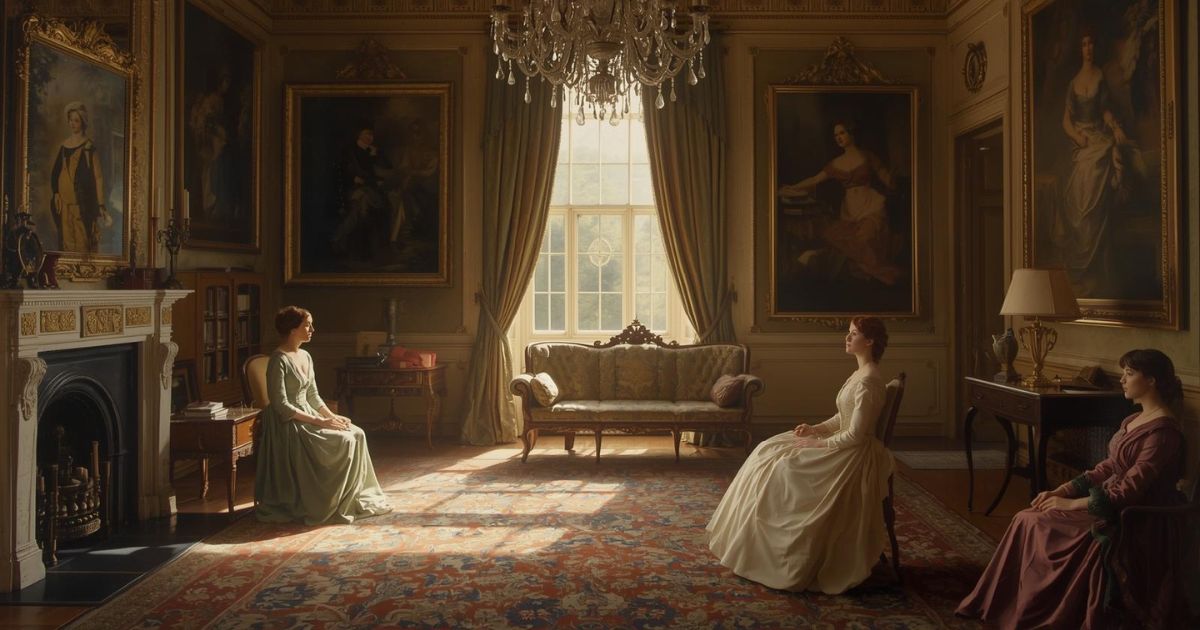
When the ladies withdrew to the drawing-room after dinner, this poverty
was particularly evident, for the gentlemen had supplied the
discourse with some variety—the variety of politics, inclosing land,
and breaking horses—but then it was all over; and one subject only
engaged the ladies till coffee came in, which was the comparative
heights of Harry Dashwood, and Lady Middleton’s second son William, who
were nearly of the same age.
Had both the children been there, the affair might have been determined
too easily by measuring them at once; but as Harry only was present, it
was all conjectural assertion on both sides; and every body had a right
to be equally positive in their opinion, and to repeat it over and over
again as often as they liked.
The parties stood thus:
The two mothers, though each really convinced that her own son was the
tallest, politely decided in favour of the other.
The two grandmothers, with not less partiality, but more sincerity,
were equally earnest in support of their own descendant.
Lucy, who was hardly less anxious to please one parent than the other,
thought the boys were both remarkably tall for their age, and could not
conceive that there could be the smallest difference in the world
between them; and Miss Steele, with yet greater address gave it, as
fast as she could, in favour of each.
Elinor, having once delivered her opinion on William’s side, by which
she offended Mrs. Ferrars and Fanny still more, did not see the
necessity of enforcing it by any farther assertion; and Marianne, when
called on for hers, offended them all, by declaring that she had no
opinion to give, as she had never thought about it.
Before her removing from Norland, Elinor had painted a very pretty pair
of screens for her sister-in-law, which being now just mounted and
brought home, ornamented her present drawing room; and these screens,
catching the eye of John Dashwood on his following the other gentlemen
into the room, were officiously handed by him to Colonel Brandon for
his admiration.
“These are done by my eldest sister,” said he; “and you, as a man of
taste, will, I dare say, be pleased with them. I do not know whether
you have ever happened to see any of her performances before, but she
is in general reckoned to draw extremely well.”
The Colonel, though disclaiming all pretensions to connoisseurship,
warmly admired the screens, as he would have done any thing painted by
Miss Dashwood; and on the curiosity of the others being of course
excited, they were handed round for general inspection. Mrs. Ferrars,
not aware of their being Elinor’s work, particularly requested to look
at them; and after they had received gratifying testimony of Lady
Middletons’s approbation, Fanny presented them to her mother,
considerately informing her, at the same time, that they were done by
Miss Dashwood.
“Hum”—said Mrs. Ferrars—“very pretty,”—and without regarding them at
all, returned them to her daughter.
Perhaps Fanny thought for a moment that her mother had been quite rude
enough,—for, colouring a little, she immediately said,
“They are very pretty, ma’am—an’t they?” But then again, the dread of
having been too civil, too encouraging herself, probably came over her,
for she presently added,
“Do you not think they are something in Miss Morton’s style of
painting, Ma’am?—She does paint most delightfully!—How beautifully
her last landscape is done!”
“Beautifully indeed! But she does every thing well.”
Marianne could not bear this.—She was already greatly displeased with
Mrs. Ferrars; and such ill-timed praise of another, at Elinor’s
expense, though she had not any notion of what was principally meant by
it, provoked her immediately to say with warmth,
“This is admiration of a very particular kind!—what is Miss Morton to
us?—who knows, or who cares, for her?—it is Elinor of whom we think
and speak.”
And so saying, she took the screens out of her sister-in-law’s hands,
to admire them herself as they ought to be admired.
Mrs. Ferrars looked exceedingly angry, and drawing herself up more
stiffly than ever, pronounced in retort this bitter philippic, “Miss
Morton is Lord Morton’s daughter.”
Fanny looked very angry too, and her husband was all in a fright at his
sister’s audacity. Elinor was much more hurt by Marianne’s warmth than
she had been by what produced it; but Colonel Brandon’s eyes, as they
were fixed on Marianne, declared that he noticed only what was amiable
in it, the affectionate heart which could not bear to see a sister
slighted in the smallest point.
Marianne’s feelings did not stop here. The cold insolence of Mrs.
Ferrars’s general behaviour to her sister, seemed, to her, to foretell
such difficulties and distresses to Elinor, as her own wounded heart
taught her to think of with horror; and urged by a strong impulse of
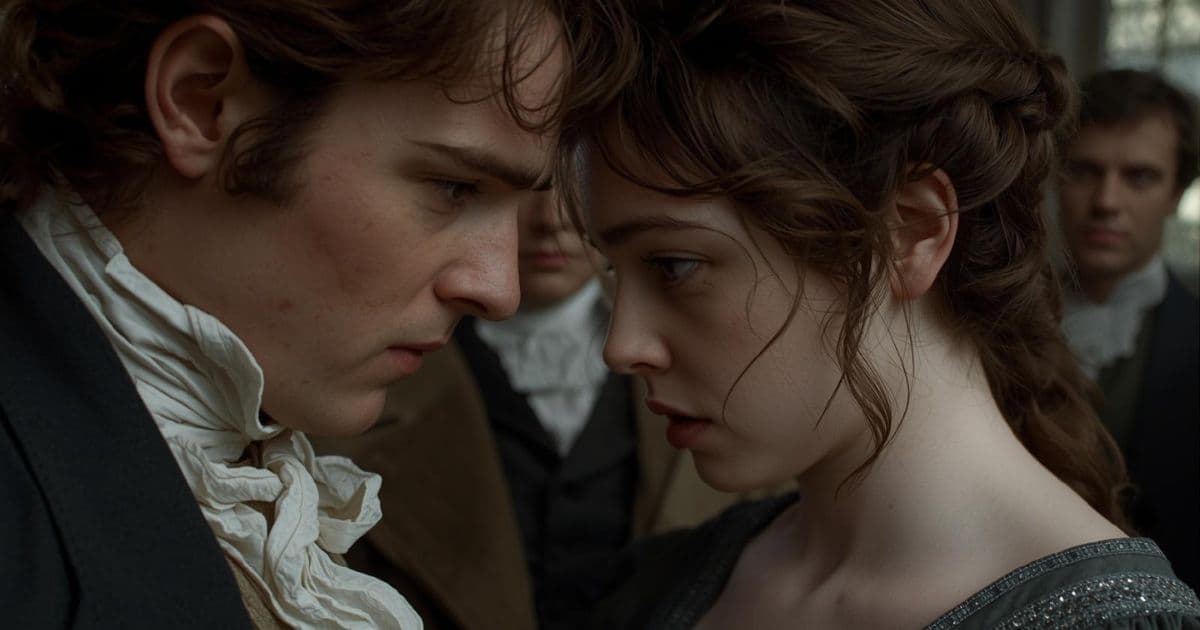
affectionate sensibility, she moved after a moment, to her sister’s
chair, and putting one arm round her neck, and one cheek close to hers,
said in a low, but eager, voice,
“Dear, dear Elinor, don’t mind them. Don’t let them make you
unhappy.”
She could say no more; her spirits were quite overcome, and hiding her
face on Elinor’s shoulder, she burst into tears. Every body’s attention
was called, and almost every body was concerned.—Colonel Brandon rose
up and went to them without knowing what he did.—Mrs. Jennings, with a
very intelligent “Ah! poor dear,” immediately gave her her salts; and
Sir John felt so desperately enraged against the author of this nervous
distress, that he instantly changed his seat to one close by Lucy
Steele, and gave her, in a whisper, a brief account of the whole
shocking affair.
In a few minutes, however, Marianne was recovered enough to put an end
to the bustle, and sit down among the rest; though her spirits retained
the impression of what had passed, the whole evening.
“Poor Marianne!” said her brother to Colonel Brandon, in a low voice,
as soon as he could secure his attention: “She has not such good health
as her sister,—she is very nervous,—she has not Elinor’s
constitution;—and one must allow that there is something very trying to
a young woman who has been a beauty in the loss of her personal
attractions. You would not think it perhaps, but Marianne was
remarkably handsome a few months ago; quite as handsome as Elinor. Now
you see it is all gone.”
Master this chapter. Complete your experience
Purchase the complete book to access all chapters and support classic literature
As an Amazon Associate, we earn a small commission from qualifying purchases at no additional cost to you.
Available in paperback, hardcover, and e-book formats
Let's Analyse the Pattern
The Trap of Early Commitments
When past commitments made from immaturity or desperation become prisons that prevent growth and authentic choice.
Why This Matters
Connect literature to life
This chapter teaches how to identify when someone's 'loyalty' is actually fear-based obligation that's hurting everyone involved.
Practice This Today
This week, notice when people stay in situations 'out of principle'—ask yourself whether their honor is serving growth or preventing it.
Now let's explore the literary elements.
Key Quotes & Analysis
"I was simple enough to think, that because my faith was plighted to another, there could be no danger in my being with you."
Context: Edward explains why he thought he could safely spend time with Elinor despite being engaged
Shows Edward's naivety about his own emotions and the power of genuine connection. He underestimated how much he would come to love Elinor.
In Today's Words:
I thought I could just be friends with you since I was already taken, but I was kidding myself.
"The lady, I suppose, has no choice in the affair."
Context: Elinor's bitter response when Edward talks about his duty to Lucy
Reveals Elinor's pain and frustration at being the victim of Edward's honorable but misguided choices. She has no power in this situation.
In Today's Words:
I guess what I want doesn't matter in all this.
"I never deserved her, but I thought that if I could have made her happy, I should have been satisfied."
Context: Edward reflecting on his relationship with Lucy and his sense of duty
Shows Edward's self-awareness about the mismatch with Lucy, but also his misguided belief that sacrifice alone makes relationships work.
In Today's Words:
I knew we weren't right for each other, but I thought if I could make her happy, that would be enough.
Thematic Threads
Honor vs. Happiness
In This Chapter
Edward feels bound by duty to Lucy despite loving Elinor and recognizing his mistake
Development
Developed from earlier hints about Edward's constraint and unhappiness
In Your Life:
You might face this when loyalty to old promises conflicts with what you know is right for your future.
Consequences of Youth
In This Chapter
Edward's impulsive teenage engagement now controls his adult life four years later
Development
Introduced here as explanation for Edward's previous distance
In Your Life:
You might recognize how decisions you made at eighteen still shape your options at thirty.
Emotional Honesty
In This Chapter
Elinor finally gets the truth about Edward's feelings and situation
Development
Culmination of Elinor's patient observation and Edward's growing trust
In Your Life:
You might need this when someone's behavior doesn't match their apparent feelings toward you.
Class and Choice
In This Chapter
Edward's family disapproval and social expectations limit his romantic freedom
Development
Continuation of how class pressures shape personal relationships
In Your Life:
You might feel this when family or social expectations conflict with your personal desires.
Incompatibility
In This Chapter
Edward realizes he and Lucy have completely different values and character
Development
First clear articulation of what we've sensed about Lucy's nature
In Your Life:
You might recognize this when someone you committed to early reveals themselves to be fundamentally different from you.
You now have the context. Time to form your own thoughts.
Discussion Questions
- 1
What does Edward reveal about how he got engaged to Lucy, and why does he feel trapped now?
analysis • surface - 2
Why did Edward make this commitment at nineteen, and how has he changed since then?
analysis • medium - 3
Where do you see people today trapped by commitments they made when they were younger or desperate?
application • medium - 4
When is it honorable to keep a promise, and when does keeping it become self-destructive?
application • deep - 5
What does Edward's situation teach us about the difference between loyalty and wisdom?
reflection • deep
Critical Thinking Exercise
Map Your Own Honor Traps
List three commitments in your life - past or present. For each one, identify: What state were you in when you made it? (desperate, young, seeking approval, genuinely choosing?) How have you changed since then? Does this commitment still serve who you're becoming, or has it become a prison?
Consider:
- •Consider commitments to jobs, relationships, family expectations, or promises you made
- •Notice the difference between commitments made from fear versus those made from genuine choice
- •Ask whether your sense of honor is serving growth or preventing it
Journaling Prompt
Write about a time when you felt trapped by a promise you made when you were in a different place in life. How did you handle it, or how are you handling it now?
Coming Up Next...
Chapter 35: Marianne's Illness
Mrs. Jennings arrives with shocking news that will change everything for the Dashwood sisters. The revelation she brings will force several characters to make decisions they've been avoiding.