An excerpt from the original text.(complete · 2312 words)
linor’s curiosity to see Mrs. Ferrars was satisfied. She had found in
her every thing that could tend to make a farther connection between
the families undesirable. She had seen enough of her pride, her
meanness, and her determined prejudice against herself, to comprehend
all the difficulties that must have perplexed the engagement, and
retarded the marriage, of Edward and herself, had he been otherwise
free; and she had seen almost enough to be thankful for her own sake,
that one greater obstacle preserved her from suffering under any other
of Mrs. Ferrars’s creation, preserved her from all dependence upon her
caprice, or any solicitude for her good opinion. Or at least, if she
did not bring herself quite to rejoice in Edward’s being fettered to
Lucy, she determined, that had Lucy been more amiable, she ought to
have rejoiced.
She wondered that Lucy’s spirits could be so very much elevated by the
civility of Mrs. Ferrars;—that her interest and her vanity should so
very much blind her as to make the attention which seemed only paid her
because she was not Elinor, appear a compliment to herself—or to
allow her to derive encouragement from a preference only given her,
because her real situation was unknown. But that it was so, had not
only been declared by Lucy’s eyes at the time, but was declared over
again the next morning more openly, for at her particular desire, Lady
Middleton set her down in Berkeley Street on the chance of seeing
Elinor alone, to tell her how happy she was.
The chance proved a lucky one, for a message from Mrs. Palmer soon
after she arrived, carried Mrs. Jennings away.
“My dear friend,” cried Lucy, as soon as they were by themselves, “I
come to talk to you of my happiness. Could anything be so flattering as
Mrs. Ferrars’s way of treating me yesterday? So exceeding affable as
she was! You know how I dreaded the thoughts of seeing her; but the
very moment I was introduced, there was such an affability in her
behaviour as really should seem to say, she had quite took a fancy to
me. Now was not it so? You saw it all; and was not you quite struck
with it?”
“She was certainly very civil to you.”
“Civil!—Did you see nothing but only civility?—I saw a vast deal more.
Such kindness as fell to the share of nobody but me!—No pride, no
hauteur, and your sister just the same—all sweetness and affability!”
Elinor wished to talk of something else, but Lucy still pressed her to
own that she had reason for her happiness; and Elinor was obliged to go
on.
“Undoubtedly, if they had known your engagement,” said she, “nothing
could be more flattering than their treatment of you;—but as that was
not the case—”
“I guessed you would say so,”—replied Lucy quickly—“but there was no
reason in the world why Mrs. Ferrars should seem to like me, if she did
not, and her liking me is every thing. You shan’t talk me out of my
satisfaction. I am sure it will all end well, and there will be no
difficulties at all, to what I used to think. Mrs. Ferrars is a
charming woman, and so is your sister. They are both delightful women,
indeed!—I wonder I should never hear you say how agreeable Mrs.
Dashwood was!”
To this Elinor had no answer to make, and did not attempt any.
“Are you ill, Miss Dashwood?—you seem low—you don’t speak;—sure you
an’t well.”
“I never was in better health.”
“I am glad of it with all my heart; but really you did not look it. I
should be sorry to have you ill; you, that have been the greatest
comfort to me in the world!—Heaven knows what I should have done
without your friendship.”
Elinor tried to make a civil answer, though doubting her own success.
But it seemed to satisfy Lucy, for she directly replied,
“Indeed I am perfectly convinced of your regard for me, and next to
Edward’s love, it is the greatest comfort I have. Poor Edward! But now
there is one good thing, we shall be able to meet, and meet pretty
often, for Lady Middleton’s delighted with Mrs. Dashwood, so we shall
be a good deal in Harley Street, I dare say, and Edward spends half his
time with his sister—besides, Lady Middleton and Mrs. Ferrars will
visit now;—and Mrs. Ferrars and your sister were both so good to say
more than once, they should always be glad to see me. They are such
charming women!—I am sure if ever you tell your sister what I think of
her, you cannot speak too high.”
But Elinor would not give her any encouragement to hope that she
should tell her sister. Lucy continued.
“I am sure I should have seen it in a moment, if Mrs. Ferrars had took
a dislike to me. If she had only made me a formal courtesy, for
instance, without saying a word, and never after had took any notice of
me, and never looked at me in a pleasant way—you know what I mean—if I
had been treated in that forbidding sort of way, I should have gave it
all up in despair. I could not have stood it. For where she does
dislike, I know it is most violent.”
Elinor was prevented from making any reply to this civil triumph, by
the door’s being thrown open, the servant’s announcing Mr. Ferrars, and
Edward’s immediately walking in.
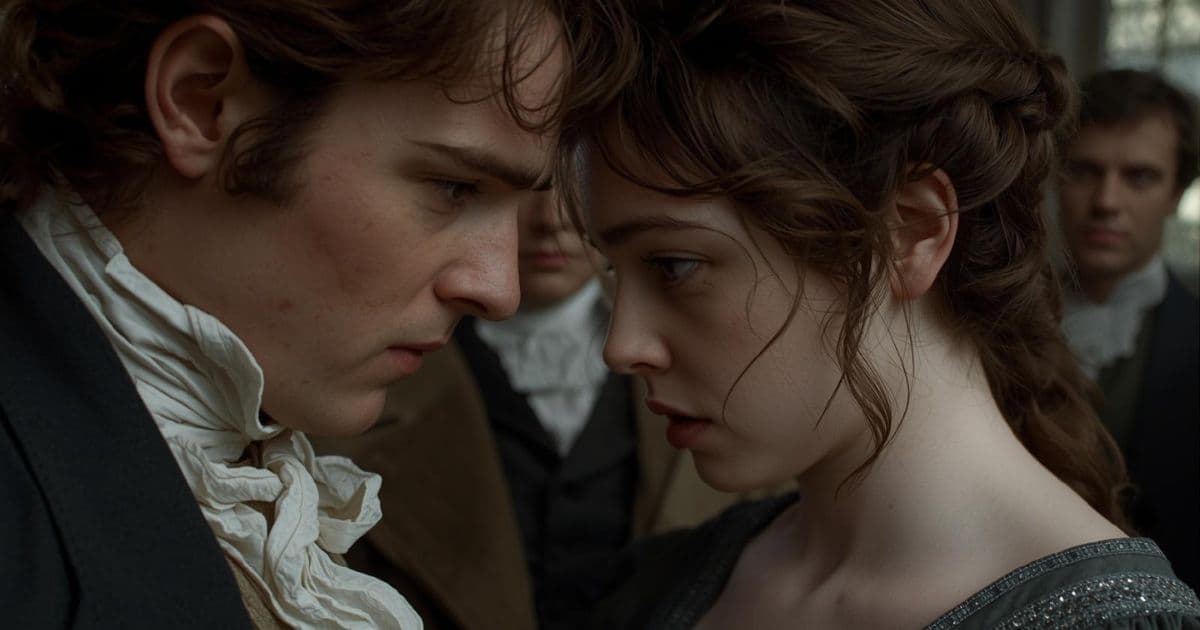
It was a very awkward moment; and the countenance of each showed that
it was so. They all looked exceedingly foolish; and Edward seemed to
have as great an inclination to walk out of the room again, as to
advance farther into it. The very circumstance, in its unpleasantest
form, which they would each have been most anxious to avoid, had fallen
on them.—They were not only all three together, but were together
without the relief of any other person. The ladies recovered themselves
first. It was not Lucy’s business to put herself forward, and the
appearance of secrecy must still be kept up. She could therefore only
look her tenderness, and after slightly addressing him, said no more.
But Elinor had more to do; and so anxious was she, for his sake and her
own, to do it well, that she forced herself, after a moment’s
recollection, to welcome him, with a look and manner that were almost
easy, and almost open; and another struggle, another effort still
improved them. She would not allow the presence of Lucy, nor the
consciousness of some injustice towards herself, to deter her from
saying that she was happy to see him, and that she had very much
regretted being from home, when he called before in Berkeley Street.
She would not be frightened from paying him those attentions which, as
a friend and almost a relation, were his due, by the observant eyes of
Lucy, though she soon perceived them to be narrowly watching her.
Her manners gave some re-assurance to Edward, and he had courage enough
to sit down; but his embarrassment still exceeded that of the ladies in
a proportion, which the case rendered reasonable, though his sex might
make it rare; for his heart had not the indifference of Lucy’s, nor
could his conscience have quite the ease of Elinor’s.
Lucy, with a demure and settled air, seemed determined to make no
contribution to the comfort of the others, and would not say a word;
and almost every thing that was said, proceeded from Elinor, who was
obliged to volunteer all the information about her mother’s health,
their coming to town, &c. which Edward ought to have inquired about,
but never did.
Her exertions did not stop here; for she soon afterwards felt herself
so heroically disposed as to determine, under pretence of fetching
Marianne, to leave the others by themselves; and she really did it, and
that in the handsomest manner, for she loitered away several minutes
on the landing-place, with the most high-minded fortitude, before she
went to her sister. When that was once done, however, it was time for
the raptures of Edward to cease; for Marianne’s joy hurried her into
the drawing-room immediately. Her pleasure in seeing him was like every
other of her feelings, strong in itself, and strongly spoken. She met
him with a hand that would be taken, and a voice that expressed the
affection of a sister.
“Dear Edward!” she cried, “this is a moment of great happiness!—This
would almost make amends for every thing!”
Edward tried to return her kindness as it deserved, but before such
witnesses he dared not say half what he really felt. Again they all sat
down, and for a moment or two all were silent; while Marianne was
looking with the most speaking tenderness, sometimes at Edward and
sometimes at Elinor, regretting only that their delight in each other
should be checked by Lucy’s unwelcome presence. Edward was the first to
speak, and it was to notice Marianne’s altered looks, and express his
fear of her not finding London agree with her.
“Oh, don’t think of me!” she replied with spirited earnestness, though
her eyes were filled with tears as she spoke, “don’t think of my
health. Elinor is well, you see. That must be enough for us both.”
This remark was not calculated to make Edward or Elinor more easy, nor
to conciliate the good will of Lucy, who looked up at Marianne with no
very benignant expression.
“Do you like London?” said Edward, willing to say any thing that might
introduce another subject.
“Not at all. I expected much pleasure in it, but I have found none. The
sight of you, Edward, is the only comfort it has afforded; and thank
Heaven! you are what you always were!”
She paused—no one spoke.
“I think, Elinor,” she presently added, “we must employ Edward to take
care of us in our return to Barton. In a week or two, I suppose, we
shall be going; and, I trust, Edward will not be very unwilling to
accept the charge.”
Poor Edward muttered something, but what it was, nobody knew, not even
himself. But Marianne, who saw his agitation, and could easily trace it
to whatever cause best pleased herself, was perfectly satisfied, and
soon talked of something else.
“We spent such a day, Edward, in Harley Street yesterday! So dull, so
wretchedly dull!—But I have much to say to you on that head, which
cannot be said now.”
And with this admirable discretion did she defer the assurance of her
finding their mutual relatives more disagreeable than ever, and of her
being particularly disgusted with his mother, till they were more in
private.
“But why were you not there, Edward?—Why did you not come?”
“I was engaged elsewhere.”
“Engaged! But what was that, when such friends were to be met?”
“Perhaps, Miss Marianne,” cried Lucy, eager to take some revenge on
her, “you think young men never stand upon engagements, if they have no
mind to keep them, little as well as great.”
Elinor was very angry, but Marianne seemed entirely insensible of the
sting; for she calmly replied,
“Not so, indeed; for, seriously speaking, I am very sure that
conscience only kept Edward from Harley Street. And I really believe he
has the most delicate conscience in the world; the most scrupulous in
performing every engagement, however minute, and however it may make
against his interest or pleasure. He is the most fearful of giving
pain, of wounding expectation, and the most incapable of being selfish,
of any body I ever saw. Edward, it is so, and I will say it. What! are
you never to hear yourself praised!—Then you must be no friend of mine;
for those who will accept of my love and esteem, must submit to my open
commendation.”
The nature of her commendation, in the present case, however, happened
to be particularly ill-suited to the feelings of two thirds of her
auditors, and was so very unexhilarating to Edward, that he very soon
got up to go away.
“Going so soon!” said Marianne; “my dear Edward, this must not be.”
And drawing him a little aside, she whispered her persuasion that Lucy
could not stay much longer. But even this encouragement failed, for he
would go; and Lucy, who would have outstaid him, had his visit lasted
two hours, soon afterwards went away.
“What can bring her here so often?” said Marianne, on her leaving them.
“Could not she see that we wanted her gone!—how teazing to Edward!”
“Why so?—we were all his friends, and Lucy has been the longest known
to him of any. It is but natural that he should like to see her as well
as ourselves.”
Marianne looked at her steadily, and said, “You know, Elinor, that this
is a kind of talking which I cannot bear. If you only hope to have your
assertion contradicted, as I must suppose to be the case, you ought to
recollect that I am the last person in the world to do it. I cannot
descend to be tricked out of assurances, that are not really wanted.”
She then left the room; and Elinor dared not follow her to say more,
for bound as she was by her promise of secrecy to Lucy, she could give
no information that would convince Marianne; and painful as the
consequences of her still continuing in an error might be, she was
obliged to submit to it. All that she could hope, was that Edward would
not often expose her or himself to the distress of hearing Marianne’s
mistaken warmth, nor to the repetition of any other part of the pain
that had attended their recent meeting—and this she had every reason to
expect.
Master this chapter. Complete your experience
Purchase the complete book to access all chapters and support classic literature
As an Amazon Associate, we earn a small commission from qualifying purchases at no additional cost to you.
Available in paperback, hardcover, and e-book formats
Let's Analyse the Pattern
The Honor Trap - When Integrity Becomes a Prison
When personal integrity becomes rigid self-punishment that serves no one's actual wellbeing.
Why This Matters
Connect literature to life
This chapter teaches how to spot when moral obligations have become destructive cycles that help no one.
Practice This Today
This week, notice when someone (including yourself) is suffering to keep a promise that no longer serves anyone - then ask who actually benefits from this sacrifice.
Now let's explore the literary elements.
Key Quotes & Analysis
"I was simple enough to think, that because my faith was plighted to another, there could be no danger in my being with you."
Context: Edward explains why he thought he could safely spend time with Elinor despite being engaged to Lucy
This shows Edward's self-deception and weakness. He convinced himself he could have emotional intimacy with Elinor without consequences, revealing his immaturity and poor judgment.
In Today's Words:
I thought I could hang out with you without catching feelings since I was already committed to someone else.
"The youthful infatuation of nineteen would naturally blind him to every thing but her beauty and good nature."
Context: Describing how Edward got trapped in his engagement to Lucy when he was young
This explains how people make life-altering decisions based on temporary attraction and limited life experience. It shows compassion for youthful mistakes while acknowledging their lasting consequences.
In Today's Words:
When you're nineteen, you think good looks and a sweet personality are enough to build a life on.
"I will not talk of my own happiness; that must be out of the question."
Context: Edward acknowledging that his personal happiness is impossible given his circumstances
This reveals Edward's resignation and self-pity. Instead of fighting for what he wants, he's accepted defeat. It also shows how rigid social expectations could trap people in miserable situations.
In Today's Words:
I've given up on being happy - that's just not going to happen for me.
Thematic Threads
Duty vs. Happiness
In This Chapter
Edward feels bound by duty to marry Lucy despite loving Elinor and knowing the marriage will make everyone miserable
Development
This conflict has been building since Lucy's revelation, now reaching its painful climax
In Your Life:
You might face this when family obligations conflict with your own dreams and wellbeing
Emotional Strength
In This Chapter
Elinor comforts Edward even while her own heart is breaking, showing remarkable selflessness
Development
Elinor's strength has grown throughout the novel, now reaching its peak moment of grace under pressure
In Your Life:
You might discover your own strength when supporting others through their worst moments
Class and Social Expectations
In This Chapter
Edward's sense of honor is tied to his identity as a gentleman - breaking his word would damage his social standing
Development
The novel continues exploring how class expectations shape personal choices and trap individuals
In Your Life:
You might feel pressure to meet others' expectations of who you 'should' be based on your role or background
Love and Sacrifice
In This Chapter
Elinor demonstrates that true love sometimes means putting the other person's needs before your own desires
Development
The novel's exploration of love deepens from romantic attraction to mature, selfless care
In Your Life:
You might find that real love requires letting go of what you want for what's best for everyone
Personal Agency
In This Chapter
Edward reveals himself as passive, letting circumstances control his life rather than making active choices
Development
This weakness has been hinted at before but is now fully exposed in contrast to Elinor's strength
In Your Life:
You might recognize when you're letting life happen to you instead of taking control of your own story
You now have the context. Time to form your own thoughts.
Discussion Questions
- 1
What does Edward reveal about his engagement to Lucy, and why can't he break it off even though he no longer loves her?
analysis • surface - 2
Why does Elinor comfort Edward instead of being angry with him for breaking her heart?
analysis • medium - 3
Where do you see people today staying trapped in situations because they gave their word, even when it's making everyone miserable?
application • medium - 4
When is breaking a promise actually the more honorable choice than keeping it?
application • deep - 5
What does this chapter reveal about the difference between rigid rule-following and true wisdom?
reflection • deep
Critical Thinking Exercise
Map Your Honor Traps
List three commitments or promises in your life - past or present. For each one, identify: Who made you feel you had to promise? What were the consequences of keeping vs. breaking that promise? Who actually benefited from your sacrifice? Look for patterns in how you make commitments and whether your sense of duty sometimes works against everyone's wellbeing.
Consider:
- •Notice if you make promises to avoid conflict or gain approval
- •Consider whether the person asking for the promise had your best interests at heart
- •Ask if keeping this promise created more suffering than breaking it would have
Journaling Prompt
Write about a time when you kept a promise that made you miserable. What would you do differently now, knowing what you know about honor traps?
Coming Up Next...
Chapter 36: The Crisis
News of Edward's secret engagement is about to become very public, and the fallout will shake both the Dashwood and Ferrars families. Meanwhile, Willoughby's past is catching up with him in ways no one expects.