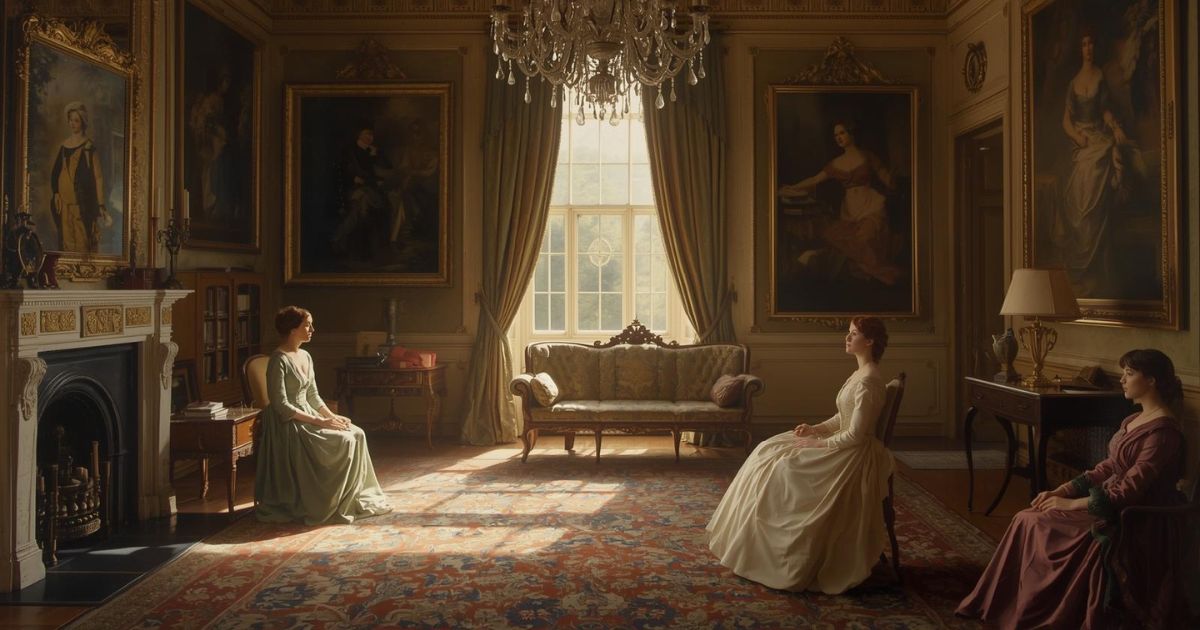
An excerpt from the original text.(complete · 1935 words)
hough Mrs. Jennings was in the habit of spending a large portion of
the year at the houses of her children and friends, she was not without
a settled habitation of her own. Since the death of her husband, who
had traded with success in a less elegant part of the town, she had
resided every winter in a house in one of the streets near Portman
Square. Towards this home, she began on the approach of January to turn
her thoughts, and thither she one day abruptly, and very unexpectedly
by them, asked the elder Misses Dashwood to accompany her. Elinor,
without observing the varying complexion of her sister, and the
animated look which spoke no indifference to the plan, immediately gave
a grateful but absolute denial for both, in which she believed herself
to be speaking their united inclinations. The reason alleged was their
determined resolution of not leaving their mother at that time of the
year. Mrs. Jennings received the refusal with some surprise, and
repeated her invitation immediately.
“Oh, Lord! I am sure your mother can spare you very well, and I do
beg you will favour me with your company, for I’ve quite set my heart
upon it. Don’t fancy that you will be any inconvenience to me, for I
shan’t put myself at all out of my way for you. It will only be sending
Betty by the coach, and I hope I can afford that. We three shall be
able to go very well in my chaise; and when we are in town, if you do
not like to go wherever I do, well and good, you may always go with one
of my daughters. I am sure your mother will not object to it; for I
have had such good luck in getting my own children off my hands that
she will think me a very fit person to have the charge of you; and if I
don’t get one of you at least well married before I have done with you,
it shall not be my fault. I shall speak a good word for you to all the
young men, you may depend upon it.”
“I have a notion,” said Sir John, “that Miss Marianne would not object
to such a scheme, if her elder sister would come into it. It is very
hard indeed that she should not have a little pleasure, because Miss
Dashwood does not wish it. So I would advise you two, to set off for
town, when you are tired of Barton, without saying a word to Miss
Dashwood about it.”
“Nay,” cried Mrs. Jennings, “I am sure I shall be monstrous glad of
Miss Marianne’s company, whether Miss Dashwood will go or not, only the
more the merrier say I, and I thought it would be more comfortable for
them to be together; because, if they got tired of me, they might talk
to one another, and laugh at my odd ways behind my back. But one or the
other, if not both of them, I must have. Lord bless me! how do you
think I can live poking by myself, I who have been always used till
this winter to have Charlotte with me. Come, Miss Marianne, let us
strike hands upon the bargain, and if Miss Dashwood will change her
mind by and bye, why so much the better.”
“I thank you, ma’am, sincerely thank you,” said Marianne, with warmth:
“your invitation has insured my gratitude for ever, and it would give
me such happiness, yes, almost the greatest happiness I am capable of,
to be able to accept it. But my mother, my dearest, kindest mother,—I
feel the justice of what Elinor has urged, and if she were to be made
less happy, less comfortable by our absence—Oh! no, nothing should
tempt me to leave her. It should not, must not be a struggle.”
Mrs. Jennings repeated her assurance that Mrs. Dashwood could spare
them perfectly well; and Elinor, who now understood her sister, and saw
to what indifference to almost every thing else she was carried by her
eagerness to be with Willoughby again, made no farther direct
opposition to the plan, and merely referred it to her mother’s
decision, from whom however she scarcely expected to receive any
support in her endeavour to prevent a visit, which she could not
approve of for Marianne, and which on her own account she had
particular reasons to avoid. Whatever Marianne was desirous of, her
mother would be eager to promote—she could not expect to influence the
latter to cautiousness of conduct in an affair respecting which she had
never been able to inspire her with distrust; and she dared not explain
the motive of her own disinclination for going to London. That
Marianne, fastidious as she was, thoroughly acquainted with Mrs.
Jennings’ manners, and invariably disgusted by them, should overlook
every inconvenience of that kind, should disregard whatever must be
most wounding to her irritable feelings, in her pursuit of one object,
was such a proof, so strong, so full, of the importance of that object
to her, as Elinor, in spite of all that had passed, was not prepared to
witness.
On being informed of the invitation, Mrs. Dashwood, persuaded that such
an excursion would be productive of much amusement to both her
daughters, and perceiving through all her affectionate attention to
herself, how much the heart of Marianne was in it, would not hear of
their declining the offer upon her account; insisted on their both
accepting it directly; and then began to foresee, with her usual
cheerfulness, a variety of advantages that would accrue to them all,
from this separation.
“I am delighted with the plan,” she cried, “it is exactly what I could
wish. Margaret and I shall be as much benefited by it as yourselves.
When you and the Middletons are gone, we shall go on so quietly and
happily together with our books and our music! You will find Margaret
so improved when you come back again! I have a little plan of
alteration for your bedrooms too, which may now be performed without
any inconvenience to any one. It is very right that you should go to
town; I would have every young woman of your condition in life
acquainted with the manners and amusements of London. You will be under
the care of a motherly good sort of woman, of whose kindness to you I
can have no doubt. And in all probability you will see your brother,
and whatever may be his faults, or the faults of his wife, when I
consider whose son he is, I cannot bear to have you so wholly estranged
from each other.”
“Though with your usual anxiety for our happiness,” said Elinor, “you
have been obviating every impediment to the present scheme which
occurred to you, there is still one objection which, in my opinion,
cannot be so easily removed.”
Marianne’s countenance sunk.
“And what,” said Mrs. Dashwood, “is my dear prudent Elinor going to
suggest? What formidable obstacle is she now to bring forward? Do not
let me hear a word about the expense of it.”
“My objection is this; though I think very well of Mrs. Jennings’s
heart, she is not a woman whose society can afford us pleasure, or
whose protection will give us consequence.”
“That is very true,” replied her mother, “but of her society,
separately from that of other people, you will scarcely have any thing
at all, and you will almost always appear in public with Lady
Middleton.”
“If Elinor is frightened away by her dislike of Mrs. Jennings,” said
Marianne, “at least it need not prevent MY accepting her invitation. I
have no such scruples, and I am sure I could put up with every
unpleasantness of that kind with very little effort.”
Elinor could not help smiling at this display of indifference towards
the manners of a person, to whom she had often had difficulty in
persuading Marianne to behave with tolerable politeness; and resolved
within herself, that if her sister persisted in going, she would go
likewise, as she did not think it proper that Marianne should be left
to the sole guidance of her own judgment, or that Mrs. Jennings should
be abandoned to the mercy of Marianne for all the comfort of her
domestic hours. To this determination she was the more easily
reconciled, by recollecting that Edward Ferrars, by Lucy’s account, was
not to be in town before February; and that their visit, without any
unreasonable abridgement, might be previously finished.
“I will have you both go,” said Mrs. Dashwood; “these objections are
nonsensical. You will have much pleasure in being in London, and
especially in being together; and if Elinor would ever condescend to
anticipate enjoyment, she would foresee it there from a variety of
sources; she would, perhaps, expect some from improving her
acquaintance with her sister-in-law’s family.”
Elinor had often wished for an opportunity of attempting to weaken her
mother’s dependence on the attachment of Edward and herself, that the
shock might be less when the whole truth were revealed, and now on this
attack, though almost hopeless of success, she forced herself to begin
her design by saying, as calmly as she could, “I like Edward Ferrars
very much, and shall always be glad to see him; but as to the rest of
the family, it is a matter of perfect indifference to me, whether I am
ever known to them or not.”
Mrs. Dashwood smiled, and said nothing. Marianne lifted up her eyes in
astonishment, and Elinor conjectured that she might as well have held
her tongue.
After very little farther discourse, it was finally settled that the
invitation should be fully accepted. Mrs. Jennings received the
information with a great deal of joy, and many assurances of kindness
and care; nor was it a matter of pleasure merely to her. Sir John was
delighted; for to a man, whose prevailing anxiety was the dread of
being alone, the acquisition of two, to the number of inhabitants in
London, was something. Even Lady Middleton took the trouble of being
delighted, which was putting herself rather out of her way; and as for
the Miss Steeles, especially Lucy, they had never been so happy in
their lives as this intelligence made them.
Elinor submitted to the arrangement which counteracted her wishes with
less reluctance than she had expected to feel. With regard to herself,
it was now a matter of unconcern whether she went to town or not, and
when she saw her mother so thoroughly pleased with the plan, and her
sister exhilarated by it in look, voice, and manner, restored to all
her usual animation, and elevated to more than her usual gaiety, she
could not be dissatisfied with the cause, and would hardly allow
herself to distrust the consequence.
Marianne’s joy was almost a degree beyond happiness, so great was the
perturbation of her spirits and her impatience to be gone. Her
unwillingness to quit her mother was her only restorative to calmness;
and at the moment of parting her grief on that score was excessive. Her
mother’s affliction was hardly less, and Elinor was the only one of the
three, who seemed to consider the separation as any thing short of
eternal.
Their departure took place in the first week in January. The Middletons
were to follow in about a week. The Miss Steeles kept their station at
the park, and were to quit it only with the rest of the family.
Master this chapter. Complete your experience
Purchase the complete book to access all chapters and support classic literature
As an Amazon Associate, we earn a small commission from qualifying purchases at no additional cost to you.
Available in paperback, hardcover, and e-book formats
Let's Analyse the Pattern
The Territory Marking Conversation
Using the appearance of openness and need for support to deliver power moves and claim territory.
Why This Matters
Connect literature to life
This chapter teaches how to spot when someone uses fake openness and requests for support to deliver power moves and claim territory.
Practice This Today
This week, notice when someone shares devastating information while positioning themselves as vulnerable and needing your advice—ask yourself what they're actually accomplishing.
Now let's explore the literary elements.
Key Quotes & Analysis
"I have been engaged to Mr. Edward Ferrars for above four years."
Context: Lucy drops this bombshell while pretending to seek Elinor's friendship and advice
This simple statement destroys Elinor's romantic hopes in one sentence. Lucy delivers it matter-of-factly, as if discussing the weather, which makes it even more devastating. The timing and casualness reveal Lucy's strategic nature.
In Today's Words:
Oh, by the way, I've been with that guy you like for four years.
"We have been engaged these four years, and not a soul has known it but ourselves."
Context: Lucy emphasizes the secrecy of her engagement while confiding in Elinor
Lucy stresses the secret nature to make Elinor feel special for being told, while also highlighting how long she's had a claim on Edward. It's manipulation disguised as intimacy.
In Today's Words:
We've been together forever, but you're the first person I'm telling - aren't you lucky to know my secret?
"I am sure I should have seen it in a moment, if there had been the least alteration in his behaviour to me when we met, or any lowness of spirits that I could not account for."
Context: Lucy claims she would have noticed if Edward had feelings for someone else
This is Lucy's way of saying she's been watching Edward carefully and knows about his interest in Elinor. She's warning Elinor that she's aware of the attraction while pretending to be oblivious.
In Today's Words:
Don't think I haven't noticed something's up with him - I see everything.
Thematic Threads
Deception
In This Chapter
Lucy uses false friendship to reveal damaging secrets while appearing innocent
Development
Escalated from earlier social maneuvering to direct emotional warfare
In Your Life:
People in your life may use concern or friendship as cover for competitive moves.
Class
In This Chapter
Lucy, from a lower social position, uses information as power against higher-status Elinor
Development
Continued exploration of how class differences create strategic relationships
In Your Life:
Those with less formal power often use information and timing as equalizers.
Secrets
In This Chapter
Edward's hidden engagement poisoned his relationship with Elinor before it could develop
Development
Building on earlier hints about Edward's mysterious behavior and family tensions
In Your Life:
Major secrets in relationships create distance and confusion even when unspoken.
Identity
In This Chapter
Elinor must rapidly readjust her understanding of who Edward is and what their connection meant
Development
Continued theme of characters discovering others aren't who they seemed
In Your Life:
Learning hidden truths about people forces you to reconstruct your entire relationship narrative.
Social Expectations
In This Chapter
Lucy and Edward are trapped by an engagement made when she was fourteen, showing how social contracts bind people
Development
Ongoing exploration of how social rules can conflict with personal desires
In Your Life:
Commitments made in different life circumstances can become prisons as you grow and change.
You now have the context. Time to form your own thoughts.
Discussion Questions
- 1
What does Lucy accomplish by telling Elinor about her secret engagement to Edward, and how does she frame this revelation?
analysis • surface - 2
Why does Lucy choose this particular moment to reveal her secret, and what does her timing tell us about her intentions?
analysis • medium - 3
Where have you seen people use 'seeking advice' or 'needing support' as a way to deliver information that actually serves their own interests?
application • medium - 4
If you were in Elinor's position, how would you respond to Lucy's revelation without falling into the trap of providing comfort to someone who just hurt you?
application • deep - 5
What does this scene reveal about how people use emotional intimacy as a weapon, and how can we protect ourselves while still being open to genuine connection?
reflection • deep
Critical Thinking Exercise
Decode the Real Conversation
Think of a recent conversation where someone told you something important but framed it as seeking your help or advice. Write down what they said they wanted versus what they actually accomplished. Then rewrite how you could have responded to the real message instead of the surface request.
Consider:
- •Look for timing patterns - when do people choose to share 'difficult' information?
- •Notice how vulnerability can be performed rather than genuine
- •Consider what territory or advantage the person gained from the conversation
Journaling Prompt
Write about a time when you had to deliver difficult news to someone. How did you frame it? Were you protecting yourself or genuinely considering their feelings? What would you do differently now?
Coming Up Next...
Chapter 26: Colonel Brandon's Offer
Elinor must now navigate daily life knowing Edward belongs to another woman, while Lucy continues to confide in her about the very relationship that's breaking her heart. The torture of keeping someone else's secret when it's destroying your own happiness is just beginning.