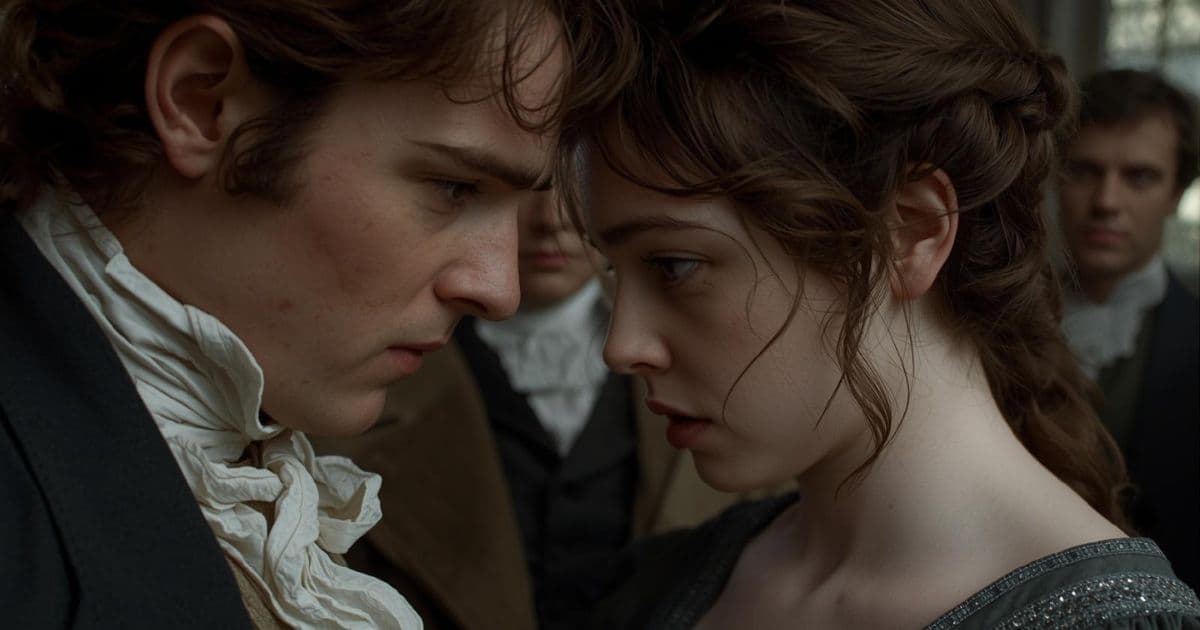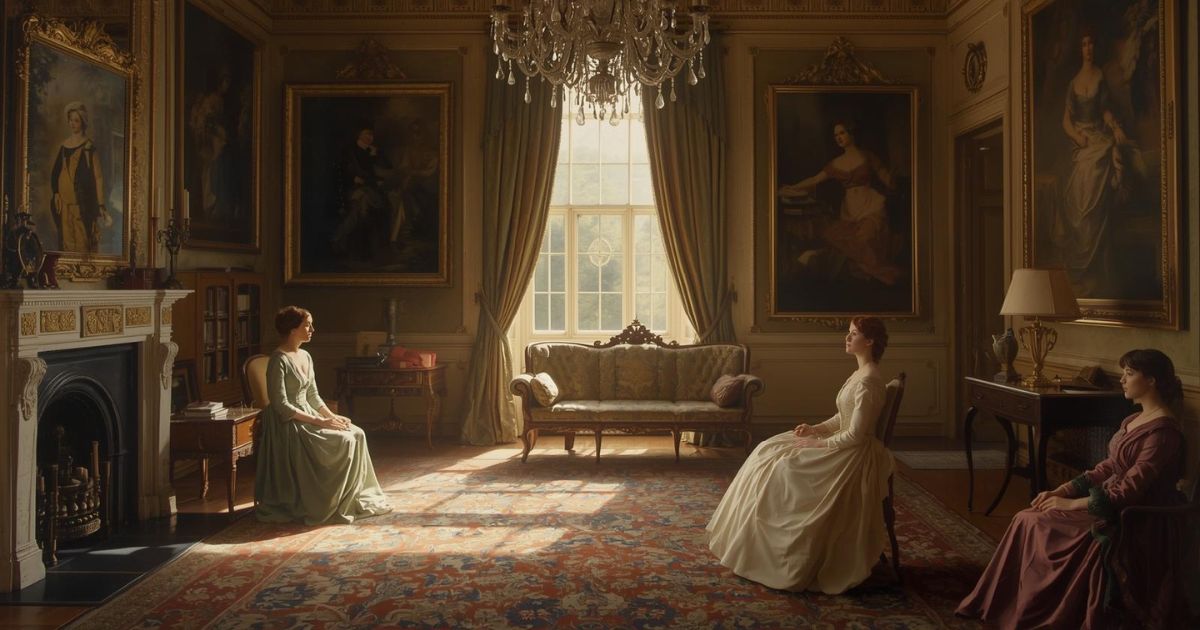
An excerpt from the original text.(complete · 2108 words)
n a firm, though cautious tone, Elinor thus began.
“I should be undeserving of the confidence you have honoured me with,
if I felt no desire for its continuance, or no farther curiosity on its
subject. I will not apologize therefore for bringing it forward again.”
“Thank you,” cried Lucy warmly, “for breaking the ice; you have set my
heart at ease by it; for I was somehow or other afraid I had offended
you by what I told you that Monday.”
“Offended me! How could you suppose so? Believe me,” and Elinor spoke
it with the truest sincerity, “nothing could be farther from my
intention than to give you such an idea. Could you have a motive for
the trust, that was not honourable and flattering to me?”
“And yet I do assure you,” replied Lucy, her little sharp eyes full of
meaning, “there seemed to me to be a coldness and displeasure in your
manner that made me quite uncomfortable. I felt sure that you was angry
with me; and have been quarrelling with myself ever since, for having
took such a liberty as to trouble you with my affairs. But I am very
glad to find it was only my own fancy, and that you really do not blame
me. If you knew what a consolation it was to me to relieve my heart
speaking to you of what I am always thinking of every moment of my
life, your compassion would make you overlook every thing else I am
sure.”
“Indeed, I can easily believe that it was a very great relief to you,
to acknowledge your situation to me, and be assured that you shall
never have reason to repent it. Your case is a very unfortunate one;
you seem to me to be surrounded with difficulties, and you will have
need of all your mutual affection to support you under them. Mr.
Ferrars, I believe, is entirely dependent on his mother.”
“He has only two thousand pounds of his own; it would be madness to
marry upon that, though for my own part, I could give up every prospect
of more without a sigh. I have been always used to a very small income,
and could struggle with any poverty for him; but I love him too well to
be the selfish means of robbing him, perhaps, of all that his mother
might give him if he married to please her. We must wait, it may be for
many years. With almost every other man in the world, it would be an
alarming prospect; but Edward’s affection and constancy nothing can
deprive me of I know.”
“That conviction must be every thing to you; and he is undoubtedly
supported by the same trust in your’s. If the strength of your
reciprocal attachment had failed, as between many people, and under
many circumstances it naturally would during a four years’ engagement,
your situation would have been pitiable, indeed.”
Lucy here looked up; but Elinor was careful in guarding her countenance
from every expression that could give her words a suspicious tendency.
“Edward’s love for me,” said Lucy, “has been pretty well put to the
test, by our long, very long absence since we were first engaged, and
it has stood the trial so well, that I should be unpardonable to doubt
it now. I can safely say that he has never gave me one moment’s alarm
on that account from the first.”
Elinor hardly knew whether to smile or sigh at this assertion.
Lucy went on. “I am rather of a jealous temper too by nature, and from
our different situations in life, from his being so much more in the
world than me, and our continual separation, I was enough inclined for
suspicion, to have found out the truth in an instant, if there had been
the slightest alteration in his behaviour to me when we met, or any
lowness of spirits that I could not account for, or if he had talked
more of one lady than another, or seemed in any respect less happy at
Longstaple than he used to be. I do not mean to say that I am
particularly observant or quick-sighted in general, but in such a case
I am sure I could not be deceived.”
“All this,” thought Elinor, “is very pretty; but it can impose upon
neither of us.”
“But what,” said she after a short silence, “are your views? or have
you none but that of waiting for Mrs. Ferrars’s death, which is a
melancholy and shocking extremity?—Is her son determined to submit to
this, and to all the tediousness of the many years of suspense in which
it may involve you, rather than run the risk of her displeasure for a
while by owning the truth?”
“If we could be certain that it would be only for a while! But Mrs.
Ferrars is a very headstrong proud woman, and in her first fit of anger
upon hearing it, would very likely secure every thing to Robert, and
the idea of that, for Edward’s sake, frightens away all my inclination
for hasty measures.”
“And for your own sake too, or you are carrying your disinterestedness
beyond reason.”
Lucy looked at Elinor again, and was silent.
“Do you know Mr. Robert Ferrars?” asked Elinor.
“Not at all—I never saw him; but I fancy he is very unlike his
brother—silly and a great coxcomb.”
“A great coxcomb!” repeated Miss Steele, whose ear had caught those
words by a sudden pause in Marianne’s music. “Oh, they are talking of
their favourite beaux, I dare say.”
“No sister,” cried Lucy, “you are mistaken there, our favourite beaux
are not great coxcombs.”
“I can answer for it that Miss Dashwood’s is not,” said Mrs. Jennings,
laughing heartily; “for he is one of the modestest, prettiest behaved
young men I ever saw; but as for Lucy, she is such a sly little
creature, there is no finding out who she likes.”
“Oh,” cried Miss Steele, looking significantly round at them, “I dare
say Lucy’s beau is quite as modest and pretty behaved as Miss
Dashwood’s.”
Elinor blushed in spite of herself. Lucy bit her lip, and looked
angrily at her sister. A mutual silence took place for some time. Lucy
first put an end to it by saying in a lower tone, though Marianne was
then giving them the powerful protection of a very magnificent
concerto,—
“I will honestly tell you of one scheme which has lately come into my
head, for bringing matters to bear; indeed I am bound to let you into
the secret, for you are a party concerned. I dare say you have seen
enough of Edward to know that he would prefer the church to every other
profession; now my plan is that he should take orders as soon as he
can, and then through your interest, which I am sure you would be kind
enough to use out of friendship for him, and I hope out of some regard
to me, your brother might be persuaded to give him Norland living;
which I understand is a very good one, and the present incumbent not
likely to live a great while. That would be enough for us to marry
upon, and we might trust to time and chance for the rest.”
“I should always be happy,” replied Elinor, “to show any mark of my
esteem and friendship for Mr. Ferrars; but do you not perceive that my
interest on such an occasion would be perfectly unnecessary? He is
brother to Mrs. John Dashwood—that must be recommendation enough to
her husband.”
“But Mrs. John Dashwood would not much approve of Edward’s going into
orders.”
“Then I rather suspect that my interest would do very little.”
They were again silent for many minutes. At length Lucy exclaimed with
a deep sigh,
“I believe it would be the wisest way to put an end to the business at
once by dissolving the engagement. We seem so beset with difficulties
on every side, that though it would make us miserable for a time, we
should be happier perhaps in the end. But you will not give me your
advice, Miss Dashwood?”
“No,” answered Elinor, with a smile, which concealed very agitated
feelings, “on such a subject I certainly will not. You know very well
that my opinion would have no weight with you, unless it were on the
side of your wishes.”
“Indeed you wrong me,” replied Lucy, with great solemnity; “I know
nobody of whose judgment I think so highly as I do of yours; and I do
really believe, that if you was to say to me, ‘I advise you by all
means to put an end to your engagement with Edward Ferrars, it will be
more for the happiness of both of you,’ I should resolve upon doing it
immediately.”
Elinor blushed for the insincerity of Edward’s future wife, and
replied, “This compliment would effectually frighten me from giving any
opinion on the subject had I formed one. It raises my influence much
too high; the power of dividing two people so tenderly attached is too
much for an indifferent person.”
“’Tis because you are an indifferent person,” said Lucy, with some
pique, and laying a particular stress on those words, “that your
judgment might justly have such weight with me. If you could be
supposed to be biased in any respect by your own feelings, your opinion
would not be worth having.”
Elinor thought it wisest to make no answer to this, lest they might
provoke each other to an unsuitable increase of ease and unreserve; and
was even partly determined never to mention the subject again. Another
pause therefore of many minutes’ duration, succeeded this speech, and
Lucy was still the first to end it.
“Shall you be in town this winter, Miss Dashwood?” said she with all
her accustomary complacency.
“Certainly not.”
“I am sorry for that,” returned the other, while her eyes brightened at
the information, “it would have gave me such pleasure to meet you
there! But I dare say you will go for all that. To be sure, your
brother and sister will ask you to come to them.”
“It will not be in my power to accept their invitation if they do.”
“How unlucky that is! I had quite depended upon meeting you there. Anne
and me are to go the latter end of January to some relations who have
been wanting us to visit them these several years! But I only go for
the sake of seeing Edward. He will be there in February, otherwise
London would have no charms for me; I have not spirits for it.”
Elinor was soon called to the card-table by the conclusion of the first
rubber, and the confidential discourse of the two ladies was therefore
at an end, to which both of them submitted without any reluctance, for
nothing had been said on either side to make them dislike each other
less than they had done before; and Elinor sat down to the card table
with the melancholy persuasion that Edward was not only without
affection for the person who was to be his wife; but that he had not
even the chance of being tolerably happy in marriage, which sincere
affection on her side would have given, for self-interest alone could
induce a woman to keep a man to an engagement, of which she seemed so
thoroughly aware that he was weary.
From this time the subject was never revived by Elinor, and when
entered on by Lucy, who seldom missed an opportunity of introducing it,
and was particularly careful to inform her confidante, of her happiness
whenever she received a letter from Edward, it was treated by the
former with calmness and caution, and dismissed as soon as civility
would allow; for she felt such conversations to be an indulgence which
Lucy did not deserve, and which were dangerous to herself.
The visit of the Miss Steeles at Barton Park was lengthened far beyond
what the first invitation implied. Their favour increased; they could
not be spared; Sir John would not hear of their going; and in spite of
their numerous and long arranged engagements in Exeter, in spite of the
absolute necessity of returning to fulfill them immediately, which was
in full force at the end of every week, they were prevailed on to stay
nearly two months at the park, and to assist in the due celebration of
that festival which requires a more than ordinary share of private
balls and large dinners to proclaim its importance.
Master this chapter. Complete your experience
Purchase the complete book to access all chapters and support classic literature
As an Amazon Associate, we earn a small commission from qualifying purchases at no additional cost to you.
Available in paperback, hardcover, and e-book formats
Let's Analyse the Pattern
The Territory Marking Conversation - When Information Becomes Warfare
Using the pretense of seeking advice or sharing vulnerabilities to deliver psychological damage while maintaining plausible deniability.
Why This Matters
Connect literature to life
This chapter teaches how to recognize when someone uses fake openness and advice-seeking as a delivery system for psychological damage.
Practice This Today
This week, notice when someone shares information that hurts you while asking for your support—that's not coincidence, it's strategy.
Now let's explore the literary elements.
Key Quotes & Analysis
"I have for some time past been thinking of showing you some of Edward's letters. I have one with me now that I am quite dying for somebody to see."
Context: Lucy casually mentions having Edward's letters while pretending this is just friendly sharing
This seemingly innocent comment is actually a calculated attack. Lucy is about to destroy Elinor's hopes while pretending it's just girl talk. The phrase 'dying for somebody to see' shows how eager she is to hurt Elinor.
In Today's Words:
I've been waiting for the perfect moment to show you proof that he's mine, not yours.
"We have been engaged these four years, and it was our meeting by chance which has discovered it now."
Context: Lucy reveals the shocking length of her secret engagement to Edward
Four years is a lifetime of secret commitment. Lucy drops this bombshell to show Elinor that whatever feelings Edward might have for her are nothing compared to this long-standing obligation. She's establishing the timeline of her claim.
In Today's Words:
We've been together way longer than you've even known him, so don't get any ideas.
"I certainly did not know her before, but begging your pardon, there seemed to be a coldness and displeasure in your manner that made me quite uncomfortable."
Context: Lucy pretends to be hurt by Elinor's reaction to the devastating news
This is manipulation at its finest. After delivering crushing news, Lucy now plays the victim, making Elinor feel guilty for not being warm enough. She's turning the tables and making Elinor responsible for managing Lucy's feelings.
In Today's Words:
You're not taking this news well enough for my liking, and now I'm going to make that your problem too.
Thematic Threads
Deception
In This Chapter
Lucy's fake friendship masks territorial aggression—she pretends to seek advice while actually marking her claim on Edward
Development
Evolved from Willoughby's romantic deception to Lucy's social manipulation—showing how deception adapts to different relationships
In Your Life:
You might encounter this when someone shares 'good news' that directly threatens something you want while asking for your support.
Class
In This Chapter
Lucy uses her lower status strategically, positioning herself as needing guidance while actually wielding power through her secret engagement
Development
Builds on earlier class tensions, showing how perceived weakness can become a weapon in social warfare
In Your Life:
You might see this when someone uses their 'disadvantaged' position to manipulate situations in their favor.
Social Expectations
In This Chapter
Elinor must respond graciously to Lucy's 'friendship' even while being emotionally destroyed—politeness becomes a trap
Development
Deepens the theme of how social rules can be weaponized against those who follow them honestly
In Your Life:
You might feel trapped by politeness when someone uses social expectations to force you into uncomfortable situations.
Hidden Information
In This Chapter
Lucy's four-year secret engagement explains Edward's recent behavior and transforms Elinor's understanding of their relationship
Development
Continues the pattern of crucial information being concealed, showing how secrets shape all interactions
In Your Life:
You might discover that someone's puzzling behavior suddenly makes sense when you learn what they've been hiding.
Female Relationships
In This Chapter
Lucy and Elinor's conversation reveals how women can wound each other while maintaining perfect social facades
Development
Introduced here as a specific dynamic distinct from romantic or family relationships
In Your Life:
You might recognize this in competitive female friendships where support and sabotage become indistinguishable.
You now have the context. Time to form your own thoughts.
Discussion Questions
- 1
What specific tactics does Lucy use to deliver the news about her engagement while maintaining the appearance of friendship?
analysis • surface - 2
Why does Lucy choose to tell Elinor about the engagement now, and what does she hope to accomplish?
analysis • medium - 3
Where have you seen people use 'advice-seeking' or 'sharing secrets' as a way to hurt someone while looking innocent?
application • medium - 4
How would you protect yourself if someone was delivering painful information while pretending to seek your friendship or advice?
application • deep - 5
What does this chapter reveal about how people use politeness and social rules as weapons?
reflection • deep
Critical Thinking Exercise
Decode the Hidden Message
Think of a recent conversation where someone shared information that hurt you while appearing helpful or friendly. Write down what they actually said, then translate what they were really communicating underneath the polite words. What was their true message, and how did they deliver maximum impact while maintaining plausible deniability?
Consider:
- •Look for timing - when did they choose to share this information?
- •Notice the packaging - how did they frame themselves as the vulnerable one?
- •Identify the real audience - were they performing for others or targeting you specifically?
Journaling Prompt
Write about a time when you recognized someone was using fake friendship to hurt you. How did you handle it, and what would you do differently now that you can name this pattern?
Coming Up Next...
Chapter 25: Edward's Honor
Elinor must now navigate family gatherings and social events knowing Edward's secret, while Lucy continues her psychological games. The strain of keeping this devastating knowledge to herself begins to take its toll.