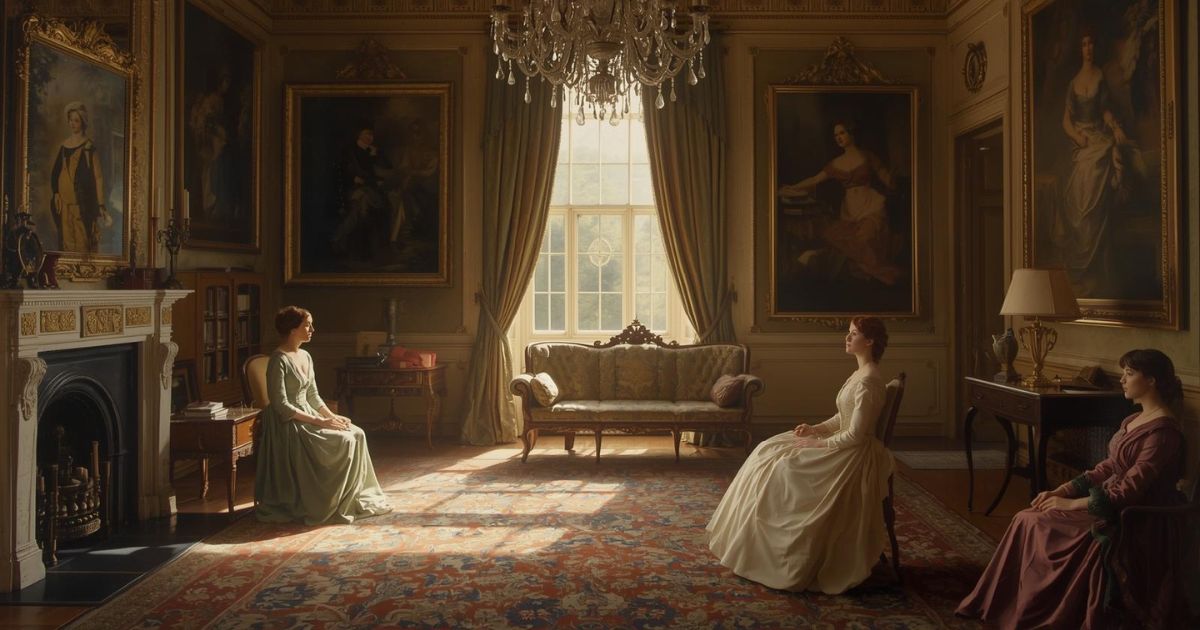
An excerpt from the original text.(complete · 1504 words)
he sudden termination of Colonel Brandon’s visit at the park, with his
steadiness in concealing its cause, filled the mind, and raised the
wonder of Mrs. Jennings for two or three days; she was a great
wonderer, as every one must be who takes a very lively interest in all
the comings and goings of all their acquaintance. She wondered, with
little intermission what could be the reason of it; was sure there must
be some bad news, and thought over every kind of distress that could
have befallen him, with a fixed determination that he should not escape
them all.
“Something very melancholy must be the matter, I am sure,” said she. “I
could see it in his face. Poor man! I am afraid his circumstances may
be bad. The estate at Delaford was never reckoned more than two
thousand a year, and his brother left everything sadly involved. I do
think he must have been sent for about money matters, for what else can
it be? I wonder whether it is so. I would give anything to know the
truth of it. Perhaps it is about Miss Williams and, by the bye, I dare
say it is, because he looked so conscious when I mentioned her. May be
she is ill in town; nothing in the world more likely, for I have a
notion she is always rather sickly. I would lay any wager it is about
Miss Williams. It is not so very likely he should be distressed in his
circumstances now, for he is a very prudent man, and to be sure must
have cleared the estate by this time. I wonder what it can be! May be
his sister is worse at Avignon, and has sent for him over. His setting
off in such a hurry seems very like it. Well, I wish him out of all his
trouble with all my heart, and a good wife into the bargain.”
So wondered, so talked Mrs. Jennings. Her opinion varying with every
fresh conjecture, and all seeming equally probable as they arose.
Elinor, though she felt really interested in the welfare of Colonel
Brandon, could not bestow all the wonder on his going so suddenly away,
which Mrs. Jennings was desirous of her feeling; for besides that the
circumstance did not in her opinion justify such lasting amazement or
variety of speculation, her wonder was otherwise disposed of. It was
engrossed by the extraordinary silence of her sister and Willoughby on
the subject, which they must know to be peculiarly interesting to them
all. As this silence continued, every day made it appear more strange
and more incompatible with the disposition of both. Why they should not
openly acknowledge to her mother and herself, what their constant
behaviour to each other declared to have taken place, Elinor could not
imagine.
She could easily conceive that marriage might not be immediately in
their power; for though Willoughby was independent, there was no reason
to believe him rich. His estate had been rated by Sir John at about six
or seven hundred a year; but he lived at an expense to which that
income could hardly be equal, and he had himself often complained of
his poverty. But for this strange kind of secrecy maintained by them
relative to their engagement, which in fact concealed nothing at all,
she could not account; and it was so wholly contradictory to their
general opinions and practice, that a doubt sometimes entered her mind
of their being really engaged, and this doubt was enough to prevent her
making any inquiry of Marianne.
Nothing could be more expressive of attachment to them all, than
Willoughby’s behaviour. To Marianne it had all the distinguishing
tenderness which a lover’s heart could give, and to the rest of the
family it was the affectionate attention of a son and a brother. The
cottage seemed to be considered and loved by him as his home; many more
of his hours were spent there than at Allenham; and if no general
engagement collected them at the park, the exercise which called him
out in the morning was almost certain of ending there, where the rest
of the day was spent by himself at the side of Marianne, and by his
favourite pointer at her feet.
One evening in particular, about a week after Colonel Brandon left the
country, his heart seemed more than usually open to every feeling of
attachment to the objects around him; and on Mrs. Dashwood’s happening
to mention her design of improving the cottage in the spring, he warmly
opposed every alteration of a place which affection had established as
perfect with him.
“What!” he exclaimed—“Improve this dear cottage! No. That I will
never consent to. Not a stone must be added to its walls, not an inch
to its size, if my feelings are regarded.”
“Do not be alarmed,” said Miss Dashwood, “nothing of the kind will be
done; for my mother will never have money enough to attempt it.”
“I am heartily glad of it,” he cried. “May she always be poor, if she
can employ her riches no better.”
“Thank you, Willoughby. But you may be assured that I would not
sacrifice one sentiment of local attachment of yours, or of any one
whom I loved, for all the improvements in the world. Depend upon it
that whatever unemployed sum may remain, when I make up my accounts in
the spring, I would even rather lay it uselessly by than dispose of it
in a manner so painful to you. But are you really so attached to this
place as to see no defect in it?”
“I am,” said he. “To me it is faultless. Nay, more, I consider it as
the only form of building in which happiness is attainable, and were I
rich enough I would instantly pull Combe down, and build it up again in
the exact plan of this cottage.”
“With dark narrow stairs and a kitchen that smokes, I suppose,” said
Elinor.
“Yes,” cried he in the same eager tone, “with all and every thing
belonging to it;—in no one convenience or inconvenience about it,
should the least variation be perceptible. Then, and then only, under
such a roof, I might perhaps be as happy at Combe as I have been at
Barton.”
“I flatter myself,” replied Elinor, “that even under the disadvantage
of better rooms and a broader staircase, you will hereafter find your
own house as faultless as you now do this.”
“There certainly are circumstances,” said Willoughby, “which might
greatly endear it to me; but this place will always have one claim of
my affection, which no other can possibly share.”
Mrs. Dashwood looked with pleasure at Marianne, whose fine eyes were
fixed so expressively on Willoughby, as plainly denoted how well she
understood him.
“How often did I wish,” added he, “when I was at Allenham this time
twelvemonth, that Barton cottage were inhabited! I never passed within
view of it without admiring its situation, and grieving that no one
should live in it. How little did I then think that the very first news
I should hear from Mrs. Smith, when I next came into the country, would
be that Barton cottage was taken: and I felt an immediate satisfaction
and interest in the event, which nothing but a kind of prescience of
what happiness I should experience from it, can account for. Must it
not have been so, Marianne?” speaking to her in a lowered voice. Then
continuing his former tone, he said, “And yet this house you would
spoil, Mrs. Dashwood? You would rob it of its simplicity by imaginary
improvement! and this dear parlour in which our acquaintance first
began, and in which so many happy hours have been since spent by us
together, you would degrade to the condition of a common entrance, and
every body would be eager to pass through the room which has hitherto
contained within itself more real accommodation and comfort than any
other apartment of the handsomest dimensions in the world could
possibly afford.”
Mrs. Dashwood again assured him that no alteration of the kind should
be attempted.
“You are a good woman,” he warmly replied. “Your promise makes me easy.
Extend it a little farther, and it will make me happy. Tell me that not
only your house will remain the same, but that I shall ever find you
and yours as unchanged as your dwelling; and that you will always
consider me with the kindness which has made everything belonging to
you so dear to me.”
The promise was readily given, and Willoughby’s behaviour during the
whole of the evening declared at once his affection and happiness.
“Shall we see you tomorrow to dinner?” said Mrs. Dashwood, when he was
leaving them. “I do not ask you to come in the morning, for we must
walk to the park, to call on Lady Middleton.”
He engaged to be with them by four o’clock.
Master this chapter. Complete your experience
Purchase the complete book to access all chapters and support classic literature
As an Amazon Associate, we earn a small commission from qualifying purchases at no additional cost to you.
Available in paperback, hardcover, and e-book formats
Let's Analyse the Pattern
Using someone's good manners and social expectations against them to cause harm while maintaining plausible deniability.
Why This Matters
Connect literature to life
This chapter teaches how to recognize when someone uses your good character as a shield for their bad behavior.
Practice This Today
This week, notice when someone makes comments that feel pointed but sound innocent—that's often weaponized politeness in action.
Now let's explore the literary elements.
Key Quotes & Analysis
"I have been so fortunate as to meet with extremely good friends, some of them very near relations of yours, I believe, who have been so kind as to wish me well."
Context: Lucy is hinting about her connection to Edward while speaking to Elinor's family
This is a masterclass in passive aggression. Lucy is telling Elinor's family about her relationship with Edward without actually saying his name. She's forcing Elinor to sit there and listen while she stakes her claim.
In Today's Words:
I've been hanging out with some people you know really well, and they totally approve of me.
"Perhaps you mean my brother, Mr. Edward Ferrars."
Context: Elinor is forced to acknowledge what Lucy is hinting at
Elinor shows her strength here by refusing to let Lucy play games. She calls out the subtext directly but politely, taking control of the conversation while maintaining her dignity.
In Today's Words:
You're talking about Edward, aren't you? Let's just say it.
"It is always painful to be obliged to think ill of any person that we have been used to look upon with respect."
Context: Elinor's response when discussing Edward's character
This shows Elinor's emotional maturity. Even though Edward has hurt her deeply, she won't trash-talk him publicly. She acknowledges her disappointment without being petty or vindictive.
In Today's Words:
It hurts when someone you respected lets you down, but I'm not going to badmouth them.
Thematic Threads
Social Expectations
In This Chapter
Elinor must remain polite and gracious even while being deliberately hurt by Lucy's pointed comments about Edward
Development
Evolving from general social pressure to specific weaponization of manners
In Your Life:
Those moments when you have to smile and nod while someone uses your professionalism or politeness to hurt you
Hidden Power
In This Chapter
Lucy wields secret knowledge about Edward as a weapon, knowing Elinor can't respond without exposing the secret
Development
Building from earlier hints about information as currency
In Your Life:
When someone uses private information or your own discretion against you in public settings
Emotional Control
In This Chapter
Elinor maintains perfect composure despite internal anguish, refusing to give Lucy the satisfaction of seeing her pain
Development
Deepening from earlier displays of self-control under pressure
In Your Life:
Keeping your poker face when someone is deliberately trying to get a reaction out of you
Class Performance
In This Chapter
Both women must perform their roles as 'ladies' even while engaged in psychological warfare
Development
Continuing the theme of how class expectations constrain authentic expression
In Your Life:
When professional or social roles prevent you from responding naturally to mistreatment
Strategic Silence
In This Chapter
Elinor chooses dignity over drama, protecting herself and others by refusing to escalate
Development
Introduced here as a conscious choice rather than mere passivity
In Your Life:
Deciding when speaking up will help versus when staying quiet is the stronger move
You now have the context. Time to form your own thoughts.
Discussion Questions
- 1
Why does Lucy Steele choose to have this conversation with Elinor in front of the family rather than privately?
analysis • surface - 2
What gives Lucy the confidence that she can hurt Elinor without facing consequences?
analysis • medium - 3
Where have you seen people use others' politeness against them in workplace or family situations?
application • medium - 4
If you were Elinor's friend and witnessed this conversation, how would you support her afterward?
application • deep - 5
What does Elinor's response reveal about the difference between being weak and being strong?
reflection • deep
Critical Thinking Exercise
Decode the Hidden Conversation
Rewrite this scene as two separate conversations: what Lucy and Elinor actually say out loud, and what they're really communicating underneath. Put the surface conversation in one column and the hidden meanings in another. Notice how much damage can be done with 'innocent' words.
Consider:
- •Pay attention to how Lucy's comments sound harmless to observers but pointed to Elinor
- •Notice how Elinor's responses maintain dignity while revealing nothing
- •Consider how much energy it takes to manage both conversations at once
Journaling Prompt
Write about a time when someone used your good manners or professional behavior to hurt you. How did you handle it, and what would you do differently now?
Coming Up Next...
Chapter 15: Elinor's Burden
The social tensions continue to build as more family dynamics come into play. Elinor will need every ounce of her composure as the web of secrets grows more complicated.