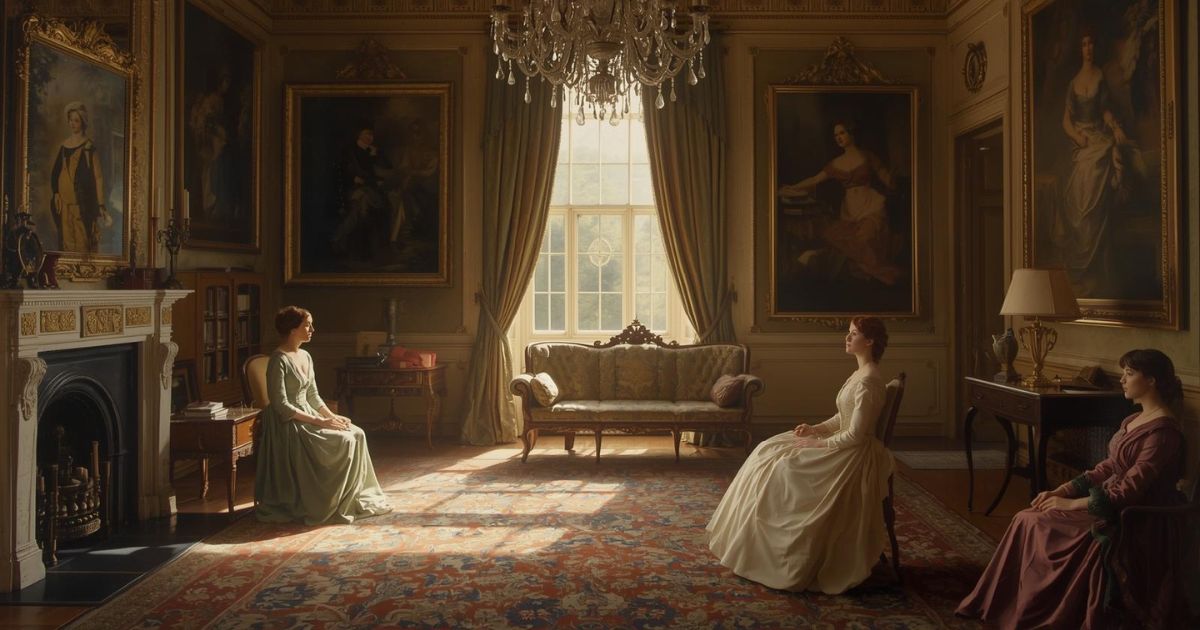
An excerpt from the original text.(complete · 2097 words)
heir intended excursion to Whitwell turned out very different from
what Elinor had expected. She was prepared to be wet through, fatigued,
and frightened; but the event was still more unfortunate, for they did
not go at all.
By ten o’clock the whole party was assembled at the park, where they
were to breakfast. The morning was rather favourable, though it had
rained all night, as the clouds were then dispersing across the sky,
and the sun frequently appeared. They were all in high spirits and good
humour, eager to be happy, and determined to submit to the greatest
inconveniences and hardships rather than be otherwise.
While they were at breakfast the letters were brought in. Among the
rest there was one for Colonel Brandon;—he took it, looked at the
direction, changed colour, and immediately left the room.
“What is the matter with Brandon?” said Sir John.
Nobody could tell.
“I hope he has had no bad news,” said Lady Middleton. “It must be
something extraordinary that could make Colonel Brandon leave my
breakfast table so suddenly.”
In about five minutes he returned.
“No bad news, Colonel, I hope;” said Mrs. Jennings, as soon as he
entered the room.
“None at all, ma’am, I thank you.”
“Was it from Avignon? I hope it is not to say that your sister is
worse.”
“No, ma’am. It came from town, and is merely a letter of business.”
“But how came the hand to discompose you so much, if it was only a
letter of business? Come, come, this won’t do, Colonel; so let us hear
the truth of it.”
“My dear madam,” said Lady Middleton, “recollect what you are saying.”
“Perhaps it is to tell you that your cousin Fanny is married?” said
Mrs. Jennings, without attending to her daughter’s reproof.
“No, indeed, it is not.”
“Well, then, I know who it is from, Colonel. And I hope she is well.”
“Whom do you mean, ma’am?” said he, colouring a little.
“Oh! you know who I mean.”
“I am particularly sorry, ma’am,” said he, addressing Lady Middleton,
“that I should receive this letter today, for it is on business which
requires my immediate attendance in town.”
“In town!” cried Mrs. Jennings. “What can you have to do in town at
this time of year?”
“My own loss is great,” he continued, “in being obliged to leave so
agreeable a party; but I am the more concerned, as I fear my presence
is necessary to gain your admittance at Whitwell.”
What a blow upon them all was this!
“But if you write a note to the housekeeper, Mr. Brandon,” said
Marianne, eagerly, “will it not be sufficient?”
He shook his head.
“We must go,” said Sir John.—“It shall not be put off when we are so
near it. You cannot go to town till tomorrow, Brandon, that is all.”
“I wish it could be so easily settled. But it is not in my power to
delay my journey for one day!”
“If you would but let us know what your business is,” said Mrs.
Jennings, “we might see whether it could be put off or not.”
“You would not be six hours later,” said Willoughby, “if you were to
defer your journey till our return.”
“I cannot afford to lose one hour.”
Elinor then heard Willoughby say, in a low voice to Marianne, “There
are some people who cannot bear a party of pleasure. Brandon is one of
them. He was afraid of catching cold I dare say, and invented this
trick for getting out of it. I would lay fifty guineas the letter was
of his own writing.”
“I have no doubt of it,” replied Marianne.
“There is no persuading you to change your mind, Brandon, I know of
old,” said Sir John, “when once you are determined on anything. But,
however, I hope you will think better of it. Consider, here are the two
Miss Careys come over from Newton, the three Miss Dashwoods walked up
from the cottage, and Mr. Willoughby got up two hours before his usual
time, on purpose to go to Whitwell.”
Colonel Brandon again repeated his sorrow at being the cause of
disappointing the party; but at the same time declared it to be
unavoidable.
“Well, then, when will you come back again?”
“I hope we shall see you at Barton,” added her ladyship, “as soon as
you can conveniently leave town; and we must put off the party to
Whitwell till you return.”
“You are very obliging. But it is so uncertain, when I may have it in
my power to return, that I dare not engage for it at all.”
“Oh! he must and shall come back,” cried Sir John. “If he is not here
by the end of the week, I shall go after him.”
“Ay, so do, Sir John,” cried Mrs. Jennings, “and then perhaps you may
find out what his business is.”
“I do not want to pry into other men’s concerns. I suppose it is
something he is ashamed of.”
Colonel Brandon’s horses were announced.
“You do not go to town on horseback, do you?” added Sir John.
“No. Only to Honiton. I shall then go post.”
“Well, as you are resolved to go, I wish you a good journey. But you
had better change your mind.”
“I assure you it is not in my power.”
He then took leave of the whole party.
“Is there no chance of my seeing you and your sisters in town this
winter, Miss Dashwood?”
“I am afraid, none at all.”
“Then I must bid you farewell for a longer time than I should wish to
do.”
To Marianne, he merely bowed and said nothing.
“Come Colonel,” said Mrs. Jennings, “before you go, do let us know what
you are going about.”
He wished her a good morning, and, attended by Sir John, left the room.
The complaints and lamentations which politeness had hitherto
restrained, now burst forth universally; and they all agreed again and
again how provoking it was to be so disappointed.
“I can guess what his business is, however,” said Mrs. Jennings
exultingly.
“Can you, ma’am?” said almost every body.
“Yes; it is about Miss Williams, I am sure.”
“And who is Miss Williams?” asked Marianne.
“What! do not you know who Miss Williams is? I am sure you must have
heard of her before. She is a relation of the Colonel’s, my dear; a
very near relation. We will not say how near, for fear of shocking the
young ladies.” Then, lowering her voice a little, she said to Elinor,
“She is his natural daughter.”
“Indeed!”
“Oh, yes; and as like him as she can stare. I dare say the Colonel will
leave her all his fortune.”
When Sir John returned, he joined most heartily in the general regret
on so unfortunate an event; concluding however by observing, that as
they were all got together, they must do something by way of being
happy; and after some consultation it was agreed, that although
happiness could only be enjoyed at Whitwell, they might procure a
tolerable composure of mind by driving about the country. The carriages
were then ordered; Willoughby’s was first, and Marianne never looked
happier than when she got into it. He drove through the park very fast,
and they were soon out of sight; and nothing more of them was seen till
their return, which did not happen till after the return of all the
rest. They both seemed delighted with their drive; but said only in
general terms that they had kept in the lanes, while the others went on
the downs.
It was settled that there should be a dance in the evening, and that
every body should be extremely merry all day long. Some more of the
Careys came to dinner, and they had the pleasure of sitting down nearly
twenty to table, which Sir John observed with great contentment.
Willoughby took his usual place between the two elder Miss Dashwoods.
Mrs. Jennings sat on Elinor’s right hand; and they had not been long
seated, before she leant behind her and Willoughby, and said to
Marianne, loud enough for them both to hear, “I have found you out in
spite of all your tricks. I know where you spent the morning.”
Marianne coloured, and replied very hastily, “Where, pray?”
“Did not you know,” said Willoughby, “that we had been out in my
curricle?”
“Yes, yes, Mr. Impudence, I know that very well, and I was determined
to find out where you had been to. I hope you like your house, Miss
Marianne. It is a very large one, I know; and when I come to see you, I
hope you will have new-furnished it, for it wanted it very much when I
was there six years ago.”
Marianne turned away in great confusion. Mrs. Jennings laughed
heartily; and Elinor found that in her resolution to know where they
had been, she had actually made her own woman enquire of Mr.
Willoughby’s groom; and that she had by that method been informed that
they had gone to Allenham, and spent a considerable time there in
walking about the garden and going all over the house.
Elinor could hardly believe this to be true, as it seemed very unlikely
that Willoughby should propose, or Marianne consent, to enter the house
while Mrs. Smith was in it, with whom Marianne had not the smallest
acquaintance.
As soon as they left the dining-room, Elinor enquired of her about it;
and great was her surprise when she found that every circumstance
related by Mrs. Jennings was perfectly true. Marianne was quite angry
with her for doubting it.
“Why should you imagine, Elinor, that we did not go there, or that we
did not see the house? Is not it what you have often wished to do
yourself?”
“Yes, Marianne, but I would not go while Mrs. Smith was there, and with
no other companion than Mr. Willoughby.”
“Mr. Willoughby however is the only person who can have a right to show
that house; and as he went in an open carriage, it was impossible to
have any other companion. I never spent a pleasanter morning in my
life.”
“I am afraid,” replied Elinor, “that the pleasantness of an employment
does not always evince its propriety.”
“On the contrary, nothing can be a stronger proof of it, Elinor; for if
there had been any real impropriety in what I did, I should have been
sensible of it at the time, for we always know when we are acting
wrong, and with such a conviction I could have had no pleasure.”
“But, my dear Marianne, as it has already exposed you to some very
impertinent remarks, do you not now begin to doubt the discretion of
your own conduct?”
“If the impertinent remarks of Mrs. Jennings are to be the proof of
impropriety in conduct, we are all offending every moment of our lives.
I value not her censure any more than I should do her commendation. I
am not sensible of having done anything wrong in walking over Mrs.
Smith’s grounds, or in seeing her house. They will one day be Mr.
Willoughby’s, and—”
“If they were one day to be your own, Marianne, you would not be
justified in what you have done.”
She blushed at this hint; but it was even visibly gratifying to her;
and after a ten minutes’ interval of earnest thought, she came to her
sister again, and said with great good humour, “Perhaps, Elinor, it
was rather ill-judged in me to go to Allenham; but Mr. Willoughby
wanted particularly to show me the place; and it is a charming house, I
assure you.—There is one remarkably pretty sitting room up stairs; of a
nice comfortable size for constant use, and with modern furniture it
would be delightful. It is a corner room, and has windows on two sides.
On one side you look across the bowling-green, behind the house, to a
beautiful hanging wood, and on the other you have a view of the church
and village, and, beyond them, of those fine bold hills that we have so
often admired. I did not see it to advantage, for nothing could be more
forlorn than the furniture,—but if it were newly fitted up—a couple of
hundred pounds, Willoughby says, would make it one of the pleasantest
summer-rooms in England.”
Could Elinor have listened to her without interruption from the others,
she would have described every room in the house with equal delight.
Master this chapter. Complete your experience
Purchase the complete book to access all chapters and support classic literature
As an Amazon Associate, we earn a small commission from qualifying purchases at no additional cost to you.
Available in paperback, hardcover, and e-book formats
Let's Analyse the Pattern
Complete emotional openness with unvetted people transforms vulnerability into a weapon against you.
Why This Matters
Connect literature to life
This chapter teaches how manipulators use mirroring and love-bombing to fast-track intimacy before their victims can evaluate their true character.
Practice This Today
This week, notice when someone pushes for deeper disclosure than the relationship has earned, or when their intensity feels disproportionate to how long you've known them.
Now let's explore the literary elements.
Key Quotes & Analysis
"I have not a doubt of it, and I have nothing to regret—nothing but my own folly."
Context: When admitting to Elinor how completely she trusted Willoughby
Shows Marianne is moving from denial to self-reflection. She's not just mourning the relationship but questioning her own judgment and recognizing that her intense, unguarded approach to love made her vulnerable to manipulation.
In Today's Words:
I totally fell for it, and now I feel stupid for trusting him so completely.
"He told me that it had been for many weeks his intention to call upon you as soon as he could engage leisure so to do."
Context: Recounting Willoughby's promises about meeting her family
Reveals how Willoughby used specific, believable lies to string Marianne along. By mentioning family meetings, he made their relationship seem legitimate and progressing toward marriage, when he was actually planning his escape.
In Today's Words:
He kept saying he was going to meet my family soon, he just needed to find the right time.
"Our confidence in each other was unrestrained."
Context: Describing the intimacy of her relationship with Willoughby
Shows how Marianne's 'sensibility' led her to complete emotional transparency with someone who didn't deserve it. This quote captures both the beauty and danger of loving without holding anything back.
In Today's Words:
We told each other everything—I had no secrets from him.
Thematic Threads
Trust
In This Chapter
Marianne's complete trust in Willoughby is revealed as dangerously naive—she shared everything without verifying his character first
Development
Evolved from earlier hints about Willoughby's questionable behavior to full revelation of betrayal
In Your Life:
You might recognize this when someone pushes for intimate details too quickly in any relationship.
Deception
In This Chapter
Willoughby's letters and promises were calculated lies designed to secure Marianne's devotion while planning his exit
Development
Built from his mysterious departure to this full exposure of his manipulative strategy
In Your Life:
You see this when someone's words are beautiful but their actions don't match over time.
Sisterhood
In This Chapter
Elinor provides steady, non-judgmental support as Marianne finally opens up about her secret relationship
Development
Deepened from earlier tension to genuine emotional intimacy and mutual support
In Your Life:
This appears when you need someone who listens without trying to fix or judge your choices.
Personal Growth
In This Chapter
Marianne begins questioning her own judgment and approach to love, marking the start of real self-reflection
Development
First major shift from denial and drama toward genuine self-examination
In Your Life:
You experience this when a major disappointment forces you to examine your own patterns and blind spots.
Class
In This Chapter
Willoughby's abandonment of Marianne for a wealthy heiress reveals how money ultimately trumped his feelings
Development
Confirmed earlier suspicions about his financial motivations and social climbing
In Your Life:
This shows up when someone chooses financial security or social advantage over their relationship with you.
You now have the context. Time to form your own thoughts.
Discussion Questions
- 1
What specific details about Willoughby's deception does Marianne finally reveal to Elinor, and why was she keeping these secrets?
analysis • surface - 2
How did Willoughby's technique of mirroring Marianne's intensity make his manipulation more effective?
analysis • medium - 3
Where do you see this pattern of 'love-bombing' followed by abandonment in modern relationships, workplace dynamics, or friendships?
application • medium - 4
If you were coaching someone like Marianne, what graduated disclosure strategy would you recommend for future relationships?
application • deep - 5
What does this chapter reveal about the difference between authentic vulnerability and strategic emotional manipulation?
reflection • deep
Critical Thinking Exercise
Create Your Emotional Speed Limits
Design a personal graduated disclosure system by mapping out what information you'd share at different relationship milestones. Start with surface-level details you'd share in week one, medium-level information for month one, and deeper vulnerabilities only after trust is established. Consider romantic relationships, friendships, and workplace connections separately.
Consider:
- •What are your 'red flag' indicators that someone isn't handling your information responsibly?
- •How do you test whether someone reciprocates vulnerability or just collects your information?
- •What's the difference between healthy caution and walls that prevent genuine connection?
Journaling Prompt
Write about a time when you shared too much too soon with someone. What information did you reveal, how was it used against you, and what warning signs did you miss that could guide your future decisions?
Coming Up Next...
Chapter 14: The Engagement
As Marianne begins to heal, the Dashwood sisters prepare for new social obligations that will test both their resolve and their hearts. Old acquaintances return with unexpected news that could change everything.