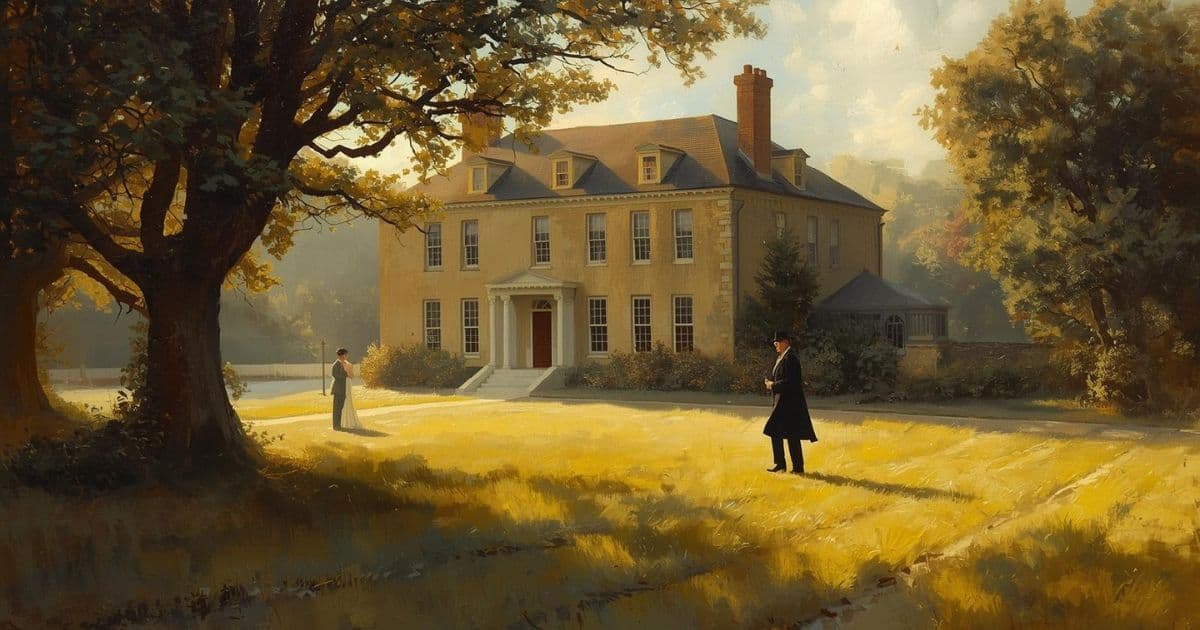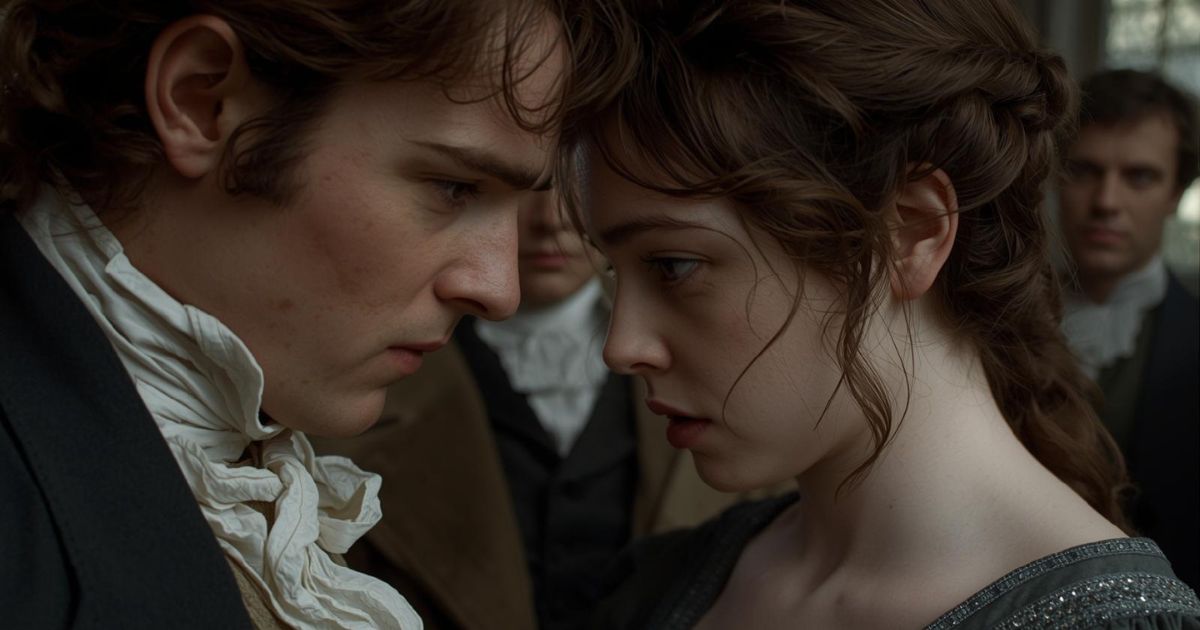
An excerpt from the original text.(complete · 2079 words)
I.
[Illustration]
Their sister’s wedding-day arrived; and Jane and Elizabeth felt for her
probably more than she felt for herself. The carriage was sent to meet
them at----, and they were to return in it by dinnertime. Their arrival
was dreaded by the elder Miss Bennets--and Jane more especially, who
gave Lydia the feelings which would have attended herself, had she
been the culprit, and was wretched in the thought of what her sister
must endure.
They came. The family were assembled in the breakfast-room to receive
them. Smiles decked the face of Mrs. Bennet, as the carriage drove up to
the door; her husband looked impenetrably grave; her daughters, alarmed,
anxious, uneasy.
Lydia’s voice was heard in the vestibule; the door was thrown open, and
she ran into the room. Her mother stepped forwards, embraced her, and
welcomed her with rapture; gave her hand with an affectionate smile to
Wickham, who followed his lady; and wished them both joy, with an
alacrity which showed no doubt of their happiness.
Their reception from Mr. Bennet, to whom they then turned, was not quite
so cordial. His countenance rather gained in austerity; and he scarcely
opened his lips. The easy assurance of the young couple, indeed, was
enough to provoke him.
Elizabeth was disgusted, and even Miss Bennet was shocked. Lydia was
Lydia still; untamed, unabashed, wild, noisy, and fearless. She turned
from sister to sister, demanding their congratulations; and when at
length they all sat down, looked eagerly round the room, took notice of
some little alteration in it, and observed, with a laugh, that it was a
great while since she had been there.
Wickham was not at all more distressed than herself; but his manners
were always so pleasing, that, had his character and his marriage been
exactly what they ought, his smiles and his easy address, while he
claimed their relationship, would have delighted them all. Elizabeth
had not before believed him quite equal to such assurance; but she sat
down, resolving within herself to draw no limits in future to the
impudence of an impudent man. She blushed, and Jane blushed; but the
cheeks of the two who caused their confusion suffered no variation of
colour.
There was no want of discourse. The bride and her mother could neither
of them talk fast enough; and Wickham, who happened to sit near
Elizabeth, began inquiring after his acquaintance in that neighbourhood,
with a good-humoured ease, which she felt very unable to equal in her
replies. They seemed each of them to have the happiest memories in the
world. Nothing of the past was recollected with pain; and Lydia led
voluntarily to subjects which her sisters would not have alluded to for
the world.
“Only think of its being three months,” she cried, “since I went away:
it seems but a fortnight, I declare; and yet there have been things
enough happened in the time. Good gracious! when I went away, I am sure
I had no more idea of being married till I came back again! though I
thought it would be very good fun if I was.”
Her father lifted up his eyes, Jane was distressed, Elizabeth looked
expressively at Lydia; but she, who never heard nor saw anything of
which she chose to be insensible, gaily continued,--
“Oh, mamma, do the people hereabouts know I am married to-day? I was
afraid they might not; and we overtook William Goulding in his curricle,
so I was determined he should know it, and so I let down the side glass
next to him, and took off my glove and let my hand just rest upon the
window frame, so that he might see the ring, and then I bowed and
smiled like anything.”
Elizabeth could bear it no longer. She got up and ran out of the room;
and returned no more, till she heard them passing through the hall to
the dining-parlour. She then joined them soon enough to see Lydia, with
anxious parade, walk up to her mother’s right hand, and hear her say to
her eldest sister,--
“Ah, Jane, I take your place now, and you must go lower, because I am a
married woman.”
It was not to be supposed that time would give Lydia that embarrassment
from which she had been so wholly free at first. Her ease and good
spirits increased. She longed to see Mrs. Philips, the Lucases, and all
their other neighbours, and to hear herself called “Mrs. Wickham” by
each of them; and in the meantime she went after dinner to show her ring
and boast of being married to Mrs. Hill and the two housemaids.
“Well, mamma,” said she, when they were all returned to the
breakfast-room, “and what do you think of my husband? Is not he a
charming man? I am sure my sisters must all envy me. I only hope they
may have half my good luck. They must all go to Brighton. That is the
place to get husbands. What a pity it is, mamma, we did not all go!”
“Very true; and if I had my will we should. But, my dear Lydia, I don’t
at all like your going such a way off. Must it be so?”
“Oh, Lord! yes; there is nothing in that. I shall like it of all things.
You and papa, and my sisters, must come down and see us. We shall be at
Newcastle all the winter, and I dare say there will be some balls, and I
will take care to get good partners for them all.”
“I should like it beyond anything!” said her mother.
“And then when you go away, you may leave one or two of my sisters
behind you; and I dare say I shall get husbands for them before the
winter is over.”
“I thank you for my share of the favour,” said Elizabeth; “but I do not
particularly like your way of getting husbands.”
Their visitors were not to remain above ten days with them. Mr. Wickham
had received his commission before he left London, and he was to join
his regiment at the end of a fortnight.
No one but Mrs. Bennet regretted that their stay would be so short; and
she made the most of the time by visiting about with her daughter, and
having very frequent parties at home. These parties were acceptable to
all; to avoid a family circle was even more desirable to such as did
think than such as did not.
Wickham’s affection for Lydia was just what Elizabeth had expected to
find it; not equal to Lydia’s for him. She had scarcely needed her
present observation to be satisfied, from the reason of things, that
their elopement had been brought on by the strength of her love rather
than by his; and she would have wondered why, without violently caring
for her, he chose to elope with her at all, had she not felt certain
that his flight was rendered necessary by distress of circumstances; and
if that were the case, he was not the young man to resist an opportunity
of having a companion.
Lydia was exceedingly fond of him. He was her dear Wickham on every
occasion; no one was to be put in competition with him. He did
everything best in the world; and she was sure he would kill more birds
on the first of September than anybody else in the country.
One morning, soon after their arrival, as she was sitting with her two
elder sisters, she said to Elizabeth,--
“Lizzy, I never gave you an account of my wedding, I believe. You were
not by, when I told mamma, and the others, all about it. Are not you
curious to hear how it was managed?”
“No, really,” replied Elizabeth; “I think there cannot be too little
said on the subject.”
“La! You are so strange! But I must tell you how it went off. We were
married, you know, at St. Clement’s, because Wickham’s lodgings were in
that parish. And it was settled that we should all be there by eleven
o’clock. My uncle and aunt and I were to go together; and the others
were to meet us at the church.
“Well, Monday morning came, and I was in such a fuss! I was so afraid,
you know, that something would happen to put it off, and then I should
have gone quite distracted. And there was my aunt, all the time I was
dressing, preaching and talking away just as if she was reading a
sermon. However, I did not hear above one word in ten, for I was
thinking, you may suppose, of my dear Wickham. I longed to know whether
he would be married in his blue coat.
“Well, and so we breakfasted at ten as usual: I thought it would never
be over; for, by the bye, you are to understand that my uncle and aunt
were horrid unpleasant all the time I was with them. If you’ll believe
me, I did not once put my foot out of doors, though I was there a
fortnight. Not one party, or scheme, or anything! To be sure, London was
rather thin, but, however, the Little Theatre was open.
“Well, and so, just as the carriage came to the door, my uncle was
called away upon business to that horrid man Mr. Stone. And then, you
know, when once they get together, there is no end of it. Well, I was so
frightened I did not know what to do, for my uncle was to give me away;
and if we were beyond the hour we could not be married all day. But,
luckily, he came back again in ten minutes’ time, and then we all set
out. However, I recollected afterwards, that if he had been prevented
going, the wedding need not be put off, for Mr. Darcy might have done as
well.”
“Mr. Darcy!” repeated Elizabeth, in utter amazement.
“Oh, yes! he was to come there with Wickham, you know. But, gracious me!
I quite forgot! I ought not to have said a word about it. I promised
them so faithfully! What will Wickham say? It was to be such a secret!”
“If it was to be a secret,” said Jane, “say not another word on the
subject. You may depend upon my seeking no further.”
“Oh, certainly,” said Elizabeth, though burning with curiosity; “we will
ask you no questions.”
“Thank you,” said Lydia; “for if you did, I should certainly tell you
all, and then Wickham would be so angry.”
On such encouragement to ask, Elizabeth was forced to put it out of her
power, by running away.
But to live in ignorance on such a point was impossible; or at least it
was impossible not to try for information. Mr. Darcy had been at her
sister’s wedding. It was exactly a scene, and exactly among people,
where he had apparently least to do, and least temptation to go.
Conjectures as to the meaning of it, rapid and wild, hurried into her
brain; but she was satisfied with none. Those that best pleased her, as
placing his conduct in the noblest light, seemed most improbable. She
could not bear such suspense; and hastily seizing a sheet of paper,
wrote a short letter to her aunt, to request an explanation of what
Lydia had dropped, if it were compatible with the secrecy which had been
intended.
“You may readily comprehend,” she added, “what my curiosity must be to
know how a person unconnected with any of us, and, comparatively
speaking, a stranger to our family, should have been amongst you at such
a time. Pray write instantly, and let me understand it--unless it is,
for very cogent reasons, to remain in the secrecy which Lydia seems to
think necessary; and then I must endeavour to be satisfied with
ignorance.”
“Not that I shall, though,” she added to herself, and she finished the
letter; “and, my dear aunt, if you do not tell me in an honourable
manner, I shall certainly be reduced to tricks and stratagems to find it
out.”
Jane’s delicate sense of honour would not allow her to speak to
Elizabeth privately of what Lydia had let fall; Elizabeth was glad of
it:--till it appeared whether her inquiries would receive any
satisfaction, she had rather be without a confidante.
[Illustration:
“I am sure she did not listen.”
]
Master this chapter. Complete your experience
Purchase the complete book to access all chapters and support classic literature
As an Amazon Associate, we earn a small commission from qualifying purchases at no additional cost to you.
Available in paperback, hardcover, and e-book formats
Let's Analyse the Pattern
Why This Matters
Connect literature to life
This chapter teaches how to recognize who actually wields influence versus who appears to be in charge.
Now let's explore the literary elements.
Key Quotes & Analysis
"When I consider how little you have been to blame in this affair, I am the more surprised and concerned at its having been brought about at all."
Context: Explaining why Darcy felt compelled to intervene in the Wickham-Lydia situation
This reveals Darcy's sense of responsibility and guilt about not exposing Wickham earlier. It shows his moral character - he takes blame even when others wouldn't hold him accountable.
"He took all the trouble of seeking her out, of finding where they were, of settling her debts, and procuring her marriage."
Context: Describing the full extent of Darcy's secret intervention
This catalog of actions shows the enormous effort and expense Darcy undertook without any expectation of thanks. It demonstrates true selflessness and contradicts Elizabeth's earlier view of him as selfish.
"She was wild to be at home—to hear, to see, to be upon the spot to share with Jane in the cares that must now fall wholly upon her."
Context: Elizabeth's reaction upon learning the truth about Darcy's involvement
Shows Elizabeth's immediate desire to process this revelation with someone she trusts. Her world has been turned upside down, and she needs to make sense of her completely changed understanding of Darcy.
Thematic Threads
Hidden Labor
In This Chapter
Darcy's secret rescue work goes unrecognized while family takes credit
Development
Evolved from earlier themes about women's invisible emotional work
In Your Life:
When have you done something significant to help others but received no credit while someone else got the praise?
Misjudgment
In This Chapter
Elizabeth must confront how completely wrong she was about Darcy's character
Development
Culmination of prejudice theme—final major reversal of her assumptions
In Your Life:
Can you think of a time when you discovered you were completely wrong about someone's character - what made you finally see the truth?
Class Power
In This Chapter
Darcy's wealth enables him to solve problems others cannot
Development
Shows positive use of class privilege versus earlier negative examples
In Your Life:
How do you use whatever advantages you have (money, connections, skills) to help others who don't have the same resources?
Obligation
In This Chapter
Elizabeth feels the weight of gratitude and debt to Darcy
Development
Introduced here—creates new power dynamic between them
In Your Life:
Have you ever felt uncomfortable accepting help from someone because it made you feel indebted to them?
Personal Growth
In This Chapter
Elizabeth forced to completely reevaluate her judgment and character assessment
Development
Continuation of her learning to see beyond first impressions
In Your Life:
What's the most dramatic way you've had to change your opinion about someone, and how did it feel to admit you were so wrong?
You now have the context. Time to form your own thoughts.
Discussion Questions
- 1
What does Elizabeth learn about who really solved the Wickham and Lydia crisis, and how does this discovery change her understanding of recent events?
- 2
Why do you think Darcy chose to work behind the scenes rather than publicly taking credit for saving Elizabeth's family from scandal?
- 3
Think about your workplace, family, or community - who are the people doing essential work that others don't see or acknowledge?
- 4
When you've been helped by someone working behind the scenes, how can you acknowledge their contribution without making them uncomfortable?
- 5
What does this chapter reveal about the difference between people who solve problems and people who get credit for solutions?
Critical Thinking Exercise
Map Your Hidden Heroes
Think about a recent success or solved problem in your life - getting a promotion, resolving a family crisis, or completing a difficult project. List everyone who contributed, then mark whether their help was visible to others or hidden. Consider who got thanked publicly versus who worked behind the scenes. Finally, identify one hidden helper you could acknowledge this week.
Consider:
- •Notice the pattern of who tends to work visibly versus invisibly in your circles
- •Consider whether you're typically a hidden hero or visible contributor, and what that means for your goals
- •Think about how acknowledging hidden work could change the dynamics in your relationships or workplace
Coming Up Next...
Chapter 52
Elizabeth's letter to her aunt will finally reveal the full truth about who really saved Lydia and why Darcy was at that wedding - and the answer will change everything Elizabeth thought she knew.