An excerpt from the original text.(complete · 4847 words)
III.
[Illustration]
Elizabeth, as they drove along, watched for the first appearance of
Pemberley Woods with some perturbation; and when at length they turned
in at the lodge, her spirits were in a high flutter.
The park was very large, and contained great variety of ground. They
entered it in one of its lowest points, and drove for some time through
a beautiful wood stretching over a wide extent.
Elizabeth’s mind was too full for conversation, but she saw and admired
every remarkable spot and point of view. They gradually ascended for
half a mile, and then found themselves at the top of a considerable
eminence, where the wood ceased, and the eye was instantly caught by
Pemberley House, situated on the opposite side of the valley, into which
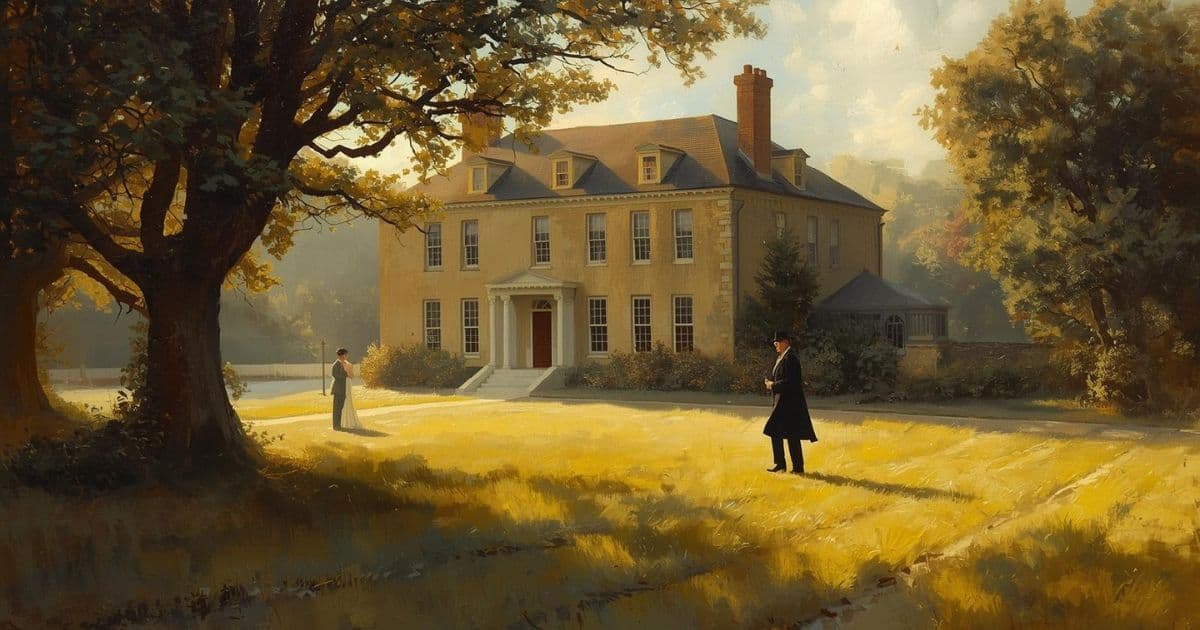
the road with some abruptness wound. It was a large, handsome stone
building, standing well on rising ground, and backed by a ridge of high
woody hills; and in front a stream of some natural importance was
swelled into greater, but without any artificial appearance. Its banks
were neither formal nor falsely adorned. Elizabeth was delighted. She
had never seen a place for which nature had done more, or where natural
beauty had been so little counteracted by an awkward taste. They were
all of them warm in their admiration; and at that moment she felt that
to be mistress of Pemberley might be something!
They descended the hill, crossed the bridge, and drove to the door; and,
while examining the nearer aspect of the house, all her apprehension of
meeting its owner returned. She dreaded lest the chambermaid had been
mistaken. On applying to see the place, they were admitted into the
hall; and Elizabeth, as they waited for the housekeeper, had leisure to
wonder at her being where she was.
The housekeeper came; a respectable looking elderly woman, much less
fine, and more civil, than she had any notion of finding her. They
followed her into the dining-parlour. It was a large, well-proportioned
room, handsomely fitted up. Elizabeth, after slightly surveying it, went
to a window to enjoy its prospect. The hill, crowned with wood, from
which they had descended, receiving increased abruptness from the
distance, was a beautiful object. Every disposition of the ground was
good; and she looked on the whole scene, the river, the trees scattered
on its banks, and the winding of the valley, as far as she could trace
it, with delight. As they passed into other rooms, these objects were
taking different positions; but from every window there were beauties
to be seen. The rooms were lofty and handsome, and their furniture
suitable to the fortune of their proprietor; but Elizabeth saw, with
admiration of his taste, that it was neither gaudy nor uselessly
fine,--with less of splendour, and more real elegance, than the
furniture of Rosings.
“And of this place,” thought she, “I might have been mistress! With
these rooms I might have now been familiarly acquainted! Instead of
viewing them as a stranger, I might have rejoiced in them as my own, and
welcomed to them as visitors my uncle and aunt. But, no,” recollecting
herself, “that could never be; my uncle and aunt would have been lost to
me; I should not have been allowed to invite them.”
This was a lucky recollection--it saved her from something like regret.
She longed to inquire of the housekeeper whether her master were really
absent, but had not courage for it. At length, however, the question was
asked by her uncle; and she turned away with alarm, while Mrs. Reynolds
replied, that he was; adding, “But we expect him to-morrow, with a large
party of friends.” How rejoiced was Elizabeth that their own journey had
not by any circumstance been delayed a day!
Her aunt now called her to look at a picture. She approached, and saw
the likeness of Mr. Wickham, suspended, amongst several other
miniatures, over the mantel-piece. Her aunt asked her, smilingly, how
she liked it. The housekeeper came forward, and told them it was the
picture of a young gentleman, the son of her late master’s steward, who
had been brought up by him at his own expense. “He is now gone into the
army,” she added; “but I am afraid he has turned out very wild.”
Mrs. Gardiner looked at her niece with a smile, but Elizabeth could not
return it.
“And that,” said Mrs. Reynolds, pointing to another of the miniatures,
“is my master--and very like him. It was drawn at the same time as the
other--about eight years ago.”
“I have heard much of your master’s fine person,” said Mrs. Gardiner,
looking at the picture; “it is a handsome face. But, Lizzy, you can tell
us whether it is like or not.”
Mrs. Reynolds’ respect for Elizabeth seemed to increase on this
intimation of her knowing her master.
“Does that young lady know Mr. Darcy?”
Elizabeth coloured, and said, “A little.”
“And do not you think him a very handsome gentleman, ma’am?”
“Yes, very handsome.”
“I am sure I know none so handsome; but in the gallery upstairs you
will see a finer, larger picture of him than this. This room was my late
master’s favourite room, and these miniatures are just as they used to
be then. He was very fond of them.”
This accounted to Elizabeth for Mr. Wickham’s being among them.
Mrs. Reynolds then directed their attention to one of Miss Darcy, drawn
when she was only eight years old.
“And is Miss Darcy as handsome as her brother?” said Mr. Gardiner.
“Oh, yes--the handsomest young lady that ever was seen; and so
accomplished! She plays and sings all day long. In the next room is a
new instrument just come down for her--a present from my master: she
comes here to-morrow with him.”
Mr. Gardiner, whose manners were easy and pleasant, encouraged her
communicativeness by his questions and remarks: Mrs. Reynolds, either
from pride or attachment, had evidently great pleasure in talking of her
master and his sister.
“Is your master much at Pemberley in the course of the year?”
“Not so much as I could wish, sir: but I dare say he may spend half his
time here; and Miss Darcy is always down for the summer months.”
“Except,” thought Elizabeth, “when she goes to Ramsgate.”
“If your master would marry, you might see more of him.”
“Yes, sir; but I do not know when that will be. I do not know who is
good enough for him.”
Mr. and Mrs. Gardiner smiled. Elizabeth could not help saying, “It is
very much to his credit, I am sure, that you should think so.”
“I say no more than the truth, and what everybody will say that knows
him,” replied the other. Elizabeth thought this was going pretty far;
and she listened with increasing astonishment as the housekeeper added,
“I have never had a cross word from him in my life, and I have known him
ever since he was four years old.”
This was praise of all others most extraordinary, most opposite to her
ideas. That he was not a good-tempered man had been her firmest opinion.
Her keenest attention was awakened: she longed to hear more; and was
grateful to her uncle for saying,--
“There are very few people of whom so much can be said. You are lucky in
having such a master.”
“Yes, sir, I know I am. If I were to go through the world, I could not
meet with a better. But I have always observed, that they who are
good-natured when children, are good-natured when they grow up; and he
was always the sweetest tempered, most generous-hearted boy in the
world.”
Elizabeth almost stared at her. “Can this be Mr. Darcy?” thought she.
“His father was an excellent man,” said Mrs. Gardiner.
“Yes, ma’am, that he was indeed; and his son will be just like him--just
as affable to the poor.”
Elizabeth listened, wondered, doubted, and was impatient for more. Mrs.
Reynolds could interest her on no other point. She related the subjects
of the pictures, the dimensions of the rooms, and the price of the
furniture in vain. Mr. Gardiner, highly amused by the kind of family
prejudice, to which he attributed her excessive commendation of her
master, soon led again to the subject; and she dwelt with energy on his
many merits, as they proceeded together up the great staircase.
“He is the best landlord, and the best master,” said she, “that ever
lived. Not like the wild young men now-a-days, who think of nothing but
themselves. There is not one of his tenants or servants but what will
give him a good name. Some people call him proud; but I am sure I never
saw anything of it. To my fancy, it is only because he does not rattle
away like other young men.”
“In what an amiable light does this place him!” thought Elizabeth.
“This fine account of him,” whispered her aunt as they walked, “is not
quite consistent with his behaviour to our poor friend.”
“Perhaps we might be deceived.”
“That is not very likely; our authority was too good.”
On reaching the spacious lobby above, they were shown into a very pretty
sitting-room, lately fitted up with greater elegance and lightness than
the apartments below; and were informed that it was but just done to
give pleasure to Miss Darcy, who had taken a liking to the room, when
last at Pemberley.
“He is certainly a good brother,” said Elizabeth, as she walked towards
one of the windows.
Mrs. Reynolds anticipated Miss Darcy’s delight, when she should enter
the room. “And this is always the way with him,” she added. “Whatever
can give his sister any pleasure, is sure to be done in a moment. There
is nothing he would not do for her.”
The picture gallery, and two or three of the principal bed-rooms, were
all that remained to be shown. In the former were many good paintings:
but Elizabeth knew nothing of the art; and from such as had been already
visible below, she had willingly turned to look at some drawings of Miss
Darcy’s, in crayons, whose subjects were usually more interesting, and
also more intelligible.
In the gallery there were many family portraits, but they could have
little to fix the attention of a stranger. Elizabeth walked on in quest
of the only face whose features would be known to her. At last it
arrested her--and she beheld a striking resemblance of Mr. Darcy, with
such a smile over the face, as she remembered to have sometimes seen,
when he looked at her. She stood several minutes before the picture, in
earnest contemplation, and returned to it again before they quitted the
gallery. Mrs. Reynolds informed them, that it had been taken in his
father’s lifetime.
There was certainly at this moment, in Elizabeth’s mind, a more gentle
sensation towards the original than she had ever felt in the height of
their acquaintance. The commendation bestowed on him by Mrs. Reynolds
was of no trifling nature. What praise is more valuable than the praise
of an intelligent servant? As a brother, a landlord, a master, she
considered how many people’s happiness were in his guardianship! How
much of pleasure or pain it was in his power to bestow! How much of good
or evil must be done by him! Every idea that had been brought forward by
the housekeeper was favourable to his character; and as she stood before
the canvas, on which he was represented, and fixed his eyes upon
herself, she thought of his regard with a deeper sentiment of gratitude
than it had ever raised before: she remembered its warmth, and softened
its impropriety of expression.
When all of the house that was open to general inspection had been seen,
they returned down stairs; and, taking leave of the housekeeper, were
consigned over to the gardener, who met them at the hall door.
As they walked across the lawn towards the river, Elizabeth turned back
to look again; her uncle and aunt stopped also; and while the former was
conjecturing as to the date of the building, the owner of it himself
suddenly came forward from the road which led behind it to the stables.
They were within twenty yards of each other; and so abrupt was his
appearance, that it was impossible to avoid his sight. Their eyes
instantly met, and the cheeks of each were overspread with the deepest
blush. He absolutely started, and for a moment seemed immovable from
surprise; but shortly recovering himself, advanced towards the party,
and spoke to Elizabeth, if not in terms of perfect composure, at least
of perfect civility.
She had instinctively turned away; but stopping on his approach,
received his compliments with an embarrassment impossible to be
overcome. Had his first appearance, or his resemblance to the picture
they had just been examining, been insufficient to assure the other two
that they now saw Mr. Darcy, the gardener’s expression of surprise, on
beholding his master, must immediately have told it. They stood a little
aloof while he was talking to their niece, who, astonished and confused,
scarcely dared lift her eyes to his face, and knew not what answer she
returned to his civil inquiries after her family. Amazed at the
alteration of his manner since they last parted, every sentence that he
uttered was increasing her embarrassment; and every idea of the
impropriety of her being found there recurring to her mind, the few
minutes in which they continued together were some of the most
uncomfortable of her life. Nor did he seem much more at ease; when he
spoke, his accent had none of its usual sedateness; and he repeated his
inquiries as to the time of her having left Longbourn, and of her stay
in Derbyshire, so often, and in so hurried a way, as plainly spoke the
distraction of his thoughts.
At length, every idea seemed to fail him; and after standing a few
moments without saying a word, he suddenly recollected himself, and took
leave.
The others then joined her, and expressed their admiration of his
figure; but Elizabeth heard not a word, and, wholly engrossed by her own
feelings, followed them in silence. She was overpowered by shame and
vexation. Her coming there was the most unfortunate, the most ill-judged
thing in the world! How strange must it appear to him! In what a
disgraceful light might it not strike so vain a man! It might seem as if
she had purposely thrown herself in his way again! Oh! why did she come?
or, why did he thus come a day before he was expected? Had they been
only ten minutes sooner, they should have been beyond the reach of his
discrimination; for it was plain that he was that moment arrived, that
moment alighted from his horse or his carriage. She blushed again and
again over the perverseness of the meeting. And his behaviour, so
strikingly altered,--what could it mean? That he should even speak to
her was amazing!--but to speak with such civility, to inquire after her
family! Never in her life had she seen his manners so little dignified,
never had he spoken with such gentleness as on this unexpected meeting.
What a contrast did it offer to his last address in Rosings Park, when
he put his letter into her hand! She knew not what to think, or how to
account for it.
They had now entered a beautiful walk by the side of the water, and
every step was bringing forward a nobler fall of ground, or a finer
reach of the woods to which they were approaching: but it was some time
before Elizabeth was sensible of any of it; and, though she answered
mechanically to the repeated appeals of her uncle and aunt, and seemed
to direct her eyes to such objects as they pointed out, she
distinguished no part of the scene. Her thoughts were all fixed on that
one spot of Pemberley House, whichever it might be, where Mr. Darcy then
was. She longed to know what at that moment was passing in his mind; in
what manner he thought of her, and whether, in defiance of everything,
she was still dear to him. Perhaps he had been civil only because he
felt himself at ease; yet there had been that in his voice, which was
not like ease. Whether he had felt more of pain or of pleasure in seeing
her, she could not tell, but he certainly had not seen her with
composure.
At length, however, the remarks of her companions on her absence of mind
roused her, and she felt the necessity of appearing more like herself.
They entered the woods, and, bidding adieu to the river for a while,
ascended some of the higher grounds; whence, in spots where the opening
of the trees gave the eye power to wander, were many charming views of
the valley, the opposite hills, with the long range of woods
overspreading many, and occasionally part of the stream. Mr. Gardiner
expressed a wish of going round the whole park, but feared it might be
beyond a walk. With a triumphant smile, they were told, that it was ten
miles round. It settled the matter; and they pursued the accustomed
circuit; which brought them again, after some time, in a descent among
hanging woods, to the edge of the water, and one of its narrowest parts.
They crossed it by a simple bridge, in character with the general air of
the scene: it was a spot less adorned than any they had yet visited; and
the valley, here contracted into a glen, allowed room only for the
stream, and a narrow walk amidst the rough coppice-wood which bordered
it. Elizabeth longed to explore its windings; but when they had crossed
the bridge, and perceived their distance from the house, Mrs. Gardiner,
who was not a great walker, could go no farther, and thought only of
returning to the carriage as quickly as possible. Her niece was,
therefore, obliged to submit, and they took their way towards the house
on the opposite side of the river, in the nearest direction; but their
progress was slow, for Mr. Gardiner, though seldom able to indulge the
taste, was very fond of fishing, and was so much engaged in watching the
occasional appearance of some trout in the water, and talking to the man
about them, that he advanced but little. Whilst wandering on in this
slow manner, they were again surprised, and Elizabeth’s astonishment was
quite equal to what it had been at first, by the sight of Mr. Darcy
approaching them, and at no great distance. The walk being here less
sheltered than on the other side, allowed them to see him before they
met. Elizabeth, however astonished, was at least more prepared for an
interview than before, and resolved to appear and to speak with
calmness, if he really intended to meet them. For a few moments, indeed,
she felt that he would probably strike into some other path. The idea
lasted while a turning in the walk concealed him from their view; the
turning past, he was immediately before them. With a glance she saw that
he had lost none of his recent civility; and, to imitate his politeness,
she began as they met to admire the beauty of the place; but she had not
got beyond the words “delightful,” and “charming,” when some unlucky
recollections obtruded, and she fancied that praise of Pemberley from
her might be mischievously construed. Her colour changed, and she said
no more.
Mrs. Gardiner was standing a little behind; and on her pausing, he asked
her if she would do him the honour of introducing him to her friends.
This was a stroke of civility for which she was quite unprepared; and
she could hardly suppress a smile at his being now seeking the
acquaintance of some of those very people, against whom his pride had
revolted, in his offer to herself. “What will be his surprise,” thought
she, “when he knows who they are! He takes them now for people of
fashion.”
The introduction, however, was immediately made; and as she named their
relationship to herself, she stole a sly look at him, to see how he bore
it; and was not without the expectation of his decamping as fast as he
could from such disgraceful companions. That he was surprised by the
connection was evident: he sustained it, however, with fortitude: and,
so far from going away, turned back with them, and entered into
conversation with Mr. Gardiner. Elizabeth could not but be pleased,
could not but triumph. It was consoling that he should know she had some
relations for whom there was no need to blush. She listened most
attentively to all that passed between them, and gloried in every
expression, every sentence of her uncle, which marked his intelligence,
his taste, or his good manners.
The conversation soon turned upon fishing; and she heard Mr. Darcy
invite him, with the greatest civility, to fish there as often as he
chose, while he continued in the neighbourhood, offering at the same
time to supply him with fishing tackle, and pointing out those parts of
the stream where there was usually most sport. Mrs. Gardiner, who was
walking arm in arm with Elizabeth, gave her a look expressive of her
wonder. Elizabeth said nothing, but it gratified her exceedingly; the
compliment must be all for herself. Her astonishment, however, was
extreme; and continually was she repeating, “Why is he so altered? From
what can it proceed? It cannot be for me, it cannot be for my sake
that his manners are thus softened. My reproofs at Hunsford could not
work such a change as this. It is impossible that he should still love
me.”
After walking some time in this way, the two ladies in front, the two
gentlemen behind, on resuming their places, after descending to the
brink of the river for the better inspection of some curious
water-plant, there chanced to be a little alteration. It originated in
Mrs. Gardiner, who, fatigued by the exercise of the morning, found
Elizabeth’s arm inadequate to her support, and consequently preferred
her husband’s. Mr. Darcy took her place by her niece, and they walked on
together. After a short silence the lady first spoke. She wished him to
know that she had been assured of his absence before she came to the
place, and accordingly began by observing, that his arrival had been
very unexpected--“for your housekeeper,” she added, “informed us that
you would certainly not be here till to-morrow; and, indeed, before we
left Bakewell, we understood that you were not immediately expected in
the country.” He acknowledged the truth of it all; and said that
business with his steward had occasioned his coming forward a few hours
before the rest of the party with whom he had been travelling. “They
will join me early to-morrow,” he continued, “and among them are some
who will claim an acquaintance with you,--Mr. Bingley and his sisters.”
Elizabeth answered only by a slight bow. Her thoughts were instantly
driven back to the time when Mr. Bingley’s name had been last mentioned
between them; and if she might judge from his complexion, his mind was
not very differently engaged.
“There is also one other person in the party,” he continued after a
pause, “who more particularly wishes to be known to you. Will you allow
me, or do I ask too much, to introduce my sister to your acquaintance
during your stay at Lambton?”
The surprise of such an application was great indeed; it was too great
for her to know in what manner she acceded to it. She immediately felt
that whatever desire Miss Darcy might have of being acquainted with her,
must be the work of her brother, and without looking farther, it was
satisfactory; it was gratifying to know that his resentment had not made
him think really ill of her.
They now walked on in silence; each of them deep in thought. Elizabeth
was not comfortable; that was impossible; but she was flattered and
pleased. His wish of introducing his sister to her was a compliment of
the highest kind. They soon outstripped the others; and when they had
reached the carriage, Mr. and Mrs. Gardiner were half a quarter of a
mile behind.
He then asked her to walk into the house--but she declared herself not
tired, and they stood together on the lawn. At such a time much might
have been said, and silence was very awkward. She wanted to talk, but
there seemed an embargo on every subject. At last she recollected that
she had been travelling, and they talked of Matlock and Dovedale with
great perseverance. Yet time and her aunt moved slowly--and her patience
and her ideas were nearly worn out before the tête-à-tête was over.
On Mr. and Mrs. Gardiner’s coming up they were all pressed to go into
the house and take some refreshment; but this was declined, and they
parted on each side with the utmost politeness. Mr. Darcy handed the
ladies into the carriage; and when it drove off, Elizabeth saw him
walking slowly towards the house.
The observations of her uncle and aunt now began; and each of them
pronounced him to be infinitely superior to anything they had expected.
“He is perfectly well-behaved, polite, and unassuming,” said her uncle.
“There is something a little stately in him, to be sure,” replied her
aunt; “but it is confined to his air, and is not unbecoming. I can now
say with the housekeeper, that though some people may call him proud,
I have seen nothing of it.”
“I was never more surprised than by his behaviour to us. It was more
than civil; it was really attentive; and there was no necessity for such
attention. His acquaintance with Elizabeth was very trifling.”
“To be sure, Lizzy,” said her aunt, “he is not so handsome as Wickham;
or rather he has not Wickham’s countenance, for his features are
perfectly good. But how came you to tell us that he was so
disagreeable?”
Elizabeth excused herself as well as she could: said that she had liked
him better when they met in Kent than before, and that she had never
seen him so pleasant as this morning.
“But perhaps he may be a little whimsical in his civilities,” replied
her uncle. “Your great men often are; and therefore I shall not take him
at his word about fishing, as he might change his mind another day, and
warn me off his grounds.”
Elizabeth felt that they had entirely mistaken his character, but said
nothing.
“From what we have seen of him,” continued Mrs. Gardiner, “I really
should not have thought that he could have behaved in so cruel a way by
anybody as he has done by poor Wickham. He has not an ill-natured look.
On the contrary, there is something pleasing about his mouth when he
speaks. And there is something of dignity in his countenance, that would
not give one an unfavourable idea of his heart. But, to be sure, the
good lady who showed us the house did give him a most flaming character!
I could hardly help laughing aloud sometimes. But he is a liberal
master, I suppose, and that, in the eye of a servant, comprehends
every virtue.”
Elizabeth here felt herself called on to say something in vindication of
his behaviour to Wickham; and, therefore, gave them to understand, in as
guarded a manner as she could, that by what she had heard from his
relations in Kent, his actions were capable of a very different
construction; and that his character was by no means so faulty, nor
Wickham’s so amiable, as they had been considered in Hertfordshire. In
confirmation of this, she related the particulars of all the pecuniary
transactions in which they had been connected, without actually naming
her authority, but stating it to be such as might be relied on.
Mrs. Gardiner was surprised and concerned: but as they were now
approaching the scene of her former pleasures, every idea gave way to
the charm of recollection; and she was too much engaged in pointing out
to her husband all the interesting spots in its environs, to think of
anything else. Fatigued as she had been by the morning’s walk, they had
no sooner dined than she set off again in quest of her former
acquaintance, and the evening was spent in the satisfactions of an
intercourse renewed after many years’ discontinuance.
The occurrences of the day were too full of interest to leave Elizabeth
much attention for any of these new friends; and she could do nothing
but think, and think with wonder, of Mr. Darcy’s civility, and, above
all, of his wishing her to be acquainted with his sister.
[Illustration]
Master this chapter. Complete your experience
Purchase the complete book to access all chapters and support classic literature
As an Amazon Associate, we earn a small commission from qualifying purchases at no additional cost to you.
Available in paperback, hardcover, and e-book formats
Let's Analyse the Pattern
Why This Matters
Connect literature to life
This chapter teaches how to look past public persona to see someone's true values through how they treat people with less power.
Now let's explore the literary elements.
Key Quotes & Analysis
"And of this place, I might have been mistress!"
Context: Elizabeth thinks this while touring the beautiful grounds of Pemberley
This reveals Elizabeth's growing regret about rejecting Darcy's proposal. She's realizing what she gave up - not just wealth and status, but a life with a good man.
"I have never had a cross word from him in my life, and I have known him ever since he was four years old."
Context: The housekeeper describes Darcy's character to Elizabeth during the house tour
This testimony from someone who knew Darcy as a child proves his goodness is genuine, not an act. It directly contradicts Wickham's lies about Darcy's character.
"He is the best landlord, and the best master that ever lived."
Context: She continues praising Darcy while showing Elizabeth around Pemberley
This shows how Darcy treats people who depend on him - with fairness and kindness. In Austen's world, how you treat servants and tenants reveals your true moral character.
Thematic Threads
Prejudice
In This Chapter
Elizabeth's prejudice against Darcy completely crumbles when confronted with overwhelming evidence of his true character
Development
Evolution from her initial snap judgment based on his awkward social manner to recognition of her systematic bias
In Your Life:
When have you discovered that your strong first impression of someone was completely wrong, and what made you finally see past your initial judgment?
Class
In This Chapter
The servants' genuine affection for Darcy reveals how he treats people across class lines, contradicting Elizabeth's assumptions about wealthy arrogance
Development
Deepens from earlier focus on social mobility to examining how class affects character judgment
In Your Life:
How do you think people from different economic backgrounds than yours would describe your character - would their perspective surprise you?
Personal Growth
In This Chapter
Elizabeth experiences painful self-awareness, recognizing she's been as guilty of pride as she accused Darcy of being
Development
Major breakthrough after gradual hints of her fallibility in previous chapters
In Your Life:
Can you think of a time when you realized you were guilty of the very flaw you criticized in someone else?
Pride
In This Chapter
Elizabeth's intellectual pride in her ability to read people is shattered by the reality of how wrong she's been
Development
Shifts from Darcy's social pride to Elizabeth's pride in her own judgment
In Your Life:
When has your confidence in being a good judge of character been proven embarrassingly wrong?
Marriage
In This Chapter
Elizabeth realizes she may have rejected a genuinely good man, feeling the weight of what she's potentially lost
Development
Moves from rejecting marriage for security to recognizing she may have rejected love itself
In Your Life:
Have you ever realized too late that you rejected someone or something valuable because you were focused on the wrong qualities?
You now have the context. Time to form your own thoughts.
Discussion Questions
- 1
What specific evidence does Elizabeth discover about Darcy's character during her visit to Pemberley?
- 2
Why did Elizabeth's first impressions of Darcy persist for so long, even when she encountered contradictory information?
- 3
Where do you see confirmation bias playing out in modern workplaces, healthcare, or family relationships?
- 4
What strategies could Elizabeth have used earlier to test whether her judgment of Darcy was accurate?
- 5
What does this chapter reveal about the difference between confidence and wisdom when it comes to reading people?
Critical Thinking Exercise
Test Your First Impressions
Think of someone you dislike or distrust at work, in your family, or community. Write down three specific reasons why you feel this way. Now imagine you're the housekeeper giving a tour to a stranger - what would people who interact with this person daily say about them? What evidence might you be overlooking that contradicts your assessment?
Consider:
- •Focus on observable behaviors rather than assumed motivations
- •Consider whether your sources of information might be biased or incomplete
- •Ask yourself what it would take to change your mind about this person
Coming Up Next...
Chapter 44
Just as Elizabeth begins to see Darcy in a new light, an unexpected encounter threatens to shatter her newfound peace of mind. The past has a way of catching up when you least expect it.