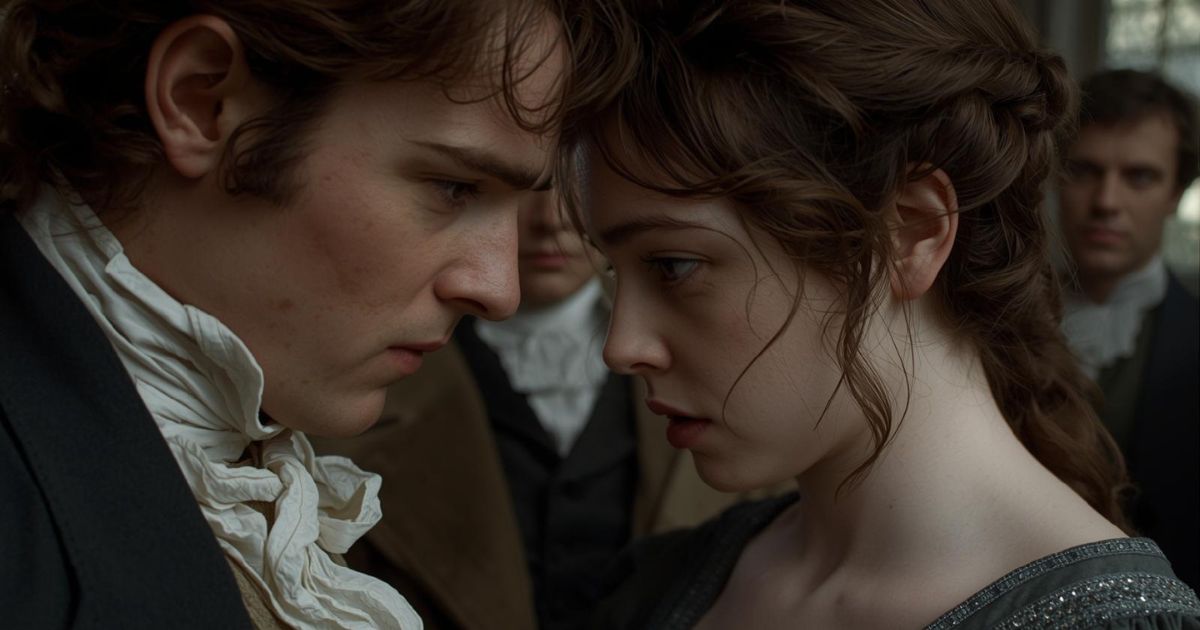
An excerpt from the original text.(complete · 1701 words)
.
[Illustration]
Elizabeth’s impatience to acquaint Jane with what had happened could no
longer be overcome; and at length resolving to suppress every particular
in which her sister was concerned, and preparing her to be surprised,
she related to her the next morning the chief of the scene between Mr.
Darcy and herself.
Miss Bennet’s astonishment was soon lessened by the strong sisterly
partiality which made any admiration of Elizabeth appear perfectly
natural; and all surprise was shortly lost in other feelings. She was
sorry that Mr. Darcy should have delivered his sentiments in a manner so
little suited to recommend them; but still more was she grieved for the
unhappiness which her sister’s refusal must have given him.
“His being so sure of succeeding was wrong,” said she, “and certainly
ought not to have appeared; but consider how much it must increase his
disappointment.”
“Indeed,” replied Elizabeth, “I am heartily sorry for him; but he has
other feelings which will probably soon drive away his regard for me.
You do not blame me, however, for refusing him?”
“Blame you! Oh, no.”
“But you blame me for having spoken so warmly of Wickham?”
“No--I do not know that you were wrong in saying what you did.”
“But you will know it, when I have told you what happened the very
next day.”
She then spoke of the letter, repeating the whole of its contents as far
as they concerned George Wickham. What a stroke was this for poor Jane,
who would willingly have gone through the world without believing that
so much wickedness existed in the whole race of mankind as was here
collected in one individual! Nor was Darcy’s vindication, though
grateful to her feelings, capable of consoling her for such discovery.
Most earnestly did she labour to prove the probability of error, and
seek to clear one, without involving the other.
“This will not do,” said Elizabeth; “you never will be able to make both
of them good for anything. Take your choice, but you must be satisfied
with only one. There is but such a quantity of merit between them; just
enough to make one good sort of man; and of late it has been shifting
about pretty much. For my part, I am inclined to believe it all Mr.
Darcy’s, but you shall do as you choose.”
It was some time, however, before a smile could be extorted from Jane.
“I do not know when I have been more shocked,” said she. “Wickham so
very bad! It is almost past belief. And poor Mr. Darcy! dear Lizzy,
only consider what he must have suffered. Such a disappointment! and
with the knowledge of your ill opinion too! and having to relate such a
thing of his sister! It is really too distressing, I am sure you must
feel it so.”
“Oh no, my regret and compassion are all done away by seeing you so full
of both. I know you will do him such ample justice, that I am growing
every moment more unconcerned and indifferent. Your profusion makes me
saving; and if you lament over him much longer, my heart will be as
light as a feather.”
“Poor Wickham! there is such an expression of goodness in his
countenance! such an openness and gentleness in his manner.”
“There certainly was some great mismanagement in the education of those
two young men. One has got all the goodness, and the other all the
appearance of it.”
“I never thought Mr. Darcy so deficient in the appearance of it as you
used to do.”
“And yet I meant to be uncommonly clever in taking so decided a dislike
to him, without any reason. It is such a spur to one’s genius, such an
opening for wit, to have a dislike of that kind. One may be continually
abusive without saying anything just; but one cannot be always laughing
at a man without now and then stumbling on something witty.”
“Lizzy, when you first read that letter, I am sure you could not treat
the matter as you do now.”
“Indeed, I could not. I was uncomfortable enough, I was very
uncomfortable--I may say unhappy. And with no one to speak to of what I
felt, no Jane to comfort me, and say that I had not been so very weak,
and vain, and nonsensical, as I knew I had! Oh, how I wanted you!”
“How unfortunate that you should have used such very strong expressions
in speaking of Wickham to Mr. Darcy, for now they do appear wholly
undeserved.”
“Certainly. But the misfortune of speaking with bitterness is a most
natural consequence of the prejudices I had been encouraging. There is
one point on which I want your advice. I want to be told whether I
ought, or ought not, to make our acquaintance in general understand
Wickham’s character.”
Miss Bennet paused a little, and then replied, “Surely there can be no
occasion for exposing him so dreadfully. What is your own opinion?”
“That it ought not to be attempted. Mr. Darcy has not authorized me to
make his communication public. On the contrary, every particular
relative to his sister was meant to be kept as much as possible to
myself; and if I endeavour to undeceive people as to the rest of his
conduct, who will believe me? The general prejudice against Mr. Darcy is
so violent, that it would be the death of half the good people in
Meryton, to attempt to place him in an amiable light. I am not equal to
it. Wickham will soon be gone; and, therefore, it will not signify to
anybody here what he really is. Some time hence it will be all found
out, and then we may laugh at their stupidity in not knowing it before.
At present I will say nothing about it.”
“You are quite right. To have his errors made public might ruin him for
ever. He is now, perhaps, sorry for what he has done, and anxious to
re-establish a character. We must not make him desperate.”
The tumult of Elizabeth’s mind was allayed by this conversation. She
had got rid of two of the secrets which had weighed on her for a
fortnight, and was certain of a willing listener in Jane, whenever she
might wish to talk again of either. But there was still something
lurking behind, of which prudence forbade the disclosure. She dared not
relate the other half of Mr. Darcy’s letter, nor explain to her sister
how sincerely she had been valued by his friend. Here was knowledge in
which no one could partake; and she was sensible that nothing less than
a perfect understanding between the parties could justify her in
throwing off this last encumbrance of mystery. “And then,” said she, “if
that very improbable event should ever take place, I shall merely be
able to tell what Bingley may tell in a much more agreeable manner
himself. The liberty of communication cannot be mine till it has lost
all its value!”
She was now, on being settled at home, at leisure to observe the real
state of her sister’s spirits. Jane was not happy. She still cherished a
very tender affection for Bingley. Having never even fancied herself in
love before, her regard had all the warmth of first attachment, and from
her age and disposition, greater steadiness than first attachments often
boast; and so fervently did she value his remembrance, and prefer him to
every other man, that all her good sense, and all her attention to the
feelings of her friends, were requisite to check the indulgence of those
regrets which must have been injurious to her own health and their
tranquillity.
“Well, Lizzy,” said Mrs. Bennet, one day, “what is your opinion now of
this sad business of Jane’s? For my part, I am determined never to speak
of it again to anybody. I told my sister Philips so the other day. But I
cannot find out that Jane saw anything of him in London. Well, he is a
very undeserving young man--and I do not suppose there is the least
chance in the world of her ever getting him now. There is no talk of his
coming to Netherfield again in the summer; and I have inquired of
everybody, too, who is likely to know.”
[Illustration:
“I am determined never to speak of it again”
]
“I do not believe that he will ever live at Netherfield any more.”
“Oh, well! it is just as he chooses. Nobody wants him to come; though I
shall always say that he used my daughter extremely ill; and, if I was
her, I would not have put up with it. Well, my comfort is, I am sure
Jane will die of a broken heart, and then he will be sorry for what he
has done.”
But as Elizabeth could not receive comfort from any such expectation she
made no answer.
“Well, Lizzy,” continued her mother, soon afterwards, “and so the
Collinses live very comfortable, do they? Well, well, I only hope it
will last. And what sort of table do they keep? Charlotte is an
excellent manager, I dare say. If she is half as sharp as her mother,
she is saving enough. There is nothing extravagant in their
housekeeping, I dare say.”
“No, nothing at all.”
“A great deal of good management, depend upon it. Yes, yes. They will
take care not to outrun their income. They will never be distressed
for money. Well, much good may it do them! And so, I suppose, they often
talk of having Longbourn when your father is dead. They look upon it
quite as their own, I dare say, whenever that happens.”
“It was a subject which they could not mention before me.”
“No; it would have been strange if they had. But I make no doubt they
often talk of it between themselves. Well, if they can be easy with an
estate that is not lawfully their own, so much the better. I should be
ashamed of having one that was only entailed on me.”
[Illustration:
“When Colonel Miller’s regiment went away”
[Copyright 1894 by George Allen.]]
Master this chapter. Complete your experience
Purchase the complete book to access all chapters and support classic literature
As an Amazon Associate, we earn a small commission from qualifying purchases at no additional cost to you.
Available in paperback, hardcover, and e-book formats
Let's Analyse the Pattern
Why This Matters
Connect literature to life
This chapter teaches how individual actions spread through interconnected systems, affecting everyone who shares your name, workplace, or community.
Now let's explore the literary elements.
Key Quotes & Analysis
"My dear Lizzy, I find myself very unwell this morning, which, I suppose, is to be imputed to my getting wet through yesterday."
Context: Lydia casually mentions her elopement in a letter focused on trivial concerns
This quote shows Lydia's complete lack of understanding about the seriousness of her actions. She treats her elopement like a minor inconvenience rather than a family-destroying scandal.
"Without allowance for the imprudence of his conduct, she was sure he had acted in the kindest and most honorable manner."
Context: Describing how Lydia views Wickham's behavior
This reveals Lydia's dangerous naivety. She sees romance where others see manipulation and scandal, showing how unprepared she was for the adult world.
"She was wild to be at home—to hear, to see, to be upon the spot to share with Jane in the cares that must now fall wholly upon her."
Context: Elizabeth's urgent need to return home after receiving the news
This shows Elizabeth's sense of family responsibility and her immediate grasp of the crisis. Unlike Lydia, she understands that actions have consequences for everyone she loves.
Thematic Threads
Reputation
In This Chapter
Lydia's elopement threatens to destroy all the Bennet sisters' marriage prospects and social standing
Development
Evolved from earlier concerns about family behavior to active crisis threatening everyone's future
In Your Life:
When someone in your family or close circle acts recklessly on social media or in public, how do you handle the anxiety that their behavior might reflect poorly on you?
Individual vs Family
In This Chapter
Lydia's selfish pursuit of romance conflicts with her family's needs and Elizabeth's happiness
Development
Intensified from background tension to direct collision between personal desires and family welfare
In Your Life:
Have you ever had to sacrifice something you wanted because a family member's poor choices created a crisis that required your attention and energy?
Class Anxiety
In This Chapter
The scandal confirms upper-class fears about the Bennet family's lack of proper restraint
Development
Crystallized from subtle class tensions into concrete social disaster
In Your Life:
When you've worked hard to fit into a professional or social group, how do you feel when someone from your background confirms negative stereotypes about where you come from?
Lost Opportunities
In This Chapter
Elizabeth realizes her chance with Darcy is likely destroyed just as she discovered her true feelings
Development
Transformed from missed connections to potentially permanent loss due to circumstances beyond her control
In Your Life:
Have you ever realized you had feelings for someone just as a major life mistake or scandal made pursuing that relationship impossible?
Personal Growth
In This Chapter
Elizabeth immediately grasps the full implications while Lydia remains obliviously cheerful
Development
Demonstrates Elizabeth's matured understanding versus continued immaturity in her family
In Your Life:
Can you think of a crisis where you immediately understood the serious consequences while others around you remained obliviously optimistic about the situation?
You now have the context. Time to form your own thoughts.
Discussion Questions
- 1
What does Lydia's letter reveal about how she views her elopement with Wickham?
- 2
Why does Elizabeth immediately understand this is a disaster while Lydia sees it as romantic adventure?
- 3
Where do you see one person's choices destroying opportunities for their whole family or group today?
- 4
If you were Elizabeth, how would you handle having a family member whose behavior threatens your future?
- 5
What does this chapter reveal about the difference between individual freedom and collective responsibility?
Critical Thinking Exercise
Map Your Network Risk
Think about your most important goal right now - a job you want, a relationship you're building, or a reputation you're establishing. Draw a simple map showing who in your life could help or hurt that goal through their actions. Include family, coworkers, roommates, close friends - anyone whose behavior reflects on you or affects your opportunities.
Consider:
- •Which connections strengthen your position and which ones create vulnerability?
- •What boundaries might you need to set with people whose chaos could sink your ship?
- •How can you build your own reputation strong enough to weather others' storms?
Coming Up Next...
Chapter 41
Time passes at home as the regiment prepares to leave Meryton. Lydia's obsession with following them to Brighton grows more intense, setting up the disaster that's coming.