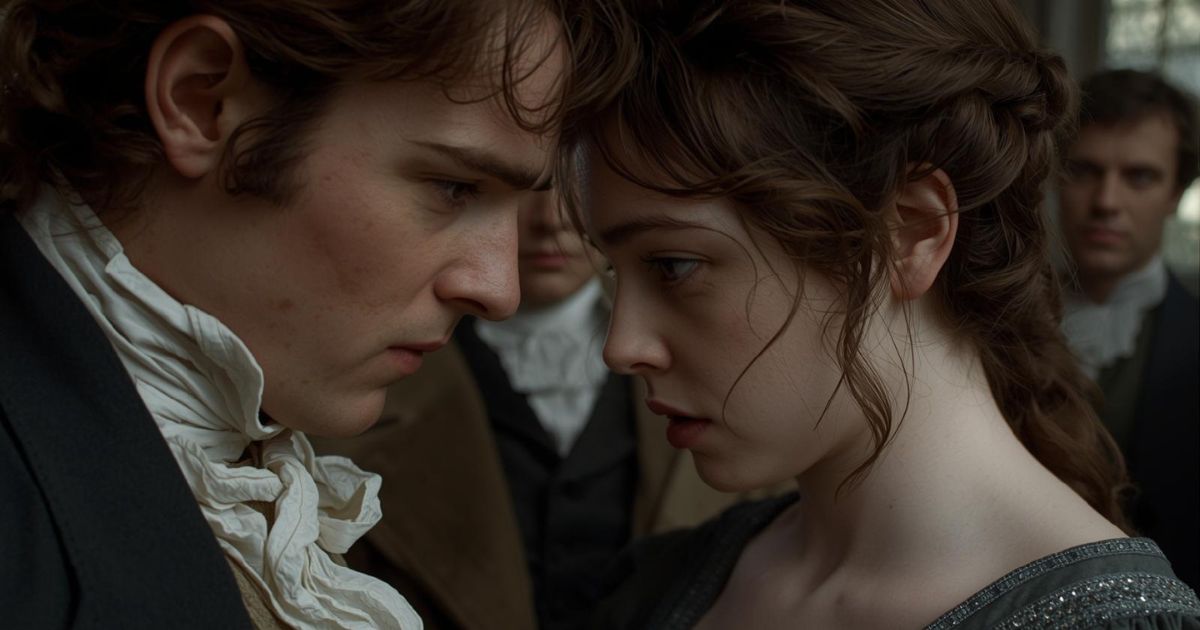
An excerpt from the original text.(complete · 2280 words)
I.
[Illustration]
The first week of their return was soon gone. The second began. It was
the last of the regiment’s stay in Meryton, and all the young ladies in
the neighbourhood were drooping apace. The dejection was almost
universal. The elder Miss Bennets alone were still able to eat, drink,
and sleep, and pursue the usual course of their employments. Very
frequently were they reproached for this insensibility by Kitty and
Lydia, whose own misery was extreme, and who could not comprehend such
hard-heartedness in any of the family.
“Good Heaven! What is to become of us? What are we to do?” would they
often exclaim in the bitterness of woe. “How can you be smiling so,
Lizzy?”
Their affectionate mother shared all their grief; she remembered what
she had herself endured on a similar occasion five-and-twenty years ago.
“I am sure,” said she, “I cried for two days together when Colonel
Miller’s regiment went away. I thought I should have broke my heart.”
“I am sure I shall break mine,” said Lydia.
“If one could but go to Brighton!” observed Mrs. Bennet.
“Oh yes!--if one could but go to Brighton! But papa is so disagreeable.”
“A little sea-bathing would set me up for ever.”
“And my aunt Philips is sure it would do me a great deal of good,”
added Kitty.
Such were the kind of lamentations resounding perpetually through
Longbourn House. Elizabeth tried to be diverted by them; but all sense
of pleasure was lost in shame. She felt anew the justice of Mr. Darcy’s
objections; and never had she before been so much disposed to pardon his
interference in the views of his friend.
But the gloom of Lydia’s prospect was shortly cleared away; for she
received an invitation from Mrs. Forster, the wife of the colonel of the
regiment, to accompany her to Brighton. This invaluable friend was a
very young woman, and very lately married. A resemblance in good-humour
and good spirits had recommended her and Lydia to each other, and out of
their three months’ acquaintance they had been intimate two.
The rapture of Lydia on this occasion, her adoration of Mrs. Forster,
the delight of Mrs. Bennet, and the mortification of Kitty, are scarcely
to be described. Wholly inattentive to her sister’s feelings, Lydia flew
about the house in restless ecstasy, calling for everyone’s
congratulations, and laughing and talking with more violence than ever;
whilst the luckless Kitty continued in the parlour repining at her fate
in terms as unreasonable as her accent was peevish.
“I cannot see why Mrs. Forster should not ask me as well as Lydia,”
said she, “though I am not her particular friend. I have just as much
right to be asked as she has, and more too, for I am two years older.”
In vain did Elizabeth attempt to make her reasonable, and Jane to make
her resigned. As for Elizabeth herself, this invitation was so far from
exciting in her the same feelings as in her mother and Lydia, that she
considered it as the death-warrant of all possibility of common sense
for the latter; and detestable as such a step must make her, were it
known, she could not help secretly advising her father not to let her
go. She represented to him all the improprieties of Lydia’s general
behaviour, the little advantage she could derive from the friendship of
such a woman as Mrs. Forster, and the probability of her being yet more
imprudent with such a companion at Brighton, where the temptations must
be greater than at home. He heard her attentively, and then said,--
“Lydia will never be easy till she has exposed herself in some public
place or other, and we can never expect her to do it with so little
expense or inconvenience to her family as under the present
circumstances.”
“If you were aware,” said Elizabeth, “of the very great disadvantage to
us all, which must arise from the public notice of Lydia’s unguarded and
imprudent manner, nay, which has already arisen from it, I am sure you
would judge differently in the affair.”
“Already arisen!” repeated Mr. Bennet. “What! has she frightened away
some of your lovers? Poor little Lizzy! But do not be cast down. Such
squeamish youths as cannot bear to be connected with a little absurdity
are not worth a regret. Come, let me see the list of the pitiful fellows
who have been kept aloof by Lydia’s folly.”
“Indeed, you are mistaken. I have no such injuries to resent. It is not
of peculiar, but of general evils, which I am now complaining. Our
importance, our respectability in the world, must be affected by the
wild volatility, the assurance and disdain of all restraint which mark
Lydia’s character. Excuse me,--for I must speak plainly. If you, my dear
father, will not take the trouble of checking her exuberant spirits, and
of teaching her that her present pursuits are not to be the business of
her life, she will soon be beyond the reach of amendment. Her character
will be fixed; and she will, at sixteen, be the most determined flirt
that ever made herself and her family ridiculous;--a flirt, too, in the
worst and meanest degree of flirtation; without any attraction beyond
youth and a tolerable person; and, from the ignorance and emptiness of
her mind, wholly unable to ward off any portion of that universal
contempt which her rage for admiration will excite. In this danger Kitty
is also comprehended. She will follow wherever Lydia leads. Vain,
ignorant, idle, and absolutely uncontrolled! Oh, my dear father, can you
suppose it possible that they will not be censured and despised wherever
they are known, and that their sisters will not be often involved in the
disgrace?”
Mr. Bennet saw that her whole heart was in the subject; and,
affectionately taking her hand, said, in reply,--
“Do not make yourself uneasy, my love. Wherever you and Jane are known,
you must be respected and valued; and you will not appear to less
advantage for having a couple of--or I may say, three--very silly
sisters. We shall have no peace at Longbourn if Lydia does not go to
Brighton. Let her go, then. Colonel Forster is a sensible man, and will
keep her out of any real mischief; and she is luckily too poor to be an
object of prey to anybody. At Brighton she will be of less importance
even as a common flirt than she has been here. The officers will find
women better worth their notice. Let us hope, therefore, that her being
there may teach her her own insignificance. At any rate, she cannot grow
many degrees worse, without authorizing us to lock her up for the rest
of her life.”
With this answer Elizabeth was forced to be content; but her own opinion
continued the same, and she left him disappointed and sorry. It was not
in her nature, however, to increase her vexations by dwelling on them.
She was confident of having performed her duty; and to fret over
unavoidable evils, or augment them by anxiety, was no part of her
disposition.
Had Lydia and her mother known the substance of her conference with her
father, their indignation would hardly have found expression in their
united volubility. In Lydia’s imagination, a visit to Brighton comprised
every possibility of earthly happiness. She saw, with the creative eye
of fancy, the streets of that gay bathing-place covered with officers.
She saw herself the object of attention to tens and to scores of them at
present unknown. She saw all the glories of the camp: its tents
stretched forth in beauteous uniformity of lines, crowded with the young
and the gay, and dazzling with scarlet; and, to complete the view, she
saw herself seated beneath a tent, tenderly flirting with at least six
officers at once.
[Illustration:
“Tenderly flirting”
[Copyright 1894 by George Allen.]]
Had she known that her sister sought to tear her from such prospects and
such realities as these, what would have been her sensations? They could
have been understood only by her mother, who might have felt nearly the
same. Lydia’s going to Brighton was all that consoled her for the
melancholy conviction of her husband’s never intending to go there
himself.
But they were entirely ignorant of what had passed; and their raptures
continued, with little intermission, to the very day of Lydia’s leaving
home.
Elizabeth was now to see Mr. Wickham for the last time. Having been
frequently in company with him since her return, agitation was pretty
well over; the agitations of former partiality entirely so. She had even
learnt to detect, in the very gentleness which had first delighted her,
an affectation and a sameness to disgust and weary. In his present
behaviour to herself, moreover, she had a fresh source of displeasure;
for the inclination he soon testified of renewing those attentions which
had marked the early part of their acquaintance could only serve, after
what had since passed, to provoke her. She lost all concern for him in
finding herself thus selected as the object of such idle and frivolous
gallantry; and while she steadily repressed it, could not but feel the
reproof contained in his believing, that however long, and for whatever
cause, his attentions had been withdrawn, her vanity would be gratified,
and her preference secured, at any time, by their renewal.
On the very last day of the regiment’s remaining in Meryton, he dined,
with others of the officers, at Longbourn; and so little was Elizabeth
disposed to part from him in good-humour, that, on his making some
inquiry as to the manner in which her time had passed at Hunsford, she
mentioned Colonel Fitzwilliam’s and Mr. Darcy’s having both spent three
weeks at Rosings, and asked him if he were acquainted with the former.
He looked surprised, displeased, alarmed; but, with a moment’s
recollection, and a returning smile, replied, that he had formerly seen
him often; and, after observing that he was a very gentlemanlike man,
asked her how she had liked him. Her answer was warmly in his favour.
With an air of indifference, he soon afterwards added, “How long did you
say that he was at Rosings?”
“Nearly three weeks.”
“And you saw him frequently?”
“Yes, almost every day.”
“His manners are very different from his cousin’s.”
“Yes, very different; but I think Mr. Darcy improves on acquaintance.”
“Indeed!” cried Wickham, with a look which did not escape her. “And pray
may I ask--” but checking himself, he added, in a gayer tone, “Is it in
address that he improves? Has he deigned to add aught of civility to his
ordinary style? for I dare not hope,” he continued, in a lower and more
serious tone, “that he is improved in essentials.”
“Oh, no!” said Elizabeth. “In essentials, I believe, he is very much
what he ever was.”
While she spoke, Wickham looked as if scarcely knowing whether to
rejoice over her words or to distrust their meaning. There was a
something in her countenance which made him listen with an apprehensive
and anxious attention, while she added,--
“When I said that he improved on acquaintance, I did not mean that
either his mind or manners were in a state of improvement; but that,
from knowing him better, his disposition was better understood.”
Wickham’s alarm now appeared in a heightened complexion and agitated
look; for a few minutes he was silent; till, shaking off his
embarrassment, he turned to her again, and said in the gentlest of
accents,--
“You, who so well know my feelings towards Mr. Darcy, will readily
comprehend how sincerely I must rejoice that he is wise enough to assume
even the appearance of what is right. His pride, in that direction,
may be of service, if not to himself, to many others, for it must deter
him from such foul misconduct as I have suffered by. I only fear that
the sort of cautiousness to which you, I imagine, have been alluding, is
merely adopted on his visits to his aunt, of whose good opinion and
judgment he stands much in awe. His fear of her has always operated, I
know, when they were together; and a good deal is to be imputed to his
wish of forwarding the match with Miss de Bourgh, which I am certain he
has very much at heart.”
Elizabeth could not repress a smile at this, but she answered only by a
slight inclination of the head. She saw that he wanted to engage her on
the old subject of his grievances, and she was in no humour to indulge
him. The rest of the evening passed with the appearance, on his side,
of usual cheerfulness, but with no further attempt to distinguish
Elizabeth; and they parted at last with mutual civility, and possibly a
mutual desire of never meeting again.
When the party broke up, Lydia returned with Mrs. Forster to Meryton,
from whence they were to set out early the next morning. The separation
between her and her family was rather noisy than pathetic. Kitty was the
only one who shed tears; but she did weep from vexation and envy. Mrs.
Bennet was diffuse in her good wishes for the felicity of her daughter,
and impressive in her injunctions that she would not miss the
opportunity of enjoying herself as much as possible,--advice which there
was every reason to believe would be attended to; and, in the clamorous
happiness of Lydia herself in bidding farewell, the more gentle adieus
of her sisters were uttered without being heard.
[Illustration:
The arrival of the
Gardiners
]
Master this chapter. Complete your experience
Purchase the complete book to access all chapters and support classic literature
As an Amazon Associate, we earn a small commission from qualifying purchases at no additional cost to you.
Available in paperback, hardcover, and e-book formats
Let's Analyse the Pattern
Why This Matters
Connect literature to life
This chapter teaches how manipulators use your existing frustrations and biases to control your perception of reality, turning your intelligence against you.
Now let's explore the literary elements.
Key Quotes & Analysis
"How despicably have I acted! I, who have prided myself on my discernment!"
Context: Elizabeth's internal reaction as she realizes how wrong she's been about Darcy and Wickham.
This moment of brutal self-honesty shows Elizabeth's character growth. She's admitting that her pride in being a good judge of character was actually arrogance that blinded her to the truth.
"Till this moment, I never knew myself."
Context: Elizabeth's realization after reading Darcy's letter and confronting her own biases.
This represents the climax of Elizabeth's character development. True self-knowledge requires the painful process of admitting our flaws and examining our motivations honestly.
"I have been a selfish being all my life, in practice, though not in principle."
Context: Elizabeth reflecting on how she's behaved toward others, particularly her sister Jane.
Elizabeth realizes there's a gap between her stated values and her actual behavior. This kind of honest self-examination is necessary for real personal growth and better relationships.
Thematic Threads
Prejudice
In This Chapter
Elizabeth confronts how her biases made her vulnerable to Wickham's manipulation and blind to Darcy's true character
Development
Evolved from surface judgments based on first impressions to deep self-examination of her own flawed reasoning
In Your Life:
When have you realized that your first impression of someone was completely wrong because you let your biases cloud your judgment?
Deception
In This Chapter
Wickham's calculated lies are fully exposed—he targeted both Elizabeth and Georgiana through emotional manipulation
Development
Revealed as systematic predatory behavior, not just casual dishonesty
In Your Life:
Have you ever been deceived by someone who seemed charming but was actually manipulating you for their own gain?
Personal Growth
In This Chapter
Elizabeth's brutal self-assessment: 'blind, partial, prejudiced, absurd'—she takes full responsibility for her errors
Development
Major breakthrough from defensive pride to genuine self-reflection and accountability
In Your Life:
Can you think of a time when you had to admit you were completely wrong about something important and take full responsibility for your mistake?
Truth vs Perception
In This Chapter
The letter forces Elizabeth to distinguish between what actually happened and what she believed happened
Development
Introduced as central conflict—reality versus the stories we tell ourselves
In Your Life:
What's a situation where you discovered the 'facts' you believed were actually just your own interpretation of events?
Protection
In This Chapter
Darcy's actions toward Georgiana and Bingley reframed as protective rather than controlling
Development
Shifts from seeming arrogance to revealed caring—context changes everything
In Your Life:
Have you ever misjudged someone's controlling behavior, only to later realize they were actually trying to protect you or others?
You now have the context. Time to form your own thoughts.
Discussion Questions
- 1
What specific information does Darcy reveal in his letter that completely changes Elizabeth's understanding of both him and Wickham?
- 2
Why was Elizabeth so ready to believe Wickham's version of events over Darcy's character, even though she barely knew Wickham?
- 3
Think about a time when you heard one side of a workplace conflict or family drama first - how did that shape your opinion of everyone involved?
- 4
If you were Elizabeth's friend, what questions would you have encouraged her to ask before deciding Wickham was trustworthy and Darcy was terrible?
- 5
What does Elizabeth's reaction to the letter teach us about the difference between being smart and being wise?
Critical Thinking Exercise
Audit Your Information Sources
Think of a strong opinion you hold about someone you don't know personally - maybe a public figure, coworker, or family member's ex. Write down what you 'know' about them, then trace each piece of information back to its source. Who told you this information, and what might have motivated them to share this particular version of events?
Consider:
- •Notice which sources had something to gain from you believing their version
- •Identify information that came from people who were emotionally invested in the outcome
- •Consider what questions you never thought to ask because the first story seemed so complete
Coming Up Next...
Chapter 42
With Lydia gone to Brighton and the immediate crisis temporarily delayed, Elizabeth prepares for a trip with the Gardiners. But Lydia's absence won't last long, and the consequences of Mr. Bennet's negligence are building toward explosion.