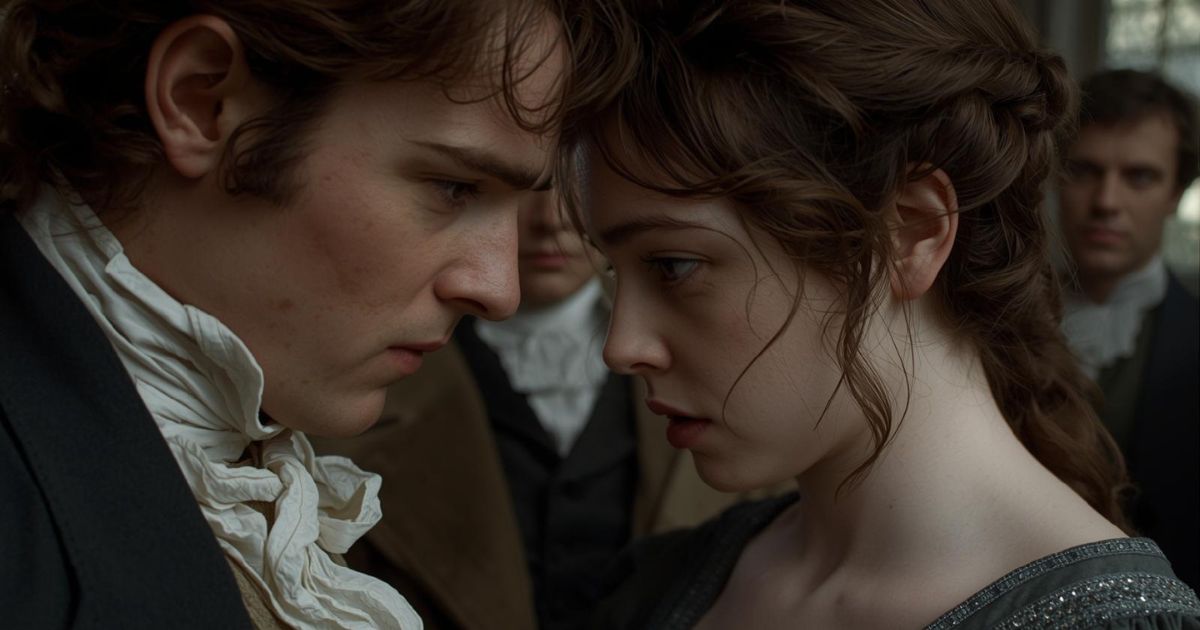
An excerpt from the original text.(complete · 1928 words)
[llustration]
Miss Bingley’s letter arrived, and put an end to doubt. The very first
sentence conveyed the assurance of their being all settled in London for
the winter, and concluded with her brother’s regret at not having had
time to pay his respects to his friends in Hertfordshire before he left
the country.
Hope was over, entirely over; and when Jane could attend to the rest of
the letter, she found little, except the professed affection of the
writer, that could give her any comfort. Miss Darcy’s praise occupied
the chief of it. Her many attractions were again dwelt on; and Caroline
boasted joyfully of their increasing intimacy, and ventured to predict
the accomplishment of the wishes which had been unfolded in her former
letter. She wrote also with great pleasure of her brother’s being an
inmate of Mr. Darcy’s house, and mentioned with raptures some plans of
the latter with regard to new furniture.
Elizabeth, to whom Jane very soon communicated the chief of all this,
heard it in silent indignation. Her heart was divided between concern
for her sister and resentment against all others. To Caroline’s
assertion of her brother’s being partial to Miss Darcy, she paid no
credit. That he was really fond of Jane, she doubted no more than she
had ever done; and much as she had always been disposed to like him, she
could not think without anger, hardly without contempt, on that easiness
of temper, that want of proper resolution, which now made him the slave
of his designing friends, and led him to sacrifice his own happiness to
the caprice of their inclinations. Had his own happiness, however, been
the only sacrifice, he might have been allowed to sport with it in
whatever manner he thought best; but her sister’s was involved in it, as
she thought he must be sensible himself. It was a subject, in short, on
which reflection would be long indulged, and must be unavailing. She
could think of nothing else; and yet, whether Bingley’s regard had
really died away, or were suppressed by his friends’ interference;
whether he had been aware of Jane’s attachment, or whether it had
escaped his observation; whichever were the case, though her opinion of
him must be materially affected by the difference, her sister’s
situation remained the same, her peace equally wounded.
A day or two passed before Jane had courage to speak of her feelings to
Elizabeth; but at last, on Mrs. Bennet’s leaving them together, after a
longer irritation than usual about Netherfield and its master, she could
not help saying,--
“O that my dear mother had more command over herself! she can have no
idea of the pain she gives me by her continual reflections on him. But I
will not repine. It cannot last long. He will be forgot, and we shall
all be as we were before.”
Elizabeth looked at her sister with incredulous solicitude, but said
nothing.
“You doubt me,” cried Jane, slightly colouring; “indeed, you have no
reason. He may live in my memory as the most amiable man of my
acquaintance but that is all. I have nothing either to hope or fear, and
nothing to reproach him with. Thank God I have not that pain. A little
time, therefore--I shall certainly try to get the better----”
With a stronger voice she soon added, “I have this comfort immediately,
that it has not been more than an error of fancy on my side, and that it
has done no harm to anyone but myself.”
“My dear Jane,” exclaimed Elizabeth, “you are too good. Your sweetness
and disinterestedness are really angelic; I do not know what to say to
you. I feel as if I had never done you justice, or loved you as you
deserve.”
Miss Bennet eagerly disclaimed all extraordinary merit, and threw back
the praise on her sister’s warm affection.
“Nay,” said Elizabeth, “this is not fair. You wish to think all the
world respectable, and are hurt if I speak ill of anybody. I only want
to think you perfect, and you set yourself against it. Do not be
afraid of my running into any excess, of my encroaching on your
privilege of universal good-will. You need not. There are few people
whom I really love, and still fewer of whom I think well. The more I see
of the world the more am I dissatisfied with it; and every day confirms
my belief of the inconsistency of all human characters, and of the
little dependence that can be placed on the appearance of either merit
or sense. I have met with two instances lately: one I will not mention,
the other is Charlotte’s marriage. It is unaccountable! in every view it
is unaccountable!”
“My dear Lizzy, do not give way to such feelings as these. They will
ruin your happiness. You do not make allowance enough for difference of
situation and temper. Consider Mr. Collins’s respectability, and
Charlotte’s prudent, steady character. Remember that she is one of a
large family; that as to fortune it is a most eligible match; and be
ready to believe, for everybody’s sake, that she may feel something like
regard and esteem for our cousin.”
“To oblige you, I would try to believe almost anything, but no one else
could be benefited by such a belief as this; for were I persuaded that
Charlotte had any regard for him, I should only think worse of her
understanding than I now do of her heart. My dear Jane, Mr. Collins is a
conceited, pompous, narrow-minded, silly man: you know he is, as well as
I do; and you must feel, as well as I do, that the woman who marries him
cannot have a proper way of thinking. You shall not defend her, though
it is Charlotte Lucas. You shall not, for the sake of one individual,
change the meaning of principle and integrity, nor endeavour to persuade
yourself or me, that selfishness is prudence, and insensibility of
danger security for happiness.”
“I must think your language too strong in speaking of both,” replied
Jane; “and I hope you will be convinced of it, by seeing them happy
together. But enough of this. You alluded to something else. You
mentioned two instances. I cannot misunderstand you, but I entreat
you, dear Lizzy, not to pain me by thinking that person to blame, and
saying your opinion of him is sunk. We must not be so ready to fancy
ourselves intentionally injured. We must not expect a lively young man
to be always so guarded and circumspect. It is very often nothing but
our own vanity that deceives us. Women fancy admiration means more than
it does.”
“And men take care that they should.”
“If it is designedly done, they cannot be justified; but I have no idea
of there being so much design in the world as some persons imagine.”
“I am far from attributing any part of Mr. Bingley’s conduct to design,”
said Elizabeth; “but, without scheming to do wrong, or to make others
unhappy, there may be error and there may be misery. Thoughtlessness,
want of attention to other people’s feelings, and want of resolution,
will do the business.”
“And do you impute it to either of those?”
“Yes; to the last. But if I go on I shall displease you by saying what I
think of persons you esteem. Stop me, whilst you can.”
“You persist, then, in supposing his sisters influence him?”
“Yes, in conjunction with his friend.”
“I cannot believe it. Why should they try to influence him? They can
only wish his happiness; and if he is attached to me no other woman can
secure it.”
“Your first position is false. They may wish many things besides his
happiness: they may wish his increase of wealth and consequence; they
may wish him to marry a girl who has all the importance of money, great
connections, and pride.”
“Beyond a doubt they do wish him to choose Miss Darcy,” replied Jane;
“but this may be from better feelings than you are supposing. They have
known her much longer than they have known me; no wonder if they love
her better. But, whatever may be their own wishes, it is very unlikely
they should have opposed their brother’s. What sister would think
herself at liberty to do it, unless there were something very
objectionable? If they believed him attached to me they would not try to
part us; if he were so, they could not succeed. By supposing such an
affection, you make everybody acting unnaturally and wrong, and me most
unhappy. Do not distress me by the idea. I am not ashamed of having been
mistaken--or, at least, it is slight, it is nothing in comparison of
what I should feel in thinking ill of him or his sisters. Let me take it
in the best light, in the light in which it may be understood.”
Elizabeth could not oppose such a wish; and from this time Mr. Bingley’s
name was scarcely ever mentioned between them.
Mrs. Bennet still continued to wonder and repine at his returning no
more; and though a day seldom passed in which Elizabeth did not account
for it clearly, there seemed little chance of her ever considering it
with less perplexity. Her daughter endeavoured to convince her of what
she did not believe herself, that his attentions to Jane had been merely
the effect of a common and transient liking, which ceased when he saw
her no more; but though the probability of the statement was admitted at
the time, she had the same story to repeat every day. Mrs. Bennet’s best
comfort was, that Mr. Bingley must be down again in the summer.
Mr. Bennet treated the matter differently. “So, Lizzy,” said he, one
day, “your sister is crossed in love, I find. I congratulate her. Next
to being married, a girl likes to be crossed in love a little now and
then. It is something to think of, and gives her a sort of distinction
among her companions. When is your turn to come? You will hardly bear to
be long outdone by Jane. Now is your time. Here are officers enough at
Meryton to disappoint all the young ladies in the country. Let Wickham
be your man. He is a pleasant fellow, and would jilt you creditably.”
“Thank you, sir, but a less agreeable man would satisfy me. We must not
all expect Jane’s good fortune.”
“True,” said Mr. Bennet; “but it is a comfort to think that, whatever of
that kind may befall you, you have an affectionate mother who will
always make the most of it.”
Mr. Wickham’s society was of material service in dispelling the gloom
which the late perverse occurrences had thrown on many of the Longbourn
family. They saw him often, and to his other recommendations was now
added that of general unreserve. The whole of what Elizabeth had already
heard, his claims on Mr. Darcy, and all that he had suffered from him,
was now openly acknowledged and publicly canvassed; and everybody was
pleased to think how much they had always disliked Mr. Darcy before they
had known anything of the matter.
Miss Bennet was the only creature who could suppose there might be any
extenuating circumstances in the case unknown to the society of
Hertfordshire: her mild and steady candour always pleaded for
allowances, and urged the possibility of mistakes; but by everybody else
Mr. Darcy was condemned as the worst of men.
[Illustration]
Master this chapter. Complete your experience
Purchase the complete book to access all chapters and support classic literature
As an Amazon Associate, we earn a small commission from qualifying purchases at no additional cost to you.
Available in paperback, hardcover, and e-book formats
Let's Analyse the Pattern
Why This Matters
Connect literature to life
This chapter teaches how individual actions ripple through connected systems, showing that personal success requires understanding and managing family and professional networks.
Now let's explore the literary elements.
Key Quotes & Analysis
"She could think of nothing but of letters; and when they were all seated, and she looked anxiously round, she saw that her uncle's countenance did not give her one favourable hope."
Context: Elizabeth anxiously waits for news about Lydia after receiving Jane's letter
This shows Elizabeth's growing maturity - she's learned to read people's faces and understand that bad news often comes in the expressions of others before words are spoken.
"When I consider how little way you have been into the world, I am amazed at your good sense."
Context: Writing to Elizabeth about her mature handling of difficult situations
This acknowledges Elizabeth's emotional growth and wisdom despite her youth. It shows how crisis can accelerate maturity and how others recognize her development.
"Never had she so honestly felt that she could have loved him, as now, when all love must be vain."
Context: Elizabeth realizes her true feelings for Darcy just as the family scandal makes their union impossible
This captures the painful irony of personal growth - Elizabeth finally understands her heart just when external circumstances seem to make happiness impossible.
Thematic Threads
Family Systems
In This Chapter
Lydia's elopement threatens Elizabeth's future despite Elizabeth's personal growth
Development
Evolved from earlier focus on individual relationships to systemic family impact
In Your Life:
How has a family member's poor choices or mistakes affected your own opportunities or relationships, even when you had no control over their actions?
Reputation
In This Chapter
One family member's scandal contaminates everyone's social standing
Development
Intensified from subtle social judgment to potential life-altering consequences
In Your Life:
When has someone else's scandal or controversy impacted your reputation at work, school, or in your community simply because you were associated with them?
Personal Growth
In This Chapter
Elizabeth's transformation feels meaningless when external forces threaten her opportunities
Development
Reached peak maturity but now faces test of whether growth survives crisis
In Your Life:
Have you ever felt like your personal growth and positive changes were overshadowed or made irrelevant by circumstances completely outside your control?
Class Barriers
In This Chapter
Scandal makes marriage across class lines impossible regardless of personal merit
Development
Evolved from subtle social pressure to absolute barrier
In Your Life:
What social or economic barriers have you encountered that seemed insurmountable regardless of your qualifications, character, or personal achievements?
Timing
In This Chapter
Elizabeth finally understands love just as circumstances make it impossible
Development
Culmination of missed timing throughout the story
In Your Life:
When have you finally been ready for an opportunity or relationship just as external circumstances made it impossible to pursue?
You now have the context. Time to form your own thoughts.
Discussion Questions
- 1
What two pieces of devastating news does Elizabeth receive, and how do they threaten her family's future?
- 2
Why does Lydia's elopement make Elizabeth feel that any future with Darcy is now impossible, even though her feelings about him have completely changed?
- 3
Think about your own workplace or community - how have you seen one person's actions affect everyone else's reputation or opportunities?
- 4
If you were Elizabeth, how would you try to protect your family's reputation while also pursuing your own happiness and growth?
- 5
What does this chapter reveal about the tension between individual responsibility and family loyalty - and how much control we really have over our own destinies?
Critical Thinking Exercise
Map Your Reputation Risk Network
Draw a simple map of the people whose actions could significantly impact your reputation, job prospects, or opportunities - family members, roommates, close colleagues, business partners. For each person, identify one specific risk they pose and one protective boundary you could establish. This isn't about cutting people off, but about recognizing where you're vulnerable and planning accordingly.
Consider:
- •Consider both professional and personal reputation risks - they often overlap in ways we don't anticipate
- •Think about which relationships give others the most power to affect your standing in your community or industry
- •Focus on realistic boundaries you can actually implement, not dramatic ultimatums that would damage important relationships
Coming Up Next...
Chapter 25
Elizabeth must face her family's crisis head-on, but an unexpected ally may emerge from the most surprising quarter. Sometimes help comes from those we least expect.