
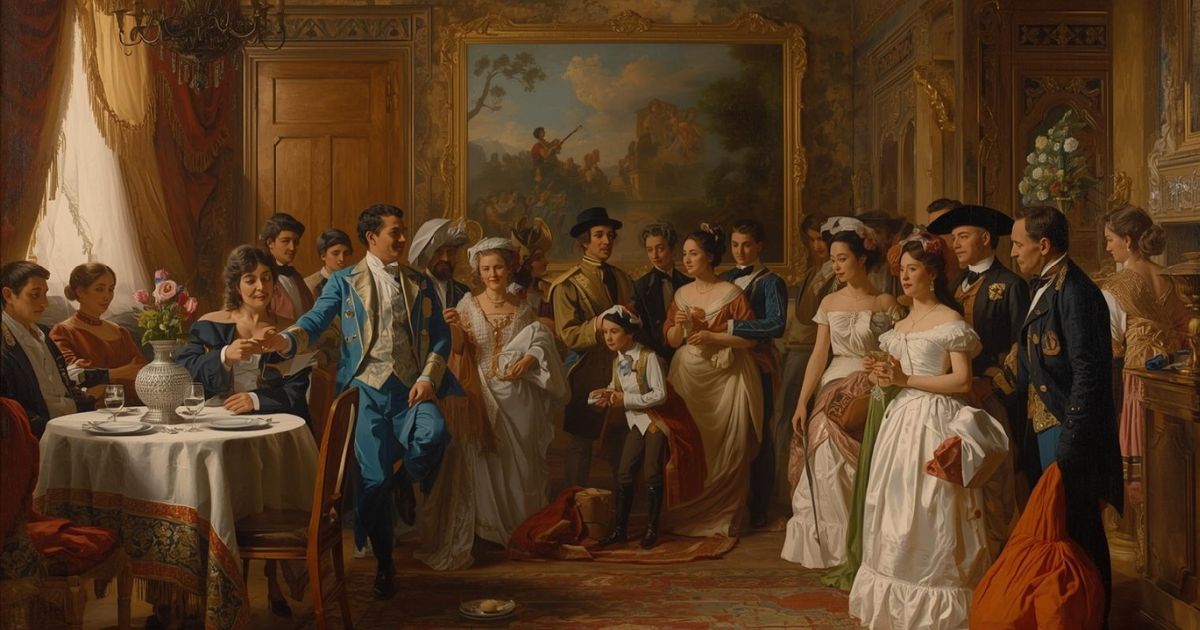
An excerpt from the original text.(complete · 4339 words)
apitan Tiago
Thy will be done on earth.
While our characters are deep in slumber or busy with their breakfasts,
let us turn our attention to Capitan Tiago. We have never had the
honor of being his guest, so it is neither our right nor our duty to
pass him by slightingly, even under the stress of important events.
Low in stature, with a clear complexion, a corpulent figure and a
full face, thanks to the liberal supply of fat which according to his
admirers was the gift of Heaven and which his enemies averred was the
blood of the poor, Capitan Tiago appeared to be younger than he really
was; he might have been thought between thirty and thirty-five years of
age. At the time of our story his countenance always wore a sanctified
look; his little round head, covered with ebony-black hair cut long in
front and short behind, was reputed to contain many things of weight;
his eyes, small but with no Chinese slant, never varied in expression;
his nose was slender and not at all inclined to flatness; and if his
mouth had not been disfigured by the immoderate use of tobacco and
buyo, which, when chewed and gathered in one cheek, marred the symmetry
of his features, we would say that he might properly have considered
himself a handsome man and have passed for such. Yet in spite of this
bad habit he kept marvelously white both his natural teeth and also
the two which the dentist furnished him at twelve pesos each.
He was considered one of the richest landlords in Binondo and a
planter of some importance by reason of his estates in Pampanga and
Laguna, principally in the town of San Diego, the income from which
increased with each year. San Diego, on account of its agreeable
baths, its famous cockpit, and his cherished memories of the place,
was his favorite town, so that he spent at least two months of the year
there. His holdings of real estate in the city were large, and it is
superfluous to state that the opium monopoly controlled by him and a
Chinese brought in large profits. They also had the lucrative contract
of feeding the prisoners in Bilibid and furnished zacate to many of the
stateliest establishments in Manila u through the medium of contracts,
of course. Standing well with all the authorities, clever, cunning,
and even bold in speculating upon the wants of others, he was the only
formidable rival of a certain Perez in the matter of the farming-out of
revenues and the sale of offices and appointments, which the Philippine
government always confides to private persons. Thus, at the time of
the events here narrated, Capitan Tiago was a happy man in so far as
it is possible for a narrow-brained individual to be happy in such
a land: he was rich, and at peace with God, the government, and men.
That he was at peace with God was beyond doubt,--almost like religion
itself. There is no need to be on bad terms with the good God when one
is prosperous on earth, when one has never had any direct dealings with
Him and has never lent Him any money. Capitan Tiago himself had never
offered any prayers to Him, even in his greatest difficulties, for
he was rich and his gold prayed for him. For masses and supplications
high and powerful priests had been created; for novenas and rosaries
God in His infinite bounty had created the poor for the service of
the rich--the poor who for a peso could be secured to recite sixteen
mysteries and to read all the sacred books, even the Hebrew Bible, for
a little extra. If at any time in the midst of pressing difficulties
he needed celestial aid and had not at hand even a red Chinese taper,
he would call upon his most adored saints, promising them many things
for the purpose of putting them under obligation to him and ultimately
convincing them of the righteousness of his desires.
The saint to whom he promised the most, and whose promises he was
the most faithful in fulfilling, was the Virgin of Antipolo, Our
Lady of Peace and Prosperous Voyages. [32] With many of the lesser
saints he was not very punctual or even decent; and sometimes,
after having his petitions granted, he thought no more about them,
though of course after such treatment he did not bother them again,
when occasion arose. Capitan Tiago knew that the calendar was full of
idle saints who perhaps had nothing wherewith to occupy their time up
there in heaven. Furthermore, to the Virgin of Antipolo he ascribed
greater power and efficiency than to all the other Virgins combined,
whether they carried silver canes, naked or richly clothed images of
the Christ Child, scapularies, rosaries, or girdles. Perhaps this
reverence was owing to the fact that she was a very strict Lady,
watchful of her name, and, according to the senior sacristan of
Antipolo, an enemy of photography. When she was angered she turned
black as ebony, while the other Virgins were softer of heart and more
indulgent. It is a well-known fact that some minds love an absolute
monarch rather than a constitutional one, as witness Louis XIV and
Louis XVI, Philip II and Amadeo I. This fact perhaps explains why
infidel Chinese and even Spaniards may be seen kneeling in the famous
sanctuary; what is not explained is why the priests run away with
the money of the terrible Image, go to America, and get married there.
In the sala of Capitan Tiago's house, that door, hidden by a silk
curtain leads to a small chapel or oratory such as must be lacking
in no Filipino home. There were placed his household gods--and we
say "gods" because he was inclined to polytheism rather than to
monotheism, which he had never come to understand. There could be
seen images of the Holy Family with busts and extremities of ivory,
glass eyes, long eyelashes, and curly blond hair--masterpieces of
Santa Cruz sculpture. Paintings in oil by artists of Paco and Ermita
[33] represented martyrdoms of saints and miracles of the Virgin;
St. Lucy gazing at the sky and carrying in a plate an extra pair
of eyes with lashes and eyebrows, such as are seen painted in the
triangle of the Trinity or on Egyptian tombs; St. Pascual Bailon;
St. Anthony of Padua in a guingón habit looking with tears upon a
Christ Child dressed as a Captain-General with the three-cornered hat,
sword, and boots, as in the children's ball at Madrid that character
is represented--which signified for Capitan Tiago that while God
might include in His omnipotence the power of a Captain-General of
the Philippines, the Franciscans would nevertheless play with Him
as with a doll. There, might also be seen a St. Anthony the Abbot
with a hog by his side, a hog that for the worthy Capitan was as
miraculous as the saint himself, for which reason he never dared to
refer to it as the hog, but as the creature of holy St. Anthony;
a St. Francis of Assisi in a coffee-colored robe and with seven
wings, placed over a St. Vincent who had only two but in compensation
carried a trumpet; a St. Peter the Martyr with his head split open
by the talibon of an evil-doer and held fast by a kneeling infidel,
side by side with another St. Peter cutting off the ear of a Moro,
Malchus [34] no doubt, who was gnawing his lips and writhing with
pain, while a fighting-cock on a doric column crowed and flapped his
wings--from all of which Capitan Tiago deduced that in order to be
a saint it was just as well to smite as to be smitten.
Who could enumerate that army of images and recount the virtues and
perfections that were treasured there! A whole chapter would hardly
suffice. Yet we must not pass over in silence a beautiful St. Michael
of painted and gilded wood almost four feet high. The Archangel
is biting his lower lip and with flashing eyes, frowning forehead,
and rosy cheeks is grasping a Greek shield and brandishing in his
right hand a Sulu kris, ready, as would appear from his attitude and
expression, to smite a worshiper or any one else who might approach,
rather than the horned and tailed devil that had his teeth set in
his girlish leg.
Capitan Tiago never went near this image from fear of a miracle. Had
not other images, even those more rudely carved ones that issue from
the carpenter shops of Paete, [35] many times come to life for the
confusion and punishment of incredulous sinners? It is a well-known
fact that a certain image of Christ in Spain, when invoked as a witness
of promises of love, had assented with a movement of the head in the
presence of the judge, and that another such image had reached out its
right arm to embrace St. Lutgarda. And furthermore, had he not himself
read a booklet recently published about a mimic sermon preached by an
image of St. Dominic in Soriano? True, the saint had not said a single
word, but from his movements it was inferred, at any rate the author of
the booklet inferred, that he was announcing the end of the world. [36]
Was it not reported, too, that the Virgin of Luta in the town of Lipa
had one cheek swollen larger than the other and that there was mud
on the borders of her gown? Does not this prove mathematically that
the holy images also walk about without holding up their skirts and
that they even suffer from the toothache, perhaps for our sake? Had
he not seen with his own eyes, during the regular Good-Friday sermon,
all the images of Christ move and bow their heads thrice in unison,
thereby calling forth wails and cries from the women and other
sensitive souls destined for Heaven? More? We ourselves have seen
the preacher show to the congregation at the moment of the descent
from the cross a handkerchief stained with blood, and were ourselves
on the point of weeping piously, when, to the sorrow of our soul, a
sacristan assured us that it was all a joke, that the blood was that
of a chicken which had been roasted and eaten on the spot in spite
of the fact that it was Good Friday--and the sacristan was fat! So
Capitan Tiago, even though he was a prudent and pious individual,
took care not to approach the kris of St. Michael. "Let's take no
chances," he would say to himself, "I know that he's an archangel,
but I don't trust him, no, I don't trust him."
Not a year passed without his joining with an orchestra in the
pilgrimage to the wealthy shrine of Antipolo. He paid for two
thanksgiving masses of the many that make up the three novenas,
and also for the days when there are no novenas, and washed himself
afterwards in the famous bátis, or pool, where the sacred Image
herself had bathed. Her votaries can even yet discern the tracks of
her feet and the traces of her locks in the hard rock, where she dried
them, resembling exactly those made by any woman who uses coconut-oil,
and just as if her hair had been steel or diamonds and she had weighed
a thousand tons. We should like to see the terrible Image once shake
her sacred hair in the eyes of those credulous persons and put her
foot upon their tongues or their heads. There at the very edge of the
pool Capitan Tiago made it his duty to eat roast pig, sinigang of
dalag with alibambang leaves, and other more or less appetizing
dishes. The two masses would cost him over four hundred pesos, but
it was cheap, after all, if one considered the glory that the Mother
of the Lord would acquire from the pin-wheels, rockets, bombs, and
mortars, and also the increased profits which, thanks to these masses,
would come to one during the year.
But Antipolo was not the only theater of his ostentatious devotion. In
Binondo, in Pampanga, and in the town of San Diego, when he was about
to put up a fighting-cock with large wagers, he would send gold moneys
to the curate for propitiatory masses and, just as the Romans consulted
the augurs before a battle, giving food to the sacred fowls, so Capitan
Tiago would also consult his augurs, with the modifications befitting
the times and the new truths, tie would watch closely the flame of
the tapers, the smoke from the incense, the voice of the priest,
and from it all attempt to forecast his luck. It was an admitted
fact that he lost very few wagers, and in those cases it was due to
the unlucky circumstance that the officiating priest was hoarse,
or that the altar-candles were few or contained too much tallow,
or that a bad piece of money had slipped in with the rest. The
warden of the Brotherhood would then assure him that such reverses
were tests to which he was subjected by Heaven to receive assurance
of his fidelity and devotion. So, beloved by the priests, respected
by the sacristans, humored by the Chinese chandlers and the dealers
in fireworks, he was a man happy in the religion of this world, and
persons of discernment and great piety even claimed for him great
influence in the celestial court.
That he was at peace with the government cannot be doubted, however
difficult an achievement it may seem. Incapable of any new idea and
satisfied with his modus vivendi, he was ever ready to gratify
the desires of the last official of the fifth class in every one of
the offices, to make presents of hams, capons, turkeys, and Chinese
fruits at all seasons of the year. If he heard any one speak ill of
the natives, he, who did not consider himself as such, would join in
the chorus and speak worse of them; if any one aspersed the Chinese or
Spanish mestizos, he would do the same, perhaps because he considered
himself become a full-blooded Iberian. He was ever first to talk in
favor of any new imposition of taxes, or special assessment, especially
when he smelled a contract or a farming assignment behind it. He always
had an orchestra ready for congratulating and serenading the governors,
judges, and other officials on their name-days and birthdays, at the
birth or death of a relative, and in fact at every variation from the
usual monotony. For such occasions he would secure laudatory poems
and hymns in which were celebrated "the kind and loving governor,"
"the brave and courageous judge for whom there awaits in heaven the
palm of the just," with many other things of the same kind.
He was the president of the rich guild of mestizos in spite of
the protests of many of them, who did not regard him as one of
themselves. In the two years that he held this office he wore out ten
frock coats, an equal number of high hats, and half a dozen canes. The
frock coat and the high hat were in evidence at the Ayuntamiento,
in the governor-general's palace, and at military headquarters; the
high hat and the frock coat might have been noticed in the cockpit,
in the market, in the processions, in the Chinese shops, and under the
hat and within the coat might have been seen the perspiring Capitan
Tiago, waving his tasseled cane, directing, arranging, and throwing
everything into disorder with marvelous activity and a gravity even
more marvelous.
So the authorities saw in him a safe man, gifted with the best of
dispositions, peaceful, tractable, and obsequious, who read no books
or newspapers from Spain, although he spoke Spanish well. Indeed,
they rather looked upon him with the feeling with which a poor student
contemplates the worn-out heel of his old shoe, twisted by his manner
of walking. In his case there was truth in both the Christian and
profane proverbs beati pauperes spiritu and beati possidentes,
[37] and there might well be applied to him that translation,
according to some people incorrect, from the Greek, "Glory to God
in the highest and peace to men of good-will on earth!" even though
we shall see further along that it is not sufficient for men to have
good-will in order to live in peace.
The irreverent considered him a fool, the poor regarded him
as a heartless and cruel exploiter of misery and want, and his
inferiors saw in him a despot and a tyrant. As to the women, ah,
the women! Accusing rumors buzzed through the wretched nipa huts,
and it was said that wails and sobs might be heard mingled with the
weak cries of an infant. More than one young woman was pointed out by
her neighbors with the finger of scorn: she had a downcast glance and
a faded cheek. But such things never robbed him of sleep nor did any
maiden disturb his peace. It was an old woman who made him suffer,
an old woman who was his rival in piety and who had gained from many
curates such enthusiastic praises and eulogies as he in his best days
had never received.
Between Capitan Tiago and this widow, who had inherited from brothers
and cousins, there existed a holy rivalry which redounded to the
benefit of the Church as the competition among the Pampanga steamers
then redounded to the benefit of the public. Did Capitan Tiago present
to some Virgin a silver wand ornamented with emeralds and topazes? At
once Doña Patrocinio had ordered another of gold set with diamonds! If
at the time of the Naval procession [38] Capitan Tiago erected an
arch with two façades, covered with ruffled cloth and decorated with
mirrors, glass globes, and chandeliers, then Doña Patrocinio would
have another with four facades, six feet higher, and more gorgeous
hangings. Then he would fall back on his reserves, his strong point,
his specialty--masses with bombs and fireworks; whereat Doña Patrocinia
could only gnaw at her lips with her toothless gums, because, being
exceedingly nervous, she could not endure the chiming of the bells and
still less the explosions of the bombs. While he smiled in triumph,
she would plan her revenge and pay the money of others to secure the
best orators of the five Orders in Manila, the most famous preachers
of the Cathedral, and even the Paulists, [39] to preach on the holy
days upon profound theological subjects to the sinners who understood
only the vernacular of the mariners. The partizans of Capitan Tiago
would observe that she slept during the sermon; but her adherents
would answer that the sermon was paid for in advance, and by her,
and that in any affair payment was the prime requisite. At length,
she had driven him from the field completely by presenting to the
church three andas of gilded silver, each one of which cost her
over three thousand pesos. Capitan Tiago hoped that the old woman
would breathe her last almost any day, or that she would lose five or
six of her lawsuits, so that he might be alone in serving God; but
unfortunately the best lawyers of the Real Audiencia looked after
her interests, and as to her health, there was no part of her that
could be attacked by sickness; she seemed to be a steel wire, no doubt
for the edification of souls, and she hung on in this vale of tears
with the tenacity of a boil on the skin. Her adherents were secure in
the belief that she would be canonized at her death and that Capitan
Tiago himself would have to worship her at the altars--all of which
he agreed to and cheerfully promised, provided only that she die soon.
Such was Capitan Tiago in the days of which we write. As for the past,
he was the only son of a sugar-planter of Malabon, wealthy enough,
but so miserly that he would not spend a cent to educate his son,
for which reason the little Santiago had been the servant of a good
Dominican, a worthy man who had tried to train him in all of good
that he knew and could teach. When he had reached the happy stage
of being known among his acquaintances as a logician, that is,
when he began to study logic, the death of his protector, soon
followed by that of his father, put an end to his studies and he
had to turn his attention to business affairs. He married a pretty
young woman of Santa Cruz, who gave him social position and helped
him to make his fortune. Doña Pia Alba was not satisfied with buying
and selling sugar, indigo, and coffee, but wished to plant and reap,
so the newly-married couple bought land in San Diego. From this time
dated their friendship with Padre Damoso and with Don Rafael Ibarra,
the richest capitalist of the town.
The lack of an heir in the first six years of their wedded life
made of that eagerness to accumulate riches almost a censurable
ambition. Doña Pia was comely, strong, and healthy, yet it was in
vain that she offered novenas and at the advice of the devout women
of San Diego made a pilgrimage to the Virgin of Kaysaysay [40] in
Taal, distributed alms to the poor, and danced at midday in May in
the procession of the Virgin of Turumba [41] in Pakil. But it was all
with no result until Fray Damaso advised her to go to Obando to dance
in the fiesta of St. Pascual Bailon and ask him for a son. Now it
is well known that there is in Obando a trinity which grants sons or
daughters according to request--Our Lady of Salambaw, St. Clara, and
St. Pascual. Thanks to this wise advice, Doña Pia soon recognized the
signs of approaching motherhood. But alas! like the fisherman of whom
Shakespeare tells in Macbeth, who ceased to sing when he had found a
treasure, she at once lost all her mirthfulness, fell into melancholy,
and was never seen to smile again. "Capriciousness, natural in her
condition," commented all, even Capitan Tiago. A puerperal fever put
an end to her hidden grief, and she died, leaving behind a beautiful
girl baby for whom Fray Damaso himself stood sponsor. As St. Pascual
had not granted the son that was asked, they gave the child the name
of Maria Clara, in honor of the Virgin of Salambaw and St. Clara,
punishing the worthy St. Pascual with silence.
The little girl grew up under the care of her aunt Isabel, that good
old lady of monkish urbanity whom we met at the beginning of the
story. For the most part, her early life was spent in San Diego, on
account of its healthful climate, and there Padre Damaso was devoted
to her.
Maria Clara had not the small eyes of her father; like her mother,
she had eyes large, black, long-lashed, merry and smiling when she
was playing but sad, deep, and pensive in moments of repose. As a
child her hair was curly and almost blond, her straight nose was
neither too pointed nor too flat, while her mouth with the merry
dimples at the corners recalled the small and pleasing one of her
mother, her skin had the fineness of an onion-cover and was white as
cotton, according to her perplexed relatives, who found the traces
of Capitan Tiago's paternity in her small and shapely ears. Aunt
Isabel ascribed her half-European features to the longings of Doña
Pia, whom she remembered to have seen many times weeping before
the image of St. Anthony. Another cousin was of the same opinion,
differing only in the choice of the smut, as for her it was either
the Virgin herself or St. Michael. A famous philosopher, who was
the cousin of Capitan Tinong and who had memorized the "Amat," [42]
sought for the true explanation in planetary influences.
The idol of all, Maria Clara grew up amidst smiles and love. The
very friars showered her with attentions when she appeared in the
processions dressed in white, her abundant hair interwoven with
tuberoses and sampaguitas, with two diminutive wings of silver and
gold fastened on the back of her gown, and carrying in her hands a
pair of white doves tied with blue ribbons. Afterwards, she would
be so merry and talk so sweetly in her childish simplicity that the
enraptured Capitan Tiago could do nothing but bless the saints of
Obando and advise every one to purchase beautiful works of sculpture.
In southern countries the girl of thirteen or fourteen years
changes into a woman as the bud of the night becomes a flower in the
morning. At this period of change, so full of mystery and romance,
Maria Clara was placed, by the advice of the curate of Binondo, in
the nunnery of St. Catherine [43] in order to receive strict religious
training from the Sisters. With tears she took leave of Padre Damaso
and of the only lad who had been a friend of her childhood, Crisostomo
Ibarra, who himself shortly afterward went away to Europe. There in
that convent, which communicates with the world through double bars,
even under the watchful eyes of the nuns, she spent seven years.
Each having his own particular ends in view and knowing the mutual
inclinations of the two young persons, Don Rafael and Capitan Tiago
agreed upon the marriage of their children and the formation of a
business partnership. This agreement, which was concluded some years
after the younger Ibarra's departure, was celebrated with equal joy
by two hearts in widely separated parts of the world and under very
different circumstances.
Master this chapter. Complete your experience
Purchase the complete book to access all chapters and support classic literature
As an Amazon Associate, we earn a small commission from qualifying purchases at no additional cost to you.
Available in paperback, hardcover, and e-book formats
Let's Analyse the Pattern
Using good deeds as investments to justify harmful actions or maintain social standing rather than expressing genuine care.
Why This Matters
Connect literature to life
This chapter teaches you to spot when charity becomes a shield for exploitation by following the money trail behind good deeds.
Practice This Today
This week, notice when businesses or politicians promote their charitable work - ask yourself: who really benefits, and what are they not talking about?
Now let's explore the literary elements.
Key Quotes & Analysis
"his little round head, covered with ebony-black hair cut long in front and short behind, was reputed to contain many things of weight"
Context: Rizal's ironic description of Capitan Tiago's appearance and supposed wisdom
This sarcastic description suggests that while people think Tiago is wise and important, his 'weighty thoughts' are actually just schemes for profit and self-preservation. Rizal is mocking how society mistakes cunning for intelligence.
In Today's Words:
Everyone thought he was really smart, but he was just good at playing the game
"his enemies averred was the blood of the poor"
Context: Describing how Tiago's wealth and fat appearance came to be
This direct accusation reveals how Tiago's prosperity literally comes from exploiting poor people. His physical appearance reflects the moral weight of his actions - he has grown fat on others' suffering.
In Today's Words:
His critics said he got rich by bleeding regular people dry
"he kept marvelously white both his natural teeth and also the two which"
Context: Describing Tiago's careful attention to his appearance despite his tobacco habit
Even this detail about dental care shows Tiago's obsession with maintaining appearances and respectability. He wants to look good even while engaging in habits that should reveal his true nature.
In Today's Words:
He worked hard to keep up a perfect image, even covering up his bad habits
Thematic Threads
Class
In This Chapter
Tiago's wealth comes from exploiting prisoners and controlling opium, yet his status protects him from consequences
Development
Builds on earlier class tensions, showing how the wealthy justify their position through religious performance
In Your Life:
You might see this when wealthy people use charity galas to maintain their image while their businesses harm workers.
Identity
In This Chapter
Tiago constructs his identity as a devout Catholic while his actions contradict his professed values
Development
Continues the theme of characters struggling between their public personas and private realities
In Your Life:
You might recognize this when you or others perform virtue publicly while compromising privately.
Social Expectations
In This Chapter
Tiago competes with a wealthy widow in religious displays, each trying to outdo the other's donations
Development
Shows how social pressure drives performative behavior rather than authentic action
In Your Life:
You might see this in social media virtue signaling or keeping up with neighbors' charitable giving.
Human Relationships
In This Chapter
Tiago treats saints like business partners and maintains relationships with officials through entertainment and compliance
Development
Reveals how power corrupts even sacred relationships, turning them into transactions
In Your Life:
You might notice this when relationships feel more like business deals than genuine connections.
Personal Growth
In This Chapter
Tiago's character shows stunted moral development, using wealth to avoid confronting his ethical failures
Development
Contrasts with characters who face difficult truths about themselves
In Your Life:
You might recognize this when avoiding hard conversations about your own behavior by focusing on good deeds instead.
You now have the context. Time to form your own thoughts.
Discussion Questions
- 1
How does Capitan Tiago use his wealth and religious displays to maintain his position in society?
analysis • surface - 2
Why does Tiago treat saints like business partners, promising donations for favorable outcomes in gambling and trade?
analysis • medium - 3
Where do you see people today using charity or good deeds to cover up questionable business practices or personal behavior?
application • medium - 4
How would you distinguish between someone genuinely trying to help others versus someone using good deeds as a public relations strategy?
application • deep - 5
What does Tiago's character reveal about how people use religion or moral causes to justify their pursuit of wealth and power?
reflection • deep
Critical Thinking Exercise
Spot the Virtue Performance
Think of three public figures, companies, or organizations that heavily promote their charitable work or moral stances. For each one, research what they do behind the scenes - their business practices, how they treat employees, or their actual policy positions. Create a simple chart comparing their public virtue signals with their private actions.
Consider:
- •Look for patterns where the charity work directly benefits their business interests
- •Notice if their good deeds get more publicity than their questionable practices
- •Consider whether their virtue signaling increases during times of controversy
Journaling Prompt
Write about a time when you felt pressured to perform goodness for appearances rather than acting from genuine care. What was driving that pressure, and how did it feel different from times when you helped others without anyone watching?
Coming Up Next...
Chapter 7: Love Letters and Hidden Feelings
The story shifts to a romantic scene on a rooftop terrace, where we'll witness the tender reunion between two young lovers whose lives have been shaped by the very system Capitan Tiago represents.



