
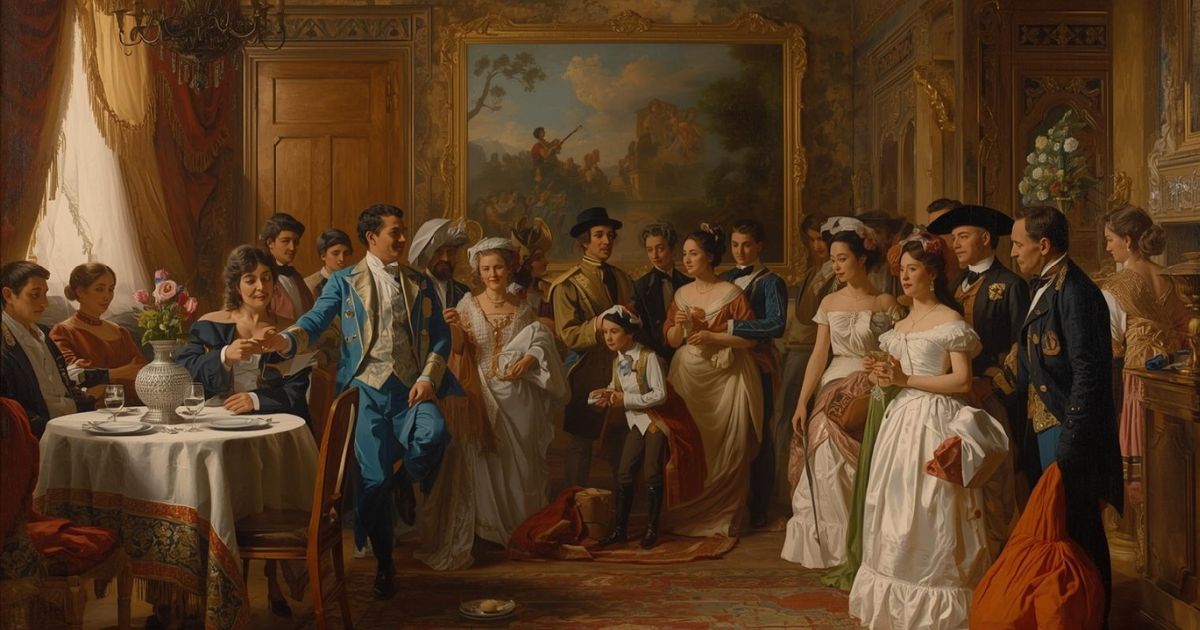
An excerpt from the original text.(complete · 805 words)
Star in a Dark Night
Ibarra went to his room, which overlooked the river, and dropping
into a chair gazed out into the vast expanse of the heavens spread
before him through the open window. The house on the opposite bank
was profusely lighted, and gay strains of music, largely from stringed
instruments, were borne across the river even to his room.
If the young man had been less preoccupied, if he had had more
curiosity and had cared to see with his opera glasses what was going
on in that atmosphere of light, he would have been charmed with one of
those magical and fantastic spectacles, the like of which is sometimes
seen in the great theaters of Europe. To the subdued strains of the
orchestra there seems to appear in the midst of a shower of light, a
cascade of gold and diamonds in an Oriental setting, a deity wrapped
in misty gauze, a sylph enveloped in a luminous halo, who moves
forward apparently without touching the floor. In her presence the
flowers bloom, the dance awakens, the music bursts forth, and troops
of devils, nymphs, satyrs, demons, angels, shepherds and shepherdesses,
dance, shake their tambourines, and whirl about in rhythmic evolutions,
each one placing some tribute at the feet of the goddess. Ibarra would
have seen a beautiful and graceful maiden, clothed in the picturesque
garments of the daughters of the Philippines, standing in the center
Of a semicircle made up of every class of people, Chinese, Spaniards,
Filipinos, soldiers, curates, old men and young, all gesticulating
and moving about in a lively manner. Padre Damaso stood at the side
of the beauty, smiling like one especially blessed. Fray Sibyla--yes,
Fray Sibyla himself--was talking to her. Doña Victorina was arranging
in the magnificent hair of the maiden a string of pearls and diamonds
which threw out all the beautiful tints of the rainbow. She was white,
perhaps too much so, and whenever she raised her downcast eyes there
shone forth a spotless soul. When she smiled so as to show her small
white teeth the beholder realized that the rose is only a flower
and ivory but the elephant's tusk. From out the filmy piña draperies
around her white and shapely neck there blinked, as the Tagalogs say,
the bright eyes of a collar of diamonds. One man only in all the crowd
seemed insensible to her radiant influence--a young Franciscan, thin,
wasted, and pale, who watched her from a distance, motionless as a
statue and scarcely breathing.
But Ibarra saw nothing of all this--his eyes were fixed on other
things. A small space was enclosed by four bare and grimy walls, in
one of which was an iron grating. On the filthy and loathsome floor
was a mat upon which an old man lay alone in the throes of death,
an old man breathing with difficulty and turning his head from side
to side as amid his tears he uttered a name. The old man was alone,
but from time to time a groan or the rattle of a chain was heard on
the other side of the wall. Far away there was a merry feast, almost
an orgy; a youth was laughing, shouting, and pouring wine upon the
flowers amid the applause and drunken laughter of his companions. The
old man had the features of his father, the youth was himself, and
the name that the old man uttered with tears was his own name! This
was what the wretched young man saw before him. The lights in the
house opposite were extinguished, the music and the noises ceased,
but Ibarra still heard the anguished cry of his father calling upon
his son in the hour of his death.
Silence had now blown its hollow breath over the city, and all
things seemed to sleep in the embrace of nothingness. The cock-crow
alternated with the strokes of the clocks in the church towers and
the mournful cries of the weary sentinels. A waning moon began to
appear, and everything seemed to be at rest; even Ibarra himself,
worn out by his sad thoughts or by his journey, now slept.
Only the young Franciscan whom we saw not so long ago standing
motionless and silent in the midst of the gaiety of the ballroom slept
not, but kept vigil. In his cell, with his elbow upon the window
sill and his pale, worn cheek resting on the palm of his hand, he
was gazing silently into the distance where a bright star glittered
in the dark sky. The star paled and disappeared, the dim light of the
waning moon faded, but the friar did not move from his place--he was
gazing out over the field of Bagumbayan and the sleeping sea at the
far horizon wrapped in the morning mist.
Master this chapter. Complete your experience
Purchase the complete book to access all chapters and support classic literature
As an Amazon Associate, we earn a small commission from qualifying purchases at no additional cost to you.
Available in paperback, hardcover, and e-book formats
Let's Analyse the Pattern
Unresolved trauma creates competing emotional realities where past pain feels more real than present moments.
Why This Matters
Connect literature to life
This chapter teaches how to identify when trauma creates competing realities that make the past feel more real than the present.
Practice This Today
This week, notice when your mind gets stuck replaying a painful moment - name it as 'trauma-time' and practice grounding yourself in what's happening right now.
Now let's explore the literary elements.
Key Quotes & Analysis
"If the young man had been less preoccupied, if he had had more curiosity and had cared to see with his opera glasses what was going on in that atmosphere of light, he would have been charmed"
Context: Describing how Ibarra's trauma prevents him from seeing the beauty and celebration happening nearby
Shows how depression and grief create tunnel vision - when you're drowning in pain, you literally cannot see joy or beauty around you. The 'if only' structure emphasizes what trauma steals from us.
In Today's Words:
If he wasn't so messed up in his head, he might have actually enjoyed watching the party across the way
"In her presence the flowers bloom, the dance awakens, the music bursts forth"
Context: Describing the magical effect of María Clara's presence at the celebration
Creates a fairy-tale image of feminine power and beauty bringing life to everything around it. Contrasts sharply with Ibarra's deathly inner world.
In Today's Words:
She's the kind of person who lights up every room she enters
"The house on the opposite bank was profusely lighted, and gay strains of music, largely from stringed instruments, were borne across the river"
Context: Setting up the contrast between Ibarra's dark room and the bright celebration
The river becomes a metaphor for the distance between joy and sorrow, celebration and grief. Physical proximity doesn't guarantee emotional connection.
In Today's Words:
The party across the street was lit up and loud with music, but it might as well have been on another planet
Thematic Threads
Guilt
In This Chapter
Ibarra's overwhelming guilt over his absence during his father's death consumes him even during celebration
Development
Deepens from earlier hints of family tragedy into visceral, paralyzing self-blame
In Your Life:
You might recognize this when you can't enjoy good moments because you're stuck replaying times you feel you failed someone.
Isolation
In This Chapter
Despite being surrounded by community celebration, Ibarra remains completely alone in his suffering
Development
Evolves from social displacement in earlier chapters to complete emotional disconnection
In Your Life:
This shows up when you feel most alone precisely when you're surrounded by people who seem happy.
Class
In This Chapter
The stark contrast between the festive gathering of the privileged and Ibarra's private torment reflects social divides
Development
Continues the exploration of how social position affects experience and suffering
In Your Life:
You see this when your struggles feel invisible to people who live in different economic realities.
Observation
In This Chapter
The mysterious friar watches from shadows, representing another kind of outsider perspective
Development
Introduced here as a new element of surveillance and hidden judgment
In Your Life:
This appears when you feel like someone is always watching and judging your choices from the sidelines.
Identity
In This Chapter
Ibarra's sense of self is completely overtaken by his role as the absent son who failed his father
Development
Builds on earlier identity confusion, now crystallizing around guilt and failure
In Your Life:
You experience this when one mistake or absence becomes how you define yourself entirely.
You now have the context. Time to form your own thoughts.
Discussion Questions
- 1
Why can't Ibarra enjoy the party happening across the river when everyone else is celebrating?
analysis • surface - 2
How does Ibarra's guilt over missing his father's death create a 'parallel reality' that feels more real than the present moment?
analysis • medium - 3
Where have you seen someone unable to participate in current joy because they're stuck reliving a painful moment from their past?
application • medium - 4
What practical techniques could help someone like Ibarra anchor themselves in the present when trauma pulls them into the shadow world of the past?
application • deep - 5
What does this chapter reveal about how unresolved grief can hijack our ability to experience life as it's actually happening?
reflection • deep
Critical Thinking Exercise
Map Your Parallel Realities
Think of a time when you couldn't fully engage with something good happening because a painful memory kept pulling your attention away. Draw two circles on paper - one representing the present moment you were physically in, and another representing the past moment your mind kept returning to. In each circle, write what was happening, what you were feeling, and which reality felt more 'real' to you at the time.
Consider:
- •Notice how trauma doesn't just create memories - it creates competing versions of reality
- •Consider how the past moment might have felt more vivid than what was actually happening around you
- •Think about what anchoring techniques might have helped you stay present
Journaling Prompt
Write about what it would look like to acknowledge both realities - honoring your pain while also reclaiming your right to experience joy in the present moment.
Coming Up Next...
Chapter 6: The Wealthy Hypocrite's Empire
We're about to meet Capitan Tiago, a key figure whose house likely hosted that glittering party. His story will reveal the complex social dynamics and power structures that shape everyone's lives in this colonial world.



