
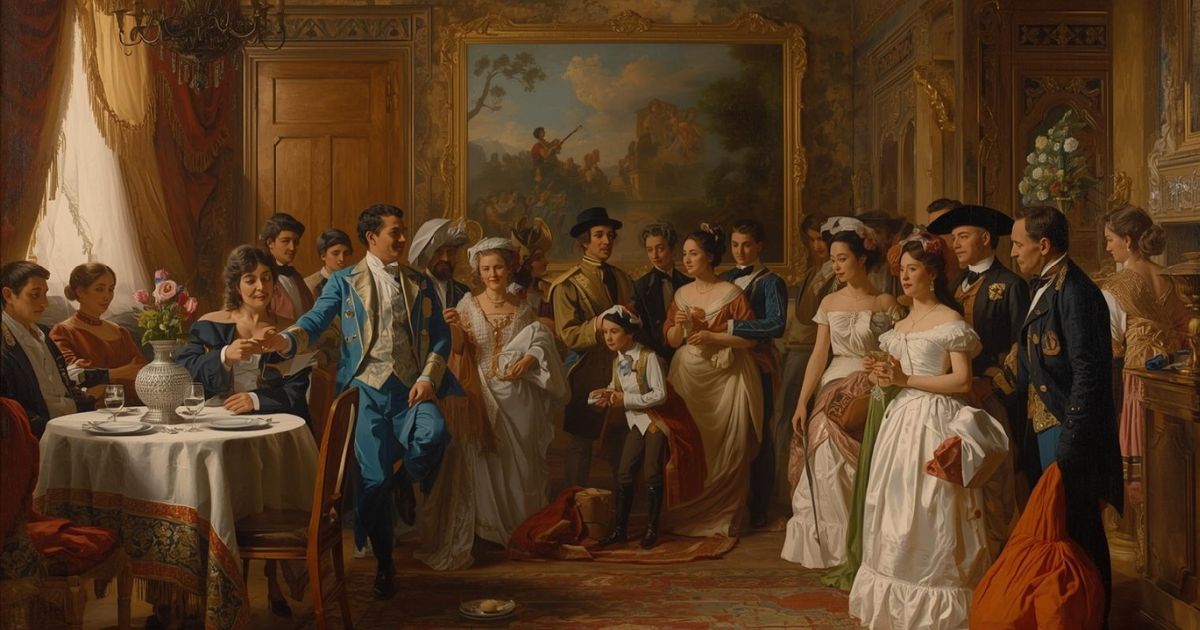
An excerpt from the original text.(complete · 3307 words)
n Idyl on an Azotea
The Song of Songs, which is Solomon's.
That morning Aunt Isabel and Maria Clara went early to mass,
the latter elegantly dressed and wearing a rosary of blue beads,
which partly served as a bracelet for her, and the former with her
spectacles in order to read her Anchor of Salvation during the holy
communion. Scarcely had the priest disappeared from the altar when the
maiden expressed a desire for returning home, to the great surprise and
displeasure of her good aunt, who believed her niece to be as pious
and devoted to praying as a nun, at least. Grumbling and crossing
herself, the good old lady rose. "The good Lord will forgive me, Aunt
Isabel, since He must know the hearts of girls better than you do,"
Maria Clara might have said to check the severe yet maternal chidings.
After they had breakfasted, Maria Clara consumed her impatience in
working at a silk purse while her aunt was trying to clean up the
traces of the former night's revelry by swinging a feather duster
about. Capitan Tiago was busy looking over some papers. Every noise in
the street, every carriage that passed, caused the maiden to tremble
and quickened the beatings of her heart. Now she wished that she were
back in the quiet convent among her friends; there she could have seen
him without emotion and agitation! But was he not the companion of her
infancy, had they not played together and even quarreled at times? The
reason for all this I need not explain; if you, O reader, have ever
loved, you will understand; and if you have not, it is useless for
me to tell you, as the uninitiated do not comprehend these mysteries.
"I believe, Maria, that the doctor is right," said Capitan Tiago. "You
ought to go into the country, for you are pale and need fresh air. What
do you think of Malabon or San Diego?" At the mention of the latter
place Maria Clara blushed like a poppy and was unable to answer.
"You and Isabel can go at once to the convent to get your clothes
and to say good-by to your friends," he continued, without raising
his head. "You will not stay there any longer."
The girl felt the vague sadness that possesses the mind when we leave
forever a place where we have been happy, but another thought softened
this sorrow.
"In four or five days, after you get some new clothes made, we'll
go to Malabon. Your godfather is no longer in San Diego. The priest
that you may have noticed here last night, that young padre, is the
new curate whom we have there, and he is a saint."
"I think that San Diego would be better, cousin," observed Aunt
Isabel. "Besides, our house there is better and the time for the
fiesta draws near."
Maria Clara wanted to embrace her aunt for this speech, but hearing
a carriage stop, she turned pale.
"Ah, very true," answered Capitan Tiago, and then in a different tone
he exclaimed, "Don Crisostomo!"
The maiden let her sewing fall from her hands and wished to move but
could not--a violent tremor ran through her body. Steps were heard
on the stairway and then a fresh, manly voice. As if that voice had
some magic power, the maiden controlled her emotion and ran to hide
in the oratory among the saints. The two cousins laughed, and Ibarra
even heard the noise of the door closing. Pale and breathing rapidly,
the maiden pressed her beating heart and tried to listen. She heard
his voice, that beloved voice that for so long a time she had heard
only in her dreams he was asking for her! Overcome with joy, she
kissed the nearest saint, which happened to be St. Anthony the Abbot,
a saint happy in flesh and in wood, ever the object of pleasing
temptations! Afterwards she sought the keyhole in order to see and
examine him. She smiled, and when her aunt snatched her from that
position she unconsciously threw her arms around the old lady's neck
and rained kisses upon her.
"Foolish child, what's the matter with you?" the old lady was at last
able to say as she wiped a tear from her faded eyes. Maria Clara felt
ashamed and covered her eyes with her plump arm.
"Come on, get ready, come!" added the old aunt fondly. "While he is
talking to your father about you. Come, don't make him wait." Like
a child the maiden obediently followed her and they shut themselves
up in her chamber.
Capitan Tiago and Ibarra were conversing in a lively manner when Aunt
Isabel appeared half dragging her niece, who was looking in every
direction except toward the persons in the room.
What said those two souls communicating through the language of the
eyes, more perfect than that of the lips, the language given to the
soul in order that sound may not mar the ecstasy of feeling? In such
moments, when the thoughts of two happy beings penetrate into each
other's souls through the eyes, the spoken word is halting, rude, and
weak--it is as the harsh, slow roar of the thunder compared with the
rapidity of the dazzling lightning flash, expressing feelings already
recognized, ideas already understood, and if words are made use of
it is only because the heart's desire, dominating all the being and
flooding it with happiness, wills that the whole human organism with
all its physical and psychical powers give expression to the song of
joy that rolls through the soul. To the questioning glance of love,
as it flashes out and then conceals itself, speech has no reply;
the smile, the kiss, the sigh answer.
Soon the two lovers, fleeing from the dust raised by Aunt Isabel's
broom, found themselves on the azotea where they could commune in
liberty among the little arbors. What did they tell each other in
murmurs that you nod your heads, O little red cypress flowers? Tell
it, you who have fragrance in your breath and color on your lips. And
thou, O zephyr, who learnest rare harmonies in the stillness of the
dark night amid the hidden depths of our virgin forests! Tell it,
O sunbeams, brilliant manifestation upon earth of the Eternal, sole
immaterial essence in a material world, you tell it, for I only know
how to relate prosaic commonplaces. But since you seem unwilling to
do so, I am going to try myself.
The sky was blue and a fresh breeze, not yet laden with the fragrance
of roses, stirred the leaves and flowers of the vines; that is why
the cypresses, the orchids, the dried fishes, and the Chinese lanterns
were trembling. The splash of paddles in the muddy waters of the river
and the rattle of carriages and carts passing over the Binondo bridge
came up to them distinctly, although they did not hear what the old
aunt murmured as she saw where they were: "That's better, there you'll
be watched by the whole neighborhood." At first they talked nonsense,
giving utterance only to those sweet inanities which are so much like
the boastings of the nations of Europe--pleasing and honey-sweet at
home, but causing foreigners to laugh or frown.
She, like a sister of Cain, was of course jealous and asked her
sweetheart, "Have you always thought of me? Have you never forgotten me
on all your travels in the great cities among so many beautiful women?"
He, too, was a brother of Cain, and sought to evade such questions,
making use of a little fiction. "Could I forget you?" he answered
as he gazed enraptured into her dark eyes. "Could I be faithless
to my oath, my sacred oath? Do you remember that stormy night when
you saw me weeping alone by the side of my dead mother and, drawing
near to me, you put your hand on my shoulder, that hand which for so
long a time you had not allowed me to touch, saying to me, 'You have
lost your mother while I never had one,' and you wept with me? You
loved her and she looked upon you as a daughter. Outside it rained
and the lightning flashed, but within I seemed to hear music and to
see a smile on the pallid face of the dead. Oh, that my parents were
alive and might behold you now! I then caught your hand along with
the hand of my mother and swore to love you and to make you happy,
whatever fortune Heaven might have in store for me; and that oath,
which has never weighed upon me as a burden, I now renew!
"Could I forget you? The thought of you has ever been with me,
strengthening me amid the dangers of travel, and has been a comfort
to my soul's loneliness in foreign lands. The thoughts of you
have neutralized the lotus-effect of Europe, which erases from the
memories of so many of our countrymen the hopes and misfortunes of our
fatherland. In dreams I saw you standing on the shore at Manila, gazing
at the far horizon wrapped in the warm light of the early dawn. I heard
the slow, sad song that awoke in me sleeping affections and called
back to the memory of my heart the first years of our childhood, our
joys, our pleasures, and all that happy past which you gave life to
while you were in our town. It seemed to me that you were the fairy,
the spirit, the poetic incarnation of my fatherland, beautiful,
unaffected, lovable, frank, a true daughter of the Philippines,
that beautiful land which unites with the imposing virtues of the
mother country, Spain, the admirable qualities of a young people,
as you unite in your being all that is beautiful and lovely, the
inheritance of both races" so indeed the love of you and that of my
fatherland have become fused into one.
"Could I forget you? Many times have I thought that I heard the
sound of your piano and the accents of your voice. When in Germany,
as I wandered at twilight in the woods, peopled with the fantastic
creations of its poets and the mysterious legends of past generations,
always I called upon your name, imagining that I saw you in the mists
that rose from the depths of the valley, or I fancied that I heard
your voice in the rustling of the leaves. When from afar I heard the
songs of the peasants as they returned from their labors, it seemed to
me that their tones harmonized with my inner voices, that they were
singing for you, and thus they lent reality to my illusions and
dreams. At times I became lost among the mountain paths and while the
night descended slowly, as it does there, I would find myself still
wandering, seeking my way among the pines and beeches and oaks. Then
when some scattering rays of moonlight slipped down into the clear
spaces left in the dense foliage, I seemed to see you in the heart of
the forest as a dim, loving shade wavering about between the spots of
light and shadow. If perhaps the nightingale poured forth his varied
trills, I fancied it was because he saw you and was inspired by you.
"Have I thought of you? The fever of love not only gave warmth to the
snows but colored the ice! The beautiful skies of Italy with their
clear depths reminded me of your eyes, its sunny landscape spoke to
me of your smile; the plains of Andalusia with their scent-laden
airs, peopled with oriental memories, full of romance and color,
told me of your love! On dreamy, moonlit nights, while boating oil
the Rhine, I have asked myself if my fancy did not deceive me as I
saw you among the poplars on the banks, on the rocks of the Lorelei,
or in the midst of the waters, singing in the silence of the night
as if you were a comforting fairy maiden sent to enliven the solitude
and sadness of those ruined castles!"
"I have not traveled like you, so I know only your town and Manila and
Antipolo," she answered with a smile which showed that she believed
all he said. "But since I said good-by to you and entered the convent,
I have always thought of you and have only put you out of my mind
when ordered to do so by my confessor, who imposed many penances upon
me. I recalled our games and our quarrels when we were children. You
used to pick up the most beautiful shells and search in the river
for the roundest and smoothest pebbles of different colors that we
might play games with them. You were very stupid and always lost,
and by way of a forfeit I would slap you with the palm of my hand,
but I always tried not to strike you hard, for I had pity on you. In
those games you cheated much, even more than I did, and we used to
finish our play in a quarrel. Do you remember that time when you
became really angry at me? Then you made me suffer, but afterwards,
when I thought of it in the convent, I smiled and longed for you so
that we might quarrel again--so that we might once more make up. We
were still children and had gone with your mother to bathe in the brook
under the shade of the thick bamboo. On the banks grew many flowers
and plants whose strange names you told me in Latin and Spanish, for
you were even then studying in the Ateneo. [44] I paid no attention,
but amused myself by running after the needle-like dragon-flies and
the butterflies with their rainbow colors and tints of mother-of-pearl
as they swarmed about among the flowers. Sometimes I tried to surprise
them with my hands or to catch the little fishes that slipped rapidly
about amongst the moss and stones in the edge of the water. Once you
disappeared suddenly and when you returned you brought a crown of
leaves and orange blossoms, which you placed upon my head, calling me
Chloe. For yourself you made one of vines. But your mother snatched
away my crown, and after mashing it with a stone mixed it with the
gogo with which she was going to wash our heads. The tears came into
your eyes and you said that she did not understand mythology. 'Silly
boy,' your mother exclaimed, 'you'll see how sweet your hair will
smell afterwards.' I laughed, but you were offended and would not talk
with me, and for the rest of the day appeared so serious that then
I wanted to cry. On our way back to the town through the hot sun,
I picked some sage leaves that grew beside the path and gave them
to you to put in your hat so that you might not get a headache. You
smiled and caught my hand, and we made up."
Ibarra smiled with happiness as he opened his pocketbook and took from
it a piece of paper in which were wrapped some dry, blackened leaves
which gave off a sweet odor. "Your sage leaves," he said, in answer
to her inquiring look. "This is all that you have ever given me."
She in turn snatched from her bosom a little pouch of white
satin. "You must not touch this," she said, tapping the palm of his
hand lightly. "It's a letter of farewell."
"The one I wrote to you before leaving?"
"Have you ever written me any other, sir?"
"And what did I say to you then?"
"Many fibs, excuses of a delinquent debtor," she answered smilingly,
thus giving him to understand how sweet to her those fibs were. "Be
quiet now and I'll read it to you. I'll leave out your fine phrases
in order not to make a martyr of you."
Raising the paper to the height of her eyes so that the youth might
not see her face, she began: "'My'--but I'll not read what follows
that because it's not true."
Her eyes ran along some lines.
"'My father wishes me to go away, in spite of all my pleadings. 'You
are a man now,' he told me, 'and you must think about your future
and about your duties. You must learn the science of life, a thing
which your fatherland cannot teach you, so that you may some day be
useful to it. If you remain here in my shadow, in this environment
of business affairs, you will not learn to look far ahead. The
day in which you lose me you will find yourself like the plant
of which our poet Baltazar tells: grown in the water, its leaves
wither at the least scarcity of moisture and a moment's heat dries
it up. Don't you understand? You are almost a young man, and yet you
weep!' These reproaches hurt me and I confessed that I loved you. My
father reflected for a time in silence and then, placing his hand on
my shoulder, said in a trembling voice, 'Do you think that you alone
know how to love, that your father does not love you, and that he will
not feel the separation from you? It is only a short time since we
lost your mother, and I must journey on alone toward old age, toward
the very time of life when I would seek help and comfort from your
youth, yet I accept my loneliness, hardly knowing whether I shall
ever see you again. But you must think of other and greater things;
the future lies open before you, while for me it is already passing
behind; your love is just awakening, while mine is dying; fire burns
in your blood, while the chill is creeping into mine. Yet you weep
and cannot sacrifice the present for the future, useful as it may be
alike to yourself and to your country.' My father's eyes filled with
tears and I fell upon my knees at his feet, I embraced him, I begged
his forgiveness, and I assured him that I was ready to set out--'"
Ibarra's growing agitation caused her to suspend the reading, for he
had grown pale and was pacing back and forth.
"What's the matter? What is troubling you?" she asked him.
"You have almost made me forget that I have my duties, that I must
leave at once for the town. Tomorrow is the day for commemorating
the dead."
Maria Clara silently fixed her large dreamy eyes upon him for a few
moments and then, picking some flowers, she said with emotion, "Go,
I won't detain you longer! In a few days we shall see each other
again. Lay these flowers on the tomb of your parents."
A few moments later the youth descended the stairway accompanied by
Capitan Tiago and Aunt Isabel, while Maria Clara shut herself up in
the oratory.
"Please tell Andeng to get the house ready, as Maria and Isabel are
coming. A pleasant journey!" said Capitan Tiago as Ibarra stepped into
the carriage, which at once started in the direction of the plaza of
San Gabriel.
Afterwards, by way of consolation, her father said to Maria Clara, who
was weeping beside an image of the Virgin, "Come, light two candles
worth two reals each, one to St. Roch, [45] and one to St. Raphael,
the protector of travelers. Light the lamp of Our Lady of Peace and
Prosperous Voyages, since there are so many tulisanes. It's better
to spend four reals for wax and six cuartos for oil now than to pay
a big ransom later."
Master this chapter. Complete your experience
Purchase the complete book to access all chapters and support classic literature
As an Amazon Associate, we earn a small commission from qualifying purchases at no additional cost to you.
Available in paperback, hardcover, and e-book formats
Let's Analyse the Pattern
Authentic relationships survive separation through consistent, meaningful acts of remembrance that serve as emotional anchors across time and distance.
Why This Matters
Connect literature to life
This chapter teaches how to identify which relationships have genuine staying power by observing what people preserve and remember.
Practice This Today
This week, notice what small things you save from people who matter to you - photos, texts, ticket stubs - and recognize these as signs of real emotional investment.
Now let's explore the literary elements.
Key Quotes & Analysis
"The good Lord will forgive me, Aunt Isabel, since He must know the hearts of girls better than you do"
Context: When her aunt scolds her for wanting to leave mass early
This reveals Maria Clara's inner rebellion against the strict religious expectations placed on her. She's using God as an ally against human judgment, suggesting that true spirituality might understand love better than rigid rules.
In Today's Words:
God gets it even if you don't - He knows what it's really like to be young and in love.
"Now she wished that she were back in the quiet convent among her friends; there she could have seen him without emotion and agitation!"
Context: As Maria Clara waits anxiously for Crisostomo's arrival
This shows how sheltered environments can feel safer than real life with real emotions. The convent represents control and predictability, while love brings beautiful but terrifying uncertainty.
In Today's Words:
She wished she was back in her safe space where she could handle seeing him without falling apart.
"But was he not the companion of her infancy, had they not played together"
Context: Maria Clara remembering her shared history with Crisostomo
This emphasizes how childhood bonds create the deepest connections. Their love isn't just romance - it's built on shared experiences and genuine friendship, making it more threatening to social expectations.
In Today's Words:
They weren't just boyfriend and girlfriend - they were best friends since they were kids, which makes it so much deeper.
Thematic Threads
Love
In This Chapter
Maria Clara and Ibarra's love proves resilient through years of separation, sustained by preserved memories and tokens
Development
First deep exploration of romantic love as a sustaining force
In Your Life:
You might see this in how certain relationships feel unchanged even after long periods apart.
Memory
In This Chapter
Both characters have carefully preserved physical tokens (sage leaves, letters) that anchor their shared history
Development
Memory emerges as active preservation rather than passive recollection
In Your Life:
You might recognize this in the seemingly random items you keep because they remind you of someone important.
Social Expectations
In This Chapter
Their private reunion is shadowed by Ibarra's public duty to honor his father's grave, showing competing loyalties
Development
Continues the tension between personal desires and social obligations
In Your Life:
You might feel this when personal happiness conflicts with family or professional responsibilities.
Identity
In This Chapter
Both characters have maintained their essential selves despite years of change and growth
Development
Explores how core identity persists through transformation
In Your Life:
You might notice this in how you recognize your 'true self' even after major life changes.
Class
In This Chapter
Their ability to reunite freely reflects their privileged social positions, unlike other characters we've met
Development
Shows how class privilege enables certain freedoms
In Your Life:
You might see this in how economic stability affects your ability to maintain relationships across distance.
You now have the context. Time to form your own thoughts.
Discussion Questions
- 1
What specific items did Maria Clara and Ibarra keep to remember each other during their separation, and why were these particular objects meaningful to them?
analysis • surface - 2
How did their years apart actually strengthen rather than weaken their relationship, and what does this reveal about the difference between surface-level attraction and deeper connection?
analysis • medium - 3
Think about long-distance relationships today - friendships, family, romantic partnerships. What are the modern equivalents of Maria Clara's pressed sage leaves or Ibarra's treasured letter?
application • medium - 4
When Ibarra remembers his duty to visit his father's grave, it interrupts their romantic moment. How do you balance personal happiness with family obligations in your own life?
application • deep - 5
Maria Clara gives Ibarra flowers for his parents' tomb, showing love supporting duty rather than competing with it. What does this teach us about relationships that truly last versus those that create constant conflict?
reflection • deep
Critical Thinking Exercise
Map Your Connection Anchors
List three important relationships in your life where physical distance or busy schedules make staying connected challenging. For each relationship, identify what 'connection anchors' you currently use (texts, photos, calls, letters, gifts) and brainstorm one new way you could strengthen that bond through small, consistent gestures.
Consider:
- •Focus on relationships that matter most to you, not ones you feel obligated to maintain
- •Consider what would be meaningful to them, not just what's convenient for you
- •Think about consistency over grand gestures - small actions done regularly beat big efforts done rarely
Journaling Prompt
Write about a time when someone's small gesture of remembrance made you feel truly seen and valued. What made that moment powerful, and how can you create similar moments for others?
Coming Up Next...
Chapter 8: Memories Shape Our Vision
Ibarra's journey to his hometown brings back painful memories and reveals how much has changed during his absence. His visit to his father's grave will uncover disturbing truths about what really happened while he was away.



