
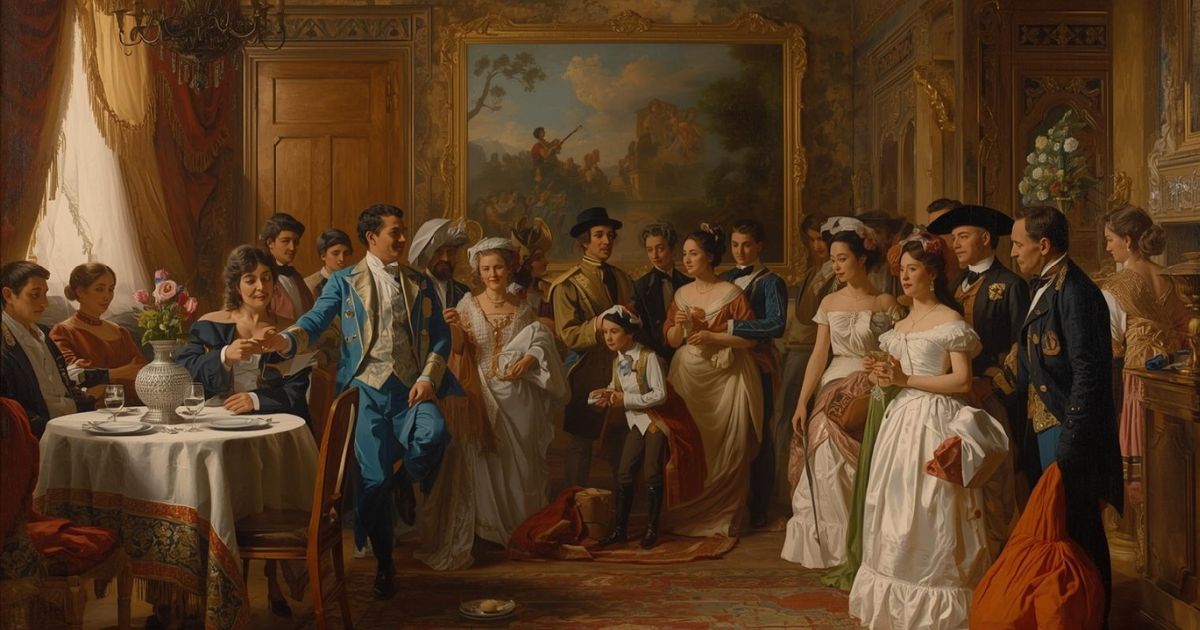
An excerpt from the original text.(complete · 1036 words)
risostomo Ibarra
It was not two beautiful and well-gowned young women that attracted
the attention of all, even including Fray Sibyla, nor was it his
Excellency the Captain-General with his staff, that the lieutenant
should start from his abstraction and take a couple of steps forward,
or that Fray Damaso should look as if turned to stone; it was simply
the original of the oil-painting leading by the hand a young man
dressed in deep mourning.
"Good evening, gentlemen! Good evening, Padre!" were the greetings
of Capitan Tiago as he kissed the hands of the priests, who forgot
to bestow upon him their benediction. The Dominican had taken off
his glasses to stare at the newly arrived youth, while Fray Damaso
was pale and unnaturally wide-eyed.
"I have the honor of presenting to you Don Crisostomo Ibarra, the son
of my deceased friend," went on Capitan Tiago. "The young gentleman
has just arrived from Europe and I went to meet him."
At the mention of the name exclamations were heard. The lieutenant
forgot to pay his respects to his host and approached the young man,
looking him over from head to foot. The young man himself at that
moment was exchanging the conventional greetings with all in the group,
nor did there seem to be any thing extraordinary about him except
his mourning garments in the center of that brilliantly lighted
room. Yet in spite of them his remarkable stature, his features,
and his movements breathed forth an air of healthy youthfulness in
which both body and mind had equally developed. There might have been
noticed in his frank, pleasant face some faint traces of Spanish
blood showing through a beautiful brown color, slightly flushed at
the cheeks as a result perhaps of his residence in cold countries.
"What!" he exclaimed with joyful surprise, "the curate of my native
town! Padre Damaso, my father's intimate friend!"
Every look in the room was directed toward the Franciscan, who made
no movement.
"Pardon me, perhaps I'm mistaken," added Ibarra, embarrassed.
"You are not mistaken," the friar was at last able to articulate in a
changed voice, "but your father was never an intimate friend of mine."
Ibarra slowly withdrew his extended hand, looking greatly surprised,
and turned to encounter the gloomy gaze of the lieutenant fixed on him.
"Young man, are you the son of Don Rafael Ibarra?" he asked.
The youth bowed. Fray Damaso partly rose in his chair and stared
fixedly at the lieutenant.
"Welcome back to your country! And may you be happier in it than your
father was!" exclaimed the officer in a trembling voice. "I knew him
well and can say that he was one of the worthiest and most honorable
men in the Philippines."
"Sir," replied Ibarra, deeply moved, "the praise you bestow upon my
father removes my doubts about the manner of his death, of which I,
his son, am yet ignorant."
The eyes of the old soldier filled with tears and turning away hastily
he withdrew. The young man thus found himself alone in the center
of the room. His host having disappeared, he saw no one who might
introduce him to the young ladies, many of whom were watching him
with interest. After a few moments of hesitation he started toward
them in a simple and natural manner.
"Allow me," he said, "to overstep the rules of strict etiquette. It
has been seven years since I have been in my own country and upon
returning to it I cannot suppress my admiration and refrain from
paying my respects to its most precious ornaments, the ladies."
But as none of them ventured a reply, he found himself obliged to
retire. He then turned toward a group of men who, upon seeing him
approach, arranged themselves in a semicircle.
"Gentlemen," he addressed them, "it is a custom in Germany,
when a stranger finds himself at a function and there is no one to
introduce him to those present, that he give his name and so introduce
himself. Allow me to adopt this usage here, not to introduce foreign
customs when our own are so beautiful, but because I find myself driven
to it by necessity. I have already paid my respects to the skies and
to the ladies of my native land; now I wish to greet its citizens,
my fellow-countrymen. Gentlemen, my name is Juan Crisostomo Ibarra
y Magsalin."
The others gave their names, more or less obscure, and unimportant
here.
"My name is A----," said one youth dryly, as he made a slight bow.
"Then I have the honor of addressing the poet whose works have done
so much to keep up my enthusiasm for my native land. It is said that
you do not write any more, but I could not learn the reason."
"The reason? Because one does not seek inspiration in order to debase
himself and lie. One writer has been imprisoned for having put a
very obvious truth into verse. They may have called me a poet but
they sha'n't call me a fool."
"And may I enquire what that truth was?"
"He said that the lion's son is also a lion. He came very near to being
exiled for it," replied the strange youth, moving away from the group.
A man with a smiling face, dressed in the fashion of the natives
of the country, with diamond studs in his shirt-bosom, came up at
that moment almost running. He went directly to Ibarra and grasped
his hand, saying, "Señor Ibarra, I've been eager to make your
acquaintance. Capitan Tiago is a friend of mine and I knew your
respected father. I am known as Capitan Tinong and live in Tondo,
where you will always be welcome. I hope that you will honor me with a
visit. Come and dine with us tomorrow." He smiled and rubbed his hands.
"Thank you," replied Ibarra, warmly, charmed with such amiability,
"but tomorrow morning I must leave for San Diego."
"How unfortunate! Then it will be on your return."
"Dinner is served!" announced a waiter from the café La Campana, and
the guests began to file out toward the table, the women, especially
the Filipinas, with great hesitation.
Master this chapter. Complete your experience
Purchase the complete book to access all chapters and support classic literature
As an Amazon Associate, we earn a small commission from qualifying purchases at no additional cost to you.
Available in paperback, hardcover, and e-book formats
Let's Analyse the Pattern
Personal development often leads to social isolation as you outgrow old communities while struggling to find new ones that match your evolved identity.
Why This Matters
Connect literature to life
This chapter teaches how to recognize when someone's cold response reveals deeper institutional conflicts rather than personal dislike.
Practice This Today
This week, notice when people's reactions to you seem disproportionate to the conversation - their real issue might be with what you represent, not who you are.
Now let's explore the literary elements.
Key Quotes & Analysis
"I have the honor of presenting to you Don Crisostomo Ibarra, the son of my deceased friend"
Context: Introducing Ibarra to the dinner party guests
This formal introduction immediately creates tension because everyone recognizes the Ibarra name and its controversial history. Captain Tiago's nervous formality shows he's trying to rehabilitate Ibarra's reputation while protecting his own social standing.
In Today's Words:
Here's the kid whose family got into all that trouble - please be nice to him
"Your father was never an intimate friend of mine"
Context: Responding coldly to Ibarra's warm greeting
This brutal rejection reveals the depth of hostility toward Ibarra's family and shows how quickly former friends can disown you when it's politically convenient. Damaso's defensiveness suggests guilt about his role in Don Rafael's fate.
In Today's Words:
Don't act like we were close - I barely knew your dad
"At the mention of the name exclamations were heard"
Context: The crowd's reaction when Ibarra is introduced
This shows how the Ibarra name has become notorious in their absence. The shocked reactions reveal that whatever happened to Don Rafael was public, scandalous, and still fresh in everyone's memory.
In Today's Words:
Everyone started whispering the moment they heard that name
Thematic Threads
Identity
In This Chapter
Ibarra struggles with who he is now - too European for Filipino society, too Filipino for European customs
Development
Building on earlier class tensions, now focused on personal transformation
In Your Life:
You might feel this when education or life experience changes how you see the world, making old relationships feel strained.
Class
In This Chapter
Ibarra's European education creates invisible barriers between him and his childhood community
Development
Deepens from earlier social hierarchy observations to personal experience of class mobility
In Your Life:
You might experience this when moving between economic levels - feeling not quite accepted in either world.
Social Expectations
In This Chapter
The community expects Ibarra to remain the boy who left, not the educated man who returned
Development
Continues theme of rigid social roles, now showing consequences of breaking them
In Your Life:
You might face this when family expects you to play old roles even after you've grown and changed.
Hidden Truths
In This Chapter
Padre Damaso's cold rejection and the lieutenant's cryptic condolences hint at concealed information about Ibarra's father
Development
Introduced here as new thread about family secrets and their social consequences
In Your Life:
You might recognize this when people's reactions to your family name or background reveal secrets you weren't told.
Power Dynamics
In This Chapter
The priest's ability to publicly humiliate Ibarra shows how religious authority operates in this society
Development
Builds on earlier observations of institutional control, now showing personal impact
In Your Life:
You might see this in how authority figures can socially isolate people who challenge or threaten their position.
You now have the context. Time to form your own thoughts.
Discussion Questions
- 1
What specific reactions does Ibarra's arrival trigger in different people at the party, and what do these reactions tell us about his family's reputation?
analysis • surface - 2
Why does Padre Damaso so coldly reject Ibarra's friendly greeting, and what does this suggest about what happened to Ibarra's father?
analysis • medium - 3
How does Ibarra's awkward self-introduction using German customs reflect the challenge many people face when returning home after significant personal growth or life changes?
application • medium - 4
If you were advising Ibarra on how to reconnect with his community while honoring his growth, what strategies would you suggest?
application • deep - 5
What does this chapter reveal about how communities respond to members who return changed, and why might growth threaten existing social dynamics?
reflection • deep
Critical Thinking Exercise
Map Your Growth-Gap Moments
Think of a time when you returned to an old environment after significant personal change - maybe after college, military service, recovery, a new job, or major life experience. Write down who reacted differently to you and how. Then identify what specific changes in you might have triggered those reactions, even if the changes were positive.
Consider:
- •Consider both obvious changes (education, appearance, confidence) and subtle ones (vocabulary, body language, priorities)
- •Notice whether people's reactions reflected their own insecurities or genuine concern about losing connection with you
- •Think about times when you've been on the other side - feeling left behind by someone else's growth
Journaling Prompt
Write about a relationship that struggled because of your personal growth. What did you lose, what did you gain, and how might you handle similar situations differently in the future?
Coming Up Next...
Chapter 3: Power Plays at the Dinner Table
The dinner party continues with Ibarra learning more about what happened to his father during his absence. The social tensions that surfaced during introductions are about to explode over the dinner table, revealing the true cost of speaking truth in a colonial society.



