
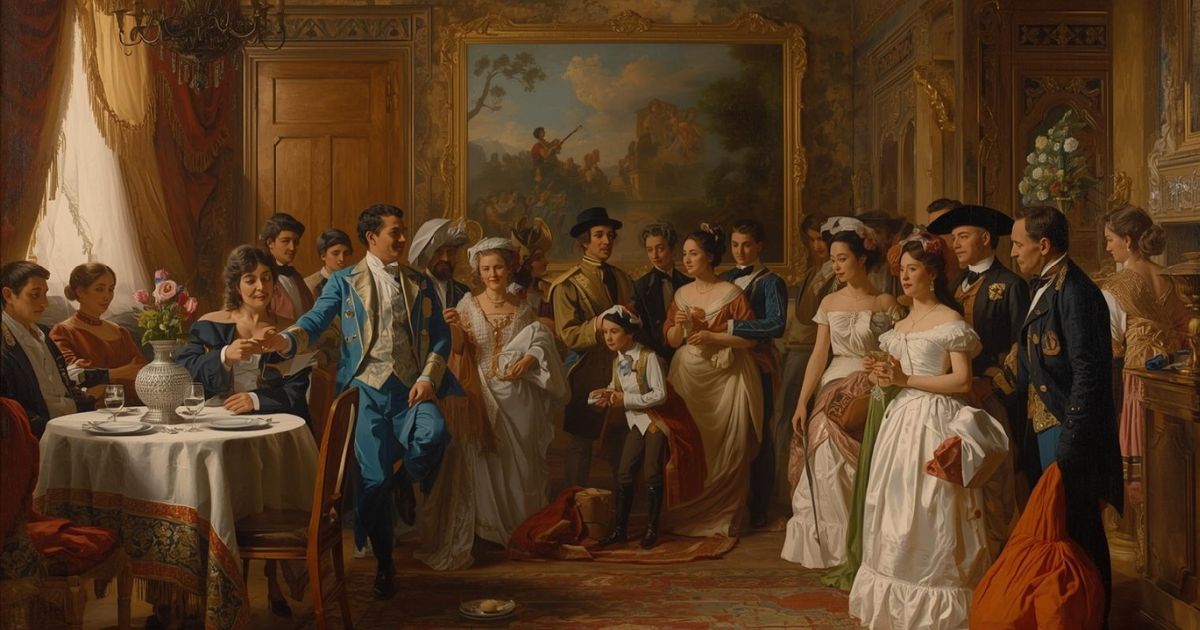
An excerpt from the original text.(complete · 4283 words)
Social Gathering
On the last of October Don Santiago de los Santos, popularly known as
Capitan Tiago, gave a dinner. In spite of the fact that, contrary to
his usual custom, he had made the announcement only that afternoon,
it was already the sole topic of conversation in Binondo and adjacent
districts, and even in the Walled City, for at that time Capitan
Tiago was considered one of the most hospitable of men, and it was
well known that his house, like his country, shut its doors against
nothing except commerce and all new or bold ideas. Like an electric
shock the announcement ran through the world of parasites, bores,
and hangers-on, whom God in His infinite bounty creates and so kindly
multiplies in Manila. Some looked at once for shoe-polish, others
for buttons and cravats, but all were especially concerned about how
to greet the master of the house in the most familiar tone, in order
to create an atmosphere of ancient friendship or, if occasion should
arise, to excuse a late arrival.
This dinner was given in a house on Calle Anloague, and although we do
not remember the number we will describe it in such a way that it may
still be recognized, provided the earthquakes have not destroyed it. We
do not believe that its owner has had it torn down, for such labors are
generally entrusted to God or nature--which Powers hold the contracts
also for many of the projects of our government. It is a rather large
building, in the style of many in the country, and fronts upon the arm
of the Pasig which is known to some as the Binondo River, and which,
like all the streams in Manila, plays the varied rôles of bath, sewer,
laundry, fishery, means of transportation and communication, and even
drinking water if the Chinese water-carrier finds it convenient. It
is worthy of note that in the distance of nearly a mile this important
artery of the district, where traffic is most dense and movement most
deafening, can boast of only one wooden bridge, which is out of repair
on one side for six months and impassable on the other for the rest of
the year, so that during the hot season the ponies take advantage of
this permanent status quo to jump off the bridge into the water,
to the great surprise of the abstracted mortal who may be dozing
inside the carriage or philosophizing upon the progress of the age.
The house of which we are speaking is somewhat low and not exactly
correct in all its lines: whether the architect who built it was
afflicted with poor eyesight or whether the earthquakes and typhoons
have twisted it out of shape, no one can say with certainty. A wide
staircase with green newels and carpeted steps leads from the tiled
entrance up to the main floor between rows of flower-pots set upon
pedestals of motley-colored and fantastically decorated Chinese
porcelain. Since there are neither porters nor servants who demand
invitation cards, we will go in, O you who read this, whether friend or
foe, if you are attracted by the strains of the orchestra, the lights,
or the suggestive rattling of dishes, knives, and forks, and if you
wish to see what such a gathering is like in the distant Pearl of
the Orient. Gladly, and for my own comfort, I should spare you this
description of the house, were it not of great importance, since we
mortals in general are very much like tortoises: we are esteemed and
classified according to our shells; in this and still other respects
the mortals of the Philippines in particular also resemble tortoises.
If we go up the stairs, we immediately find ourselves in a spacious
hallway, called there, for some unknown reason, the caida, which
tonight serves as the dining-room and at the same time affords a
place for the orchestra. In the center a large table profusely and
expensively decorated seems to beckon to the hanger-on with sweet
promises, while it threatens the bashful maiden, the simple dalaga,
with two mortal hours in the company of strangers whose language and
conversation usually have a very restricted and special character.
Contrasted with these terrestrial preparations are the motley paintings
on the walls representing religious matters, such as "Purgatory,"
"Hell," "The Last Judgment," "The Death of the Just," and "The Death
of the Sinner."
At the back of the room, fastened in a splendid and elegant framework,
in the Renaissance style, possibly by Arévalo, is a glass case in
which are seen the figures of two old women. The inscription on this
reads: "Our Lady of Peace and Prosperous Voyages, who is worshiped in
Antipolo, visiting in the disguise of a beggar the holy and renowned
Capitana Inez during her sickness." [15] While the work reveals little
taste or art, yet it possesses in compensation an extreme realism,
for to judge from the yellow and bluish tints of her face the sick
woman seems to be already a decaying corpse, and the glasses and other
objects, accompaniments of long illness, are so minutely reproduced
that even their contents may be distinguished. In looking at these
pictures, which excite the appetite and inspire gay bucolic ideas, one
may perhaps be led to think that the malicious host is well acquainted
with the characters of the majority of those who are to sit at his
table and that, in order to conceal his own way of thinking, he has
hung from the ceiling costly Chinese lanterns; bird-cages without
birds; red, green, and blue globes of frosted glass; faded air-plants;
and dried and inflated fishes, which they call botetes. The view is
closed on the side of the river by curious wooden arches, half Chinese
and half European, affording glimpses of a terrace with arbors and
bowers faintly lighted by paper lanterns of many colors.
In the sala, among massive mirrors and gleaming chandeliers, the
guests are assembled. Here, on a raised platform, stands a grand
piano of great price, which tonight has the additional virtue of not
being played upon. Here, hanging on the wall, is an oil-painting of a
handsome man in full dress, rigid, erect, straight as the tasseled cane
he holds in his stiff, ring-covered fingers--the whole seeming to say,
"Ahem! See how well dressed and how dignified I am!" The furnishings
of the room are elegant and perhaps uncomfortable and unhealthful,
since the master of the house would consider not so much the comfort
and health of his guests as his own ostentation, "A terrible thing
is dysentery," he would say to them, "but you are sitting in European
chairs and that is something you don't find every day."
This room is almost filled with people, the men being separated from
the women as in synagogues and Catholic churches. The women consist of
a number of Filipino and Spanish maidens, who, when they open their
mouths to yawn, instantly cover them with their fans and who murmur
only a few words to each other, any conversation ventured upon dying
out in monosyllables like the sounds heard in a house at night, sounds
made by the rats and lizards. Is it perhaps the different likenesses
of Our Lady hanging on the walls that force them to silence and a
religious demeanor or is it that the women here are an exception?
A cousin of Capitan Tiago, a sweet-faced old woman, who speaks Spanish
quite badly, is the only one receiving the ladies. To offer to the
Spanish ladies a plate of cigars and buyos, to extend her hand to
her countrywomen to be kissed, exactly as the friars do,--this is
the sum of her courtesy, her policy. The poor old lady soon became
bored, and taking advantage of the noise of a plate breaking, rushed
precipitately away, muttering, "Jesús! Just wait, you rascals!" and
failed to reappear.
The men, for their part, are making more of a stir. Some cadets
in one corner are conversing in a lively manner but in low tones,
looking around now and then to point out different persons in the room
while they laugh more or less openly among themselves. In contrast,
two foreigners dressed in white are promenading silently from one end
of the room to the other with their hands crossed behind their backs,
like the bored passengers on the deck of a ship. All the interest and
the greatest animation proceed from a group composed of two priests,
two civilians, and a soldier who are seated around a small table on
which are seen bottles of wine and English biscuits.
The soldier, a tall, elderly lieutenant with an austere countenance--a
Duke of Alva straggling behind in the roster of the Civil Guard--talks
little, but in a harsh, curt way. One of the priests, a youthful
Dominican friar, handsome, graceful, polished as the gold-mounted
eyeglasses he wears, maintains a premature gravity. He is the curate
of Binondo and has been in former years a professor in the college of
San Juan de Letran, [16] where he enjoyed the reputation of being a
consummate dialectician, so much so that in the days when the sons
of Guzman [17] still dared to match themselves in subtleties with
laymen, the able disputant B. de Luna had never been able either to
catch or to confuse him, the distinctions made by Fray Sibyla leaving
his opponent in the situation of a fisherman who tries to catch eels
with a lasso. The Dominican says little, appearing to weigh his words.
Quite in contrast, the other priest, a Franciscan, talks much and
gesticulates more. In spite of the fact that his hair is beginning to
turn gray, he seems to be preserving well his robust constitution,
while his regular features, his rather disquieting glance, his wide
jaws and herculean frame give him the appearance of a Roman noble in
disguise and make us involuntarily recall one of those three monks of
whom Heine tells in his "Gods in Exile," who at the September equinox
in the Tyrol used to cross a lake at midnight and each time place in
the hand of the poor boatman a silver piece, cold as ice, which left
him full of terror. [18] But Fray Damaso is not so mysterious as they
were. He is full of merriment, and if the tone of his voice is rough
like that of a man who has never had occasion to correct himself and
who believes that whatever he says is holy and above improvement, still
his frank, merry laugh wipes out this disagreeable impression and even
obliges us to pardon his showing to the room bare feet and hairy legs
that would make the fortune of a Mendieta in the Quiapo fairs. [19]
One of the civilians is a very small man with a black beard, the only
thing notable about him being his nose, which, to judge from its size,
ought not to belong to him. The other is a rubicund youth, who seems
to have arrived but recently in the country. With him the Franciscan
is carrying on a lively discussion.
"You'll see," the friar was saying, "when you've been here a few
months you'll be convinced of what I say. It's one thing to govern
in Madrid and another to live in the Philippines."
"But--"
"I, for example," continued Fray Damaso, raising his voice still
higher to prevent the other from speaking, "I, for example, who can
look back over twenty-three years of bananas and morisqueta, know
whereof I speak. Don't come at me with theories and fine speeches,
for I know the Indian. [20] Mark well that the moment I arrived in the
country I was assigned to a toxin, small it is true, but especially
devoted to agriculture. I didn't understand Tagalog very well then,
but I was, soon confessing the women, and we understood one another
and they came to like me so well that three years later, when I was
transferred to another and larger town, made vacant by the death of
the native curate, all fell to weeping, they heaped gifts upon me,
they escorted me with music--"
"But that only goes to show--"
"Wait, wait! Don't be so hasty! My successor remained a shorter
time, and when he left he had more attendance, more tears, and more
music. Yet he had been more given to whipping and had raised the fees
in the parish to almost double."
"But you will allow me--"
"But that isn't all. I stayed in the town of San Diego twenty years
and it has been only a few months since I left it."
Here he showed signs of chagrin.
"Twenty years, no one can deny, are more than sufficient to get
acquainted with a town. San Diego has a population of six thousand
souls and I knew every inhabitant as well as if I had been his mother
and wet-nurse. I knew in which foot this one was lame, where the
shoe pinched that one, who was courting that girl, what affairs she
had had and with whom, who was the real father of the child, and so
on--for I was the confessor of every last one, and they took care not
to fail in their duty. Our host, Santiago, will tell you whether I am
speaking the truth, for he has a lot of land there and that was where
we first became friends. Well then, you may see what the Indian is:
when I left I was escorted by only a few old women and some of the
tertiary brethren--and that after I had been there twenty years!"
"But I don't see what that has to do with the abolition of the tobacco
monopoly," [21] ventured the rubicund youth, taking advantage of the
Franciscan's pausing to drink a glass of sherry.
Fray Damaso was so greatly surprised that he nearly let his glass
fall. He remained for a moment staring fixedly at the young man.
"What? How's that?" he was finally able to exclaim in great
wonderment. "Is it possible that you don't see it as clear as
day? Don't you see, my son, that all this proves plainly that the
reforms of the ministers are irrational?"
It was now the youth's turn to look perplexed. The lieutenant wrinkled
his eyebrows a little more and the small man nodded toward Fray Damaso
equivocally. The Dominican contented himself with almost turning his
back on the whole group.
"Do you really believe so?" the young man at length asked with great
seriousness, as he looked at the friar with curiosity.
"Do I believe so? As I believe the Gospel! The Indian is so indolent!"
"Ah, pardon me for interrupting you," said the young man, lowering
his voice and drawing his chair a little closer, "but you have said
something that awakens all my interest. Does this indolence actually,
naturally, exist among the natives or is there some truth in what a
foreign traveler says: that with this indolence we excuse our own,
as well as our backwardness and our colonial system. He referred to
other colonies whose inhabitants belong to the same race--"
"Bah, jealousy! Ask Señor Laruja, who also knows this country. Ask him
if there is any equal to the ignorance and indolence of the Indian."
"It's true," affirmed the little man, who was referred to as Señor
Laruja. "In no part of the world can you find any one more indolent
than the Indian, in no part of the world."
"Nor more vicious, nor more ungrateful!"
"Nor more unmannerly!"
The rubicund youth began to glance about nervously. "Gentlemen," he
whispered, "I believe that we are in the house of an Indian. Those
young ladies--"
"Bah, don't be so apprehensive! Santiago doesn't consider himself an
Indian--and besides, he's not here. And what if he were! These are
the nonsensical ideas of the newcomers. Let a few months pass and you
will change your opinion, after you have attended a lot of fiestas
and bailúhan, slept on cots, and eaten your fill of tinola."
"Ah, is this thing that you call tinola a variety of lotus which
makes people--er--forgetful?"
"Nothing of the kind!" exclaimed Fray Damaso with a smile. "You're
getting absurd. Tinola is a stew of chicken and squash. How long
has it been since you got here?"
"Four days," responded the youth, rather offended.
"Have you come as a government employee?"
"No, sir, I've come at my own expense to study the country."
"Man, what a rare bird!" exclaimed Fray Damaso, staring at him with
curiosity. "To come at one's own expense and for such foolishness! What
a wonder! When there are so many books! And with two fingerbreadths
of forehead! Many have written books as big as that! With two
fingerbreadths of forehead!"
The Dominican here brusquely broke in upon the conversation. "Did
your Reverence, Fray Damaso, say that you had been twenty years in
the town of San Diego and that you had left it? Wasn't your Reverence
satisfied with the town?"
At this question, which was put in a very natural and almost
negligent tone, Fray Damaso suddenly lost all his merriment and stopped
laughing. "No!" he grunted dryly, and let himself back heavily against
the back of his chair.
The Dominican went on in a still more indifferent tone. "It must be
painful to leave a town where one has been for twenty years and which
he knows as well as the clothes he wears. I certainly was sorry to
leave Kamiling and that after I had been there only a few months. But
my superiors did it for the good of the Orders for my own good."
Fray Damaso, for the first time that evening, seemed to be very
thoughtful. Suddenly he brought his fist down on the arm of his chair
and with a heavy breath exclaimed: "Either Religion is a fact or it
is not! That is, either the curates are free or they are not! The
country is going to ruin, it is lost!" And again he struck the arm
of his chair.
Everybody in the sala turned toward the group with astonished
looks. The Dominican raised his head to stare at the Franciscan from
under his glasses. The two foreigners paused a moment, stared with an
expression of mingled severity and reproof, then immediately continued
their promenade.
"He's in a bad humor because you haven't treated him with deference,"
murmured Señor Laruja into the ear of the rubicund youth.
"What does your Reverence mean? What's the trouble?" inquired the
Dominican and the lieutenant at the same time, but in different tones.
"That's why so many calamities come! The ruling powers support
heretics against the ministers of God!" continued the Franciscan,
raising his heavy fists.
"What do you mean?" again inquired the frowning lieutenant, half
rising from his chair.
"What do I mean?" repeated Fray Damaso, raising his voice and facing
the lieutenant. "I'll tell you what I mean. I, yes I, mean to say that
when a priest throws out of his cemetery the corpse of a heretic,
no one, not even the King himself, has any right to interfere and
much less to impose any punishment! But a little General--a little
General Calamity--"
"Padre, his Excellency is the Vice-Regal Patron!" shouted the soldier,
rising to his feet.
"Excellency! Vice-Regal Patron! What of that!" retorted the Franciscan,
also rising. "In other times he would have been dragged down a
staircase as the religious orders once did with the impious Governor
Bustamente. [22] Those were indeed the days of faith."
"I warn you that I can't permit this! His Excellency represents his
Majesty the King!"
"King or rook! What difference does that make? For us there is no
king other than the legitimate [23]--"
"Halt!" shouted the lieutenant in a threatening tone, as if he were
commanding his soldiers. "Either you withdraw what you have said or
tomorrow I will report it to his Excellency!"
"Go ahead--right now--go on!" was the sarcastic rejoinder of Fray
Damaso as he approached the officer with clenched fists. "Do you think
that because I wear the cloth, I'm afraid? Go now, while I can lend
you my carriage!"
The dispute was taking a ludicrous turn, but fortunately the
Dominican intervened. "Gentlemen," he began in an authoritative
tone and with the nasal twang that so well becomes the friars,
"you must not confuse things or seek for offenses where there are
none. We must distinguish in the words of Fray Damaso those of the
man from those of the priest. The latter, as such, per se, can
never give offense, because they spring from absolute truth, while
in those of the man there is a secondary distinction to be made:
those which he utters ab irato, those which he utters ex ore,
but not in corde, and those which he does utter in corde. These
last are the only ones that can really offend, and only according to
whether they preexisted as a motive in mente, or arose solely per
accidens in the heat of the discussion, if there really exist--"
"But I, by accidens and for my own part, understand his motives,
Padre Sibyla," broke in the old soldier, who saw himself about to
be entangled in so many distinctions that he feared lest he might
still be held to blame. "I understand the motives about which your
Reverence is going to make distinctions. During the absence of Padre
Damaso from San Diego, his coadjutor buried the body of an extremely
worthy individual--yes, sir, extremely worthy, for I had had dealings
with him many times and had been entertained in his house. What
if he never went to confession, what does that matter? Neither do
I go to confession! But to say that he committed suicide is a lie,
a slander! A man such as he was, who has a son upon whom he centers
his affection and hopes, a man who has faith in God, who recognizes
his duties to society, a just and honorable man, does not commit
suicide. This much I will say and will refrain from expressing the
rest of my thoughts here, so please your Reverence."
Then, turning his back on the Franciscan, he went on: "Now then, this
priest on his return to the town, after maltreating the poor coadjutor,
had the corpse dug up and taken away from the cemetery to be buried I
don't know where. The people of San Diego were cowardly enough not to
protest, although it is true that few knew of the outrage. The dead
man had no relatives there and his only son was in Europe. But his
Excellency learned of the affair and as he is an upright man asked
for some punishment--and Padre Damaso was transferred to a better
town. That's all there is to it. Now your Reverence can make your
distinctions."
So saying, he withdrew from the group.
"I'm sorry that I inadvertently brought up so delicate a subject,"
said Padre Sibyla sadly. "But, after all, if there has been a gain
in the change of towns--"
"How is there to be a gain? And what of all the things that
are lost in moving, the letters, and the--and everything that is
mislaid?" interrupted Fray Damaso, stammering in the vain effort to
control his anger.
Little by little the party resumed its former tranquillity. Other
guests had come in, among them a lame old Spaniard of mild and
inoffensive aspect leaning on the arm of an elderly Filipina,
who was resplendent in frizzes and paint and a European gown. The
group welcomed them heartily, and Doctor De Espadaña and his
señora, the Doctora Doña Victorina, took their seats among our
acquaintances. Some newspaper reporters and shopkeepers greeted one
another and moved about aimlessly without knowing just what to do.
"But can you tell me, Señor Laruja, what kind of man our host
is?" inquired the rubicund youth. "I haven't been introduced to
him yet."
"They say that he has gone out. I haven't seen him either."
"There's no need of introductions here," volunteered Fray
Damaso. "Santiago is made of the right stuff."
"No, he's not the man who invented gunpowder," [24] added Laruja.
"You too, Señor Laruja," exclaimed Doña Victorina in mild reproach,
as she fanned herself. "How could the poor man invent gunpowder if,
as is said, the Chinese invented it centuries ago?"
"The Chinese! Are you crazy?" cried Fray Damaso. "Out with you! A
Franciscan, one of my Order, Fray What-do-you-call-him Savalls,
[25] invented it in the--ah the seventh century!"
"A Franciscan? Well, he must have been a missionary in China, that
Padre Savalls," replied the lady, who did not thus easily part from
her beliefs.
"Schwartz, [26] perhaps you mean, señora," said Fray Sibyla, without
looking at her.
"I don't know. Fray Damaso said a Franciscan and I was only repeating."
"Well, Savalls or Chevas, what does it matter? The difference of
a letter doesn't make him a Chinaman," replied the Franciscan in
bad humor.
"And in the fourteenth century, not the seventh," added the Dominican
in a tone of correction, as if to mortify the pride of the other friar.
"Well, neither does a century more or less make him a Dominican."
"Don't get angry, your Reverence," admonished Padre Sibyla,
smiling. "So much the better that he did invent it so as to save his
brethren the trouble."
"And did you say, Padre Sibyla, that it was in the fourteenth
century?" asked Doña Victorina with great interest. "Was that before
or after Christ?"
Fortunately for the individual questioned, two persons entered
the room.
Master this chapter. Complete your experience
Purchase the complete book to access all chapters and support classic literature
As an Amazon Associate, we earn a small commission from qualifying purchases at no additional cost to you.
Available in paperback, hardcover, and e-book formats
Let's Analyse the Pattern
Using noble language and higher purposes to justify abusive behavior and avoid accountability.
Why This Matters
Connect literature to life
This chapter teaches how to recognize when people use noble language to justify harmful behavior and make themselves untouchable to criticism.
Practice This Today
This week, notice when someone claims they're acting 'for the greater good' or 'just trying to help' - then look at the actual results of their actions, not their stated intentions.
Now let's explore the literary elements.
Key Quotes & Analysis
"his house, like his country, shut its doors against nothing except commerce and all new or bold ideas"
Context: Describing Captain Tiago's hospitality and the Philippines under Spanish rule
This reveals how colonial rule stifled economic development and intellectual progress while maintaining superficial openness. The comparison between Tiago's house and the country shows how individual behavior reflects larger political systems.
In Today's Words:
He welcomed everyone except anyone who might actually challenge the system or bring real change
"The indio is so lazy!"
Context: Ranting about Filipino character during dinner conversation
This racist stereotype justified Spanish control by portraying Filipinos as naturally inferior and needing foreign guidance. It reveals how colonizers used prejudice to maintain power and excuse exploitation.
In Today's Words:
These people are just naturally lazy - that's why they need us to run things
"I know the country, sir, I've lived here for twenty years"
Context: Defending his authority when challenged about his knowledge of the Philippines
He confuses length of residence with understanding, showing the arrogance of colonizers who never truly learned about the culture they controlled. Time spent doesn't equal wisdom gained.
In Today's Words:
I've been here forever, so obviously I know what I'm talking about
Thematic Threads
Power
In This Chapter
Fray Damaso wields religious authority to justify racist views and grave desecration, while civil authorities struggle to check church power
Development
Introduced here
In Your Life:
You see this when supervisors, family members, or officials use their position to avoid consequences for harmful behavior.
Class
In This Chapter
The dinner party itself segregates by status, with wealthy Captain Tiago hosting parasites and social climbers seeking favor
Development
Introduced here
In Your Life:
You encounter this in any social setting where people position themselves around those with money or influence.
Identity
In This Chapter
Captain Tiago's house reflects cultural confusion—Spanish colonial mixed with Chinese decorations and morbid religious art
Development
Introduced here
In Your Life:
You face this when trying to balance different cultural expectations or when your environment reflects conflicting values.
Social Expectations
In This Chapter
Guests maintain surface civility despite underlying tensions and fundamental disagreements about authority and race
Development
Introduced here
In Your Life:
You navigate this at family gatherings, workplace events, or community functions where you must be polite despite serious disagreements.
Corruption
In This Chapter
Religious authority corrupted into personal prejudice and abuse, with Damaso's transfer revealing scandal reaching the highest levels
Development
Introduced here
In Your Life:
You see this when institutions you're supposed to trust—healthcare, education, religion—prioritize self-interest over their stated mission.
You now have the context. Time to form your own thoughts.
Discussion Questions
- 1
What does Captain Tiago's house reveal about his position in colonial society, and why does he host these elaborate dinner parties?
analysis • surface - 2
Why does Fray Damaso become so angry when questioned about his transfer from San Diego, and what does his reaction reveal about his character?
analysis • medium - 3
Where do you see people today using noble language or higher purposes to justify questionable behavior in your workplace, family, or community?
application • medium - 4
When someone wraps bad behavior in righteous language, how can you respond effectively without directly challenging their claimed noble purpose?
application • deep - 5
What does this dinner party teach us about how power corrupts people, even those who genuinely believe they're doing good?
reflection • deep
Critical Thinking Exercise
Decode the Sacred Mask
Think of someone in your life who uses noble language to justify behavior that bothers you - a boss who claims everything is 'for the team,' a family member who controls others 'out of love,' or a leader who makes unpopular decisions 'for the greater good.' Write down their stated noble purpose, then list the actual results of their actions. What pattern emerges when you compare the mask to the reality?
Consider:
- •Focus on observable actions and outcomes, not intentions or motivations
- •Look for patterns over time rather than isolated incidents
- •Consider how the noble language makes it harder for others to object or resist
Journaling Prompt
Write about a time when you caught yourself using noble language to justify something you wanted to do anyway. What were you really protecting or pursuing beneath the righteous words?
Coming Up Next...
Chapter 2: The Return of the Prodigal Son
The mysterious young man referenced in the heated discussion - the son of the dishonored dead man - is about to make his entrance. Crisostomo Ibarra's arrival will transform this evening from mere social gossip into something far more dangerous.



