
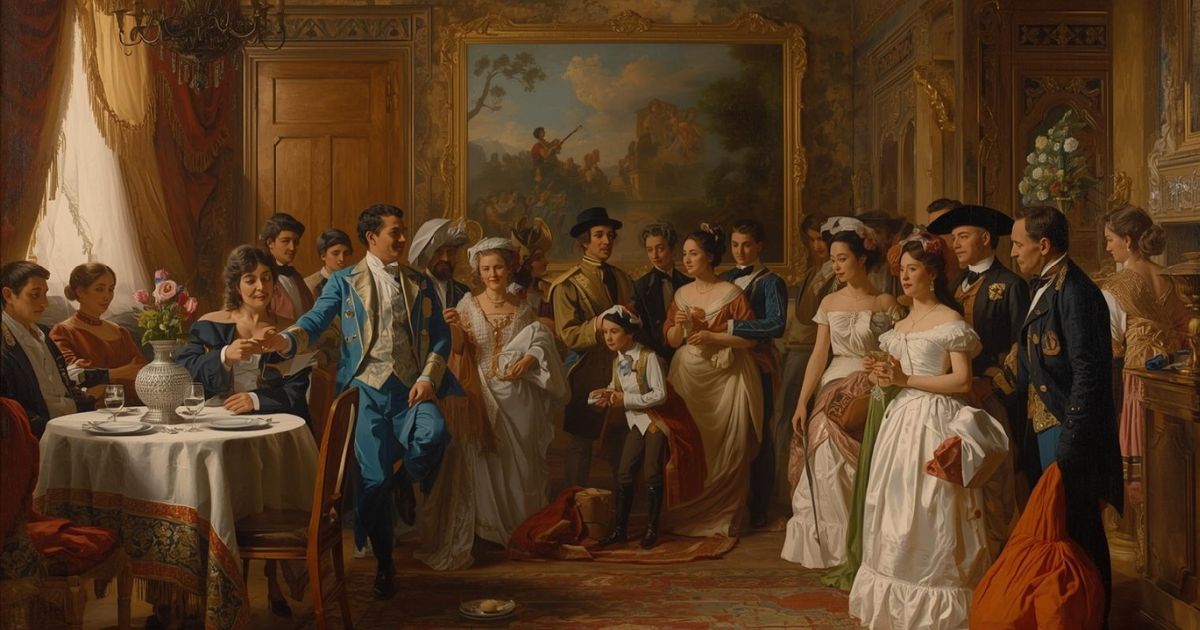
An excerpt from the original text.(complete · 1631 words)
he Dinner
Jele, jele, bago quiere. [27]
Fray Sibyla seemed to be very content as he moved along tranquilly with
the look of disdain no longer playing about his thin, refined lips. He
even condescended to speak to the lame doctor, De Espadaña, who
answered in monosyllables only, as he was somewhat of a stutterer. The
Franciscan was in a frightful humor, kicking at the chairs and even
elbowing a cadet out of his way. The lieutenant was grave while the
others talked vivaciously, praising the magnificence of the table. Doña
Victorina, however, was just turning up her nose in disdain when she
suddenly became as furious as a trampled serpent--the lieutenant had
stepped on the train of her gown.
"Haven't you any eyes?" she demanded.
"Yes, señora, two better than yours, but the fact is that I was
admiring your frizzes," retorted the rather ungallant soldier as he
moved away from her.
As if from instinct the two friars both started toward the head of the
table, perhaps from habit, and then, as might have been expected, the
same thing happened that occurs with the competitors for a university
position, who openly exalt the qualifications and superiority of their
opponents, later giving to understand that just the contrary was meant,
and who murmur and grumble when they do not receive the appointment.
"For you, Fray Damaso."
"For you, Fray Sibyla."
"An older friend of the family--confessor of the deceased lady--age,
dignity, and authority--"
"Not so very old, either! On the other hand, you are the curate of
the district," replied Fray Damaso sourly, without taking his hand
from the back of the chair.
"Since you command it, I obey," concluded Fray Sibyla, disposing
himself to take the seat.
"I don't command it!" protested the Franciscan. "I don't command it!"
Fray Sibyla was about to seat himself without paying any more attention
to these protests when his eyes happened to encounter those of the
lieutenant. According to clerical opinion in the Philippines, the
highest secular official is inferior to a friar-cook: cedant arma
togae, said Cicero in the Senate--cedant arma cottae, say the
friars in the Philippines. [28]
But Fray Sibyla was a well-bred person, so he said, "Lieutenant, here
we are in the world and not in the church. The seat of honor belongs
to you." To judge from the tone of his voice, however, even in the
world it really did belong to him, and the lieutenant, either to keep
out of trouble or to avoid sitting between two friars, curtly declined.
None of the claimants had given a thought to their host. Ibarra
noticed him watching the scene with a smile of satisfaction.
"How's this, Don Santiago, aren't you going to sit down with us?"
But all the seats were occupied; Lucullus was not to sup in the house
of Lucullus.
"Sit still, don't get up!" said Capitan Tiago, placing his hand on
the young man's shoulder. "This fiesta is for the special purpose
of giving thanks to the Virgin for your safe arrival. Oy! Bring
on the tinola! I ordered tinola as you doubtless have not tasted
any for so long a time."
A large steaming tureen was brought in. The Dominican, after muttering
the benedicite, to which scarcely any one knew how to respond, began
to serve the contents. But whether from carelessness or other cause,
Padre Damaso received a plate in which a bare neck and a tough wing
of chicken floated about in a large quantity of soup amid lumps of
squash, while the others were eating legs and breasts, especially
Ibarra, to whose lot fell the second joints. Observing all this, the
Franciscan mashed up some pieces of squash, barely tasted the soup,
dropped his spoon noisily, and roughly pushed his plate away. The
Dominican was very busy talking to the rubicund youth.
"How long have you been away from the country?" Laruja asked Ibarra.
"Almost seven years."
"Then you have probably forgotten all about it."
"Quite the contrary. Even if my country does seem to have forgotten
me, I have always thought about it."
"How do you mean that it has forgotten you?" inquired the rubicund
youth.
"I mean that it has been a year since I have received any news from
here, so that I find myself a stranger who does not yet know how and
when his father died."
This statement drew a sudden exclamation from the lieutenant.
"And where were you that you didn't telegraph?" asked Doña
Victorina. "When we were married we telegraphed to the Peñinsula." [29]
"Señora, for the past two years I have been in the northern part of
Europe, in Germany and Russian Poland."
Doctor De Espadaña, who until now had not ventured upon any
conversation, thought this a good opportunity to say something. "I--I
knew in S-spain a P-pole from W-warsaw, c-called S-stadtnitzki, if
I r-remember c-correctly. P-perhaps you s-saw him?" he asked timidly
and almost blushingly.
"It's very likely," answered Ibarra in a friendly manner, "but just
at this moment I don't recall him."
"B-but you c-couldn't have c-confused him with any one else," went
on the Doctor, taking courage. "He was r-ruddy as gold and t-talked
Spanish very b-badly."
"Those are good clues, but unfortunately while there I talked Spanish
only in a few consulates."
"How then did you get along?" asked the wondering Doña Victorina.
"The language of the country served my needs, madam."
"Do you also speak English?" inquired the Dominican, who had been in
Hongkong, and who was a master of pidgin-English, that adulteration
of Shakespeare's tongue used by the sons of the Celestial Empire.
"I stayed in England a year among people who talked nothing but
English."
"Which country of Europe pleased you the most?" asked the rubicund
youth.
"After Spain, my second fatherland, any country of free Europe."
"And you who seem to have traveled so much, tell us what do you
consider the most notable thing that you have seen?" inquired Laruja.
Ibarra appeared to reflect. "Notable--in what way?"
"For example, in regard to the life of the people--the social,
political, religious life--in general, in its essential features--as
a whole."
Ibarra paused thoughtfully before replying. "Frankly, I like everything
in those people, setting aside the national pride of each one. But
before visiting a country, I tried to familiarize myself with its
history, its Exodus, if I may so speak, and afterwards I found
everything quite natural. I have observed that the prosperity or
misery of each people is in direct proportion to its liberties or its
prejudices and, accordingly, to the sacrifices or the selfishness of
its forefathers."
"And haven't you observed anything more than that?" broke in the
Franciscan with a sneer. Since the beginning of the dinner he had not
uttered a single word, his whole attention having been taking up,
no doubt, with the food. "It wasn't worth while to squander your
fortune to learn so trifling a thing. Any schoolboy knows that."
Ibarra was placed in an embarrassing position, and the rest looked
from one to the other as if fearing a disagreeable scene. He was
about to say, "The dinner is nearly over and his Reverence is now
satiated," but restrained himself and merely remarked to the others,
"Gentlemen, don't be surprised at the familiarity with which our former
curate treats me. He treated me so when I was a child, and the years
seem to make no difference in his Reverence. I appreciate it, too,
because it recalls the days when his Reverence visited our home and
honored my father's table."
The Dominican glanced furtively at the Franciscan, who was trembling
visibly. Ibarra continued as he rose from the table: "You will now
permit me to retire, since, as I have just arrived and must go away
tomorrow morning, there remain some important business matters for me
to attend to. The principal part of the dinner is over and I drink
but little wine and seldom touch cordials. Gentlemen, all for Spain
and the Philippines!" Saying this, he drained his glass, which he had
not before touched. The old lieutenant silently followed his example.
"Don't go!" whispered Capitan Tiago. "Maria Clara will be here. Isabel
has gone to get her. The new curate of your town, who is a saint,
is also coming."
"I'll call tomorrow before starting. I've a very important visit to
make now." With this he went away.
Meanwhile the Franciscan had recovered himself. "Do you see?" he
said to the rubicund youth, at the same time flourishing his dessert
spoon. "That comes from pride. They can't stand to have the curate
correct them. They even think that they are respectable persons. It's
the evil result of sending young men to Europe. The government ought
to prohibit it."
"And how about the lieutenant?" Doña Victorina chimed in upon the
Franciscan, "he didn't get the frown off his face the whole evening. He
did well to leave us so old and still only a lieutenant!" The lady
could not forget the allusion to her frizzes and the trampled ruffles
of her gown.
That night the rubicund youth wrote down, among other things, the
following title for a chapter in his Colonial Studies: "Concerning
the manner in which the neck and wing of a chicken in a friar's plate
of soup may disturb the merriment of a feast." Among his notes there
appeared these observations: "In the Philippines the most unnecessary
person at a dinner is he who gives it, for they are quite capable of
beginning by throwing the host into the street and then everything
will go on smoothly. Under present conditions it would perhaps be a
good thing not to allow the Filipinos to leave the country, and even
not to teach them to read."
Master this chapter. Complete your experience
Purchase the complete book to access all chapters and support classic literature
As an Amazon Associate, we earn a small commission from qualifying purchases at no additional cost to you.
Available in paperback, hardcover, and e-book formats
Let's Analyse the Pattern
Creating fake injuries against yourself to justify hostile behavior toward others.
Why This Matters
Connect literature to life
This chapter teaches how to recognize when someone creates fake injuries against themselves to justify attacking you.
Practice This Today
This week, notice when someone positions themselves as the victim right before they become aggressive—that's manufactured grievance in action.
Now let's explore the literary elements.
Key Quotes & Analysis
"I don't eat chicken - it might be that the chicken knew the priest who confessed it"
Context: Damaso refuses the good piece of chicken, taking the worst portion instead to manufacture a grievance
This seemingly joking comment reveals Damaso's strategy - he creates problems so he can be offended and attack Ibarra. The manufactured slight gives him an excuse to escalate conflict.
In Today's Words:
I'm going to find something to be offended about so I can start a fight
"The lieutenant was grave while the others talked vivaciously, praising the magnificence of the table"
Context: Describing the social dynamics as guests navigate the complex hierarchy at dinner
Shows how everyone must perform their assigned role in colonial society. Some can be cheerful, others must be serious, all based on their position in the hierarchy.
In Today's Words:
Everyone was playing their expected part in this social performance
"Haven't you any eyes?"
Context: Angry at the lieutenant for stepping on her dress
Reveals how colonial society creates constant friction as people compete for tiny scraps of respect and recognition. Her fury over a minor accident shows deeper frustrations.
In Today's Words:
Are you blind or just stupid?
Thematic Threads
Power
In This Chapter
Religious authority expects automatic deference, even from military officers and wealthy hosts
Development
Building from earlier establishment of colonial hierarchy
In Your Life:
You might see this when managers expect respect they haven't earned simply because of their title.
Class
In This Chapter
Capitan Tiago doesn't even get a seat at his own dinner table, showing internalized subordination
Development
Deepening the theme of how colonial subjects police themselves
In Your Life:
You might recognize this when you automatically defer to people who haven't actually proven their authority.
Education
In This Chapter
Ibarra's travels and learning make him dangerous because he can articulate alternatives to the current system
Development
Introduced here as a threat to established power
In Your Life:
You might experience this when your education or experience makes others feel threatened or defensive.
Social Performance
In This Chapter
The entire dinner becomes theater where everyone must play their assigned role in the hierarchy
Development
Expanding from earlier scenes of public positioning
In Your Life:
You might notice this in family gatherings or work events where everyone performs expected roles rather than being authentic.
Dignity
In This Chapter
Ibarra maintains his composure and exits gracefully rather than being provoked into a fight
Development
Introduced here as strategic self-preservation
In Your Life:
You might need this skill when someone tries to bait you into reacting in ways that would hurt your reputation or position.
You now have the context. Time to form your own thoughts.
Discussion Questions
- 1
Why does Padre Damaso deliberately choose the worst piece of chicken, and how does he use this choice to justify his attack on Ibarra?
analysis • surface - 2
What does Capitan Tiago's lack of a seat at his own dinner table reveal about how power works in this society?
analysis • medium - 3
Think about your workplace, family, or community. Where have you seen someone create a problem just so they could complain about it or use it against others?
application • medium - 4
How does Ibarra handle Damaso's provocation, and what can we learn from his response about dealing with manufactured conflict?
application • deep - 5
Why do people in positions of authority sometimes feel threatened by those who have seen different ways of living or working?
reflection • deep
Critical Thinking Exercise
Decode the Manufactured Grievance
Think of a recent conflict in your life where someone seemed to be looking for reasons to be upset with you. Write down what actually happened, then identify what the person claimed was wrong, and finally analyze what they might have really been protecting or afraid of losing. This exercise helps you separate manufactured drama from genuine problems.
Consider:
- •Look for patterns - does this person regularly find new reasons to be upset?
- •Consider timing - did the grievance appear when you gained independence or success?
- •Notice the mismatch between the stated problem and the emotional intensity of the response
Journaling Prompt
Write about a time when you realized someone's anger at you wasn't really about what they claimed it was about. How did recognizing the real issue change how you handled the situation?
Coming Up Next...
Chapter 4: Buried Truth Revealed
Ibarra's departure from the dinner doesn't end the controversy—it only makes his enemies bolder. The labels 'heretic' and 'filibuster' are about to be attached to him, setting in motion forces that will determine his fate in the colony.



