
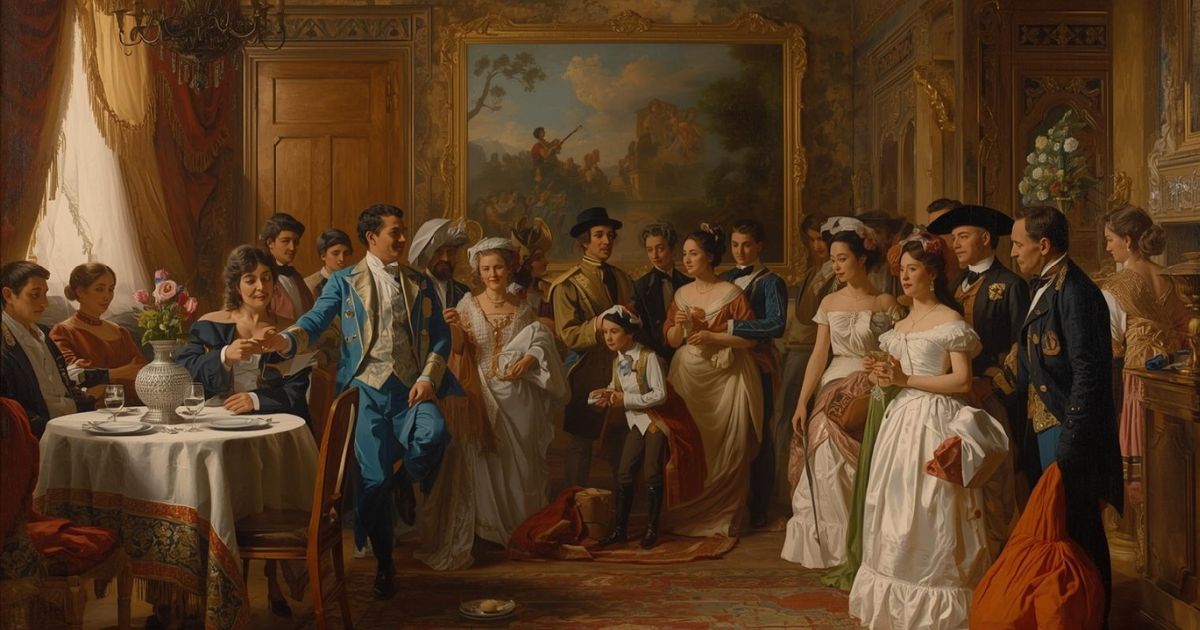
An excerpt from the original text.(complete · 2546 words)
eretic and Filibuster
Ibarra stood undecided for a moment. The night breeze, which during
those months blows cool enough in Manila, seemed to drive from his
forehead the light cloud that had darkened it. He took off his hat and
drew a deep breath. Carriages flashed by, public rigs moved along at a
sleepy pace, pedestrians of many nationalities were passing. He walked
along at that irregular pace which indicates thoughtful abstraction
or freedom from care, directing his steps toward Binondo Plaza and
looking about him as if to recall the place. There were the same
streets and the identical houses with their white and blue walls,
whitewashed, or frescoed in bad imitation of granite; the church
continued to show its illuminated clock face; there were the same
Chinese shops with their soiled curtains and their iron gratings, in
one of which was a bar that he, in imitation of the street urchins of
Manila, had twisted one night; it was still unstraightened. "How slowly
everything moves," he murmured as he turned into Calle Sacristia. The
ice-cream venders were repeating the same shrill cry, "Sorbeteee!"
while the smoky lamps still lighted the identical Chinese stands and
those of the old women who sold candy and fruit.
"Wonderful!" he exclaimed. "There's the same Chinese who was here
seven years ago, and that old woman--the very same! It might be said
that tonight I've dreamed of a seven years' journey in Europe. Good
heavens, that pavement is still in the same unrepaired condition
as when I left!" True it was that the stones of the sidewalk on the
corner of San Jacinto and Sacristia were still loose.
While he was meditating upon this marvel of the city's stability in
a country where everything is so unstable, a hand was placed lightly
on his shoulder. He raised his head to see the old lieutenant gazing
at him with something like a smile in place of the hard expression
and the frown which usually characterized him.
"Young man, be careful! Learn from your father!" was the abrupt
greeting of the old soldier.
"Pardon me, but you seem to have thought a great deal of my father. Can
you tell me how he died?" asked Ibarra, staring at him.
"What! Don't you know about it?" asked the officer.
"I asked Don Santiago about it, but he wouldn't promise to tell me
until tomorrow. Perhaps you know?"
"I should say I do, as does everybody else. He died in prison!"
The young man stepped backward a pace and gazed searchingly at the
lieutenant. "In prison? Who died in prison?"
"Your father, man, since he was in confinement," was the somewhat
surprised answer.
"My father--in prison--confined in a prison? What are you talking
about? Do you know who my father was? Are you--?" demanded the young
man, seizing the officer's arm.
"I rather think that I'm not mistaken. He was Don Rafael Ibarra."
"Yes, Don Rafael Ibarra," echoed the youth weakly.
"Well, I thought you knew about it," muttered the soldier in a
tone of compassion as he saw what was passing in Ibarra's mind. "I
supposed that you--but be brave! Here one cannot be honest and keep
out of jail."
"I must believe that you are not joking with me," replied Ibarra in
a weak voice, after a few moments' silence. "Can you tell me why he
was in prison?"
The old man seemed to be perplexed. "It's strange to me that your
family affairs were not made known to you."
"His last letter, a year ago, said that I should not be uneasy if
he did not write, as he was very busy. He charged me to continue my
studies and--sent me his blessing."
"Then he wrote that letter to you just before he died. It will soon
be a year since we buried him."
"But why was my father a prisoner?"
"For a very honorable reason. But come with me to the barracks and
I'll tell you as we go along. Take my arm."
They moved along for some time in silence. The elder seemed to be in
deep thought and to be seeking inspiration from his goatee, which he
stroked continually.
"As you well know," he began, "your father was the richest man in
the province, and while many loved and respected him, there were
also some who envied and hated him. We Spaniards who come to the
Philippines are unfortunately not all we ought to be. I say this as
much on account of one of your ancestors as on account of your father's
enemies. The continual changes, the corruption in the higher circles,
the favoritism, the low cost and the shortness of the journey, are to
blame for it all. The worst characters of the Peninsula come here,
and even if a good man does come, the country soon ruins him. So it
was that your father had a number of enemies among the curates and
other Spaniards."
Here he hesitated for a while. "Some months after your departure the
troubles with Padre Damaso began, but I am unable to explain the real
cause of them. Fray Damaso accused him of not coming to confession,
although he had not done so formerly and they had nevertheless been
good friends, as you may still remember. Moreover, Don Rafael was a
very upright man, more so than many of those who regularly attend
confession and than the confessors themselves. He had framed for
himself a rigid morality and often said to me, when he talked of
these troubles, 'Señor Guevara, do you believe that God will pardon
any crime, a murder for instance, solely by a man's telling it to a
priest--a man after all and one whose duty it is to keep quiet about
it--by his fearing that he will roast in hell as a penance--by being
cowardly and certainly shameless into the bargain? I have another
conception of God,' he used to say, 'for in my opinion one evil does
not correct another, nor is a crime to be expiated by vain lamentings
or by giving alms to the Church. Take this example: if I have killed
the father of a family, if I have made of a woman a sorrowing widow
and destitute orphans of some happy children, have I satisfied eternal
Justice by letting myself be hanged, or by entrusting my secret to one
who is obliged to guard it for me, or by giving alms to priests who
are least in need of them, or by buying indulgences and lamenting
night and day? What of the widow and the orphans? My conscience
tells me that I should try to take the place of him whom I killed,
that I should dedicate my whole life to the welfare of the family
whose misfortunes I caused. But even so, who can replace the love of
a husband and a father?' Thus your father reasoned and by this strict
standard of conduct regulated all his actions, so that it can be said
that he never injured anybody. On the contrary, he endeavored by his
good deeds to wipe out some injustices which he said your ancestors
had committed. But to get back to his troubles with the curate--these
took on a serious aspect. Padre Damaso denounced him from the pulpit,
and that he did not expressly name him was a miracle, since anything
might have been expected of such a character. I foresaw that sooner
or later the affair would have serious results."
Again the old lieutenant paused. "There happened to be wandering about
the province an ex-artilleryman who has been discharged from the army
on account of his stupidity and ignorance. As the man had to live and
he was not permitted to engage in manual labor, which would injure
our prestige, he somehow or other obtained a position as collector of
the tax on vehicles. The poor devil had no education at all, a fact of
which the natives soon became aware, as it was a marvel for them to see
a Spaniard who didn't know how to read and write. Every one ridiculed
him and the payment of the tax was the occasion of broad smiles. He
knew that he was an object of ridicule and this tended to sour his
disposition even more, rough and bad as it had formerly been. They
would purposely hand him the papers upside down to see his efforts
to read them, and wherever he found a blank space he would scribble
a lot of pothooks which rather fitly passed for his signature. The
natives mocked while they paid him. He swallowed his pride and made
the collections, but was in such a state of mind that he had no respect
for any one. He even came to have some hard words with your father.
"One day it happened that he was in a shop turning a document over and
over in the effort to get it straight when a schoolboy began to make
signs to his companions and to point laughingly at the collector with
his finger. The fellow heard the laughter and saw the joke reflected
in the solemn faces of the bystanders. He lost his patience and,
turning quickly, started to chase the boys, who ran away shouting ba,
be, bi, bo, bu. [30] Blind with rage and unable to catch them, he
threw his cane and struck one of the boys on the head, knocking him
down. He ran up and began to kick the fallen boy, and none of those
who had been laughing had the courage to interfere. Unfortunately,
your father happened to come along just at that time. He ran forward
indignantly, caught the collector by the arm, and reprimanded him
severely. The artilleryman, who was no doubt beside himself with rage,
raised his hand, but your father was too quick for him, and with the
strength of a descendant of the Basques--some say that he struck him,
others that he merely pushed him, but at any rate the man staggered
and fell a little way off, striking his head against a stone. Don
Rafael quietly picked the wounded boy up and carried him to the town
hall. The artilleryman bled freely from the mouth and died a few
moments later without recovering consciousness.
"As was to be expected, the authorities intervened and arrested
your father. All his hidden enemies at once rose up and false
accusations came from all sides. He was accused of being a heretic
and a filibuster. To be a heretic is a great danger anywhere,
but especially so at that time when the province was governed by an
alcalde who made a great show of his piety, who with his servants used
to recite his rosary in the church in a loud voice, perhaps that all
might hear and pray with him. But to be a filibuster is worse than
to be a heretic and to kill three or four tax-collectors who know
how to read, write, and attend to business. Every one abandoned him,
and his books and papers were seized. He was accused of subscribing to
El Correo de Ultramar, and to newspapers from Madrid, of having sent
you to Germany, of having in his possession letters and a photograph
of a priest who had been legally executed, and I don't know what
not. Everything served as an accusation, even the fact that he, a
descendant of Peninsulars, wore a camisa. Had it been any one but
your father, it is likely that he would soon have been set free,
as there was a physician who ascribed the death of the unfortunate
collector to a hemorrhage. But his wealth, his confidence in the law,
and his hatred of everything that was not legal and just, wrought his
undoing. In spite of my repugnance to asking for mercy from any one,
I applied personally to the Captain-General--the predecessor of our
present one--and urged upon him that there could not be anything of
the filibuster about a man who took up with all the Spaniards, even
the poor emigrants, and gave them food and shelter, and in whose
veins yet flowed the generous blood of Spain. It was in vain that
I pledged my life and swore by my poverty and my military honor. I
succeeded only in being coldly listened to and roughly sent away with
the epithet of chiflado." [31]
The old man paused to take a deep breath, and after noticing the
silence of his companion, who was listening with averted face,
continued: "At your father's request I prepared the defense in the
case. I went first to the celebrated Filipino lawyer, young A----,
but he refused to take the case. 'I should lose it,' he told me,
'and my defending him would furnish the motive for another charge
against him and perhaps one against me. Go to Señor M----, who is a
forceful and fluent speaker and a Peninsular of great influence.' I
did so, and the noted lawyer took charge of the case, and conducted it
with mastery and brilliance. But your father's enemies were numerous,
some of them hidden and unknown. False witnesses abounded, and their
calumnies, which under other circumstances would have melted away
before a sarcastic phrase from the defense, here assumed shape and
substance. If the lawyer succeeded in destroying the force of their
testimony by making them contradict each other and even perjure
themselves, new charges were at once preferred. They accused him of
having illegally taken possession of a great deal of land and demanded
damages. They said that he maintained relations with the tulisanes in
order that his crops and animals might not be molested by them. At
last the case became so confused that at the end of a year no one
understood it. The alcalde had to leave and there came in his place
one who had the reputation of being honest, but unfortunately he stayed
only a few months, and his successor was too fond of good horses.
"The sufferings, the worries, the hard life in the prison, or the pain
of seeing so much ingratitude, broke your father's iron constitution
and he fell ill with that malady which only the tomb can cure. When
the case was almost finished and he was about to be acquitted of the
charge of being an enemy of the fatherland and of being the murderer
of the tax-collector, he died in the prison with no one at his side. I
arrived just in time to see him breathe his last."
The old lieutenant became silent, but still Ibarra said nothing. They
had arrived meanwhile at the door of the barracks, so the soldier
stopped and said, as he grasped the youth's hand, "Young man, for
details ask Capitan Tiago. Now, good night, as I must return to duty
and see that all's well."
Silently, but with great feeling, Ibarra shook the lieutenant's bony
hand and followed him with his eyes until he disappeared. Then he
turned slowly and signaled to a passing carriage. "To Lala's Hotel,"
was the direction he gave in a scarcely audible voice.
"This fellow must have just got out of jail," thought the cochero as
he whipped up his horses.
Master this chapter. Complete your experience
Purchase the complete book to access all chapters and support classic literature
As an Amazon Associate, we earn a small commission from qualifying purchases at no additional cost to you.
Available in paperback, hardcover, and e-book formats
Let's Analyse the Pattern
Corrupt systems turn your strengths and moral qualities into evidence against you when you threaten their power.
Why This Matters
Connect literature to life
This chapter teaches how corrupt systems turn your positive qualities into evidence against you when you threaten their power.
Practice This Today
This week, notice when someone reframes your strengths as problems—your thoroughness becomes 'obsessive,' your questions become 'difficult,' your success becomes 'suspicious.'
Now let's explore the literary elements.
Key Quotes & Analysis
"How slowly everything moves"
Context: Walking through Manila streets that look exactly the same as seven years ago
This reveals Ibarra's growing awareness that while he's changed and grown during his European education, the Philippines remains trapped in the same corrupt, stagnant system. The physical unchanged-ness of the streets mirrors the unchanged corruption.
In Today's Words:
Nothing ever changes around here
"They called him a filibuster, a heretic, an enemy of God and Spain"
Context: Explaining how Don Rafael's enemies destroyed him with false accusations
Shows how corrupt systems use moral and patriotic language to destroy good people. The accusations are designed to make defense impossible - how do you prove you're not an enemy of God?
In Today's Words:
They painted him as a terrorist and traitor who hated America and Christianity
"The lawyer was good, but his client was poor - poor in friends, poor in protection"
Context: Explaining why Don Rafael lost despite having a strong legal case
Reveals that justice isn't about evidence or law, but about power and connections. Even with the best legal representation, those without political protection are doomed in a corrupt system.
In Today's Words:
Having a good lawyer doesn't matter if you don't have the right connections
Thematic Threads
Institutional Corruption
In This Chapter
The colonial system systematically destroys Don Rafael by twisting legal processes, manufacturing evidence, and turning his virtues into crimes
Development
Introduced here as the driving force behind the tragedy
In Your Life:
You might see this when workplace politics target the most competent employees or when family systems scapegoat the truth-teller
Class Warfare
In This Chapter
Don Rafael's wealth and education make him a target—his very success threatens those who profit from keeping others down
Development
Builds on earlier hints about social tensions and resentment
In Your Life:
You might experience this when your achievements make others uncomfortable or when success changes how people treat you
Betrayal
In This Chapter
Neighbors, officials, and priests who once benefited from Don Rafael's generosity turn against him when it becomes profitable
Development
Introduced here as a shocking revelation of human nature
In Your Life:
You might see this when crisis reveals who your real friends are, or when people abandon you the moment supporting you becomes inconvenient
Truth vs. Power
In This Chapter
Facts become irrelevant when powerful people decide someone must be destroyed—the truth can't compete with coordinated lies
Development
Introduced here as the central conflict
In Your Life:
You might encounter this in workplace investigations, family disputes, or any situation where admitting the truth would embarrass those in charge
Inherited Consequences
In This Chapter
Ibarra inherits not just his father's death but the enemies and reputation that come with it—the son pays for the father's virtue
Development
Introduced here, setting up Ibarra's future challenges
In Your Life:
You might face this through family reputation, neighborhood history, or workplace dynamics that existed before you arrived
You now have the context. Time to form your own thoughts.
Discussion Questions
- 1
What specific evidence did Don Rafael's enemies use against him, and how did they twist his good qualities into crimes?
analysis • surface - 2
Why do you think corrupt systems target people with strong moral principles rather than ignoring them?
analysis • medium - 3
Where have you seen someone's strengths get turned against them in your workplace, school, or community?
application • medium - 4
If you were in Don Rafael's position today, what would you do differently to protect yourself while still standing up for what's right?
application • deep - 5
What does this chapter reveal about the relationship between power, fear, and the need to destroy what threatens you?
reflection • deep
Critical Thinking Exercise
Strength Inventory and Protection Plan
List three of your strongest qualities or values that you're known for. For each one, write down how someone with bad intentions could potentially twist that strength into something negative. Then brainstorm one specific way you could protect that strength while still using it positively.
Consider:
- •Think about qualities that make you stand out or that others frequently comment on
- •Consider how your strengths might threaten people who benefit from the status quo
- •Focus on practical protection strategies, not changing who you are
Journaling Prompt
Write about a time when one of your positive qualities was misinterpreted or used against you. How did you handle it, and what would you do differently now?
Coming Up Next...
Chapter 5: A Star in a Dark Night
Devastated by the truth about his father's death, Ibarra retreats to process this revelation. But in the darkness of his grief, an unexpected encounter may offer the first glimmer of hope and human connection he desperately needs.



