
An excerpt from the original text.(complete · 2499 words)
the Twilight
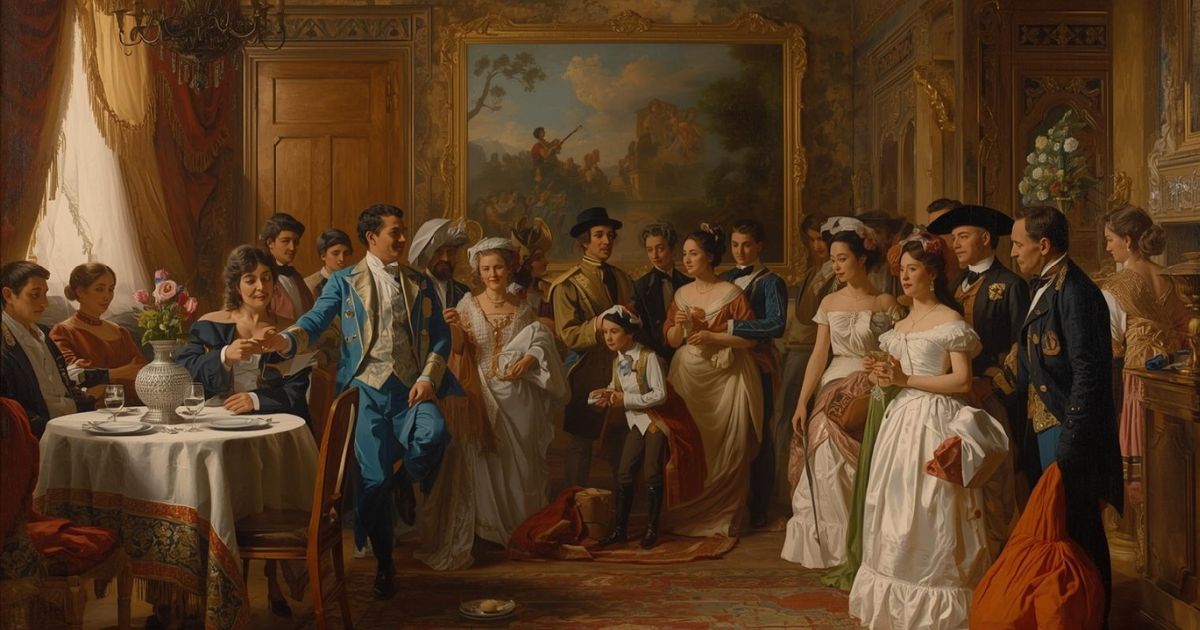
In Capitan Tiago's house also great preparations had been made. We
know its owner, whose love of ostentation and whose pride as a
Manilan imposed the necessity of humiliating the provincials with his
splendor. Another reason, too, made it his duty to eclipse all others:
he had his daughter Maria Clara with him, and there was present his
future son-in-law, who was attracting universal attention.
In fact one of the most serious newspapers in Manila had devoted to
Ibarra an article on its front page, entitled, "Imitate him!" heaping
him with praise and giving him some advice. It had called him, "The
cultivated young gentleman and rich capitalist;" two lines further
on, "The distinguished philanthropist;" in the following paragraph,
"The disciple of Minerva who had gone to the mother country to
pay his respects to the true home of the arts and sciences;" and
a little further on, "The Filipino Spaniard." Capitan Tiago burned
with generous zeal to imitate him and wondered whether he ought not
to erect a convento at his own expense.
Some days before there had arrived at the house where Maria Clara
and Aunt Isabel were staying a profusion of eases of European wines
and food-stuffs, colossal mirrors, paintings, and Maria Clara's
piano. Capitan Tiago had arrived on the day before the fiesta and as
his daughter kissed his hand, had presented her with a beautiful locket
set with diamonds and emeralds, containing a sliver from St. Peter's
boat, in which Our Savior sat during the fishing. His first interview
with his future son-in-law could not have been more cordial. Naturally,
they talked about the school, and Capitan Tiago wanted it named
"School of St. Francis." "Believe me," he said, "St. Francis is a good
patron. If you call it 'School of Primary Instruction,' you will gain
nothing. Who is Primary Instruction, anyhow?"
Some friends of Maria Clara came and asked her to go for a walk. "But
come back quickly," said Capitan Tiago to his daughter, when she asked
his permission, "for you know that Padre Damaso, who has just arrived,
will dine with us."
Then turning to Ibarra, who had become thoughtful, he said, "You dine
with us also, you'll be all alone in your house."
"I would with the greatest pleasure, but I have to be at home in
case visitors come," stammered the youth, as he avoided the gaze of
Maria Clara.
"Bring your friends along," replied Capitan Tiago heartily. "In my
house there's always plenty to eat. Also, I want you and Padre Damaso
to get on good terms."
"There'll be time enough for that," answered Ibarra with a forced
smile, as he prepared to accompany the girls.
They went downstairs, Maria Clara in the center between Victoria
and Iday, Aunt Isabel following. The people made way for them
respectfully. Maria Clara was startling in her beauty; her pallor
was all gone, and if her eyes were still pensive, her mouth on the
contrary seemed to know only smiles. With maiden friendliness the
happy young woman greeted the acquaintances of her childhood, now
the admirers of her promising youth. In less than a fortnight she had
succeeded in recovering that frank confidence, that childish prattle,
which seemed to have been benumbed between the narrow walls of the
nunnery. It might be said that on leaving the cocoon the butterfly
recognized all the flowers, for it seemed to be enough for her to
spread her wings for a moment and warm herself in the sun's rays to
lose all the stiffness of the chrysalis. This new life manifested
itself in her whole nature. Everything she found good and beautiful,
and she showed her love with that maiden modesty which, having never
been conscious of any but pure thoughts, knows not the meaning of false
blushes. While she would cover her face when she was teased, still her
eyes smiled, and a light thrill would course through her whole being.
The houses were beginning to show lights, and in the streets where
the music was moving about there were lighted torches of bamboo and
wood made in imitation of those in the church. From the streets
the people in the houses might be seen through the windows in an
atmosphere of music and flowers, moving about to the sounds of piano,
harp, or orchestra. Swarming in the streets were Chinese, Spaniards,
Filipinos, some dressed in European style, some in the costumes
of the country. Crowding, elbowing, and pushing one another, walked
servants carrying meat and chickens, students in white, men and women,
all exposing themselves to be knocked down by the carriages which,
in spite of the drivers' cries, made their way with difficulty.
In front of Capitan Basilio's house some young women called to our
acquaintances and invited them to enter. The merry voice of Sinang as
she ran down the stairs put an end to all excuses. "Come up a moment
so that I may go with you," she said. "I'm bored staying here among
so many strangers who talk only of game-cocks and cards."
They were ushered into a large room filled with people, some of whom
came forward to greet Ibarra, for his name was now well known. All
gazed in ecstasy at the beauty of Maria Clara and some old women
murmured, as they chewed their buyo, "She looks like the Virgin!"
There they had to have chocolate, as Capitan Basilio had become a warm
friend and defender of Ibarra since the day of the picnic. He had
learned from the half of the telegram given to his daughter Sinang
that Ibarra had known beforehand about the court's decision in the
latter's favor, so, not wishing to be outdone in generosity, he had
tried to set aside the decision of the chess-match. But when Ibarra
would not consent to this, he had proposed that the money which would
have been spent in court fees should be used to pay a teacher in the
new school. In consequence, the orator employed all his eloquence to
the end that other litigants should give up their extravagant claims,
saying to them, "Believe me, in a lawsuit the winner is left without
a camisa." But he had succeeded in convincing no one, even though he
cited the Romans.
After drinking the chocolate our young people had to listen to
piano-playing by the town organist. "When I listen to him in the
church," exclaimed Sinang, pointing to the organist, "I want to dance,
and now that he's playing here I feel like praying, so I'm going out
with you."
"Don't you want to join us tonight?" whispered Capitan Basilio into
Ibarra's ear as they were leaving. "Padre Damaso is going to set up
a little bank." Ibarra smiled and answered with an equivocal shake
of his head.
"Who's that?" asked Maria Clara of Victoria, indicating with a rapid
glance a youth who was following them.
"He's--he's a cousin of mine," she answered with some agitation.
"And the other?"
"He's no cousin of mine," put in Sinang merrily. "He's my uncle's son."
They passed in front of the parish rectory, which was not one of the
least animated buildings. Sinang was unable to repress an exclamation
of surprise on seeing the lamps burning, those lamps of antique
pattern which Padre Salvi had never allowed to be lighted, in order
not to waste kerosene. Loud talk and resounding bursts of laughter
might be heard as the friars moved slowly about, nodding their heads
in unison with the big cigars that adorned their lips. The laymen
with them, who from their European garments appeared to be officials
and employees of the province, were endeavoring to imitate whatever
the good priests did. Maria Clara made out the rotund figure of Padre
Damaso at the side of the trim silhouette of Padre Sibyla. Motionless
in his place stood the silent and mysterious Fray Salvi.
"He's sad," observed Sinang, "for he's thinking about how much so
many visitors are going to cost. But you'll see how he'll not pay
it himself, but the sacristans will. His visitors always eat at
other places."
"Sinang!" scolded Victoria.
"I haven't been able to endure him since he tore up the Wheel of
Fortune. I don't go to confession to him any more."
Of all the houses one only was to be noticed without lights and with
all the windows closed--that of the alferez. Maria Clara expressed
surprise at this.
"The witch! The Muse of the Civil Guard, as the old man says,"
exclaimed the irrepressible Sinang. "What has she to do with our
merrymakings? I imagine she's raging! But just let the cholera come
and you'd see her give a banquet."
"But, Sinang!" again her cousin scolded.
"I never was able to endure her and especially since she disturbed our
picnic with her civil-guards. If I were the Archbishop I'd marry Her
to Padre Salvi--then think what children! Look how she tried to arrest
the poor pilot, who threw himself into the water simply to please--"
She was not allowed to finish, for in the corner of the plaza
where a blind man was singing to the accompaniment of a guitar,
a curious spectacle was presented. It was a man miserably dressed,
wearing a broad salakot of palm leaves. His clothing consisted of a
ragged coat and wide pantaloons, like those worn by the Chinese, torn
in many places. Wretched sandals covered his feet. His countenance
remained hidden in the shadow of his wide hat, but from this shadow
there flashed intermittently two burning rays. Placing a flat basket
on the ground, he would withdraw a few paces and utter strange,
incomprehensible sounds, remaining the while standing entirely alone as
if he and the crowd were mutually avoiding each other. Then some women
would approach the basket and put into it fruit, fish, or rice. When
no one any longer approached, from the shadows would issue sadder
but less pitiful sounds, cries of gratitude perhaps. Then he would
take up the basket and make his way to another place to repeat the
same performance.
Maria Clara divined that there must be some misfortune there, and
full of interest she asked concerning the strange creature.
"He's a leper," Iday told her. "Four years ago he contracted the
disease, some say from taking care of his mother, others from lying
in a damp prison. He lives in the fields near the Chinese cemetery,
having intercourse with no one, because all flee from him for fear of
contagion. If you might only see his home! It's a tumbledown shack,
through which the wind and rain pass like a needle through cloth. He
has been forbidden to touch anything belonging to the people. One day
when a little child fell into a shallow ditch as he was passing,
he helped to get it out. The child's father complained to the
gobernadorcillo, who ordered that the leper be flogged through the
streets and that the rattan be burned afterwards. It was horrible! The
leper fled with his flogger in pursuit, while the gobernadorcillo
cried, 'Catch him! Better be drowned than get the disease you have!'"
"Can it be true!" murmured Maria Clara, then, without saying what she
was about to do, went up to the wretch's basket and dropped into it
the locket her father had given her.
"What have you done?" her friends asked.
"I hadn't anything else," she answered, trying to conceal her tears
with a smile.
"What is he going to do with your locket?" Victoria asked her. "One
day they gave him some money, but he pushed it away with a stick;
why should he want it when no one accepts anything that comes from
him? As if the locket could be eaten!"
Maria Clara gazed enviously at the women who were selling food-stuffs
and shrugged her shoulders. The leper approached the basket, picked
up the jeweled locket, which glittered in his hands, then fell upon
his knees, kissed it, and taking off his salakot buried his forehead
in the dust where the maiden had stepped. Maria Clara hid her face
behind her fan and raised her handkerchief to her eyes.
Meanwhile, a poor woman had approached the leper, who seemed to be
praying. Her long hair was loose and unkempt, and in the light of
the torches could be recognized the extremely emaciated features of
the crazy Sisa. Feeling the touch of her hand, the leper jumped up
with a cry, but to the horror of the onlooker's Sisa caught him by
the arm and said:
"Let us pray, let us pray! Today is All Souls' day! Those lights are
the souls of men! Let us pray for my sons!"
"Separate them! Separate them! The madwoman will get the
disease!" cried the crowd, but no one dared to go near them.
"Do you see that light in the tower? That is my son Basilio sliding
down a rope! Do you see that light in the convento? That is my son
Crispin! But I'm not going to see them because the curate is sick
and had many gold pieces and the gold pieces are lost! Pray, let us
pray for the soul of the curate! I took him the finest fruits, for
my garden was full of flowers and I had two sons! I had a garden,
I used to take care of my flowers, and I had two sons!"
Then releasing her hold of the leper, she ran away singing, "I had
a garden and flowers, I had two sons, a garden, and flowers!"
"What have you been able to do for that poor woman?" Maria Clara
asked Ibarra.
"Nothing! Lately she has been missing from the totem and wasn't to
be found," answered the youth, rather confusedly. "Besides, I have
been very busy. But don't let it trouble you. The curate has promised
to help me, but advised that I proceed with great tact and caution,
for the Civil Guard seems to be mixed up in it. The curate is greatly
interested in her case."
"Didn't the alferez say that he would have search made for her sons?"
"Yes, but at the time he was somewhat--drunk." Scarcely had he said
this when they saw the crazy woman being led, or rather dragged along,
by a soldier. Sisa was offering resistance.
"Why are you arresting her? What has she done?" asked Ibarra.
"Why, haven't you seen how she's been raising a disturbance?" was
the reply of the guardian of the public peace.
The leper caught up his basket hurriedly and ran away.
Maria Clara wanted to go home, as she had lost all her mirth and good
humor. "So there are people who are not happy," she murmured. Arriving
at her door, she felt her sadness increase when her fiancé declined
to go in, excusing himself on the plea of necessity. Maria Clara went
upstairs thinking what a bore are the fiesta days, when strangers
make their visits.
Master this chapter. Complete your experience
Purchase the complete book to access all chapters and support classic literature
As an Amazon Associate, we earn a small commission from qualifying purchases at no additional cost to you.
Available in paperback, hardcover, and e-book formats
Let's Analyse the Pattern
The Performance vs. Compassion Split
When social systems reward calculated performance over genuine human response, authentic compassion becomes both rare and revolutionary.
Why This Matters
Connect literature to life
This chapter teaches you to distinguish between genuine human connection and calculated social positioning.
Practice This Today
This week, notice when you're performing versus being real - pay attention to how each feels in your body, then look for one person everyone else is ignoring.
Now let's explore the literary elements.
Key Quotes & Analysis
"The cultivated young gentleman and rich capitalist"
Context: The Manila newspaper heaps praise on Ibarra in a front-page article
This quote shows how the media creates public personas that may not match reality. The newspaper reduces Ibarra to buzzwords that sound impressive but create impossible expectations for him to maintain.
In Today's Words:
The successful entrepreneur and philanthropist everyone should look up to
"Capitan Tiago burned with generous zeal to imitate him"
Context: Describing Capitan Tiago's reaction to Ibarra's media coverage
This reveals how public praise creates pressure on others to compete and perform. Tiago's 'generous zeal' is actually driven by envy and the need to maintain his social position.
In Today's Words:
Capitan Tiago was desperately trying to keep up with the Joneses
"Without hesitation, she gave him her precious diamond locket"
Context: Maria Clara's spontaneous act of charity toward the leper
This moment reveals Maria Clara's genuine compassion versus the calculated charity of others. Her immediate response shows moral courage that transcends social expectations about who deserves help.
In Today's Words:
She didn't think twice about giving him something really valuable
Thematic Threads
Class
In This Chapter
The rigid separation between the wealthy displaying prosperity and the outcasts like the leper and Sisa who are forbidden human contact
Development
Evolved from earlier subtle distinctions to stark, visible barriers that literally prevent human touch
In Your Life:
You might notice this when certain people become invisible in your workplace or community based on their economic status.
Identity
In This Chapter
Ibarra's transformation into a public figure with media coverage creates new pressures and expectations for his behavior
Development
Building from his earlier return home, now showing how public recognition changes personal freedom
In Your Life:
You might experience this when a promotion or recognition suddenly makes you feel like you're performing a role rather than being yourself.
Social Expectations
In This Chapter
Capitan Tiago's frantic dinner preparations driven by the need to maintain status and impress his future son-in-law
Development
Intensified from earlier social maneuvering to desperate performance anxiety
In Your Life:
You might recognize this when you're exhausting yourself trying to impress family members or maintain appearances during important events.
Human Relationships
In This Chapter
Maria Clara's spontaneous compassion toward the leper contrasts sharply with the calculated social interactions around her
Development
Emerging as genuine connection that cuts through the social performance established in earlier chapters
In Your Life:
You might see this when you feel most connected to others during unguarded moments rather than planned social interactions.
Personal Growth
In This Chapter
Maria Clara's act of giving her diamond locket reveals character development through moral choice rather than social compliance
Development
Shows her evolution from passive social participant to active moral agent
In Your Life:
You might experience this when you choose kindness over social acceptability, even when it costs you something valuable.
You now have the context. Time to form your own thoughts.
Discussion Questions
- 1
What contrast does Rizal draw between how Maria Clara responds to the leper versus how everyone else at the fiesta behaves?
analysis • surface - 2
Why does Capitan Tiago put so much energy into preparing an elaborate dinner, and what does this reveal about how social pressure works?
analysis • medium - 3
Where do you see people today performing success or happiness while ignoring those who are struggling right in front of them?
application • medium - 4
When you're in a group focused on appearances or status, how do you stay connected to your authentic values without becoming a social outcast yourself?
application • deep - 5
What does Maria Clara's spontaneous generosity teach us about the relationship between genuine compassion and social expectations?
reflection • deep
Critical Thinking Exercise
Map Your Social Performance vs. Authentic Moments
Think about your last week. Draw two columns: 'Performance Mode' and 'Authentic Mode.' List specific moments when you were performing for social approval versus times when you acted from genuine impulse. Look for patterns in when you switch between these modes and what triggers each one.
Consider:
- •Notice how each mode feels different in your body - performance often creates tension
- •Pay attention to who you're with when you shift into performance mode
- •Consider whether your authentic moments align with your actual values
Journaling Prompt
Write about a time when you chose authentic compassion over social expectations. What did it cost you, and what did you gain?
Coming Up Next...
Chapter 28: Letters from the Fiesta
Personal letters reveal hidden tensions and secret communications that threaten to disrupt the carefully maintained social order. What dangerous truths are being shared in private correspondence?



