
An excerpt from the original text.(complete · 2644 words)
he Eve of the Fiesta
It is now the tenth of November, the eve of the fiesta. Emerging from
its habitual monotony, the town has given itself over to unwonted
activity in house, church, cockpit, and field. Windows are covered
with banners and many-hued draperies. All space is filled with noise
and music, and the air is saturated with rejoicings.
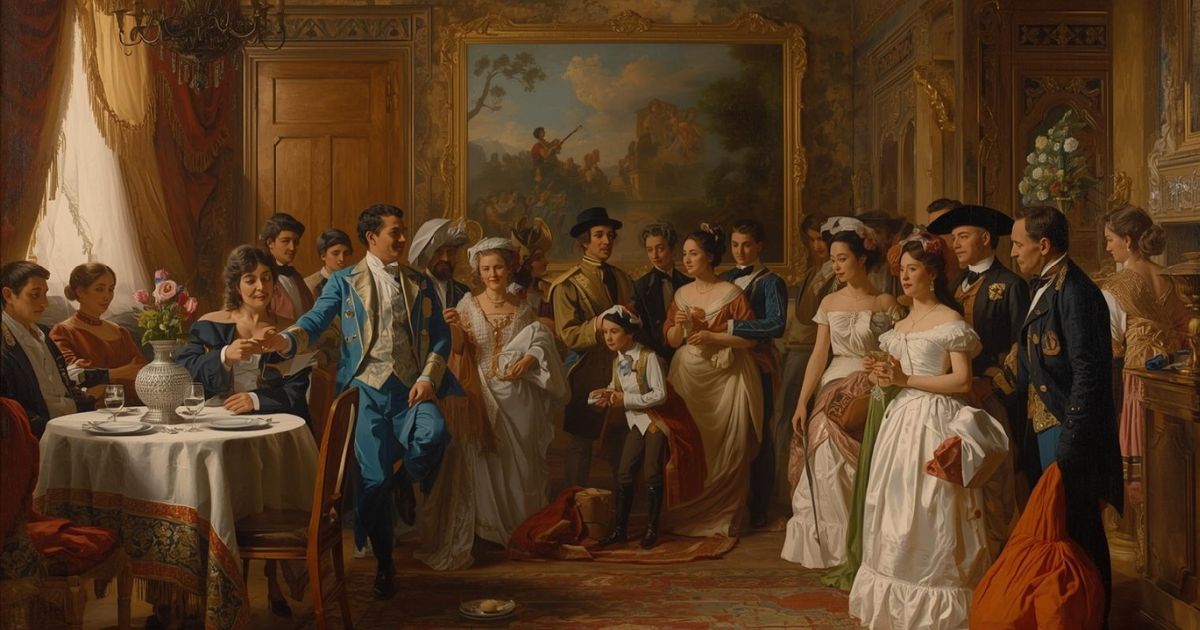
On little tables with embroidered covers the dalagas arrange in
bright-hued glass dishes different kinds of sweetmeats made from
native fruits. In the yard the hens cackle, the cocks crow, and the
hogs grunt, all terrified by this merriment of man. Servants move
in and out carrying fancy dishes and silver cutlery. Here there is a
quarrel over a broken plate, there they laugh at the simple country
girl. Everywhere there is ordering, whispering, shouting. Comments and
conjectures are made, one hurries the other,--all is commotion, noise,
and confusion. All this effort and all this toil are for the stranger
as well as the acquaintance, to entertain every one, whether he has
been seen before or not, or whether he is expected to be seen again, in
order that the casual visitor, the foreigner, friend, enemy, Filipino,
Spaniard, the poor and the rich, may go away happy and contented. No
gratitude is even asked of them nor is it expected that they do no
damage to the hospitable family either during or after digestion! The
rich, those who have ever been to Manila and have seen a little more
than their neighbors, have bought beer, champagne, liqueurs, wines,
and food-stuffs from Europe, of which they will hardly taste a bite
or drink a drop.
Their tables are luxuriously furnished. In the center is a well-modeled
artificial pineapple in which are arranged toothpicks elaborately
carved by convicts in their rest-hours. Here they have designed a
fan, there a bouquet of flowers, a bird, a rose, a palm leaf, or a
chain, all wrought from a single piece of wood, the artisan being a
forced laborer, the tool a dull knife, and the taskmaster's voice the
inspiration. Around this toothpick-holder are placed glass fruit-trays
from which rise pyramids of oranges, lansons, ates, chicos, and even
mangos in spite of the fact that it is November. On wide platters
upon bright-hued sheets of perforated paper are to be seen hams from
Europe and China, stuffed turkeys, and a big pastry in the shape of
an Agnus Dei or a dove, the Holy Ghost perhaps. Among all these are
jars of appetizing acharas with fanciful decorations made from
the flowers of the areca palm and other fruits and vegetables, all
tastefully cut and fastened with sirup to the sides of the flasks.
Glass lamp globes that have been handed down from father to son are
cleaned, the copper ornaments polished, the kerosene lamps taken out
of the red wrappings which have protected them from the flies and
mosquitoes during the year and which have made them unserviceable;
the prismatic glass pendants shake to and fro, they clink together
harmoniously in song, and even seem to take part in the fiesta as
they flash back and break up the rays of light, reflecting them on
the white walls in all the colors of the rainbow. The children play
about amusing themselves by chasing the colors, they stumble and break
the globes, but this does not interfere with the general merriment,
although at other times in the year the tears in their round eyes
would be taken account of in a different way.
Along with these venerated lamps there also come forth from their
hiding-places the work of the girls: crocheted scarfs, rugs, artificial
flowers. There appear old glass trays, on the bottoms of which are
sketched miniature lakes with little fishes, caymans, shell-fish,
seaweeds, coral, and glassy stones of brilliant hues. These are heaped
with cigars, cigarettes, and diminutive buyos prepared by the delicate
fingers of the maidens. The floor of the house shines like a mirror,
curtains of piña and husi festoon the doorways, from the windows
hang lanterns covered with glass or with paper, pink, blue, green, or
red. The house itself is filled with plants and flower-pots on stands
of Chinese porcelain. Even the saints bedeck themselves, the images
and relics put on a festive air, the dust is brushed from them and
on the freshly-washed glass of their cases are hung flowery garlands.
In the streets are raised at intervals fanciful bamboo arches, known as
sinkában, constructed in various ways and adorned with kaluskús,
the curling bunches of shavings scraped on their sides, at the sight
of which alone the hearts of the children rejoice. About the front
of the church, where the procession is to pass, is a large and costly
canopy upheld on bamboo posts. Beneath this the children run and play,
climbing, jumping, and tearing the new camisas in which they should
shine on the principal day of the fiesta.
There on the plaza a platform has been erected, the scenery being
of bamboo, nipa, and wood; there the Tondo comedians will perform
wonders and compete with the gods in improbable miracles, there
will sing and dance Marianito, Chananay, Balbino, Ratia, Carvajal,
Yeyeng, Liceria, etc. The Filipino enjoys the theater and is a deeply
interested spectator of dramatic representations, but he listens in
silence to the song, he gazes delighted at the dancing and mimicry,
he never hisses or applauds.
If the show is not to his liking, he chews his buyo or withdraws
without disturbing the others who perhaps find pleasure in it. Only
at times the commoner sort will howl when the actors embrace or kiss
the actresses, but they never go beyond that. Formerly, dramas only
were played; the local poet composed a piece in which there must
necessarily be a fight every second minute, a clown, and terrifying
transformations. But since the Tondo artist have begun to fight every
fifteen seconds, with two clowns, and even greater marvels than before,
they have put to rout their provincial compeers. The gobernadorcillo
was very fond of this sort of thing, so, with the approval of the
curate, he chose a spectacle with magic and fireworks, entitled, "The
Prince Villardo or the Captives Rescued from the Infamous Cave." [78]
From time to time the bells chime out merrily, those same bells that
ten days ago were tolling so mournfully. Pin-wheels and mortars rend
the air, for the Filipino pyrotechnist, who learned the art from
no known instructor, displays his ability by preparing fire bulls,
castles of Bengal lights, paper balloons inflated with hot air, bombs,
rockets, and the like.
Now distant strains of music are heard and the small boys rush headlong
toward the outskirts of the town to meet the bands of music, five
of which have been engaged, as well as three orchestras. The band of
Pagsanhan belonging to the escribano must not be lacking nor that of
San Pedro de Tunasan, at that time famous because it was directed by
the maestro Austria, the vagabond "Corporal Mariano" who, according to
report, carried fame and harmony in the tip of his baton. Musicians
praise his funeral march, "El Sauce," [79] and deplore his lack of
musical education, since with his genius he might have brought glory
to his country. The bands enter the town playing lively airs, followed
by ragged or half-naked urchins, one in the camisa of his brother,
another in his father's pantaloons. As soon as the band ceases, the
boys know the piece by heart, they hum and whistle it with rare skill,
they pronounce their judgment upon it.
Meanwhile, there are arriving in conveyances of all kinds relatives,
friends, strangers, the gamblers with their best game-cocks and their
bags of gold, ready to risk their fortune on the green cloth or within
the arena of the cockpit.
"The alferez has fifty pesos for each night," murmurs a small,
chubby individual into the ears of the latest arrivals. "Capitan
Tiago's coming and will set up a bank; Capitan Joaquin's bringing
eighteen thousand. There'll be liam-pó: Carlos the Chinaman will
set it up with ten thousand. Big stakes are coming from Tanawan, Lipa,
and Batangas, as well as from Santa Cruz. [80] It's going to be on a
big scale, yes, sir, on a grand scale! But have some chocolate! This
year Capitan Tiago won't break us as he did last, since he's paid
for only three thanksgiving masses and I've got a cacao mutyâ. And
how's your family?"
"Well, thank you," the visitors respond, "and Padre Damaso?"
"Padre Damaso will preach in the morning and sit in with us at night."
"Good enough! Then there's no danger."
"Sure, we're sure! Carlos the Chinaman will loosen up also." Here
the chubby individual works his fingers as though counting out pieces
of money.
Outside the town the hill-folk, the kasamá, are putting on their
best clothes to carry to the houses of their landlords well-fattened
chickens, wild pigs, deer, and birds. Some load firewood on the heavy
carts, others fruits, ferns, and orchids, the rarest that grow in
the forests, others bring broad-leafed caladiums and flame-colored
tikas-tikas blossoms to decorate the doors of the houses.
But the place where the greatest activity reigns, where it is converted
into a tumult, is there on a little plot of raised ground, a few
steps from Ibarra's house. Pulleys screech and yells are heard amid
the metallic sound of iron striking upon stone, hammers upon nails,
of axes chopping out posts. A crowd of laborers is digging in the
earth to open a wide, deep trench, while others place in line the
stones taken from the town quarries. Carts are unloaded, piles of
sand are heaped up, windlasses and derricks are set in place.
"Hey, you there! Hurry up!" cries a little old man with lively and
intelligent features, who has for a cane a copper-bound rule around
which is wound the cord of a plumb-bob. This is the foreman of the
work, Ñor Juan, architect, mason, carpenter, painter, locksmith,
stonecutter, and, on occasions, sculptor. "It must be finished right
now! Tomorrow there'll be no work and the day after tomorrow is the
ceremony. Hurry!"
"Cut that hole so that this cylinder will fit it exactly," he says
to some masons who are shaping a large square block of stone. "Within
that our names will be preserved."
He repeats to every newcomer who approaches the place what he
has already said a thousand times: "You know what we're going to
build? Well, it's a schoolhouse, a model of its kind, like those in
Germany, and even better. A great architect has drawn the plans,
and I--I am bossing the job! Yes, sir, look at it, it's going to
be a palace with two wings, one for the boys and the other for the
girls. Here in the middle a big garden with three fountains, there on
the sides shaded walks with little plots for the children to sow and
cultivate plants in during their recess-time, that they may improve
the hours and not waste them. Look how deep the foundations are,
three meters and seventy-five centimeters! This building is going
to have storerooms, cellars, and for those who are not diligent
students dungeons near the playgrounds so that the culprits may hear
how the studious children are enjoying themselves. Do you see that
big space? That will be a lawn for running and exercising in the
open air. The little girls will have a garden with benches, swings,
walks where they can jump the rope, fountains, bird-cages, and so
on. It's going to be magnificent!"
Then Ñor Juan would rub his hands together as he thought of the
fame that he was going to acquire. Strangers would come to see it
and would ask, "Who was the great artisan that built this?" and all
would answer, "Don't you know? Can it be that you've never heard
of Ñor Juan? Undoubtedly you've come from a great distance!" With
these thoughts he moved from one part to the other, examining and
reexamining everything.
"It seems to me that there's too much timber for one derrick," he
remarked to a yellowish man who was overseeing some laborers. "I
should have enough with three large beams for the tripod and three
more for the braces."
"Never mind!" answered the yellowish man, smiling in a peculiar
way. "The more apparatus we use in the work, so much the greater effect
we'll get. The whole thing will look better and of more importance,
so they'll say, 'How hard they've worked!' You'll see, you'll see
what a derrick I'll put up! Then I'll decorate it with banners, and
garlands of leaves and flowers. You'll say afterwards that you were
right in hiring me as one of your laborers, and Señor Ibarra couldn't
ask for more!" As he said this the man laughed and smiled. Ñor Juan
also smiled, but shook his head.
Some distance away were seen two kiosks united by a kind of arbor
covered with banana leaves. The schoolmaster and some thirty boys
were weaving crowns and fastening banners upon the frail bamboo posts,
which were wrapped in white cloth.
"Take care that the letters are well written," he admonished the boys
who were preparing inscriptions. "The alcalde is coming, many curates
will be present, perhaps even the Captain-General, who is now in the
province. If they see that you draw well, maybe they'll praise you."
"And give us a blackboard?"
"Perhaps, but Señor Ibarra has already ordered one from
Manila. Tomorrow some things will come to be distributed among you
as prizes. Leave those flowers in the water and tomorrow we'll make
the bouquets. Bring more flowers, for it's necessary that the table
be covered with them--flowers please the eye."
"My father will bring some water-lilies and a basket of sampaguitas
tomorrow."
"Mine has brought three cartloads of sand without pay."
"My uncle has promised to pay a teacher," added a nephew of Capitan
Basilio.
Truly, the project was receiving help from all. The curate had asked to
stand sponsor for it and himself bless the laying of the corner-stone,
a ceremony to take place on the last day of the fiesta as one of its
greatest solemnities. The very coadjutor had timidly approached Ibarra
with an offer of all the fees for masses that the devout would pay
until the building was finished. Even more, the rich and economical
Sister Rufa had declared that if money should be lacking she would
canvass other towns and beg for alms, with the mere condition that she
be paid her expenses for travel and subsistence. Ibarra thanked them
all, as he answered, "We aren't going to have anything very great,
since I am not rich and this building is not a church. Besides,
I didn't undertake to erect it at the expense of others."
The younger men, students from Manila, who had come to take part
in the fiesta, gazed at him in admiration and took him for a model;
but, as it nearly always happens, when we wish to imitate great men,
that we copy only their foibles and even their defects, since we are
capable of nothing else, so many of these admirers took note of the
way in which he tied his cravat, others of the style of his collar,
and not a few of the number of buttons on his coat and vest.
The funereal presentiments of old Tasio seemed to have been dissipated
forever. So Ibarra observed to him one day, but the old pessimist
answered: "Remember what Baltazar says:
Kung ang isalúbong sa iyong pagdating
Ay masayang maukha't may pakitang giliw,
Lalong pag-iñgata't kaaway na lihim [81]--
Baltazar was no less a thinker than a poet."
Thus in the gathering shadows before the setting of the sun events
were shaping themselves.
Master this chapter. Complete your experience
Purchase the complete book to access all chapters and support classic literature
As an Amazon Associate, we earn a small commission from qualifying purchases at no additional cost to you.
Available in paperback, hardcover, and e-book formats
Let's Analyse the Pattern
When collective momentum draws supporters who perform enthusiasm while serving their own hidden interests.
Why This Matters
Connect literature to life
This chapter teaches how to recognize when people are supporting your cause for their own positioning versus genuine commitment to your success.
Practice This Today
This week, notice when someone suddenly becomes enthusiastic about your idea - ask yourself what they gain from being associated with it, and test their commitment by seeing how they respond when supporting you becomes less convenient.
Now let's explore the literary elements.
Key Quotes & Analysis
"All this effort and all this toil are for the stranger as well as the acquaintance, to entertain every one, whether he has been seen before or not, or whether he is expected to be seen again"
Context: Describing the extreme hospitality Filipino families show during fiestas
This reveals both the beauty and burden of Filipino hospitality culture. Families exhaust themselves financially and physically to ensure every guest feels welcome, regardless of their relationship or likelihood of reciprocation.
In Today's Words:
People go broke trying to impress everyone, even strangers they'll never see again
"No gratitude is even asked of them nor is it expected that they do no damage to the hospitable family either during or after digestion"
Context: Continuing the description of fiesta hospitality
Rizal highlights the one-sided nature of this generosity, where hosts expect nothing in return and even accept potential harm. This shows both cultural nobility and the vulnerability it creates.
In Today's Words:
They don't expect thank-you notes and they know some guests might even talk trash about them later
"Beware of those who greet you with smiling faces, for they may be secret enemies"
Context: Warning Ibarra about hidden dangers among apparent supporters
This wisdom cuts through the celebratory mood to reveal a harsh truth about human nature. In colonial society especially, public support often masks private resentment or political calculation.
In Today's Words:
Watch out for fake friends - the ones smiling in your face might be plotting behind your back
Thematic Threads
Performance
In This Chapter
People perform their support for Ibarra's school project, copying his style and offering resources publicly
Development
Builds on earlier themes of social theater, showing how even positive movements become performances
In Your Life:
You might see this when colleagues suddenly champion your project after it gains management attention
Class
In This Chapter
Families stretch budgets for European delicacies they won't eat, just to maintain social appearances during fiesta
Development
Continues exploring how class expectations force people into financial strain for social acceptance
In Your Life:
You might recognize this when spending beyond your means to keep up appearances at social events
Community
In This Chapter
The fiesta temporarily erases social boundaries, welcoming everyone regardless of status or past conflicts
Development
Shows community's potential for unity while questioning whether it's genuine or ceremonial
In Your Life:
You might see this in how workplace holiday parties temporarily mask ongoing tensions and hierarchies
Deception
In This Chapter
Tasio warns Ibarra about smiling faces hiding secret enemies among his apparent supporters
Development
Introduces the idea that opposition can disguise itself as support, adding complexity to earlier trust themes
In Your Life:
You might encounter this when someone offers enthusiastic help while secretly undermining your efforts
Progress
In This Chapter
The modern German-style school represents revolutionary educational ideas taking root in traditional society
Development
Continues exploring tension between innovation and tradition, showing how change requires community buy-in
In Your Life:
You might recognize this when trying to implement new ideas at work or in your family dynamics
You now have the context. Time to form your own thoughts.
Discussion Questions
- 1
Why do families spend money on expensive foods they won't eat themselves during the fiesta, and what does this reveal about social pressure?
analysis • surface - 2
What motivates the young men from Manila to copy Ibarra's style down to his collar and buttons, and how does this relate to the community's sudden enthusiasm for his school project?
analysis • medium - 3
Where have you seen this pattern of everyone jumping on board when a project gains momentum - at work, in your community, or on social media?
application • medium - 4
If you were Ibarra, how would you distinguish between genuine supporters and people just riding the wave of popularity?
application • deep - 5
What does philosopher Tasio's warning about 'smiling faces' teach us about human nature when success makes us popular?
reflection • deep
Critical Thinking Exercise
Map Your Support Network
Think of a recent goal or project you've shared with others. Make two lists: people who offered immediate enthusiasm versus those who offered practical help or asked thoughtful questions. Notice the difference between cheerleaders and true allies. Which group would still be there if your project faced serious obstacles?
Consider:
- •Enthusiastic supporters often have their own agenda or social positioning needs
- •Quiet supporters who ask hard questions may be more valuable long-term
- •True allies care about your success even when it's not trendy or beneficial to them
Journaling Prompt
Write about a time when you got caught up in supporting something popular that you later realized didn't align with your values. What drove your initial enthusiasm, and what made you recognize the disconnect?
Coming Up Next...
Chapter 27: The Weight of Social Expectations
As twilight falls over the bustling preparations, the mood begins to shift. Hidden tensions that the daylight festivities have masked start to emerge, and Ibarra will discover that not everyone celebrates his success.



