
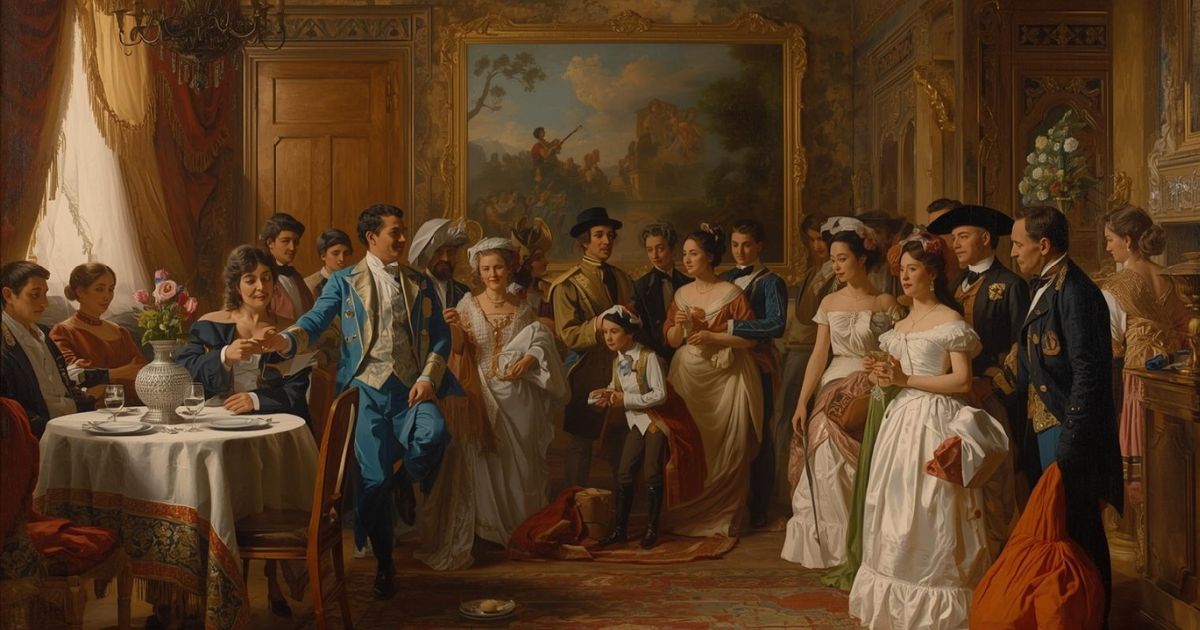
An excerpt from the original text.(complete · 4204 words)
the House of the Sage
On the morning of the following day, Ibarra, after visiting his lands,
made his way to the home of old Tasio. Complete stillness reigned in
the garden, for even the swallows circling about the eaves scarcely
made any noise. Moss grew on the old wall, over which a kind of ivy
clambered to form borders around the windows. The little house seemed
to be the abode of silence.
Ibarra hitched his horse carefully to a post and walking almost on
tiptoe crossed the clean and well-kept garden to the stairway, which
he ascended, and as the door was open, he entered. The first sight that
met his gaze was the old man bent over a book in which he seemed to be
writing. On the walls were collections of insects and plants arranged
among maps and stands filled with books and manuscripts. The old man
was so absorbed in his work that he did not notice the presence of the
youth until the latter, not wishing to disturb him, tried to retire.
"Ah, you here?" he asked, gazing at Ibarra with a strange
expression. "Excuse me," answered the youth, "I see that you're
very busy--"
"True, I was writing a little, but it's not urgent, and I want to
rest. Can I do anything for you?"
"A great deal," answered Ibarra, drawing nearer, "but--"
A glance at the book on the table caused him to exclaim in surprise,
"What, are you given to deciphering hieroglyphics?"
"No," replied the old man, as he offered his visitor a chair. "I don't
understand Egyptian or Coptic either, but I know something about the
system of writing, so I write in hieroglyphics."
"You write in hieroglyphics! Why?" exclaimed the youth, doubting what
he saw and heard.
"So that I cannot be read now."
Ibarra gazed at him fixedly, wondering to himself if the old man were
not indeed crazy. He examined the book rapidly to learn if he was
telling the truth and saw neatly drawn figures of animals, circles,
semicircles, flowers, feet, hands, arms, and such things.
"But why do you write if you don't want to be read?"
"Because I'm not writing for this generation, but for other ages. If
this generation could read, it would burn my books, the labor of
my whole life. But the generation that deciphers these characters
will be an intelligent generation, it will understand and say,
'Not all were asleep in the night of our ancestors!' The mystery of
these curious characters will save my work from the ignorance of men,
just as the mystery of strange rites has saved many truths from the
destructive priestly classes."
"In what language do you write?" asked Ibarra after a pause.
"In our own, Tagalog."
"Are the hieroglyphical signs suitable?"
"If it were not for the difficulty of drawing them, which takes time
and patience, I would almost say that they are more suitable than the
Latin alphabet. The ancient Egyptian had our vowels; our o, which
is only final and is not like that of the Spanish, which is a vowel
between o and u. Like us, the Egyptians lacked the true sound of
e, and in their language are found our ha and kha, which we
do not have in the Latin alphabet such as is used in Spanish. For
example, in this word mukha," he went on, pointing to the book,
"I transcribe the syllable ha more correctly with the figure of
a fish than with the Latin h, which in Europe is pronounced in
different ways. For a weaker aspirate, as for example in this word
haín, where the h has less force, I avail myself of this lion's
head or of these three lotus flowers, according to the quantity of
the vowel. Besides, I have the nasal sound which does not exist in
the Latin-Spanish alphabet. I repeat that if it were not for the
difficulty of drawing them exactly, these hieroglyphics could almost
be adopted, but this same difficulty obliges me to be concise and
not say more than what is exact and necessary. Moreover, this work
keeps me company when my guests from China and Japan go away."
"Your guests from China and Japan?"
"Don't you hear them? My guests are the swallows. This year one of
them is missing--some bad boy in China or Japan must have caught it."
"How do you know that they come from those countries?"
"Easily enough! Several years ago, before they left I tied to
the foot of each one a slip of paper with the name 'Philippines'
in English on it, supposing that they must not travel very far and
because English is understood nearly everywhere. For years my slips
brought no reply, so that at last I had it written in Chinese and here
in the following November they have returned with other notes which
I have had deciphered. One is written in Chinese and is a greeting
from the banks of the Hoang-Ho and the other, as the Chinaman whom
I consulted supposes, must be in Japanese. But I'm taking your time
with these things and haven't asked you what I can do for you."
"I've come to speak to you about a matter of importance," said the
youth. "Yesterday afternoon--"
"Have they caught that poor fellow?"
"You mean Elias? How did you know about him?"
"I saw the Muse of the Civil Guard!"
"The Muse of the Civil Guard? Who is she?"
"The alferez's woman, whom you didn't invite to your picnic. Yesterday
morning the incident of the cayman became known through the town. The
Muse of the Civil Guard is as astute as she is malignant and she
guessed that the pilot must be the bold person who threw her husband
into the mudhole and who assaulted Padre Damaso. As she reads all the
reports that her husband is to receive, scarcely had he got back home,
drunk and not knowing what he was doing, when to revenge herself on
you she sent the sergeant with the soldiers to disturb the merriment
of your picnic. Be careful! Eve was a good woman, sprung from the
hands of God--they say that Doña Consolacion is evil and it's not
known whose hands she came from! In order to be good, a woman needs
to have been, at least sometime, either a maid or a mother."
Ibarra smiled slightly and replied by taking some documents from his
pocketbook. "My dead father used to consult you in some things and
I recall that he had only to congratulate himself on following your
advice. I have on hand a little enterprise, the success of which
I must assure." Here he explained briefly his plan for the school,
which he had offered to his fiancée, spreading out in view of the
astonished Sage some plans which had been prepared in Manila.
"I would like to have you advise me as to what persons in the
town I must first win over in order to assure the success of the
undertaking. You know the inhabitants well, while I have just arrived
and am almost a stranger in my own country."
Old Tasio examined the plans before him with tear-dimmed eyes. "What
you are going to do has been my dream, the dream of a poor lunatic!" he
exclaimed with emotion. "And now the first thing that I advise you
to do is never to come to consult with me."
The youth gazed at him in surprise.
"Because the sensible people," he continued with bitter irony, "would
take you for a madman also. The people consider madmen those who do
not think as they do, so they hold me as such, which I appreciate,
because the day in which they think me returned to sanity, they will
deprive me of the little liberty that I've purchased at the expense
of the reputation of being a sane individual. And who knows but they
are right? I do not live according to their rules, my principles
and ideals are different. The gobernadorcillo enjoys among them the
reputation of being a wise man because he learned nothing more than
to serve chocolate and to put up with Padre Damaso's bad humor, so now
he is wealthy, he disturbs the petty destinies of his fellow-townsmen,
and at times he even talks of justice. 'That's a man of talent,' think
the vulgar, 'look how from nothing he has made himself great!' But I,
I inherited fortune and position, I have studied, and now I am poor,
I am not trusted with the most ridiculous office, and all say, 'He's a
fool! He doesn't know how to live!' The curate calls me 'philosopher'
as a nickname and gives to understand that I am a charlatan who is
making a show of what I learned in the higher schools, when that is
exactly what benefits me the least. Perhaps I really am the fool and
they the wise ones--who can say?"
The old man shook his head as if to drive away that thought, and
continued: "The second thing I can advise is that you consult the
curate, the gobernadorcillo, and all persons in authority. They will
give you bad, stupid, or useless advice, but consultation doesn't
mean compliance, although you should make it appear that you are
taking their advice and acting according to it."
Ibarra reflected a moment before he replied: "The advice is good, but
difficult to follow. Couldn't I go ahead with my idea without a shadow
being thrown upon it? Couldn't a worthy enterprise make its way over
everything, since truth doesn't need to borrow garments from error?"
"Nobody loves the naked truth!" answered the old man. "That is good
in theory and practicable in the world of which youth dreams. Here is
the schoolmaster, who has struggled in a vacuum; with the enthusiasm
of a child, he has sought the good, yet he has won only jests and
laughter. You have said that you are a stranger in your own country,
and I believe it. The very first day you arrived you began by wounding
the vanity of a priest who is regarded by the people as a saint, and
as a sage among his fellows. God grant that such a misstep may not have
already determined your future! Because the Dominicans and Augustinians
look with disdain on the guingón habit, the rope girdle, and the
immodest foot-wear, because a learned doctor in Santo Tomas [75]
may have once recalled that Pope Innocent III described the statutes
of that order as more fit for hogs than men, don't believe but that
all of them work hand in hand to affirm what a preacher once said,
'The most insignificant lay brother can do more than the government
with all its soldiers!' Cave ne cadas! [76] Gold is powerful--the
golden calf has thrown God down from His altars many times, and that
too since the days of Moses!"
"I'm not so pessimistic nor does life appear to me so perilous in
my country," said Ibarra with a smile. "I believe that those fears
are somewhat exaggerated and I hope to be able to carry out my plans
without meeting any great opposition in that quarter."
"Yes, if they extend their hands to you; no, if they withhold them. All
your efforts will be shattered against the walls of the rectory if
the friar so much as waves his girdle or shakes his habit; tomorrow
the alcalde will on some pretext deny you what today he has granted;
no mother will allow her son to attend the school, and then all your
labors will produce a counter-effect--they will dishearten those who
afterwards may wish to attempt altruistic undertakings."
"But, after all," replied the youth, "I can't believe in that power of
which you speak, and even supposing it to exist and making allowance
for it, I should still have on my side the sensible people and the
government, which is animated by the best intentions, which has great
hopes, and which frankly desires the welfare of the Philippines."
"The government! The government!" muttered the Sage, raising his eyes
to stare at the ceiling. "However inspired it may be with the desire
for fostering the greatness of the country for the benefit of the
country itself and of the mother country, however some official or
other may recall the generous spirit of the Catholic Kings [77] and
may agree with it, too, the government sees nothing, hears nothing,
nor does it decide anything, except what the curate or the Provincial
causes it to see, hear, and decide. The government is convinced that it
depends for its salvation wholly on them, that it is sustained because
they uphold it, and that the day on which they cease to support it,
it will fall like a manikin that has lost its prop. They intimidate
the government with an uprising of the people and the people with
the forces of the government, whence originates a simple game, very
much like what happens to timid persons when they visit gloomy places,
taking for ghosts their own shadows and for strange voices the echoes
of their own. As long as the government does not deal directly with
the country it will not get away from this tutelage, it will live
like those imbecile youths who tremble at the voice of their tutor,
whose kindness they are begging for. The government has no dream of
a healthy future; it is the arm, while the head is the convento. By
this inertia with which it allows itself to be dragged from depth to
depth, it becomes changed into a shadow, its integrity is impaired,
and in a weak and incapable way it trusts everything to mercenary
hands. But compare our system of government with those of the countries
you have visited--"
"Oh!" interrupted Ibarra, "that's asking too much! Let us content
ourselves with observing that our people do not complain or suffer as
do the people of other countries, thanks to Religion and the benignity
of the governing powers.
"This people does not complain because it has no voice, it does not
move because it is lethargic, and you say that it does not suffer
because you haven't seen how its heart bleeds. But some day you will
see this, you will hear its complaints, and then woe unto those who
found their strength on ignorance and fanaticism! Woe unto those
who rejoice in deceit and labor during the night, believing that all
are asleep! When the light of day shows up the monsters of darkness,
the frightful reaction will come. So many sighs suppressed, so much
poison distilled drop by drop, so much force repressed for centuries,
will come to light and burst! Who then will pay those accounts which
oppressed peoples present from time to time and which History preserves
for us on her bloody pages?"
"God, the government, and Religion will not allow that day to
come!" replied Ibarra, impressed in spite of himself. "The Philippines
is religious and loves Spain, the Philippines will realize how much
the nation is doing for her. There are abuses, yes, there are defects,
that cannot be denied, but Spain is laboring to introduce reforms
that will correct these abuses and defects, she is formulating plans,
she is not selfish!"
"I know it, and that is the worst of it! The reforms which emanate
from the higher places are annulled in the lower circles, thanks to
the vices of all, thanks, for instance, to the eager desire to get
rich in a short time, and to the ignorance of the people, who consent
to everything. A royal decree does not correct abuses when there is
no zealous authority to watch over its execution, while freedom of
speech against the insolence of petty tyrants is not conceded. Plans
will remain plans, abuses will still be abuses, and the satisfied
ministry will sleep in peace in spite of everything. Moreover,
if perchance there does come into a high place a person with great
and generous ideas, he will begin to hear, while behind his back he
is considered a fool, 'Your Excellency does not know the country,
your Excellency does not understand the character of the Indians,
your Excellency is going to ruin them, your Excellency will do well
to trust So-and-so,' and his Excellency in fact does not know the
country, for he has been until now stationed in America, and besides
that, he has all the shortcomings and weaknesses of other men, so he
allows himself to be convinced. His Excellency also remembers that
to secure the appointment he has had to sweat much and suffer more,
that he holds it for only three years, that he is getting old and
that it is necessary to think, not of quixotisms, but of the future:
a modest mansion in Madrid, a cozy house in the country, and a good
income in order to live in luxury at the capital--these are what
he must look for in the Philippines. Let us not ask for miracles,
let us not ask that he who comes as an outsider to make his fortune
and go away afterwards should interest himself in the welfare of the
country. What matters to him the gratitude or the curses of a people
whom he does not know, in a country where he has no associations,
where he has no affections? Fame to be sweet must resound in the
ears of those we love, in the atmosphere of our home or of the land
that will guard our ashes; we wish that fame should hover over our
tomb to warm with its breath the chill of death, so that we may
not be completely reduced to nothingness, that something of us may
survive. Naught of this can we offer to those who come to watch over
our destinies. And the worst of all this is that they go away just
when they are beginning to get an understanding of their duties. But
we are getting away from our subject."
"But before getting back to it I must make some things plain,"
interrupted the youth eagerly. "I can admit that the government does
not know the people, but I believe that the people know the government
even less. There are useless officials, bad ones, if you wish, but
there are also good ones, and if these are unable to do anything it
is because they meet with an inert mass, the people, who take little
part in the affairs that concern them. But I didn't come to hold a
discussion with you on that point, I came to ask for advice and you
tell me to lower my head before grotesque idols!"
"Yes, I repeat it, because here you must either lower your head or
lose it."
"Either lower my head or lose it!" repeated Ibarra thoughtfully. "The
dilemma is hard! But why? Is love for my country incompatible with love
for Spain? Is it necessary to debase oneself to be a good Christian,
to prostitute one's conscience in order to carry out a good purpose? I
love my native land, the Philippines, because to it I owe my life and
my happiness, because every man should love his country. I love Spain,
the fatherland of my ancestors, because in spite of everything the
Philippines owes to it, and will continue to owe, her happiness and
her future. I am a Catholic, I preserve pure the faith of my fathers,
and I do not see why I have to lower my head when I can raise it,
to give it over to my enemies when I can humble them!"
"Because the field in which you wish to sow is in possession of your
enemies and against them you are powerless. It is necessary that you
first kiss the hand that--"
But the youth let him go no farther, exclaiming passionately, "Kiss
their hands! You forget that among them they killed my father and
threw his body from the tomb! I who am his son do not forget it,
and that I do not avenge it is because I have regard for the good
name of the Church!"
The old Sage bowed his head as he answered slowly: "Señor Ibarra, if
you preserve those memories, which I cannot counsel you to forget,
abandon the enterprise you are undertaking and seek in some other
way the welfare of your countrymen. The enterprise needs another man,
because to make it a success zeal and money alone are not sufficient;
in our country are required also self-denial, tenacity of purpose,
and faith, for the soil is not ready, it is only sown with discord."
Ibarra appreciated the value of these observations, but still would
not be discouraged. The thought of Maria Clara was in his mind and
his promise must be fulfilled.
"Doesn't your experience suggest any other than this hard means?" he
asked in a low voice.
The old man took him by the arm and led him to the window. A fresh
breeze, the precursor of the north wind, was blowing, and before their
eyes spread out the garden bounded by the wide forest that was a kind
of park.
"Why can we not do as that weak stalk laden with flowers and buds
does?" asked the Sage, pointing to a beautiful jasmine plant. "The wind
blows and shakes it and it bows its head as if to hide its precious
load. If the stalk should hold itself erect it would be broken,
its flowers would be scattered by the wind, and its buds would be
blighted. The wind passes by and the stalk raises itself erect,
proud of its treasure, yet who will blame it for having bowed before
necessity? There you see that gigantic kupang, which majestically
waves its light foliage wherein the eagle builds his nest. I brought
it from the forest as a weak sapling and braced its stem for months
with slender pieces of bamboo. If I had transplanted it large and
full of life, it is certain that it would not have lived here,
for the wind would have thrown it down before its roots could have
fixed themselves in the soil, before it could have become accustomed
to its surroundings, and before it could have secured sufficient
nourishment for its size and height. So you, transplanted from Europe
to this stony soil, may end, if you do not seek support and do not
humble yourself. You are among evil conditions, alone, elevated, the
ground shakes, the sky presages a storm, and the top of your family
tree has shown that it draws the thunderbolt. It is not courage, but
foolhardiness, to fight alone against all that exists. No one censures
the pilot who makes for a port at the first gust of the whirlwind. To
stoop as the bullet passes is not cowardly--it is worse to defy it
only to fall, never to rise again."
"But could this sacrifice produce the fruit that I hope for?" asked
Ibarra. "Would the priest believe in me and forget the affront? Would
they aid me frankly in behalf of the education that contests with the
conventos the wealth of the country? Can they not pretend friendship,
make a show of protection, and yet underneath in the shadows fight it,
undermine it, wound it in the heel, in order to weaken it quicker
than by attacking it in front? Granted the previous actions which
you surmise, anything may be expected!"
The old man remained silent from inability to answer these
questions. After meditating for some time, he said: "If such should
happen, if the enterprise should fail, you would be consoled by
the thought that you had done what was expected of you and thus
something would be gained. You would have placed the first stone,
you would have sown the seed, and after the storm had spent itself
perhaps some grain would have survived the catastrophe to grow and
save the species from destruction and to serve afterwards as the seed
for the sons of the dead sower. The example may encourage others who
are only afraid to begin."
Weighing these reasons, Ibarra realized the situation and saw that
with all the old man's pessimism there was a great deal of truth in
what he said.
"I believe you!" he exclaimed, pressing the old man's hand. "Not in
vain have I looked to you for advice. This very day I'll go and reach
an understanding with the curate, who, after all is said, has done
me no wrong and who must be good, since all of them are not like the
persecutor of my father. I have, besides, to interest him in behalf of
that unfortunate madwoman and her sons. I put my trust in God and men!"
After taking leave of the old man he mounted his horse and rode
away. As the pessimistic Sage followed him with his gaze, he muttered:
"Now let's watch how Destiny will unfold the drama that began in the
cemetery." But for once he was greatly mistaken--the drama had begun
long before!
Master this chapter. Complete your experience
Purchase the complete book to access all chapters and support classic literature
As an Amazon Associate, we earn a small commission from qualifying purchases at no additional cost to you.
Available in paperback, hardcover, and e-book formats
Let's Analyse the Pattern
When challenging corrupt systems, direct confrontation triggers destruction while strategic compromise enables progress.
Why This Matters
Connect literature to life
This chapter teaches how to assess who holds real influence and what threatens their position.
Practice This Today
This week, notice when someone in authority gets defensive about suggestions, and observe what specific language or approach triggers that response.
Now let's explore the literary elements.
Key Quotes & Analysis
"I write in hieroglyphics because I live among hieroglyphics, and it's necessary for me to seek in the past the key to the present."
Context: Explaining to Ibarra why he writes in ancient symbols
Tasio must hide his real thoughts from authorities who would punish free thinking. He studies history to understand current oppression patterns.
In Today's Words:
I have to speak in code because I'm surrounded by people who'd destroy me for telling the truth.
"The tree that would grow in the storm must bend, or it will be broken."
Context: Advising Ibarra to compromise with corrupt authorities
Sometimes survival requires strategic flexibility rather than rigid principles. Direct confrontation with overwhelming power leads to destruction.
In Today's Words:
Sometimes you have to play the game to stay alive and accomplish anything at all.
"You want to establish a school - that's good. But have you thought about who will oppose it?"
Context: Warning Ibarra about the political realities of his idealistic plans
Tasio forces Ibarra to consider the powerful forces that benefit from keeping people ignorant and will fight educational progress.
In Today's Words:
You want to make changes, but have you figured out who's going to try to stop you?
Thematic Threads
Corruption
In This Chapter
Tasio reveals how the friar-controlled system destroys anyone who threatens their power, regardless of noble intentions
Development
Builds on earlier hints about systemic oppression into explicit analysis of how corrupt authority maintains control
In Your Life:
You might see this when whistleblowing gets you fired while the problem continues unchanged.
Wisdom
In This Chapter
Tasio's hieroglyphic writing symbolizes how truth must be hidden from those who would destroy it
Development
Introduced here as tragic necessity—wisdom forced underground by hostile environment
In Your Life:
You might recognize this when you learn to phrase difficult truths carefully to avoid triggering defensive reactions.
Identity
In This Chapter
Ibarra struggles between his idealistic nature and the pragmatic reality Tasio presents
Development
Continues Ibarra's journey from naive optimism toward understanding complex social realities
In Your Life:
You might face this when your values clash with what actually works in your situation.
Social Expectations
In This Chapter
The expectation that Ibarra must seek approval from the very authorities who destroyed his father
Development
Deepens the theme of how social systems force compliance through unwritten rules
In Your Life:
You might experience this when you must work within systems you fundamentally disagree with to achieve your goals.
Class
In This Chapter
Tasio's marginalization despite his intelligence shows how class determines whose wisdom is heard
Development
Reinforces how social position affects credibility and influence regardless of merit
In Your Life:
You might notice this when your background affects whether people take your ideas seriously.
You now have the context. Time to form your own thoughts.
Discussion Questions
- 1
What specific advice does Tasio give Ibarra about pursuing his school project, and why does this advice conflict with Ibarra's natural instincts?
analysis • surface - 2
Why does Tasio write in hieroglyphics, and what does this reveal about the political climate they're living under?
analysis • medium - 3
Where have you seen this pattern of 'bowing to survive' in modern workplaces, schools, or family dynamics?
application • medium - 4
When is strategic compromise worth it versus when should you take a principled stand, even if it costs you?
application • deep - 5
What does Tasio's tragic situation teach us about the cost of being too far ahead of your time or too honest for your environment?
reflection • deep
Critical Thinking Exercise
Map Your Power Landscape
Think of a situation where you want to create change but face resistance from authority figures. Draw a simple map showing the key players, their motivations, and what they need to feel secure. Then identify three different approaches: direct confrontation, strategic partnership, and underground progress.
Consider:
- •What does the authority figure gain from the current system?
- •Who are potential allies who share your goals but have different relationships with power?
- •What small wins could build trust before pursuing bigger changes?
Journaling Prompt
Write about a time when you tried to change something and failed because you underestimated the power dynamics. What would you do differently now?
Coming Up Next...
Chapter 26: The Power of Community Celebration
As the town prepares for its annual fiesta, Ibarra must put Tasio's advice into practice. His first test comes sooner than expected when he faces the very priest who may hold the key to his school's success - or its destruction.



